The remaining 13 Security Council members unanimously supported the US-drafted resolution against North Korea
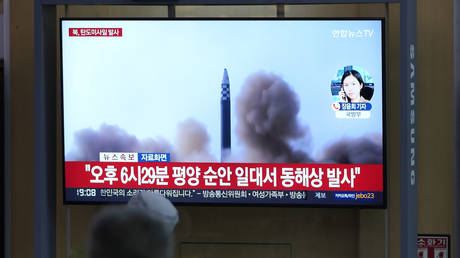
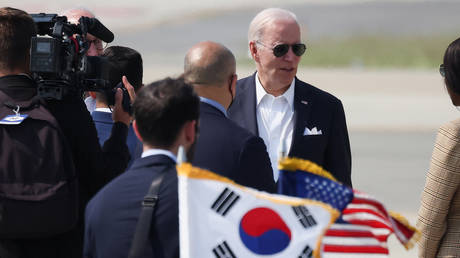
The UN Security Council failed to reach common ground on new sanctions against Pyongyang on Thursday. Washington proposed the sanctions in the wake of North Korea’s latest missile test this week, on the heels of US President Joe Biden’s Asia tour.
The vote came just a day after North Korea was accused of test-launching its largest intercontinental ballistic missile and two others. Ahead of the vote, US Ambassador Linda Thomas-Greenfield called for unity in the face of “a threat to the entire international community.”
However, China and Russia vetoed new sanctions on humanitarian grounds, pointing to their futility and even “inhumanity,” as North Korea struggled to contain a massive Covid-19 outbreak.
The UNSC imposed sanctions on North Korea back in 2006, following its first nuclear test, and has tightened them over the years. Since the latest round of restrictions in 2017, Moscow and Beijing have increasingly been arguing that further pressure is a road to nowhere and unlikely to force Pyongyang to disarm unilaterally.
“We do not think additional sanctions will be helpful in responding to the current situation. It can only make the situation even worse,” China’s UN Ambassador Zhang Jun said on Thursday.
“We have repeatedly said that the introduction of new sanctions against the DPRK is a dead end,” said Russia’s representative Vasily Nebenzya. “We emphasized the fallacy, inefficiency and inhumanity of sanctions pressure on Pyongyang.”
The new resolution sought to cut North Korea’s already limited imports of crude oil and refined petroleum products by another 25 percent, impose additional maritime sanctions, and ban the country from exporting mineral fuels, oils and waxes. Washington also proposed a global asset freeze on the state corporation that supervises North Korean laborers overseas, as well as the Lazarus hacking group, accused of “cyberespionage, data theft, monetary heists” on behalf of the Pyongyang government.
Pyongyang has for years accused Washington and Seoul of “hostile policy” towards the North, and vowed to maintain a sufficient level of deterrence. Regional tensions somewhat improved during the presidency of Donald Trump, with Pyongyang temporarily halting its missile tests. However, the two much-hyped summits between the US and DPRK leaders in 2018 and 2019 reached no lasting agreement on the subject of sanctions or denuclearization.
Biden has returned to the more hostile posture of his predecessors, while North Korea’s Kim Jong-Un has responded in kind, by firing off over a dozen of ballistic missiles this year alone and warning that the DPRK not only has a “firm will” to continue with its “nuclear deterrent” program but will use such weapons “preemptively,” if forced to.
New South Korean President Yoon Suk-yeol similarly ran on a more hawkish platform than his predecessor Moon Jae-in.
May 26 (IPS) – When the Columbine High School massacre took place in 1999 it was seen as a watershed moment in the United States – the worst mass shooting at a school in the country’s history. Now, it ranks fourth.
Moscow’s increased activities in Africa might threaten NATO security, London and Madrid claim
Russia’s expanding presence on the African continent might pose a “worrying” threat to the southern flank of NATO, Spain’s Defense Minister Margarita Robles and British Defense Secretary Ben Wallace stated at a joint press conference in Madrid on Wednesday.
African nations such as Libya and Mali see increased activities of both the Russian government and the nation’s private security companies like the Wagner Group, the two defense chiefs claimed, adding that such developments are “very clear” and that Moscow could use it as leverage against Europe or NATO.
Robles and Wallace linked Russia’s activities to the rising threat of organized crime and terrorism in the region, saying that, if coupled with growing instability and the risk of hunger in Africa, such developments can pose a serious risk to Europe.
“If [Russia] can use migrant flows as a weapon at one end of Europe, they can certainly use it at the other,” Wallace said. The UK defense secretary was referring to what Europe calls a crisis on the Polish border with Belarus, where thousands of migrants that arrived from third countries, mostly in the Middle East, are trying to cross into the EU.
Western nations previously accused the Belarusian leader, Alexander Lukashenko, of fomenting the crisis by encouraging migrants to take this route to Europe. The Kremlin was also accused of supporting Minsk in this endeavor. Both Russia and Belarus denied they were behind the problem.
Now, the Spanish and UK defense chiefs fear that Moscow might also pose a threat to the military bloc’s security in the south. “NATO cannot remain indifferent in this situation,” Robles said, while Wallace suggested that the alliance’s “strategic concept has to involve the whole of NATO, all the territory it covers through its partnership.”
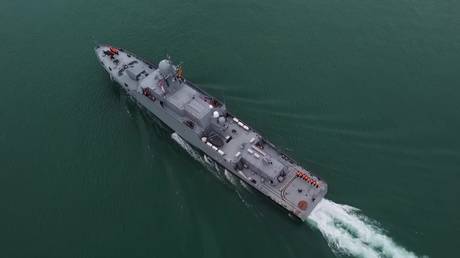
The British defense secretary also assumed that Russian President Vladimir Putin could “use his navy as a way of intimidating his enemies and that means he will be in other parts including the southern flank.” He also said that NATO should treat the Russian Navy as “more of a threat” than Moscow’s ground forces, which are, according to Wallace, “already exhausted” in Ukraine.
At the same time, Wallace called on Moscow to “do the right thing” and open Ukraine’s Black Sea ports for grain export. “That grain is for everyone, Libya, Yemen, people around the world are relying on that grain to feed themselves,” Wallace said.
Western countries accuse Russia of blockading Ukrainian ports. However, according to Moscow, it is the sanctions the West imposed that are impeding free trade, including the trade in agriculture products.
The meeting between the Spanish and UK defense chiefs took place ahead of a NATO summit in Madrid scheduled for late June. Earlier this month, the Baltic States demanded a massive NATO buildup on the eastern flank. Finland and Sweden have also officially voiced their willingness to join the military alliance.