Kami Rita Sherpa has set and broke his own world record for the most successful Mount Everest ascents multiple times in recent years. He’s now summited Everest for the 26th time.
(Image credit: Lapka Sherpa /AFP via Getty Images)
The military industrial complex wants more money to solve the problem
Rep. Mike Gallagher, a Republican from Wisconsin, has claimed that the US’ rush to arm Ukraine has “burned through” years worth of weapons stockpiles, hampering Washington’s ability to simultaneously arm Taiwan against potential conflict with China. Meanwhile, the US’ vast military industry is lobbying the White House for more contracts.
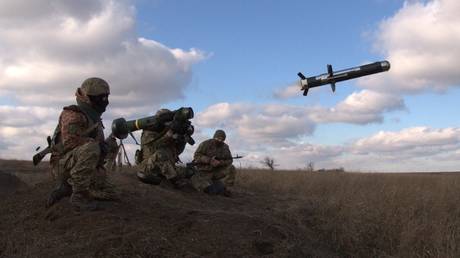
“We are running low in terms of our stockpiles,” Gallagher, who sits on the House Armed Services Committee, told Fox News on Friday. “We just burned through seven years of Javelins and that’s not only important as we continue to try and help the Ukrainians win in Ukraine, that’s important as we try to simultaneously defend Taiwan from aggression from the Chinese Communist Party.”
“They are going to need access to some of these same weapons systems, and we simply don’t have the stockpiles at present in order to backfill what we’ve spent in Ukraine,” he continued.
The Biden administration has thus far given Kiev almost $4 billion in military aid, and President Joe Biden is currently pressing Congress to pass his $33 billion Ukraine aid package, $20 billion of which would fund weapons and other military support for Kiev. Additionally, he is expected to sign the Lend-Lease Act of 2022 on Monday, reviving a piece of World War II-era legislation to allow the US to export unlimited quantities of weapons to Ukraine.
The Javelins referenced by Gallagher are shoulder-fired anti-tank missiles, and the US has already sent more than 5,000 of these to Ukraine. While the Pentagon does not publish exactly how many of which weapons it has in stock, an analyst at the weapons industry-funded Center for Strategic and International Studies told PBS last month that this represents about a third of the US’ stockpile.
The analyst added that around a quarter of the US’ stockpile of Stinger anti-air missiles have also been gifted to Ukraine.
Prior to Gallagher’s warning, Reps. Adam Smith (D-Washington) and Mike Rogers (R-Alabama), also of the House Armed Services Committee, wrote to Joint Chiefs of Staff Chairman Mark Milley to order the replenishment of these short-range missile stocks and invest in modernized replacements.
Weapons manufacturers are also awaiting contracts from the Pentagon to step up production. These firms – who have already seen their stock prices rise by up to 60% since Russia launched its offensive in Ukraine in February – told the Wall Street Journal last month that they need more money to guarantee against shortages.
“All of this points to the need to think of the defense industrial base as a capability in and of itself in which we need to invest,” Eric Fanning, president of the Aerospace Industries Association, told the newspaper. “We need to be investing in it in a sustained way so it’s there when we need it to surge.”
In a congressional hearing in late April, David Berteau of the Professional Services Council, a trade association representing government contractors, called on lawmakers to “push” the Pentagon into increasing production, the paper noted.
Amid the Biden administration’s unprecedented effort to arm Ukraine, it remains unclear how many American weapons shipments actually end up in Ukrainian hands. Russia has declared supply convoys “legitimate targets” and has destroyed several warehouses of western weapons. However, a US intelligence source recently told CNN that Washington has “almost zero” idea where its weapons end up, describing the shipments as dropping “into a big black hole.”
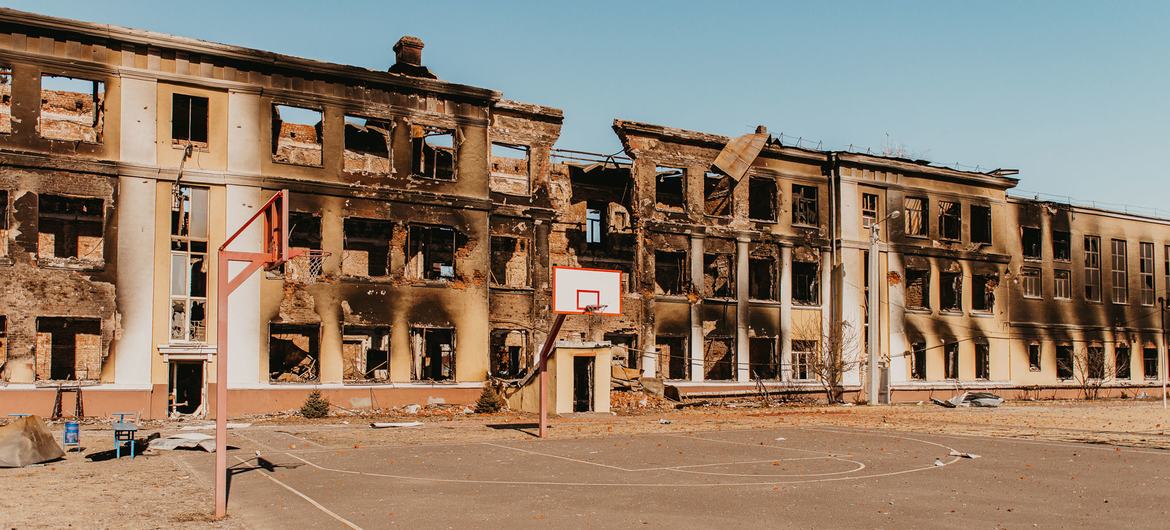
Secretary-General António Guterres said on Sunday that he was appalled by an attack on a school in Bilohorivka, eastern Ukraine, where many people were sheltering from the ongoing fighting.
U.S. first lady Jill Biden spent Mother’s Day in Slovakia, meeting Ukrainian mothers who have been displaced by Russia’s war and assuring them that the “hearts of the American people” are behind them.
Ahead of Australian election, a ruling coalition lawmaker has been accused of “tone deafness” on issue of anti-Chinese sentiments
A senator from Australia’s ruling coalition has been criticized two weeks before the May 21 federal election, after he thanked the Chinese-Australians for “putting up with racism.”
Addressing participants at the Chinese Australian Forum on Friday, the Liberal Party senator for New South Wales Andrew Bragg admitted that, amid the coronavirus pandemic and tensions in bilateral relations with Beijing, his country has seen an increase in the number of racist incidents involving Chinese nationals. He claimed that much of the political rhetoric about China had been “at times unsophisticated” and emphasized that racism was unacceptable.
“Thank you for your steadfastness, thank you for putting up with some intemperate rhetoric at times, thank you for putting up with racism at times. It’s not good,” he said.
These remarks immediately sparked outrage among Bragg’s political opponents and social media users, with one saying they show “a terrible tone-deafness.”
“To hear Senator Bragg attempting to distance himself from the racist comments and the actions of his colleagues, while at the same time seeming to present racism as something inevitable that he thanks us for putting up with, was insulting and offensive,” New South Wales state member of parliament Jenny Leong said, as quoted by AP.
She also accused Prime Minister Scott Morrison’s government of “trying to woo local Chinese communities for electoral advantage, while at the same time whipping up anti-Chinese sentiment to serve their broader political agenda.”
Bilateral relations between Canberra and Beijing suffered a major blow in 2020 when the Australian government pushed for an independent investigation into the causes of the coronavirus pandemic without consulting China, which then blasted the call “a joke.”
In November 2020, China’s embassy released a list of the country’s grievances against Australia, which included, besides the called-for inquiry into Covid’s origins, state funding for “anti-China” research, visa issues, raids on Chinese journalists, and “spearheading a crusade” on China’s affairs in Taiwan, Hong Kong and Xinjiang.
Recent weeks have seen rising tensions between the two countries over the Solomon Islands. Australia, the biggest aid donor to the islands, has criticized that state’s draft security pact with China.
Scott Morrison warned that Beijing building a naval base on the Solomon Islands would be a “red line” for Australia though he did not specify what exactly his statement meant.
According to research by the Lowy Institute published in spring 2021 amid the escalating tensions between Australia and China, 18% of Chinese-Australians had been physically threatened or attacked in the past year because of their Chinese heritage.
Citing high numbers of incidents involving Chinese nationals, Beijing media has been accusing Canberra of “chronic” racism.