Tokyo denies that it was asked to participate in alliance seeking to counter China
Japan has received unofficial offers to become part of the AUKUS military bloc, which was formed last year by Australia, the UK and the US, the Sankei Shimbun newspaper reported on Tuesday.
Several unnamed Japanese government officials told the paper that Tokyo has been informally approached on such a possibility by each of the three members of the alliance.
Japan’s Chief Cabinet Secretary Hirokazu Matsuno denied the report on Wednesday, saying that “there is no fact” in the Sankei Shimbun article. Tokyo was “not asked to participate in AUKUS,” he said.
The AUKUS pact, which is largely seen as a strategy to counter China’s growing influence in the Pacific, was announced by the leaders of Australia, the UK and the US in September 2021.
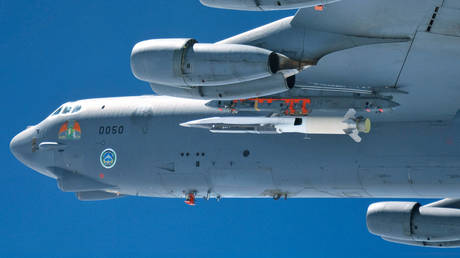
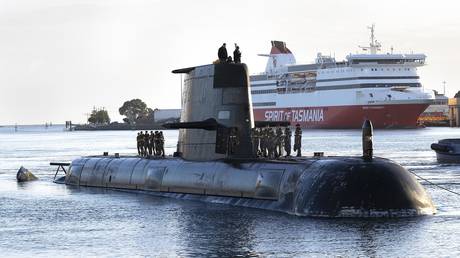
Its initial aim was to provide Canberra with a fleet of nuclear-powered, yet conventionally armed, submarines. But last week the trio announced that they were also going to cooperate on developing hypersonic tech, with Japan expressing support for the decision.
According to Sankei Shimbun, involving Tokyo in developing hypersonic missiles is one of the main motivations behind the AUKUS offer.
Two years ago, Japan announced plans to create two types of hypersonic weapons – hypersonic cruise missiles (HCMs) and hyper-velocity gliding projectiles (HVGPs) – saying that they could be fielded sometime between 2024 and 2028.
The country is also working on a special railgun that it believes could be able to shoot down incoming hypersonic missiles by firing shells at extremely high speeds using electromagnetic force.
Canberra, London and Washington are also interested in the country’s capabilities in cyberwarfare, AI and quantum technologies, the paper said.
Sankei Shimbun insisted that the Japanese government generally has a “positive opinion” about joining AUKUS, suggesting that it would increase the potential to deter China.
However, Tokyo is planning to carefully examine the offer. Some officials remain skeptical about AUKUS, saying that the country should instead focus on bilateral military cooperation agreements it already has with Australia, Britain and the US. They also point out that Japan wouldn’t be able to participate in all areas covered by AUKUS, Sankei Shimbun reported.
For example, nuclear-powered submarines would be off limits for Tokyo as the country’s laws stipulate that nuclear energy can only be used for peaceful purposes.
The abbreviation AUKUS is made up of the first letters in the names of the three countries that formed it. If Japan decided to join, it could be re-branded into ‘JAUKUS,’ according to the paper.
China has been angered by the formation of AUKUS, labelling it an “Asia-Pacific version of NATO,” which was “doomed to fail.” The pact would only cause an arms race in the region, Beijing insisted, adding that giving nuclear submarine tech to Australia was against international conventions of nuclear proliferation.
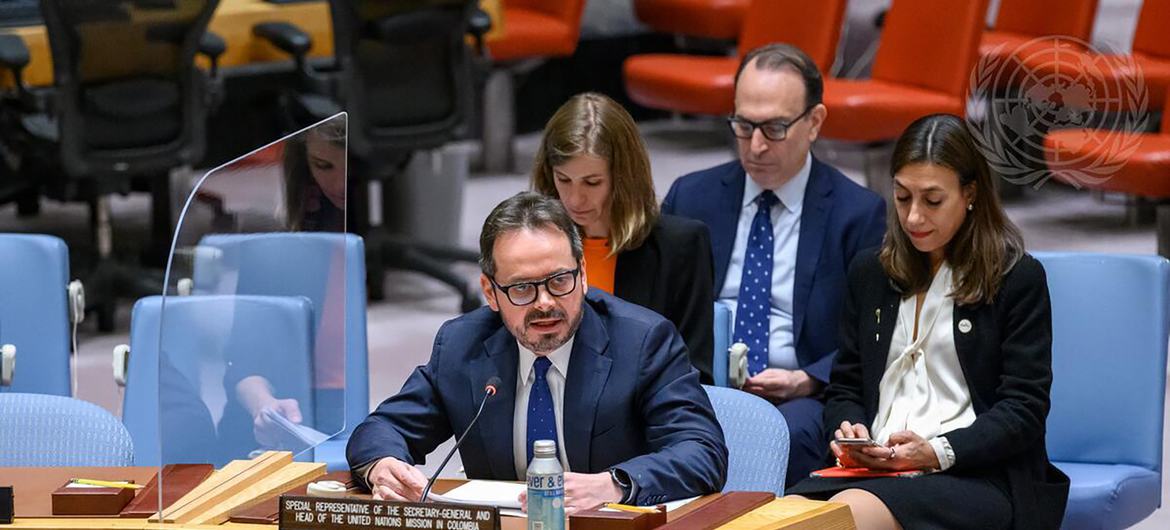
Colombia’s dynamic peace process – which saw fresh strides with the holding of a largely peaceful parliamentary election last month – will succeed or fail based on efforts to halt the deadly violence faced by former combatants, social leaders and human rights defenders, the senior UN official in the country told the Security Council on Tuesday.
The fallout from the war in Ukraine could dramatically worsen the economic outlook for developing countries already grappling with debt financing related to the COVID-19 pandemic, the UN said in a report published on Tuesday.
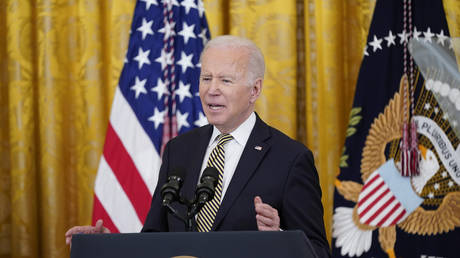
Speaking about easing restrictions on higher-ethanol gasoline amid spiking fuel costs, Biden said prices shouldn’t “hinge on whether a dictator declares war and commits genocide a half a world away.”
(Image credit: Mandel Ukraine/AFP via Getty Images)
US president echoes Ukrainian rhetoric, while trying to blame Moscow for record price hikes
US President Joe Biden accused Russia of committing a “genocide” in Ukraine during a speech in Iowa on Tuesday, while trying to promote corn-based ethanol as a way to lower gas prices amid a 40-year record inflation.
“Your family budget, your ability to fill up your tank, none of it should hinge on whether a dictator declares war and commits genocide half a world away,” Biden said in Menlo, Iowa, some 45 miles west of Des Moines. The hamlet of some 300 residents is located next to a factory producing bioethanol from corn – something the White House is trying to encourage now in order to combat the rising fuel prices, for which it blames Russia.
“I’m doing everything within my power by executive orders to bring down the price and address the Putin price hike,” Biden said, using his administration’s talking point about the 48% spike in prices at the pump since March 2021.
This is Biden’s first officially recorded use of “genocide” to describe the conflict in Ukraine. Last week, Ukrainian President Volodymyr Zelensky claimed the alleged mass killings in the town of Bucha were genocide, for which he blamed Russia.
For the first time, Pres. Biden uses the term “genocide” to describe Putin’s actions in Ukraine.
“Your family budget, your ability to fill up your tank, none of it should on hinge on whether a dictator declares war and commits genocide half a world away.” https://t.co/rjiJcYgnPhpic.twitter.com/vzs64c0J7G
When asked about it on April 4, Biden said, “No, I think it is a war crime.”
His national security adviser Jake Sullivan told reporters later that there was a process in determining what amounted to genocide, and that the US has “not yet seen a level of systematic deprivation of life of the Ukrainian people to rise to the level of genocide,” though that is “something we will continue to monitor.”
Biden called Russian President Vladimir Putin a “war criminal”in mid-March, prompting the Kremlin to denounce such rhetoric as “unacceptable and unforgivable” coming from a country “whose bombs killed hundreds of thousands of people around the world.”
The US president has escalated his rhetoric towards Russia as economic news at home grew more dire. The March inflation report from the US Bureau of Labor Statistics showed an 8.5% spike in the Consumer Price Index, highest since 1981. Gas prices had risen 18% from the previous month, and 48% from March 2021, while food was up by 8.8%, the most since May 1981.
While blaming this all on Russia’s decision to send troops into Ukraine, the White House is reportedly sending another $750 million worth of US weapons to Kiev, Reuters reported on Tuesday citing anonymous officials. The equipment – including heavy artillery – would come from US military stock and not require congressional approval, the report said.