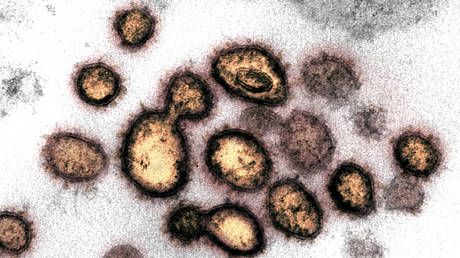
Further mutations of the Covid-19 virus could spawn a strain as contagious as the Delta variant and as deadly as the Ebola virus. That’s the stark warning from the World Medical Association.
Frank Ulrich Montgomery, chairman of the global physicians’ society (WMA), shared his fears with Germany’s Funke media group’s newspapers on Saturday. He stressed the importance of not “giving the virus a chance” to mutate any further. To achieve this, it may be necessary to keep “vaccinating the world for years” to come, Montgomery said.
The Ebola virus, whose horrific effects on humans could be matched by a new covid strain just as the WMA chairman warns, was first discovered back in 1976 in South Sudan and the Democratic Republic of Congo. The deadliest outbreak to date occurred in West Africa between 2014 and 2016, claiming more than 11,000 lives. The disease brought on by the virus causes a severe fever and internal bleeding, with the average fatality rate being around 50%, according to the World Health Organization. Some of the known strains, however, have led to death in a terrifying 90% of all cases.
When asked about the situation in his homeland, Germany, Montgomery warned that the number of Covid infections is likely to double in the coming ten days. He also called for the introduction of stricter measures in the country, urging authorities to close all Christmas markets and to ban festivities, as well as fireworks. And, should the fourth wave of Covid still not let up, nationwide business closures and lockdowns may be necessary, the scientist forecast. Any measures taken now will only have a tangible effect in two weeks’ time and, along with the vaccination campaign, the delay could be as long as six weeks, he pointed out.
The bleak predictions come hard on the heels of the discovery of the new Omicron strain in southern Africa. On Friday, the Word Health Organization formally designated Omicron a “variant of concern.” While scientists are still studying the novel strain, fears have already been voiced that the heavily mutated Covid variant could be more contagious than its predecessors.
PARIS, Nov 26 (IPS) – The member states of the United Nations Educational, Scientific and Cultural Organization (UNESCO) have agreed on a text of recommended ethics for artificial intelligence (AI) that states can apply on a “voluntary” basis.
India is repealing controversial farm laws that sparked a year of protest from farmers. Analysts say it’s both a victory for nonviolent resistance, and a shrewd political move.
The World Health Organization (WHO) decision to name the new coronavirus variant of concern ‘Omicron’ has raised some eyebrows, as under its Greek alphabet naming scheme the next ones up should have been ‘Nu’ and then ‘Xi’.
Omicron, designated as such on Friday, is supposed to be the common name for the variant of SARS-CoV-2 virus scientifically known as B.1.1.529. The WHO lists five other “variants of concern” and two more “variants of interest,” with the last of them named ‘Mu.’
Sharp-eyed observers have noted that by using ‘Omicron’ the WHO skipped over both ‘Nu’ and the next letter in the Greek alphabet, ‘Xi’.
you don’t need to be a Greek Alphabet expert to work out why WHO would skip from Nu to Omicron, avoiding Xi…. pic.twitter.com/iTXmuyriWr
While the WHO has not issued an official explanation, an official speaking on condition of anonymity with multiple journalists said the choice was indeed deliberate: Nu would have been confused with the word “new” and Xi to “avoid stigmatizing a region,” according to a senior editor at the UK newspaper Telegraph.
A WHO source confirmed the letters Nu and Xi of the Greek alphabet had been deliberately avoided. Nu had been skipped to avoid confusion with the word “new” and Xi had been skipped to “avoid stigmatising a region”, they said.
A journalist with the US outlet Washington Examiner offered even more detail, quoting the official as saying that Xi was “a common last name & WHO best practices for naming disease suggest avoiding causing offense to any cultural, social, national, regional, professional, & ethnic groups.”
It also happens to be the transliteration of the family name of China’s current president, Xi Jinping.
WHO on skipping Nu/Xi to dub variant Omicron: “Nu is too easily confounded with ‘new’ & Xi wasn’t used b/c it’s a common last name & WHO best practices for naming disease suggest avoiding causing offense to any cultural, social, national, regional, professional, & ethnic groups.”
While the first cases of the novel coronavirus were documented in Wuhan, in China’s Hubei province, the authorities in Beijing have rejected both the “lab leak” and “wet market” theories of its origin, suggesting instead it might have been brought over from the US.
The WHO named the virus SARS-CoV-2 and the disease caused by it Covid-19. By May 2021, the organization adopted the Greek alphabet naming convention for the variants and strains of the virus, to avoid what it called a “stigmatizing and discriminatory” practice of naming them by the place where they were first detected.