As India is mulling new rules for digital money, Prime Minister Narendra Modi has called for regulations to ensure cryptocurrencies like bitcoin do not “end up in the wrong hands,” warning that this could “spoil” young people.
While he did not expand on those concerns, Modi spoke on Thursday about the need for “democratic nations” to band together and deal with challenges posed by emerging technologies. He was delivering a virtual address at the Sydney Dialogue, an annual cyber-tech summit.
Noting that technology and data could either become “new weapons” for conflict or “instruments of cooperation,” Modi brought up digital currencies as an example of how it was important that like-minded nations “work together on this” to “ensure it does not end up in the wrong hands, which can spoil our youth.”
We are at a historic moment of choice. Whether all the wonderful powers of technology of our age will be instruments of cooperation or conflict, coercion or choice, domination or development, oppression or opportunity.
He also urged the development of technical and governance standards and norms, singling out the use of data, and called for renewed efforts to prevent manipulation of public opinion. In recent weeks, Indian authorities have raised concerns over claims of huge returns from cryptocurrency investment as well as its potential connections to money laundering, organized crime and terror financing.
On Saturday, Modi chaired a meeting to formulate the country’s approach to digital currencies and examine their impact on the economy. According to The Economic Times, Indian officials are drafting regulations to propose a ban on all transactions and payments in cryptocurrencies, while allowing investors to hold them as assets, similar to gold, bonds and stock shares.
Citing unnamed sources familiar with the government’s discussions, the newspaper said there was a belief in policy circles that crypto markets needed to be regulated in order to tackle the problem of opaque advertising that exaggerates investment returns in order to attract young investors.
The sources informed the newspaper that draft legislation on the matter was expected to be forwarded to Modi’s cabinet for consideration in the next two to three weeks.
In September, China had banned all cryptocurrency transactions and crypto-mining.
Denmark’s air force showed off its brand-new electric-powered planes on Thursday, saying its test flights have so far proven that the cheaper-to-run, more eco-friendly technology has potential.
It had obtained the two Velis Electro jets from Slovenian manufacturer Pipistrel, becoming the first military in the world to operate this type of hardware.
“The aircraft are 100% emission-free, very quiet, and otherwise cheap to operate,” Lieutenant Colonel Casper Børge Nielsen of the Defense Ministry’s material and procurement agency said. Initial tests indicate “there may be perspectives in using electric aircraft when the technology becomes mature,” he added.
Denmark has leased the planes for two years, rather than buying it, to avoid the “risk of ending up with equipment that we can’t really use,” Børge Nielsen said. During the lease period, the Danish Air Force hopes to gain an insight into the benefits and disadvantages of the jets’ technology to decide how it can be applied in the future.
The pilots described flying the one-man light electric planes, which are powered by two lithium batteries, as “exciting,” saying they were “built well and fly well.”
Last year, the United States military said it had been keeping an eye on the development of electric-powered planes, describing their ability to approach targets silently as “tremendous.” However, their battery capacity isn’t currently sufficient to meet the US Air Force’s needs.
Work on electric aircraft has been underway since the 1970s, but the battery issue has been a stumbling block in the way of wider adoption of the technology. Global military interest could change all that, stimulating research and investment.
The switch to electric power is likely to be a win-win across the board, as it will drastically reduce CO2 emissions and also make flying much cheaper for commercial carriers and their passengers.
Think your friends would be interested? Share this story!
The Islamic State terrorist group is tearing a path across Afghanistan, establishing itself in “nearly all” of its provinces while increasing attacks more than five-fold in the past year, the UN’s envoy to the country has warned.
Addressing the UN Security Council on Wednesday, the body’s special representative for Afghanistan Deborah Lyons spoke of a major Islamic State (IS, formerly ISIS) surge through the war-torn country, claiming the jihadist group has now expanded nationwide.
“Once limited to a few provinces and the capital, ISKP now seems to be present in nearly all provinces, and increasingly active,” Lyons said, referring to the group’s Afghanistan-based ‘Khorasan’ faction. She added that so far in 2021, IS has carried out 334 attacks, up from just 60 last year.
The envoy’s comments came just hours after an Islamic State bombing erupted in a Shiite Muslim neighborhood of the Afghan capital, killing one and wounding six others, according to Reuters.
Since taking over as the government following a chaotic US withdrawal and the outright collapse of the American-backed administration in Kabul last summer, the Taliban has struggled to keep the terrorist group at bay, Lyons said. Though she noted that the Taliban insists it is “waging a concerted campaign” against IS and is making “genuine efforts to present itself as a government,” she said its response “appears to rely heavily on extrajudicial detentions and killings.”
Despite the rise in IS attacks in recent months, however, Lyons said the overall security situation in Afghanistan has improved since the end of the US war, which stretched on for two decades.
In addition to the terrorism issue, the UN representative also cited broader concerns for the country in the coming months, warning of a looming “humanitarian catastrophe” driven by a litany of causes, including foreign sanctions – which she said have “paralyzed” the local banking system – as well as growing levels of food shortages due to famine and a failing economy, among other factors.
Think your friends would be interested? Share this story!
The EU Commission has released draft legislation aimed at tackling the destruction of woodland by introducing import restrictions on products not certified as ‘deforestation-free’.
The draft proposal, which the commission hopes will become binding rules for all member states, seeks to limit the import of beef, cocoa, coffee, palm, soy, and wood if it is not proven “deforestation-free.”
Outlining the legislation, the EU commissioner for climate action policy, Virginijus Sinkevicius, called it a “ground-breaking” proposal that will help fight “illegal deforestation” and “deforestation driven by agricultural expansion.”
Our proposal to fight deforestation will help us protect 1/3 of 🌎 lands.
We don’t only target illegal deforestation but 𝙖𝙡𝙡 deforestation driven by agricultural expansion.
We start with 6 products that must be deforestation-free 👉🏼 beef, wood, palm oil, soya, coffee, cocoa. pic.twitter.com/Cs9POoydNX
The bill comes after nations at the COP26 summit agreed to work to end deforestation by 2030. It would impose two criteria on imports, requiring items to have been produced in accordance with the origin country’s laws, and not on land that has been deforested or degraded since the start of 2021.
It is not clear when the rules would come into effect; legislative proposals by the commission have to be debated and considered by both the EU Parliament and the Council of the EU before they are passed. The implementation of measures could potentially impact the EU’s trade relations with countries like Brazil, where clearing of the Amazon rainforest hit a new record in October.
During the recent COP26 climate summit, 110 world leaders – whose countries contain around 85% of the world’s woodland – committed to ending and reversing deforestation by 2030, pledging around £14 billion ($18.84 billion) of public and private funds towards the goal.
The city council in Austria’s second-largest city, Graz, has elected a new mayor. Communist Party member Elke Kahr has become the first Communist leader of a major city in the country.
The 60-year-old politician, who has been working in the municipal government for more than 15 years and previously served as vice mayor of Graz, was elected as the new city leader on Wednesday. A member of the Austrian Communist Party (KPÖ, Kommunistische Partei Österreichs) for almost 30 years, she won the election with 28 of 46 votes. Kahr succeeded the previous long-standing mayor Siegfried Nagl of the center-right, liberal-conservative People’s Party.
“Who would have thought that the daughter of a locksmith, a Communist, would become mayor,” she said in her first speech following the vote.
Having acknowledged a number of issues to deal with in the city, especially during the Covid-19 pandemic, the new mayor highlighted a housing policy, pledging to put a stop to profit-driven construction in Ganz.
The Communists have also already formed a coalition with the Greens and the Social Democratic Party (SPÖ), and another precedent in European city governance was made – two women serving as mayor and deputy. Green leader Judith Schwentner was chosen as Graz’s vice mayor, with the new governing coalition saying they would support not only social, but also environmental changes, aiming to improve living standards especially for low-income groups. Providing a bicycle for every child in the city from the municipality is in their program.
However, not everyone in the local government is happy with the new Communist rule. A member of the right-wing Freedom Party of Austria (FPÖ), Alexis Pascuttini, described the choice as “unpleasant,” having accused the Graz Communists of empty catchphrases in their program and refusing to participate in what he described as “left-wing nonsense.” Kahr herself has been exposed to strong pressure to justify her party, being repeatedly asked about her position on “the crimes of communist parties around the world since 1917,” according to Austrian media.
New research has found that legalizing the sale and use of recreational cannabis could bring a €5 billion ($5.67 billion) boost to the German economy via annual tax revenues and cost savings within the police.
Should Germany proceed with legalization, the research estimates that it could bring in tax revenues of €3.4 billion ($3.86 billion) per year and save some €1.3 billion ($1.48 billion) in costs within the police and judicial system, alongside creating 27,000 new jobs.
The report, carried out by the Institute for Competition Economics (DICE) at the Heinrich Heine University in Düsseldorf and commissioned by the German Cannabis Association, comes amid ongoing discussions for the formation of a coalition federal government.
One of the areas under consideration in the three-way talks between the Social Democrats (SPD), the Greens, and the Free Democrats (FDP) is the potential regulation of the sale and use of recreational cannabis.
Using cannabis for medicinal purposes has been legal in Germany since 2017. However, its possession or distribution for recreational use remains illegal and can result in fines as well as time behind bars.
Earlier this year, research on the legalization of cannabis across Europe by market intel firm Prohibition Partners said that if Germany legalized its use by adults, the move would see that country alone constituting “over half of the European market until 2024.” It would also help propel the European cannabis market from its 2021 valuation of €400 million ($454 million) to some €3 billion ($3.4 billion) by 2025.
Think your friends would be interested? Share this story!
The annual migration of red crabs has brought traffic to a standstill on an Australian island. Apart from the epic journey, the species is also notorious for eating its own young.
Tens of millions of crustaceans are swarming Canberra-governed Christmas Island, which is almost a thousand miles northwest of the Australian mainland. Parks Australia, a government body in charge of wildlife conservation on the island, has deployed its staff to manage traffic, rake crabs off roads and provide advisories to local residents regarding road closures. Authorities are well-prepared to deal with the epic crab march as it repeats every year, usually in October and November. There are even special bridges and tunnels in place, built over and under busy roads so as to minimize the number of crabs crushed by cars. The sight of millions of these creatures making their perilous trek has become one of Christmas Island’s main tourist attractions.
The exact timing of the red crabs’ journey from forest to ocean is defined by rainfall and lunar phases. The march is led by male crabs, which are later joined by females. On reaching the ocean, they mate and spawn, with each female capable of producing as many as 100,000 eggs. However, most of the young crabs never make it back to the forest as they end up being eaten by fish and whale sharks for whom this is a veritable feast. To make matters worse, the crab larvae that do make it to the beach are often devoured by returning adult crabs of the very same species, hence one of their names – the cannibal crab.
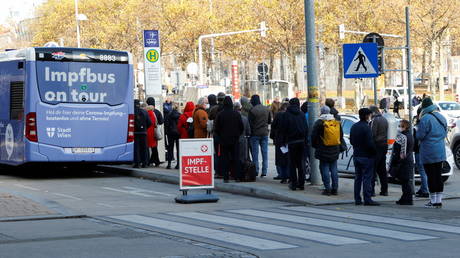
Greece will soon prohibit unvaccinated residents from entering a litany of public spaces, the country’s prime minister has announced, claiming its current Covid outbreak is largely fueled by those who haven’t received the jab.
Starting next week, the unvaccinated will be barred from entry to restaurants, cafes, theaters, bars, gyms and museums, among other indoor public places, PM Kyriakos Mitsotakis said on Thursday, noting that a negative Covid-19 test will no longer be accepted as an alternative to proof of vaccination.
“This is indeed a pandemic of the unvaccinated,” he said as he announced the move in a televised address, adding “Greece is mourning unnecessary losses because it simply does not have the vaccination rates of other European countries.”
The new rules are set to take effect on Monday, and will require Greeks to present vaccine certificates to businesses and other indoor establishments to be allowed inside. Those attending religious services mark a rare exception, however, as they will only be asked to present a negative test in order to enter a church or other place of worship.
In a bid to encourage booster vaccinations among the elderly – a population much more vulnerable to Covid-19 – citizens over the age of 60 will be made to renew their certificate after a period of seven months.
While officials had hoped to hit a full vaccination figure of 70% for Greece’s population of 11 million by autumn, the number currently stands at about 62%, according to Reuters. As its weekly case counts continue to soar to record highs, the country reported 7,317 new Covid-19 infections and 63 deaths on Thursday, bringing the totals to more than 860,000 cases and some 17,000 fatalities since the pandemic kicked off in late 2019.
The new restrictions in Greece mirror similar policies implemented elsewhere in Europe, with Austria, Germany, Italy, France, the Czech Republic and Slovakia each imposing limits on public life for the unvaccinated. Though the Austrian government recently imposed a full lockdown for millions of residents who have not received the shot, some officials in that country are pushing for even harsher policies, including a national stay-at-home order on the jabbed and non-jabbed alike.
Think your friends would be interested? Share this story!
Brazil’s former President Luiz Inacio Lula da Silva has said he is willing to stand as a candidate in elections against incumbent leader Jair Bolsonaro, labelling his potential opponent “a poor copy of Trump.”
Speaking in Brussels at a media conference in the European Parliament on Monday, Lula announced that the Workers Party needs to put forward a presidential candidate to take over from right-wing Bolsonaro in 2022 and said he was willing to run in the elections again.
“I’m willing, I’m motivated, I’m in good health,” Lula stated, adding that said he would only make his decision early next year, some months before the election scheduled for October 2022. The popular leftist said his candidacy would depend on whether the party wanted him.
“We need to have someone who stands, we need to win the elections. And at the same time, we have to rebuild Brazil,” he said, speaking on behalf of his Workers Party.
Lula, 76, also took aim at the incumbent president. “He’s a poor copy of Trump. But Bolsonaro doesn’t think, he doesn’t have any ideas,” the former president said, claiming the incumbent leader was hellbent on ensuring the beneficial legacies of Lula’s administration were “torn down.”
A recent poll put him 27 points ahead of Bolsonaro, despite his candidacy not officially being announced.
In 2010, Lula made way for his protégé, Dilma Rousseff. Rousseff was ousted from power in what was described by her supporters as a parliamentary coup. Lula served nearly two years in prison after being convicted on money laundering and corruption, despite a nine-and-a-half-year sentence. He was also barred from running in the 2018 election.
A number of judges have subsequently ruled that the case against Lula was unlawful and the Supreme Court annulled his earlier convictions, meaning he can face off against Bolsonaro in 2022.
Brazil’s former President Luiz Inacio Lula da Silva has said he is willing to stand as a candidate in elections against incumbent leader Jair Bolsonaro, labelling his potential opponent “a poor copy of Trump.”
Speaking in Brussels at a media conference in the European Parliament on Monday, Lula announced that the Workers Party needs to put forward a presidential candidate to take over from right-wing Bolsonaro in 2022 and said he was willing to run in the elections again.
“I’m willing, I’m motivated, I’m in good health,” Lula stated, adding that said he would only make his decision early next year, some months before the election scheduled for October 2022. The popular leftist said his candidacy would depend on whether the party wanted him.
“We need to have someone who stands, we need to win the elections. And at the same time, we have to rebuild Brazil,” he said, speaking on behalf of his Workers Party.
Lula, 76, also took aim at the incumbent president. “He’s a poor copy of Trump. But Bolsonaro doesn’t think, he doesn’t have any ideas,” the former president said, claiming the incumbent leader was hellbent on ensuring the beneficial legacies of Lula’s administration were “torn down.”
A recent poll put him 27 points ahead of Bolsonaro, despite his candidacy not officially being announced.
In 2010, Lula made way for his protégé, Dilma Rousseff. Rousseff was ousted from power in what was described by her supporters as a parliamentary coup. Lula served nearly two years in prison after being convicted on money laundering and corruption, despite a nine-and-a-half-year sentence. He was also barred from running in the 2018 election.
A number of judges have subsequently ruled that the case against Lula was unlawful and the Supreme Court annulled his earlier convictions, meaning he can face off against Bolsonaro in 2022.