An Argentinian woman has become the second-ever HIV-infected person whose immune system helped defeat the virus without requiring additional medical treatment. She was first diagnosed with the AIDS-causing infection in 2013.
Scientists have dubbed the 30-year-old mother the “Esperanza patient,” after her hometown. The word ‘esperanza’ translates to ‘hope’ in English. Publishing their findings in the Annals of Internal Medicine journal on Monday, the researchers said the discovery boosts hope for a “sterilizing cure” for the estimated 38 million people with the life-long infection.
“I enjoy being healthy,” the Esperanza patient told NBC News over email. “I have a healthy family. I don’t have to medicate, and I live as though nothing has happened. This already is a privilege.”
The study found no intact remnants of the virus in the 1.5 billion blood and tissue cells the researchers analyzed – confirming the discovery first announced in March at an international meeting of HIV experts.
No additional information about the woman has been made public, but she was described at the time as “athletic and beautiful” and revealed to have an HIV-negative boyfriend and newborn baby.
Only one other person, identified in August 2020 as 67-year-old Loreen Willenberg from San Francisco, has been confirmed to have overcome the virus without medical intervention. The two women have been labeled ‘elite controllers’, referring to a rare subset of HIV patients who show no signs of the infection despite not undergoing antiretroviral treatments.
Typically, an HIV-infected person requires constant drug therapy to prevent the virus from attaching to their immune cells’ DNA and replicating. But, in the eight years since she was diagnosed, the Esperanza patient only received medication for six months during pregnancy to ensure her baby would be healthy.
In all, there have been four patients cured of HIV, two of whom – the ‘Berlin patient’ Timothy Ray Brown and the ‘London patient’ Adam Castillejo – were also cancer patients who received risky bone marrow transplants from donors with HIV-resistant genes. However, the success of their procedures is yet to be replicated.
“This is really the miracle of the human immune system that did it,” Dr. Xu Yu, an immunologist at the Ragon Institute in Boston, who co-authored the study, told NBC.
Amid a surge in Covid-19 cases, Gibraltar has canceled official Christmas events and “strongly” discouraged people from hosting private gatherings for four weeks. Gibraltar’s entire eligible population is vaccinated.
The government of Gibraltar recently announced that “official Christmas parties, official receptions and similar gatherings” have been canceled, and advised the public to avoid social events and parties for the next four weeks. Outdoor spaces are recommended over indoor ones, touching and hugging is discouraged, and mask wearing is advised.
“The drastic increase in the numbers of people testing positive for Covid-19 in recent days is a stark reminder that the virus is still very prevalent in our community and that it is the responsibility of us all to take every reasonable precaution to protect ourselves and our loved ones,” Health Minister Samantha Sacramento said.
Gibraltar, a tiny British Overseas Territory sharing a land border with Spain, has seen an average of 56 Covid-19 cases per day over the last seven days, up from fewer than 10 per day in September. The rise in cases, described by the government as “exponential,” comes despite Gibraltar having the highest vaccination rate in the world.
More than 118% of Gibraltar’s population are fully vaccinated against Covid-19, with this figure stretching beyond 100% due to doses given to Spaniards who cross the border to work or visit the territory every day. Masks are still required in shops and on public transport.
The initial vaccine campaign on the British outpost came to a conclusion in early spring 2021, with a large proportion of the population fully inoculated against Covid-19. It became one of the first places in Europe to reduce restrictions following a winter of lockdowns, in what was dubbed ‘Operation Freedom’.
Gibraltar is currently doling out booster doses to the over-40s, healthcare workers, and other “vulnerable groups,” and administering vaccines to children aged between five and 12.
Similarly well-vaccinated countries have also reported surges in Covid-19 infections recently. In Singapore, where 94% of the eligible population have been inoculated, cases and deaths soared to record highs at the end of October, and have since subsided slightly. In Ireland, where around 92% of the adult population is fully vaccinated, cases of Covid-19 and deaths from the virus have roughly doubled since August.
A stream literally flowing with booze emitting a strong beery odor has been discovered in one of the tropical islands of Hawaii. Its waters have been apparently contaminated with alcohol after a leak at a beverage warehouse.
A small river with a distinctive alcoholic smell was recently found on the island of Oahu, some 15 miles (24 kilometers) away from Honolulu, Hawaiian capital. Its waters have been flowing through the Waipio valley and even turned into a 100-foot (30 meters) waterfall on their way.
The stream caught the attention of local environmental activists, who noticed the smell in the area.
“The other day we came here you would think it was a beer pub that hadn’t opened its doors for three or four days,” activist Carroll Cox told local Hawaii News Now. She also contacted the Department of Health about the issue.
Local media took samples from the unusual stream and had them checked at a private laboratory. It tested positive for alcohol, containing 1.2% percent of the substance in its waters – nearly a quarter the content in regular beer and strong enough to cause a buzz.
Local health authorities got involved, and an investigation into the source of contamination was launched. It was learned that the stream was coming from a drain pipe that was traced back to a warehouse of Hawaii’s largest liquor distributor, Paradise Beverages. Its representatives told local media they were working with officials to eliminate a possible spill, with the booze river apparently closing its free drinks service.
The Robert Koch Institute, Germany’s disease control agency, has warned that the country will face a “really terrible Christmas” unless steps are taken to mitigate a huge rise in Covid-19 cases.
Speaking on Thursday, the director of the Robert Koch Institute, Lothar Wieler, reiterated the case for new, strict countermeasures to prevent the spread of Covid-19.
“We are currently heading toward a serious emergency,” Wieler stated, adding “we are going to have a really terrible Christmas if we don’t take countermeasures now.” He added that hospitals were already struggling to find enough beds.
Wieler has called for a campaign for a further increase in vaccine uptake, from the current 67% to well over 75%.
The diseases institute director also believes bars, nightclubs, and other large-scale venues should be temporarily forced to close, and that other areas of public life should be off-limits to the unvaccinated.
His comments come as German leaders ponder new restrictions to replace the nationwide epidemic rules, which could include a lockdown of the unvaccinated, following measures already taken in neighboring Austria.
On Thursday, in an attempt to counter waning immunity levels, the country’s vaccine advisory board recommended that booster shots be made available to everyone aged 18 or above.
Controversial agriculture laws that saw farmers across India protesting for over a year are going to be rolled back, Prime Minister Narendra Modi has unexpectedly announced.
“I want to tell the country that we have decided to repeal the three farm laws,” Modi said in a televised address on Friday, which local media described as “stunning.”
The Indian parliament will complete the constitutional process of repealing the agricultural legislation in late November, he added.
However, the PM again defended the divisive legislation, saying that the reform of the sector, which accounts for some 15% of India’s $2.7 trillion economy, was actually aimed at supporting the country’s small farmers.
Whatever I did was for farmers. What I am doing is for the country.
“Maybe something was lacking in our efforts, which is why we couldn’t convince some farmers about the laws,” Modi acknowledged.
The laws, which were introduced last September, allowed farmers to sell their crops outside of the government-regulated wholesale markets, in which they were guaranteed a minimum price.
The government argued that it would see them earning more, but growers feared that that move would, on the contrary, cause a drop in prices and make them hostages to large corporations.
Thousands of farmers joined the protests against what they called “black laws,” and some rallies turned violent. A year later, many demonstrators remain camped along roads outside the capital New Delhi.
And the farmers aren’t planning on going home just yet, with one of their leaders saying on Twitter: “We will wait for parliament to repeal the laws.”
Modi’s concession to the protesters may have been unexpected, but it comes several months ahead of elections in India’s most populous state of Uttar Pradesh, as well as two other northern states with large rural populations.
Think your friends would be interested? Share this story!
Protests against renewed Covid-19 restrictions turned violent in The Hague. The unrest comes a day after several demonstrators in another Dutch city, Rotterdam, were injured amid police gunfire.
Seven people were arrested after fierce clashes broke out between law enforcement and anti-lockdown demonstrators in The Hague, the seat of the International Court of Justice (ICJ), on Saturday.
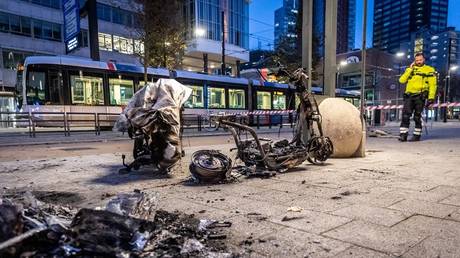
A video shared on social media shows protesters lighting firecrackers that sparked multiple fires, causing the skies in the city to glow an eerie red.
The Hague burns🔥, home of international court of justice, the seat of Dutch cabinet and 3rd largest city in Netherlands pic.twitter.com/8gjqu2sE60
Dutch police reported that five of its officers were injured in the showdown with rioters. One officer was taken to hospital with a knee injury and concussion. Two others “suffered hearing damage,” while another two suffered injuries to their hands.
The chaotic scenes in the Netherlands’ third-largest city unfolded a day after a protest against reimposed Covid-19 restrictions in Rotterdam was marred by violence. Over 50 people were arrested in the city and three were injured after police opened fire in a bid to quell the unrest. Police later claimed that officers were “compelled to shoot at targets” to protect themselves. The three injured protesters remain in hospital, and their condition is unknown.
Protests have swept through a number of Dutch cities after the Netherlands became the first country in Western Europe since summer to go into a partial lockdown last week. Tensions soared further after the government banned New Year’s Eve fireworks displays and the Dutch parliament backed the introduction of the so-called 2G system, which would bar the unvaccinated and those who have not recently recovered from the virus from a long list of public places if introduced.
Think your friends would be interested? Share this story!
Israeli and UAE defense suppliers have agreed to jointly develop unmanned vessels that can be tailored for a range of military roles, including anti-sub warfare. The move comes after the two countries held naval drills last week.
Emirati state-owned weapons maker EDGE group and the government-run Israel Aerospace Industries (IAI) announced the partnership in Dubai on Thursday. In a joint statement, the firms said they would design the 170 m-USV (modular-unmanned surface vessels) series for both military and commercial applications.
The vessels, which can apparently operate remotely or with partial and complete autonomy, are expected to be used for “maritime security operations,” intelligence-gathering, surveillance, detecting and countering submarines and mines, and as a deployment platform for vertical take-off and landing (VTOL) aircraft such as helicopters and certain types of drones.
For commercial use, the manufacturers noted that they can be customized to serve in a variety of roles, including oceanography, pollution monitoring, oil and gas exploration, transportation, search and rescue, firefighting, and first interventions.
While not specifying the sources and amount of the project’s funding, or when production would begin, EDGE Chief Executive Faisal Al Bannai described the deal as an “important milestone” that would “open many doors” for the company in “local and global markets, military and commercial alike.”
According to the statement, the EDGE-owned Abu Dhabi Ship Building (ADSB) will design the vessel and integrate the platform’s control systems and payload. IAI will develop the autonomous control systems and provide various mission-requirement payloads to the control system units.
In March, the two companies had partnered up to develop an autonomous drone defense system to “detect, identify and intercept a broad range of threats.”
Last week, the UAE and Bahrain conducted their first-ever joint maritime drill with Israel’s navy. The US Fifth Fleet also participated in the five-day show of force in the Red Sea, which was reported by Israeli media outlets as sending a message to Iran.
The naval exercises came a little more than a year after Israel and the UAE established diplomatic ties in normalization agreements brokered by the Trump administration. The Abraham Accords broke decades of Arab consensus to not formally recognize Israel until the issue of a Palestinian state was settled.
Any apology for Nazism is unacceptable, Colombia’s president Ivan Duque has insisted, after photos of police academy cadets dressed up in Third Reich uniforms were uploaded online, causing outrage.
“Any apology for Nazism is unacceptable,” Duque stated in a tweet on Friday. The president said he condemned any references to those who were “responsible for the Jewish Holocaust that claimed the lives of more than 6 million people,” adding that “anti-Semitism has no place in the world.”
Policía colombiana homenajea a Alemania con una fiesta ‘nazi’
Indignación en Colombia por la fiesta que organizó un grupo de estudiantes de la Escuela de Policía Simón Bolívar en Tuluá, en la que varios uniformados recrearon escenas alusivas a la Alemania nazi pic.twitter.com/UnF4ajUd8z
Duque had earlier made demands for “heads to roll” at an academy that “promotes such criminal practices,” with its director, Lieutenant Colonel Jorge Ferney Bayona Sanchez, already having been sacked.
Toda una polémica ha provocado el evento realizado en las últimas horas en la escuela de Policía Simón Bolívar de Tuluá. Los uniformados se disfrazaron de Adolf Hitler, haciendo alusión al nazismo durante la semana de la internacionalización. #VocesySonidospic.twitter.com/EoS4JqvzrC
Colombia’s defense ministry, which oversees the country’s police, also insisted in a statement that that its training programs “don’t envisage in any way an activity such as the one which took place” at the academy.
The images of police cadets in Nazi uniforms caused anger and bewilderment among internet users.
The German and Israeli embassies in the country reacted by issuing a joint statement, in which they expressed “total rejection of any form of apology or demonstration of Nazism.” The US embassy in Bogota also said that it was “shocked and deeply disappointed” by the development.
The controversial images, in which aspiring officers were caught sporting black SS outfits with red swastika armbands and grey Wehrmacht uniforms from the World War II era, weren’t revealed in some bombshell media report, but were actually published on the official Twitter account of the Colombian police this Thursday.
The photos were taken as part of a “cultural exchange” event at the police academy in the city of Tulua, aimed at commemorating Germany and “strengthening the knowledge of our police students.” The cosplay was apparently intended to illustrate the history of German law enforcement, with more cadets pictured wearing more modern versions of the country’s police uniforms in the pictures.
A pack of wild boars were rounded up and euthanized after one of the animals attacked a police officer in the streets of Hong Kong – the opening shot in a pitched battle between the feral hogs and the city’s law enforcement.
A group of veterinarians took seven wild boars into custody, euthanizing the beasts after knocking them out with dart guns in an area near the financial center of the city, according to a statement from Hong Kong’s Agriculture, Fisheries, and Conservation Department on Thursday.
The pigs were captured after one attacked a police officer last week, an act which reflects the city’s new policy toward the animals: stop them before they attack again.
The aggressive boar knocked down a police officer by biting his leg last week as the two faced off in a residential car park, the pig only losing the battle after falling off the building to its death. The wild boars are apparently “accustomed” to wandering back and forth along the roadway, begging for food from pedestrians and vehicles alike. Previously, the city had handled the population by capturing and sedating the animals, then relocating them to “remote areas,” according to the the department.
Hong Kong CEO Carrie Lam vowed to increase penalties for those citizens found feeding the boars, which have reportedly been responsible for some 30 attacks in recent years. While residents are warned not to feed the boars so as not to encourage population growth or disease outbreaks, the animals are a favorite among some visitors. Still, Lam insisted “we can’t simply sit on our hands while things deteriorate.”
Animal rights groups have responded with a protest letter against a policy of euthanasia, pointing out that most visitors do not feed the boars and arguing resources should be directed toward stopping the human activity rather than blaming all the boars. Allowing the boars to be captured and killed “ignores their right to live and considers their existence in urban areas as a capital offense,” the letter read.
Brazil’s former President Luiz Inacio Lula da Silva has said he is willing to stand as a candidate in elections against incumbent leader Jair Bolsonaro, labelling his potential opponent “a poor copy of Trump.”
Speaking in Brussels at a media conference in the European Parliament on Monday, Lula announced that the Workers Party needs to put forward a presidential candidate to take over from right-wing Bolsonaro in 2022 and said he was willing to run in the elections again.
“I’m willing, I’m motivated, I’m in good health,” Lula stated, adding that said he would only make his decision early next year, some months before the election scheduled for October 2022. The popular leftist said his candidacy would depend on whether the party wanted him.
“We need to have someone who stands, we need to win the elections. And at the same time, we have to rebuild Brazil,” he said, speaking on behalf of his Workers Party.
Lula, 76, also took aim at the incumbent president. “He’s a poor copy of Trump. But Bolsonaro doesn’t think, he doesn’t have any ideas,” the former president said, claiming the incumbent leader was hellbent on ensuring the beneficial legacies of Lula’s administration were “torn down.”
A recent poll put him 27 points ahead of Bolsonaro, despite his candidacy not officially being announced.
In 2010, Lula made way for his protégé, Dilma Rousseff. Rousseff was ousted from power in what was described by her supporters as a parliamentary coup. Lula served nearly two years in prison after being convicted on money laundering and corruption, despite a nine-and-a-half-year sentence. He was also barred from running in the 2018 election.
A number of judges have subsequently ruled that the case against Lula was unlawful and the Supreme Court annulled his earlier convictions, meaning he can face off against Bolsonaro in 2022.