A pack of wild boars were rounded up and euthanized after one of the animals attacked a police officer in the streets of Hong Kong – the opening shot in a pitched battle between the feral hogs and the city’s law enforcement.

A group of veterinarians took seven wild boars into custody, euthanizing the beasts after knocking them out with dart guns in an area near the financial center of the city, according to a statement from Hong Kong’s Agriculture, Fisheries, and Conservation Department on Thursday.

The pigs were captured after one attacked a police officer last week, an act which reflects the city’s new policy toward the animals: stop them before they attack again.

The aggressive boar knocked down a police officer by biting his leg last week as the two faced off in a residential car park, the pig only losing the battle after falling off the building to its death. The wild boars are apparently “accustomed” to wandering back and forth along the roadway, begging for food from pedestrians and vehicles alike. Previously, the city had handled the population by capturing and sedating the animals, then relocating them to “remote areas,” according to the the department.

Hong Kong CEO Carrie Lam vowed to increase penalties for those citizens found feeding the boars, which have reportedly been responsible for some 30 attacks in recent years. While residents are warned not to feed the boars so as not to encourage population growth or disease outbreaks, the animals are a favorite among some visitors. Still, Lam insisted “we can’t simply sit on our hands while things deteriorate.”

Animal rights groups have responded with a protest letter against a policy of euthanasia, pointing out that most visitors do not feed the boars and arguing resources should be directed toward stopping the human activity rather than blaming all the boars. Allowing the boars to be captured and killed “ignores their right to live and considers their existence in urban areas as a capital offense,” the letter read.

Like this story? Share it with a friend!
find more fun & mates at SoShow now !

An exoplanet some 70% the mass of Jupiter and about 1.4 times its size has been discovered by astronomers at India’s Physical Research Laboratory (PRL). The behemoth is 752 light years away from Earth, and has an incredible orbit.

The new discovery was revealed by the Indian Space Research Organization on Tuesday in a statement saying the country’s PRL Advanced Radial-velocity Abu-sky Search (PARAS) had measured the movements of the newly-discovered exoplanet between December 2020 and March 2021.

The planet, named either HD 82139 or TOI 1789 depending on which cataloguing method is used, is ultra-hot – with a surface temperature up to 2,000 degrees Kelvin.

Read more

Russia’s Ministry of Defense
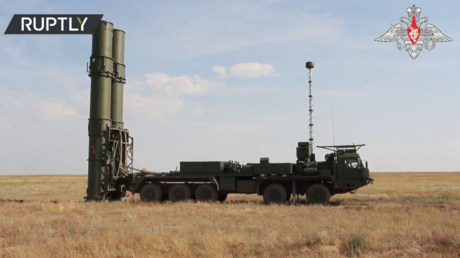
India may buy Russian S-500 anti-space-weapon defense system in world-first arms deal, despite risk of US sanctions, Moscow claims

India’s PRL Advanced Radial-velocity Abu-sky Search (PARAS), an optical fiber-fed spectrograph, observed t he exoplanet and its movements from the Mt. Abu Observatory, according to the space agency. Not only is the planet ultra-hot, but it is also one of the closest to an orbiting star yet discovered.

The measurements obtained via PARAS were confirmed by Germany’s TCES spectrograph in April, and further verified by independent photometric observations from the PRL’s 43cm telescope, also located at Mt. Abu.

The exoplanet has an unusually quick orbit – a mere 3.2 days. The pace indicates that its distance from its host star is one-tenth the distance between Mercury and the Sun. This makes the exoplanet one of fewer than 10 such solar systems discovered thus far. Given the closeness to its host star – an aging orb 1.5 times the mass of the Sun – the new planet is also one of the lowest density planets yet discovered.

Planets so close to their host stars, with a distance less than 0.1 AU and masses between 0.25 to several times the mass of Jupiter, are known as “hot-Jupiters.”

The Indian space agency hailed the detection of the new planet as an opportunity to “enhance our understanding of various mechanisms responsible for inflation in hot-Jupiters and the formation and evolution of planetary systems around evolving and aging stars.” It is the second planet to be discovered by PARAS, with a previous discovery taking place in 2018.

Like this story? Share it with a friend!
find more fun & mates at SoShow now !

France has imposed a curfew on its overseas territory of Guadeloupe and is sending extra police to the island, citing days of “violence,” unrest and vandalism in response to harsh pandemic restrictions.

“Given the ongoing social unrest and acts of vandalism, the prefect of Guadeloupe has decided to establish a curfew starting today from 6pm to 5am,” Alexandre Rochatte, who represents the archipelago as prefect, said on Friday.

Earlier on Friday, the French Interior Ministry noted that 200 French police officers and gendarmes would be shipped into Guadeloupe in the coming days to crack down on the “violence” and “restore republican order.”

READ MORE: Macron discloses whether lockdown for unvaccinated will be necessary in France

The move comes after nearly a week of heated protests over local Covid-19 policies – which include mandatory vaccinations for healthcare staff and other ‘essential’ workers, among other things. Demonstrators have torched cars and erected burning barricades in the streets, while doctors, firefighters and other professionals have walked off their jobs in protest, according to Reuters.

In footage circulating online earlier this week, men purported to be protesting firefighters were seen soaking police with a water hose hooked up to a nearby fire hydrant. Officers quickly shut off the spigot.

As in mainland France, residents are also required to present proof of vaccination, a negative PCR test or show they recently recovered from the virus in order to enter a number of public establishments, including restaurants and museums.

Those policies have proven unpopular for many locals, with trade unions launching indefinite strikes in protest over the past week, joined by other residents in street demonstrations.

Like this story? Share it with a friend!
find more fun & mates at SoShow now !

Controversial agriculture laws that saw farmers across India protesting for over a year are going to be rolled back, Prime Minister Narendra Modi has unexpectedly announced.

“I want to tell the country that we have decided to repeal the three farm laws,” Modi said in a televised address on Friday, which local media described as “stunning.”

The Indian parliament will complete the constitutional process of repealing the agricultural legislation in late November, he added.

However, the PM again defended the divisive legislation, saying that the reform of the sector, which accounts for some 15% of India’s $2.7 trillion economy, was actually aimed at supporting the country’s small farmers.

Whatever I did was for farmers. What I am doing is for the country.

“Maybe something was lacking in our efforts, which is why we couldn’t convince some farmers about the laws,” Modi acknowledged.

Read more

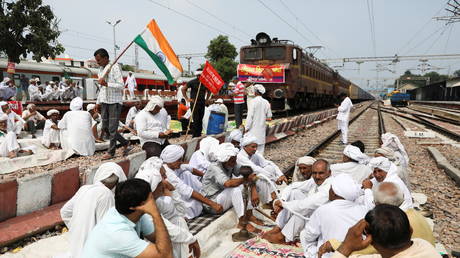
Farmers block railway tracks as part of protests against farm laws during nationwide protests, in Sonipat, northern state of Haryana, India, September 27, 2021. © Reuters / Anushree Fadnavi
Indian farmers return to hold nationwide protests against last year’s agriculture laws

The laws, which were introduced last September, allowed farmers to sell their crops outside of the government-regulated wholesale markets, in which they were guaranteed a minimum price.

The government argued that it would see them earning more, but growers feared that that move would, on the contrary, cause a drop in prices and make them hostages to large corporations.

Thousands of farmers joined the protests against what they called “black laws,” and some rallies turned violent. A year later, many demonstrators remain camped along roads outside the capital New Delhi.

And the farmers aren’t planning on going home just yet, with one of their leaders saying on Twitter: “We will wait for parliament to repeal the laws.”

Modi’s concession to the protesters may have been unexpected, but it comes several months ahead of elections in India’s most populous state of Uttar Pradesh, as well as two other northern states with large rural populations.

Think your friends would be interested? Share this story!

find more fun & mates at SoShow now !

Truckers and other motorists have been trapped in a four-mile-long traffic jam on the outskirts of the Dutch city of Rotterdam amid a protest against the government’s Covid measures.

According to local media, as many as 200 activists blocked the gates of a major port in the city’s harbor on Thursday. For several hours, they prevented any vehicles from driving in and out of the cargo hub, which, in turn, led to massive traffic congestion on the highway leading to the port. Police engaged in negotiations with the protesters, who eventually relented and left the site later in the evening.

The group behind the protest action is reportedly Dockers United, who are staunchly opposed to government Covid policies. The organization’s biggest concern is that authorities could soon make it mandatory for employees to have a vaccination or recovery certificate to enter the workplace, which, as the group argues, would be tantamount to excluding people from society on an “unconstitutional basis.” They are also generally unhappy with the curbs introduced by the Dutch government, with ‘Don’t normalize what’s not normal’ being a translation of one of their slogans.

Read more

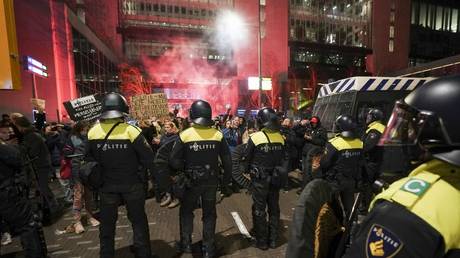
Riot police officers face protesters in the Hague on November 12, 2021, as the PM announced new Covid-19 restrictions © Jeroen Jumelet / ANP / AFP
WATCH: Protesters, police clash after new Covid restrictions announced in the Netherlands

In fact, the Dutch government did announce earlier this month that it was working on introducing a ‘corona pass’ for the workplace, though it isn’t clear yet when this measure will be rolled out and how strict it will be.

Meanwhile, on Friday the EU country logged its highest-ever number of new Covid cases within 24 hours, with that figure reaching 23,591. Medics say they are working at capacity.

Amid the spike, the Dutch prime minister imposed a partial lockdown last Saturday, which requires bars, restaurants, cafes and supermarkets to close at 8pm, while shops selling non-essential goods are to shut by 6pm. Public gatherings are banned altogether.

If you like this story, share it with a friend!

find more fun & mates at SoShow now !

The EU’s drug regulator has backed the emergency use of Merck’s pill for the treatment for clinically vulnerable Covid-19 patients as cases surge across the continent.

On Friday, the European Medicines Agency (EMA) “issued advice” backing the emergency use of the drug developed by Merck in collaboration with Ridgeback Biotherapeutics, although it has not yet been authorized by national authorities.

Read more

© Reuters / Piroschka van de Wouw
EMA green lights new Covid treatments

In a statement, the drug regulator said the medicine called Lagevrio – also known as molnupiravir or MK 4482 – “can be used to treat adults with Covid-19 who do not require supplemental oxygen and who are at increased risk of developing severe Covid-19.

It said the treatment should be administered as soon as possible after Covid-19 is diagnosed and within five days of the start of symptoms. The medicine should be taken twice a day for a period of five days.

The EMA listed the potential side effects of the capsules, including mild or moderate diarrhea, nausea, dizziness and headache. The treatment is not recommended for pregnant women.

The watchdog announced earlier on Friday that it had begun reviewing Pfizer’s medicine Paxlovid for Covid-19 with the same goal “to support national authorities” who may decide on its early use prior to marketing authorization in light of rising cases and deaths in Europe.

On Friday, Austria announced it would enter a new nationwide lockdown from Monday and make vaccination mandatory, while Germany’s health authorities claimed the country had turned into “one big outbreak.”

Both Pfizer and Merck have requested approval for their coronavirus medicines from the US Food and Drug Administration, but it is unclear when it might be granted.

Think your friends would be interested? Share this story!

find more fun & mates at SoShow now !

The Robert Koch Institute, Germany’s disease control agency, has warned that the country will face a “really terrible Christmas” unless steps are taken to mitigate a huge rise in Covid-19 cases.

Speaking on Thursday, the director of the Robert Koch Institute, Lothar Wieler, reiterated the case for new, strict countermeasures to prevent the spread of Covid-19.

Read more

(FILE PHOTO) © REUTERS/David W Cerny
Czechia rolls out new restrictions for unvaccinated

“We are currently heading toward a serious emergency,” Wieler stated, adding we are going to have a really terrible Christmas if we don’t take countermeasures now.” He added that hospitals were already struggling to find enough beds.

Wieler has called for a campaign for a further increase in vaccine uptake, from the current 67% to well over 75%.

The diseases institute director also believes bars, nightclubs, and other large-scale venues should be temporarily forced to close, and that other areas of public life should be off-limits to the unvaccinated.

His comments come as German leaders ponder new restrictions to replace the nationwide epidemic rules, which could include a lockdown of the unvaccinated, following measures already taken in neighboring Austria.

On Thursday, in an attempt to counter waning immunity levels, the country’s vaccine advisory board recommended that booster shots be made available to everyone aged 18 or above. 

If you like this story, share it with a friend!

find more fun & mates at SoShow now !

EXPERT PERSPECTIVE — On 16 June, US President Joe Biden and Russian President Vladimir Putin met for just under four hours in Geneva. This was Mr. Biden’s first meeting with Mr. Putin during his presidency and Biden is the fifth US President with whom Putin has held a summit.

Expectations for the summit were characterized as low by both sides in advance and assessed a bit more positively after the conclusion of the meeting. The meeting presented an opportunity for both leaders to present grievances and warnings to the other (and show toughness to their domestic constituencies).  Other than presenting the opportunity to blow off steam, the results of the meeting appear modest:  the agreement to return ambassadors to their posts, to resume bilateral arms control discussions, to conduct discussions on “strategic stability” and to hold unspecified consultations on cyber. In typical fashion, Mr. Putin rejected all of Mr. Biden’s assertions about Russian actions and made counter accusations referencing hostile US actions.

Of the deliverables from the summit, cyber will no doubt turn out to be the most problematic area for follow up. Mr. Biden apparently delivered to Mr. Putin a list of 16 US critical infrastructure sectors that should be considered “off limits” for cyberattacks, e.g., “red lines” not to be crossed without the risk of significant retaliation. For his part, Mr. Putin asserted that it is Russia that is the victim of cyberattacks originating from the territory of the US and it’s NATO partners and also is the victim of  attempts to interfere with Russian elections.  The challenge in cyber discussions going forward will center around three areas:  differing interpretations of the relevance of deterrence theory in today’s cyber environment, attribution, and control.

Mr. Biden’s firm comments to Mr. Putin on recent cyberattacks against the US such as the ransomware attack on Colonial Pipelines (Mr. Biden is said to have asked Mr. Putin how he would react if Russia’s pipelines were hit?) and his provision of a list of “off limits” US infrastructure entities suggests a deep belief in this administration that Russia can be deterred from engaging in future conduct of cyber operations against US targets or “sanctioning” attacks originating from the territory of the Russian Federation by criminal groups.

Unfortunately, it is highly likely that either Mr. Putin nor those who control the levers of Russian cyber operations agree that deterrence theory applies.  Deterrence only works when both sides know the other is capable of – and willing to – cause significant harm to the other.

The Russian side likely believes (and may have amply demonstrated) that the US is disproportionately vulnerable to cyber risk at every level of its economic, societal, and political infrastructure whereas Russia is not.  There is a reason the use of cyber tools has become a central feature of Russian strategic doctrine. They work and seem a legitimate tool that falls short of conventional war. Hybrid warfare using cyber tools, the Russian side would argue, is no different than the economic warfare Russia is experiencing from sanctions imposed by the US its allies.

For full access to the article, sign up to become a Cipher Brief member for just $10/mo.


“The Cipher Brief has become the most popular outlet for former intelligence officers; no media outlet is even a close second to The Cipher Brief in terms of the number of articles published by formers.” – Sept. 2018, Studies in Intelligence, Vol. 62 No.

Access all of The Cipher Brief’s national-security focused expert insight by becoming a  Cipher Brief Level I Member .  


The post After Geneva: US – Russia Strategy Moving Forward appeared first on The Cipher Brief.

find more fun & mates at SoShow now !

Pfizer co-developer says Covid vaccination will be annual

People around the world will need to get a jab against Covid-19 once a year, at least when it comes to the Pfizer vaccine, BioNTech’s CEO Ugur Sahin said in an interview on Sunday, as he praised the quality of its booster shot.

In an interview with Germany’s Bild newspaper on Sunday, Sahin said he considers the vaccine, co-developed by his company, to be “very effective.”

Read more

© Getty Images / sasacvetkovic33
Drastic drop in Covid vaccine effectiveness – study

When asked whether people should be worried about the “breakthrough infections” – in which those vaccinated with the Pfizer-BioNTech vaccine still developed Covid-19 symptoms – he dismissed such concerns, saying that the jab offers a “90 percent protection” against cases that require intensive care in those aged over 60.

A “very high” level of protection against severe illness lasts for up to nine months, the BioNTech CEO maintained. He said this level starts decreasing “from the fourth month,” however. To maintain the protection, Sahin strongly pushed for booster shots, arguing that they would not just restore levels of antibodies but would potentially help “to break … chains of infection.”

He also encouraged doctors to be “as pragmatic as possible” when it comes to greenlighting vaccination and “not to send people home unvaccinated even though they could be vaccinated without any problems.”

In the future, people might need to get booster shots once a year, the BioNTech CEO believes. He said that he expects protection from a booster shot to “last longer” than the initial immunity one acquires after getting two doses of the vaccine.

“Subsequent … vaccinations may only be needed every year – just like [with] influenza,” he said. Currently, the German Federal Center for Health Education – an agency subordinated to the Health Ministry – recommends a booster shot six months after one gets the second dose of a vaccine. It also says that “booster vaccination makes sense after a minimum interval of about four months.”

Read more

© AFP / MARTIN BERNETTI
FDA approves Covid booster shots for all US adults

Sahin’s interview comes days after it was revealed that Pfizer, BioNTech and Moderna are making a combined profit of $65,000 every minute – all thanks to their Covid-19 jabs. That is according to estimates made by the People’s Vaccine Alliance (PVA) – a coalition demanding wider access to vaccines.

The PVA estimated that the three companies are to earn a total of $34 billion in combined pre-tax profits this year alone, which roughly translates into more than $1,000 a second and $93.5 million a day.

PVA has slammed the three companies over their refusal to allow vaccine technology transfer despite receiving a combined $8 billion in public funding. Such a move could increase global supply and save millions of lives as well as drive down prices, the coalition said.

“Pfizer, BioNTech and Moderna have used their monopolies to prioritize the most profitable contracts with the richest governments, leaving low-income countries out in the cold,” said Maaza Seyoum of the African Alliance and People’s Vaccine Alliance Africa.

Think your friends would be interested? Share this story!

find more fun & mates at SoShow now !

Israel has allegedly launched two missiles targeting an area south of the Syrian capital, Damascus, Syria’s state media reported, noting that one of the projectiles was intercepted. There are no reports of damage.

The reported attack took place shortly after midnight on Wednesday local time, according to Syria’s SANA news agency. The projectiles came from the direction of the Israeli-occupied Golan Heights, the outlet noted. The strike targeted an “empty building” south of the capital and resulted in no losses, according to the report.

Read more

Historic town of the Crusader city of Tartus, Tartous, built on the antique citadel, Syria, Middle East, West Asia. © Global Look Press / imagebroker / Egmont Strigl
Syria accuses Israel of missile strikes near Russian base

Israel routinely makes incursions into Syria under the pretext of taking out alleged Iranian outposts there. The Israel Defense Forces (IDF) typically refrain from commenting on the raids, in line with its long-standing policy on military operations conducted outside its borders. Just over a week ago, two Syrian soldiers were injured in reported Israeli missile strikes on the cities of Tartus and Homs, near Russia’s naval base. The bombing also reportedly inflicted material losses. 

Damascus has repeatedly condemned Israeli attacks against its territory as violations of its sovereignty. Russia, Iran, and Turkey have also denounced the Israeli airstrikes in Syria as a breach of international law.

Think your friends would be interested? Share this story!

find more fun & mates at SoShow now !