General Joseph L. Votel (Ret.) joined BENS as CEO & President in January 2020 following a 39-year military career where he commanded special operations and conventional forces at every level; last serving as the Commander of U.S. Central Command (CENTCOM) where he was responsible for U.S. and coalition military operations in the Middle East, Levant, and Central and South Asia. General Votel’s career included combat in Panama, Afghanistan, and Iraq and he led the 79-member coalition that successfully liberated Iraq and Syria from the Islamic State Caliphate. General Votel preceded his assignment at CENTCOM with service as the Commander of U.S. Special Operations Command and the Joint Special Operations Command.

The Cipher Brief:  Did you ever envision that the U.S. would pull out so quickly or completely leaving the Afghan military on its own without U.S. air support?  

General Votel: I did not anticipate this during my time – but once the President sets a hard departure date – then a fast withdrawal is inevitable.  No Commander wants to accept unnecessary risk with troops on the ground when you are up against a clearly articulated departure date.

The Cipher Brief: Intelligence assessments wildly missed the mark on how fast Kabul would fall, what factors contributed most directly to this? 

General Votel: Certainly, the departure of our own capabilities is a big part of this; the lack of direct contact with Afghan leaders is another important factor; and, of course, once it was clear that we were departing (and took our Commander out) — we lost priority and access with our normal and reliable Afghan intelligence sources.

The Cipher Brief: U.S. personnel are facing a deteriorating security situation at the Kabul airport while U.S. forces are still deploying for the contingency operation, another sign that the administration underestimated how fast the Taliban would reach Kabul. The U.S. could have chosen to slow the Taliban advance using airpower, why didn’t it happen, do you think? 


The Cipher Brief hosts private briefings with the world’s most experienced national and global security experts.  Become a member today.


General Votel: I think it is very clear that this was no longer a priority for our Government.  The mission right now, at least articulated over the weekend, is about supporting evacuation of the diplomats and helping with the departure of those Afghans who assisted the US and meet the criteria for evacuation.  While I don’t know this for certain — I believe what we were trying to do with over the horizon air support in a rapidly developing situation, was not optimal or overly effective.  It doesn’t seem to have done much – if anything.

The Cipher Brief: The U.S. has allowed U.S. supplied military hardware, weapons and technology to fall into the hands of the Taliban, a group responsible for the deaths of U.S. personnel and thousands of innocent Afghans.  The U.S. government holds private citizens and corporations accountable for far lesser violations of export violations involving dual-use technology or military equipment, etc.  How should Americans think about this situation now, where the Taliban will use equipment, paid for the by the U.S. taxpayer, to potentially perpetrate acts of violence against U.S. interests, and erode democratic values that the U.S. tried to introduce to Afghanistan?  

General Votel: Not sure on this.  Unfortunately, it is not the first time we have seen this — remember ISIS in 2014, in Mosul?  I suspect these will be more trophy pieces than they will be hard military capability – with the exception of small arms, mortars, and artillery.  Most of this will be difficult for the Taliban to sustain – and they probably prefer their own gear, anyway.

The Cipher Brief:  There is a lot of anger among the national security community right now.  What would you say to individuals who have suffered because of the U.S. role in Afghanistan, who may be feeling anger and rage?  

General Votel: I can’t really comment on anger in the national security community — I am sure that exists, but the sentiment that seems more strong to me, is disappointment.  No one wants what we are seeing now.  I think most security professionals can accept a decision to depart by the Commander in Chief — that is well within his authority, and everyone understands this; what is harder to accept is the manner in which this happened, and how it has played out.  It was hard for me to watch Taliban sitting at a conference table that I once sat at with the Afghan President.  In a number of public engagements, I have participated in lately – people have asked me if this whole effort was a waste.  My response has been consistent.  American military personnel, members of the IC and the diplomatic corps conducted themselves honorably throughout this war.  They responded when the Nation called and did their best for our Country, each other, and the Afghan people.  There will be plenty of time to place the blame – but the vast, vast majority of Americans who participated in some aspect of the Afghan War did so nobly and to the best of their ability.  We should not lose sight of this.  That this did not turn out the way we all hoped — is not their fault … and I would not want anyone (especially families of our wounded and killed) to think these efforts were in vain.  That is not how I thought about them at the time, and it is not how I think about them now.  They answered when the Nation called.

Have a perspective to share?  Email Editor@thecipherbrief.com

Read more expert-driven national security insight, perspective and analysis in The Cipher Brief


The post The Painful Lessons of Afghanistan appeared first on The Cipher Brief.
find more fun & mates at SoShow now !

Australia’s Jewish community has condemned the repeated displays of Nazi references at anti-vaccine and anti-lockdown rallies in Victoria, some of which saw the state premier depicted as Adolf Hitler.

Daniel Aghion, the president of the Jewish Community Council of Victoria, claims that references to the genocidal regime of the Nazis amid the current unrest over pandemic rules is a false equivalence.

“The Nazis had the intention of wiping from the face of the Earth a race or religion simply because of what they were,” Aghion told Guardian Australia. “Nothing in the current proposals is remotely like that, and the comparison to Nazi Germany is therefore shocking, inappropriate and wrong,” he added.

Aghion’s comments come after demonstrators, protesting against pandemic laws, referenced Nazi Germany in an effort to make their point. Some carried placards depicting state premier, Daniel Andrews, as Hitler. 

 Wendy Lovell, a Liberal MP, had also claimed laws proposed to govern future pandemics were similar to Germany’s 1933 Enabling Act – which allowed the Reich government to issue laws without the consent of parliament and preceded atrocities, most notably the Holocaust.

MP Bernie Finn had gone as far as to share a social media post depicting the state premier as Hitler. It was later deleted.Laws proposed by Andrews seek to grant powers to the state leaders in the event of another pandemic. Under the move, the minister “may make any order… that the minister believes is reasonably necessary to protect public health.” 

Opponents claim the legislation, which would see power concentrated with the head of state and health minister, is too broad and far reaching.

If you like this story, share it with a friend!

find more fun & mates at SoShow now !

Protests against renewed Covid-19 restrictions turned violent in The Hague. The unrest comes a day after several demonstrators in another Dutch city, Rotterdam, were injured amid police gunfire.

Seven people were arrested after fierce clashes broke out between law enforcement and anti-lockdown demonstrators in The Hague, the seat of the International Court of Justice (ICJ), on Saturday.

A video shared on social media shows protesters lighting firecrackers that sparked multiple fires, causing the skies in the city to glow an eerie red.

In another clip, a group of protesters could be seen knocking down a traffic pole fitted with a surveillance camera.

Dutch police reported that five of its officers were injured in the showdown with rioters. One officer was taken to hospital with a knee injury and concussion. Two others “suffered hearing damage,” while another two suffered injuries to their hands.

Read more

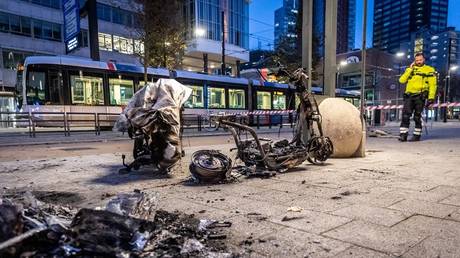
A burned electric scooter is seen after an anti-lockdown protest in Rotterdam, Netherlands, November 19, 2021 © AFP / Jeffrey Groeneweg
Lockdown protest described as ‘orgy of violence’

The chaotic scenes in the Netherlands’ third-largest city unfolded a day after a protest against reimposed Covid-19 restrictions in Rotterdam was marred by violence. Over 50 people were arrested in the city and three were injured after police opened fire in a bid to quell the unrest. Police later claimed that officers were “compelled to shoot at targets” to protect themselves. The three injured protesters remain in hospital, and their condition is unknown.

Protests have swept through a number of Dutch cities after the Netherlands became the first country in Western Europe since summer to go into a partial lockdown last week. Tensions soared further after the government banned New Year’s Eve fireworks displays and the Dutch parliament backed the introduction of the so-called 2G system, which would bar the unvaccinated and those who have not recently recovered from the virus from a long list of public places if introduced.

Think your friends would be interested? Share this story!

find more fun & mates at SoShow now !

Covid-19 variants keep emerging in different parts of the world, causing experts to ask how long the pandemic will last, and how effective the current methods of protection really are.

Since the pandemic started in 2019, people have referred to the disease which has paralyzed the world simply as ‘coronavirus’. Now, in 2021, when we talk about it, we mean not just the original variant, but also its numerous mutations. 

Read more

© Getty Images / sasacvetkovic33
Drastic drop in Covid vaccine effectiveness – study

In May, the WHO decided to label the key variants with Greek letters. Since then, the Delta variant has been proclaimed the predominant strain across the world, and now we have titles that look like codes to detail the differences between variants. Last month, the UK was put on high alert over a fast-spreading Delta AY.4.2 variant. This week, Norway reported finding one more version of the Delta strain – AY. 63. The country’s experts suggest it’s not more dangerous than the Delta mutation itself. Meanwhile, another Covid variant, discovered in France (B.1.640), brought the researchers an unpleasant surprise: they said they’d never seen mutations like it. 

Professor David Dockrell, from the Center for Inflammation Research of the University of Edinburgh, described to RT the reasons for the constant mutation of the coronavirus. “The areas in the virus that are most likely to change are those that come into contact with what we call ‘selective pressures’ – or factors that make them need to change,” he explains. “So, a version of the virus which mutates and changes to give it a selective advantage to escape from the immune system is more likely to prosper and become a dominant strain.” 

That’s how it works: The part of the virus many of the immune responses (or antibodies, T-cells etc.) are responding to is called the spike protein (or the S-protein). So, the virus tries to change it in order to survive. 

“We know that a variety of different viruses are able to mutate and change when exposed to the selective pressure of the immune system, whether it would be the human immune system or other species in which these viruses have evolved,” Prof. Dockrell says. “And of course, we’ve seen it most clearly with HIV, which is particularly good at changing and evolving. It does something called ‘reverse transcription’ – it copies material in the reversed direction from DNA to RNA.” 

Covid is still seemingly running faster than humanity’s efforts to curb it, but Prof. Dockrell has some good news. “The coronavirus – and viruses like it – are not as able to make these changes. They are going to do it to some extent, but they are not going to be as successful as retroviruses and HIV.” 

And the other major thing to say: When the viruses make changes, there’s always what we call ‘a fitness cost’. Many of the potential changes that the virus could make will actually not favor its survival. So there are only a certain number, potentially, of changes that the virus can make, before it starts affecting its fitness. 

Now, unfortunately, we are still in a phase where Covid19 can continue to evolve and change. It’s not time to panic, though, because across the world various ways to adapt the current anti-Covid strategies are already in place. First of all, people should keep getting vaccines – maybe receiving slightly altered booster doses, Prof. Dockrell suggests, “in a way, that we, after all, have to do with influenza, by providing a seasonal influenza vaccine and changing it every year.” 

Read more

RT
WHO sounds alarm over looming Covid-19 catastrophe in Europe

“And maybe we have to keep changing some of the treatments like these new monoclonal antibodies against the virus, because they also may be limited by the emergence of a mutation of the virus evolving the S-protein,” he adds. 

Sounds promising – but won’t it become a never-ending race against constantly emerging mutations? 

Hopefully not. According to Prof. Dockrell, there are parts of viruses that scientists call ‘conserved areas’. With time, vaccines and monoclonal antibodies will target these areas, which the virus finds very hard to change. “Clearly, the direction of travel is to develop either vaccine responses that affect more different kinds of virus, or these ‘monoclonal antibodies’ that we could use to prevent or treat infection, that they will target more conserved areas and therefore will be less limited by the ability of these virus to evolve and change,” he concludes.

Think your friends would be interested? Share this story!


find more fun & mates at SoShow now !

Slovakia has become the latest European country to implement lockdown restrictions on people who haven’t had the Covid vaccine, as it seeks to prevent a resurgence in infections and hospital admissions over the winter.

Slovakian Prime Minister Eduard Heger announced the new measures in a press conference on Thursday, declaring a “lockdown for the unvaccinated” after the country reported a record number of new cases.

The new restrictions in Slovakia, which come into effect on Monday, will require people to have been vaccinated or have recovered from Covid in the past six months to enter restaurants, non-essential shops, or public events.

In the past few days, the European nation has seen record numbers of new infections, including over 8,000 on Tuesday, with hospitals running out of space to treat Covid patients.

Slovakia has one of the lowest rates of vaccination in the European Union, with over 50% of individuals still not jabbed. The country of around 5.5 million has so far only inoculated 2.5 million people against the virus.

Read more

(FILE PHOTO) © REUTERS/David W Cerny
Czechia rolls out new restrictions for unvaccinated

Earlier this week, Austria became the first nation to impose restrictions on unvaccinated individuals, as it sought to limit pressure on hospitals and emergency care units. The move came into effect at midnight on Monday for anyone aged 12 and older who has not received their Covid vaccine or recently recovered from the virus.

The German state of Bavaria and the Czech Republic followed Austria in restricting access for unvaccinated individuals. Only people who can show proof of vaccination or that they have recently recovered from Covid will be allowed to enter public spaces, such as restaurants and shops. 

If you like this story, share it with a friend!

find more fun & mates at SoShow now !

At least two people were wounded by police gunfire in the Dutch city of Rotterdam after a protest over renewed Covid-19 restrictions spiraled into a violent riot, seeing demonstrators torch a squad car and clash with officers.

A large crowd of protesters showed up at Rotterdam’s iconic Coolsingel street on Friday evening to denounce a new round of pandemic measures, including an ongoing partial lockdown, a ban on New Year’s Eve fireworks displays, as well as fears the government will impose a ‘2G’ pass system allowing only the vaccinated and those who’ve recently recovered from the virus to enter a long list of public places.

At least two people were wounded during the demonstration, a local police spokesperson told Reuters, adding the injuries were “probably” due to officers’ “warning shots” but also noting that “direct shots were fired because the situation was life-threatening” to law enforcement.

Footage of the heated protest circulated online, some clips showing a police squad car fully engulfed in flames after it was apparently torched by rioters.

Demonstrators were also seen launching fireworks at police, who appeared to respond with large quantities of tear gas, which at one point blanketed the area.

Local law enforcement said that officers deployed a mobile riot control unit to Coolsingel and unleashed water cannon on protesters who refused to clear the streets, also noting that some arrests were made after an emergency order was imposed to cordon off the area.

The Dutch government announced the fireworks ban earlier on Friday, saying it is meant to “prevent, as much as possible, extra strain on healthcare, law enforcement and first responders.” However, while private displays are prohibited, officials said that local governments may still put on fireworks shows so long as their Covid-19 restrictions allow it.

The Netherlands currently has a ‘3G’ rule in place, allowing the vaccinated, the recently recovered, as well as those who test negative for the virus to enter most public spaces. But as the country remains under a partial three-week lockdown to rein in growing infections, officials are now mulling the stricter ‘2G’ scheme, prompting the intense demonstrations seen on Friday night.

Think your friends would be interested? Share this story!

find more fun & mates at SoShow now !

Planetary alignment on Friday has offered sky-gazers around the globe a chance to witness a spectacular near-total lunar eclipse, the longest since the 1440s.

The fascinating astronomical phenomenon lasted three hours and 28 minutes – the longest in centuries, according to international space agencies. On Thursday and Friday, depending on local time zones, the Earth, Sun and Moon aligned in such a way that 97.4% of our natural satellite’s surface was darkened in shadow.

When the Moon came out of the shroud, it turned bloody or rusty red in sunlight.

The dramatic celestial show was visible in those parts of the globe where the Moon appeared above the horizon during the eclipse.

Sky watchers in North and South America, parts of Eastern Asia and Australia had a chance to witness the phenomenon.

In Russia, the partial eclipse could be seen in Siberia and the Far East. Russian space agency Roscosmos also shared images of the shadowed moon as seen from the International Space Station (ISS).

Adding to the astonishment, the Moon was very low in the sky for much of the eclipse, causing an optical illusion that made it seem larger.

While the full Moon travels through Earth’s shadow roughly two times a year, lunar eclipses are usually far shorter.

The latest event, due to its rare duration, might have affected people not only visually, but also emotionally, astrologers cautioned.

Like this story? Share it with a friend!

find more fun & mates at SoShow now !

A stream literally flowing with booze emitting a strong beery odor has been discovered in one of the tropical islands of Hawaii. Its waters have been apparently contaminated with alcohol after a leak at a beverage warehouse.

A small river with a distinctive alcoholic smell was recently found on the island of Oahu, some 15 miles (24 kilometers) away from Honolulu, Hawaiian capital. Its waters have been flowing through the Waipio valley and even turned into a 100-foot (30 meters) waterfall on their way.  

Read more

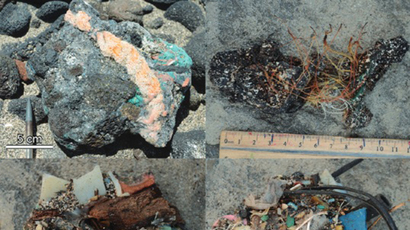
Image from geosociety.org
​‘Plastic stones’ found at remote Hawaii beach

The stream caught the attention of local environmental activists, who noticed the smell in the area.

The other day we came here you would think it was a beer pub that hadn’t opened its doors for three or four days,” activist Carroll Cox told local Hawaii News Now. She also contacted the Department of Health about the issue.

Local media took samples from the unusual stream and had them checked at a private laboratory. It tested positive for alcohol, containing 1.2% percent of the substance in its waters – nearly a quarter the content in regular beer and strong enough to cause a buzz.

Local health authorities got involved, and an investigation into the source of contamination was launched. It was learned that the stream was coming from a drain pipe that was traced back to a warehouse of Hawaii’s largest liquor distributor, Paradise Beverages. Its representatives told local media they were working with officials to eliminate a possible spill, with the booze river apparently closing its free drinks service.

Like this story? Share it with a friend!

find more fun & mates at SoShow now !

The longest lunar eclipse in over 500 years will occur in the early hours of November 19, lasting several hours.

The peak of the partial eclipse will take place in the predawn hours on Friday when 97% of the moon will be eclipsed by the Earth’s shadow. The previous longest partial eclipse took place in 2018 and lasted less than two hours, while this will last for several hours.

The eclipse will be visible from all 50 US states, Canada, and Mexico, as well as parts of South America, Polynesia, Australia, and China, according to NASA.

The moon will be at its farthest point from Earth during the eclipse, slowing its orbit and extending the time it takes to move out of the darkest part of the planet’s shadow, known as the umbra, as the moon, Earth, and sun will all be aligned. The Holcomb Observatory has released a video detailing what the eclipse will look like. 

The event will begin shortly after midnight and unlike a solar eclipse, no one will need special eyewear to view the phenomenon.

When the eclipse occurs, the moon will take on a reddish hue, with only a sliver of the actual moon visible. The event will last for several hours, making it the longest of its kind in 580 years, with the next lunar eclipse not occurring until May of 2022.

If you like this story, share it with a friend!

find more fun & mates at SoShow now !

This piece by General Joseph Votel (Ret.) and Lt. Gen. Michael K. Nagata (Ret.) and was first published by our friends at the Middle East Institute.


Lt. Gen. (ret.) Michael K. Nagata is a distinguished senior fellow on national security at MEI. He retired from the U.S. Army in 2019 after 38 years of active duty, with 34 years in US Special Operations. His final position was director of strategy for the National Counterterrorism Center from 2016 to 2019.

Gen. (ret.) Joseph L. Votel is a distinguished senior fellow on national security at MEI. He retired as a four-star general in the U.S. Army after a nearly 40-year career, during which he held a variety of commands in positions of leadership, including most recently as commander of CENTCOM from March 2016 to March 2019. 


OPINION – The United States and Pakistan have had a complex and often disappointing “love-hate” relationship since 1947 — one severely tested during the 20-year U.S.-led intervention in Afghanistan. We believe the time has come for serious policy consideration of whether and how both nations can achieve a more strategically beneficial and sustainable post-intervention relationship between the American and Pakistani governments and their populations.

As we consider a new policy, the U.S. military withdrawal from Afghanistan after two decades of leading the international coalition is almost complete. Early indications are that Afghanistan is increasingly likely to descend into significant instability and possibly serious fracture, which will have unwelcome consequences for the Afghan people and all of Afghanistan’s neighbors. It is already clear that international terrorist groups like al-Qaeda and Islamic State-Khorasan Province will continue to enjoy and probably grow their safe havens.

Whatever U.S. strategic concerns may be about the future of Afghanistan, the course and direction of Pakistan’s strategic choices in coming years will also matter to the United States. There are a variety of reasons for this.

First, Pakistan is a nuclear weapon state. Decades of investments in nuclear weapons by Pakistan and India, compounded by unrelenting and mutual historical, religious, cultural, and political antagonism between them, make this one of the world’s most dangerous flashpoints.

Second, all of the countries Pakistan borders are consequential for the U.S. Pakistan also has significant religious, cultural, and economic ties to other Muslim states such as Turkey and Saudi Arabia. In an era of “great power competition,” while Pakistan may not be one of the principal players, its network of relationships can be of strategic benefit to any of the great powers now involved, including the U.S. and China.

Third, despite its significant political and economic difficulties, Pakistan has a growing technology sector. Its youthful population and worldwide diaspora of Pakistani doctors, scientists, academics, and other professionals have become an increasingly important part of the global community.


The Cipher Brief hosts private briefings with the world’s most experienced national and global security experts.  Become a member today.


As long-time veterans of South Asia, both of us understand the sources of “weariness and wariness” that U.S. policymakers, in both Democratic and Republican administrations, often associate with strategic discussions of Pakistan. We have both seen the U.S. government’s reluctance toward undertaking any kind of strategic interaction or rapprochement with Pakistan because of previous disappointments or perceived betrayals. Understanding the enormous complexities of Pakistan’s relationships, influence, and strategic choices in the South Asia milieu can be intellectually challenging and draining.

Yet, we have both concluded that the only thing harder than establishing a functional and mutually beneficial relationship with Pakistan is living without one. Given unstable borders, a nuclear standoff with India, the continued presence of terrorist organizations, and the high potential for all of this to further disrupt our interests, there is no better alternative.

Among those areas that we believe worth exploring with the Pakistanis are these:

First, the possibility of planning, along with other like-minded international actors (both state and non-state), to manage the consequences of significant political instability and human suffering emerging from Afghanistan, including the possibility of substantial refugee flight into Pakistan. Indeed, the Pakistanis have long and miserable memories of the surge of Afghan refugees after the Kabul government collapsed in the 1990s and have consistently expressed deep concerns about a possible repeat resulting from the U.S. withdrawal now nearing its completion.

Second, the possibility of counterterrorism cooperation against any terrorist threat that emerges from Afghanistan and prevents it from sowing further instability across the region. We do not consider it likely that Pakistan will allow any positioning of U.S. intelligence or counterterrorism elements within its borders. Still, there may be other ways (e.g., working groups, forums, or exchanges) to foster better cooperation if a threat emerges from Afghanistan that is of concern to our mutual interests.

Third, the possibility of enlisting Pakistan cooperation, and that of India, toward some type of partial de-escalation of tensions along their common border and, with it, even a slight amelioration of the nuclear weapons threat. It is instructive to recall that, before 9/11, Pakistani President Pervez Musharraf and Indian Prime Minister Atal Bihari Vajpayee initiated a dialogue about the de-escalation of tensions that included the highly emotional issue of Kashmir. However, talks broke down without significant agreement. While we recognize this is an extraordinarily complex and fraught issue for the U.S. to embrace, given all of its other strategic challenges, the specter of a potential nuclear conflict in South Asia should at a minimum prompt us to ask ourselves, “why not at least try?” Indeed, U.S. antagonists such as China would probably take a dim view of such efforts, and we believe that might be a reason for doing so rather than a reason to flinch from it.


Go beyond the headlines with expert perspectives on today’s news with The Cipher Brief’s Daily Open-Source Podcast.  Listen here or wherever you listen to podcasts.


We have long heard U.S. policy and operational practitioners cite phrases such as “never underestimate the Pakistanis’ ability to disappoint us.” But, unfortunately, most American policymakers do not understand how often we have heard the Pakistanis say the same thing about Americans. Thus, both sides have longstanding “neuralgias” about the other. As we end our Afghan campaign, now is the time to move beyond our neuralgias and carefully weigh the strategic costs of whether trying to somehow partner with Pakistan is more, or less, than the cost of failing to do so. We believe, in the long run, it is likely to be less costly.

The views expressed in this piece are those of the authors.

Read more expert-driven national security insights, perspective and analysis in The Cipher Brief

The post OPINION: The Future of US Cooperation with Pakistan appeared first on The Cipher Brief.

find more fun & mates at SoShow now !