Covid-battered global supply chains are being threatened by organized criminals, including drug cartels and con artists posing as legit suppliers, a new study has found, warning that the situation is set to get worse.

The international supply chain woes amid the Covid-19 pandemic are highlighted in a new annual report, released this week by the British Standards Institution (BSI).

The document, titled the ‘Supply Chain Risk Insights Report’, highlights Covid’s impact on supply chains, with the experts also warning that organized crime has increasingly preyed on this crucial area during the pandemic. On multiple instances, criminals were posing as legitimate logistics providers, stealing goods during shipment.

“I’m seeing a significant number of false suppliers acting as genuine potential suppliers in supply chain logistics provision – warehousing distribution, distribution centres, transportation companies – and actually, they are criminal groups trying to infiltrate the logistics supply chain,” said David Fairnie, BSI’s principal consultant in supply chain security. He urged producers to “continuously monitor” the supply chain and to not immediately trust new logistics providers – especially those contacted only remotely.

So, arguably today more than ever, you do need to know your suppliers. So far in 2021, BSI has noted this issue of fake carriers in an increasing number of countries in both the Americas and Europe.

Criminals have apparently been trying to steal goods in various ways, with phony truck drivers loading up items and taking off with them, while conmen “posing as legitimate employees” have reportedly been observed lurking around delivery destinations to steal cargo.

Read more

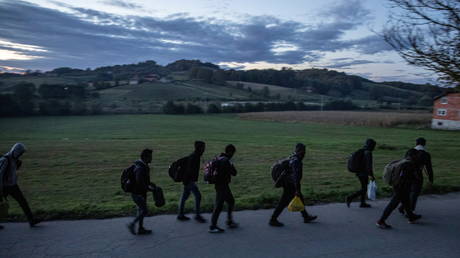
FILE PHOTO: Migrants walk towards the Bosnia-Croatia border in attempt to cross. © Reuters / Marko Djurica
Human trafficker explains migrant smuggling business

At the same time, the report found that trade in illicit goods has also been on the rise lately, with the illegal drug industry in particular appearing to flourish. While the supply chain for drug cartels, which require large amounts of assorted chemicals to produce narcotics, was disrupted due to the pandemic lockdowns and border closures impacted trafficking routes, organized crime quickly overcame these problems, the BSI noted.

“Drug cartels around the world did not miss a beat,” Chris Tomas, BSI lead intelligence analyst, said.

While many cartels shifted their production towards synthetic drugs, namely amphetamine, amid the pandemic, the apparent “lack of eradication of coca crops in Latin American countries” also remains an issue, the BSI said. The flow of cocaine has grown over the past year and is expected to increase even further, the organization warned.

“The numbers and quantities of cocaine seizures in Europe increased steadily in 2020 and 2021 and are expected to continue to rise in 2022,” the report reads.

Think your friends would be interested? Share this story!

find more fun & mates at SoShow now !

This piece by General Joseph Votel (Ret.) and Lt. Gen. Michael K. Nagata (Ret.) and was first published by our friends at the Middle East Institute.


Lt. Gen. (ret.) Michael K. Nagata is a distinguished senior fellow on national security at MEI. He retired from the U.S. Army in 2019 after 38 years of active duty, with 34 years in US Special Operations. His final position was director of strategy for the National Counterterrorism Center from 2016 to 2019.

Gen. (ret.) Joseph L. Votel is a distinguished senior fellow on national security at MEI. He retired as a four-star general in the U.S. Army after a nearly 40-year career, during which he held a variety of commands in positions of leadership, including most recently as commander of CENTCOM from March 2016 to March 2019. 


OPINION – The United States and Pakistan have had a complex and often disappointing “love-hate” relationship since 1947 — one severely tested during the 20-year U.S.-led intervention in Afghanistan. We believe the time has come for serious policy consideration of whether and how both nations can achieve a more strategically beneficial and sustainable post-intervention relationship between the American and Pakistani governments and their populations.

As we consider a new policy, the U.S. military withdrawal from Afghanistan after two decades of leading the international coalition is almost complete. Early indications are that Afghanistan is increasingly likely to descend into significant instability and possibly serious fracture, which will have unwelcome consequences for the Afghan people and all of Afghanistan’s neighbors. It is already clear that international terrorist groups like al-Qaeda and Islamic State-Khorasan Province will continue to enjoy and probably grow their safe havens.

Whatever U.S. strategic concerns may be about the future of Afghanistan, the course and direction of Pakistan’s strategic choices in coming years will also matter to the United States. There are a variety of reasons for this.

First, Pakistan is a nuclear weapon state. Decades of investments in nuclear weapons by Pakistan and India, compounded by unrelenting and mutual historical, religious, cultural, and political antagonism between them, make this one of the world’s most dangerous flashpoints.

Second, all of the countries Pakistan borders are consequential for the U.S. Pakistan also has significant religious, cultural, and economic ties to other Muslim states such as Turkey and Saudi Arabia. In an era of “great power competition,” while Pakistan may not be one of the principal players, its network of relationships can be of strategic benefit to any of the great powers now involved, including the U.S. and China.

Third, despite its significant political and economic difficulties, Pakistan has a growing technology sector. Its youthful population and worldwide diaspora of Pakistani doctors, scientists, academics, and other professionals have become an increasingly important part of the global community.


The Cipher Brief hosts private briefings with the world’s most experienced national and global security experts.  Become a member today.


As long-time veterans of South Asia, both of us understand the sources of “weariness and wariness” that U.S. policymakers, in both Democratic and Republican administrations, often associate with strategic discussions of Pakistan. We have both seen the U.S. government’s reluctance toward undertaking any kind of strategic interaction or rapprochement with Pakistan because of previous disappointments or perceived betrayals. Understanding the enormous complexities of Pakistan’s relationships, influence, and strategic choices in the South Asia milieu can be intellectually challenging and draining.

Yet, we have both concluded that the only thing harder than establishing a functional and mutually beneficial relationship with Pakistan is living without one. Given unstable borders, a nuclear standoff with India, the continued presence of terrorist organizations, and the high potential for all of this to further disrupt our interests, there is no better alternative.

Among those areas that we believe worth exploring with the Pakistanis are these:

First, the possibility of planning, along with other like-minded international actors (both state and non-state), to manage the consequences of significant political instability and human suffering emerging from Afghanistan, including the possibility of substantial refugee flight into Pakistan. Indeed, the Pakistanis have long and miserable memories of the surge of Afghan refugees after the Kabul government collapsed in the 1990s and have consistently expressed deep concerns about a possible repeat resulting from the U.S. withdrawal now nearing its completion.

Second, the possibility of counterterrorism cooperation against any terrorist threat that emerges from Afghanistan and prevents it from sowing further instability across the region. We do not consider it likely that Pakistan will allow any positioning of U.S. intelligence or counterterrorism elements within its borders. Still, there may be other ways (e.g., working groups, forums, or exchanges) to foster better cooperation if a threat emerges from Afghanistan that is of concern to our mutual interests.

Third, the possibility of enlisting Pakistan cooperation, and that of India, toward some type of partial de-escalation of tensions along their common border and, with it, even a slight amelioration of the nuclear weapons threat. It is instructive to recall that, before 9/11, Pakistani President Pervez Musharraf and Indian Prime Minister Atal Bihari Vajpayee initiated a dialogue about the de-escalation of tensions that included the highly emotional issue of Kashmir. However, talks broke down without significant agreement. While we recognize this is an extraordinarily complex and fraught issue for the U.S. to embrace, given all of its other strategic challenges, the specter of a potential nuclear conflict in South Asia should at a minimum prompt us to ask ourselves, “why not at least try?” Indeed, U.S. antagonists such as China would probably take a dim view of such efforts, and we believe that might be a reason for doing so rather than a reason to flinch from it.


Go beyond the headlines with expert perspectives on today’s news with The Cipher Brief’s Daily Open-Source Podcast.  Listen here or wherever you listen to podcasts.


We have long heard U.S. policy and operational practitioners cite phrases such as “never underestimate the Pakistanis’ ability to disappoint us.” But, unfortunately, most American policymakers do not understand how often we have heard the Pakistanis say the same thing about Americans. Thus, both sides have longstanding “neuralgias” about the other. As we end our Afghan campaign, now is the time to move beyond our neuralgias and carefully weigh the strategic costs of whether trying to somehow partner with Pakistan is more, or less, than the cost of failing to do so. We believe, in the long run, it is likely to be less costly.

The views expressed in this piece are those of the authors.

Read more expert-driven national security insights, perspective and analysis in The Cipher Brief

The post OPINION: The Future of US Cooperation with Pakistan appeared first on The Cipher Brief.

find more fun & mates at SoShow now !
American billionaire Bill Gates has claimed Covid-19 deaths and infections may drop below seasonal flu levels next year as more people get vaccinated and treatment improves, unless we encounter a new, more deadly variant.

Speaking on Thursday in a virtual interview at the Bloomberg New Economy Forum in Singapore, founder of Microsoft stated that vaccines, natural immunity and emerging oral treatments mean that “the death rate and the disease rate ought to be coming down pretty dramatically.”  

The tech mogul, who has been particularly vocal during the pandemic, said issues around vaccine-production capacity are likely to be replaced by distribution challenges and even waning demand.

“The vaccines are very good news, and the supply constraints will be largely solved as we get out in the middle of next year, and so we’ll be limited by the logistics and the demand,” he noted. 

He also told his audience that it remains to be seen how much demand there is for Covid-19 shots in places like Sub-Saharan Africa. 

Calling for more work to eradicate flu, Gates claimed Covid-19 rates and deaths would possibly fall below those of flu by the middle of next year, unless more deadly coronavirus variants emerge. 

The Bill and Melinda Gates Foundation has involved itself in the development of vaccines and virus surveillance, calling for a global response to the Covid-19 pandemic. The foundation has invested hundreds of millions dollars in the development and distribution of potentially lifesaving shots. 

According to the World Health Organization, influenza kills up to 650,000 people each year. At least five million people have died from Covid-19 since the pandemic began in late 2019.

If you like this story, share it with a friend!

find more fun & mates at SoShow now !

When the PRC decides to move on Taiwan, it is unlikely to move in a manner that makes a US decision on intervention clear cut.  Should China decide, initially at least, against a full-scale invasion of that island nation, it could instead opt to try to “win without fighting.” Beijing might do so by using its large, state-controlled fishing fleet to cut smaller Taipei-controlled islands off from Taiwan itself much as the PRC is now massing fishing boats to expand Chinese-controlled seas to press claims on the Japanese Senkakus and Whitsun Reef in Philippine waters. Chinese state-owned fisheries companies – part of the so-called ‘Maritime Militia’ – serve as fronts for PLA intelligence. Using their fleets to operate in a manner somewhere between peace and conflict in the gray zone of contested control around Taiwan would allow Beijing to test whether the US and its allies are willing to help defend the island’s independence without being seen to initiate open conflict.

“The Cipher Brief has become the most popular outlet for former intelligence officers; no media outlet is even a close second to The Cipher Brief in terms of the number of articles published by formers.” – Sept. 2018, Studies in Intelligence, Vol. 62 No.

Access all of The Cipher Brief’s national-security focused expert insight by becoming a  Cipher Brief Level I Member .  


The post Why the China – Russia Relationship Should Worry You – Part Two appeared first on The Cipher Brief.

find more fun & mates at SoShow now !

Rotterdam Mayor Ahmed Aboutaleb has described an anti-lockdown protest in his city as an “orgy of violence.” The Dutch demonstration devolved into a violent riot that saw police open fire on protesters.

Aboutaleb described the events of Friday night as an “orgy of violence,” after protesters packed Rotterdam’s central Coolsingel shopping street to voice their opposition to an ongoing partial lockdown, a ban on New Year’s Eve fireworks displays, and the possibility of a two-tiered system of freedom in the Netherlands, one of liberty for the vaccinated and restrictions for those without the jab.

Read more

A police squad car is seen engulfed in flames during a protest in Rotterdam, Netherlands, November 19, 2021.
2 wounded after shots fired at Covid protest in Netherlands

The protest soon got out of hand, and police said on Saturday that 57 people were arrested. Protesters were seen torching police vehicles and launching fireworks at police, who shot at them in response.

Aboutaleb said that the cops had been “forced” to use their weapons. “On a number of occasions the police felt it necessary to draw their weapons to defend themselves,” he told reporters. “They shot at protesters, people were injured.”

Police say at least seven people were injured. Two of these injuries were caused by police bullets, and the victims are still in hospital. One officer was hospitalized, while several others were treated at the scene for minor injuries.

Like this story? Share it with a friend!

find more fun & mates at SoShow now !

After vowing to retaliate against Lithuania’s move to allow Taiwan open a “representative office” in Vilnius, Beijing has announced it is downgrading diplomatic relations with the Baltic state.

In a statement on Sunday, the Chinese foreign ministry said that China’s diplomatic relations with Lithuania will be formally lowered to the level of charge d’affaires, while blasting Vilnius for setting a “bad international precedent” by giving the island the green light to open its mission in the Lithuanian capital.

The ministry went on to accuse Vilnius of undermining the One China principle and the principle of neutrality in bilateral relations, explaining its decision to demote relations by citing the need to “safeguard its sovereignty and the basic norms of international relations.”

Read more

The Lithuanian flag (FILE PHOTO) © REUTERS/Ints Kalnins
China reveals whether it’ll ‘punish’ Lithuania over Taiwan

“The Lithuanian government must bear all the consequences arising from this,” the ministry said, while calling on Vilnius to “correct its mistakes immediately.”

“No matter how the ‘Taiwan independence’ forces distort facts and reverse black and white, they cannot change the historical fact that the mainland and Taiwan belong to the same China,” the ministry asserted.

The move comes just two days after Beijing went on a verbal offensive against the Baltic country, warning that pushback for its cozying up to Taiwan would be imminent. “As to what necessary measures China will take, you may wait and see,” it said at the time.

Lithuania and China have been embroiled in a diplomatic row and have not maintained relations at ambassadorial level since September. After the Baltic state revealed that it would be opening a de facto Taiwanese embassy, China withdrew its ambassador from the country in August. Vilnius followed suit the following month.

Think your friends would be interested? Share this story!

find more fun & mates at SoShow now !

Vaccination of all Hungarian citizens against Covid-19 is inevitable, PM Viktor Orban has said, stating that even the most hardline anti-vaxxers will ultimately face a choice between dying with the virus and getting a jab.

Speaking to Kossuth radio on Friday, the Hungarian leader lashed out at those reluctant to get vaccinated against coronavirus, branding them a threat “not only to themselves but to all others.”

In the end, everyone will have to be vaccinated; even the anti-vaxxers will realize that they will either get vaccinated or die. So, I urge everyone to take this opportunity.

The EU member state is currently experiencing its fourth wave of coronavirus, Orban stated, blaming the situation on those who had not got vaccinated. “If everybody were inoculated, there would be no fourth wave or it would be just a small one,” the PM claimed.

Read more

FILE PHOTO. ESSEN, GERMANY. © AFP / Ina FASSBENDER
Covid rates take Germany to ‘nationwide state of emergency’

Apart from urging the unvaccinated to go and finally get their jabs, Orban also promoted booster shots, revealing that he had already taken three doses of a coronavirus vaccine.

“The only thing that protects us from the virus is vaccination. And we are now also seeing, at least the experts are unanimous in saying, that four to six months after the second vaccination, the protective power of the vaccine weakens. Therefore, a third vaccination is justified,” he said.

Hungary has already announced new anti-Covid measures, though somewhat short of the strict measures proposed by the nation’s Medical Chamber on Wednesday. The medical body called for a blanket ban on mass events, and suggested making entry to restaurants, theaters and other indoor venues conditional on bearing a Covid-19 inoculation certificate. Instead, Budapest rolled out compulsory mask wearing for most indoor environments, as well as making booster shots mandatory for all medical workers, starting from Saturday.

A nation of 10 million, Hungary’s total tally of logged Covid cases is hovering just below the one million mark. On Friday, it registered a new daily record, with nearly 11,300 new Covid infections. More than 32,700 people in Hungary have succumbed to the disease over the course of the pandemic.

Think your friends would be interested? Share this story!

find more fun & mates at SoShow now !

France’s best-known book of words, Le Petit Robert dictionary, has caused a stir by including the non-binary personal pronoun as an alternative to the existing masculine and feminine terms.

While the annual update of the Petit Robert dictionary is often a topic of considerable debate in French media, the latest edition has caused quite the backlash, with some, including a cabinet member, accusing it of pandering to wokeism.

The word “iel,” a neologism combining the French words for he and she (“il” and “elle“), is described as the personal pronoun for a person of any gender. “Personal pronoun subject to the third person singular and plural, used to evoke a person of any gender. The use of the pronominal in inclusive communication,” the dictionary’s entry reads. 

Read more

(FILE PHOTO) © REUTERS/Costas Baltas
France turns to Ancient Greece for war on woke

Striking out at the latest inclusion, François Jolivet, an MP in President Emmanuel Macron’s LREM party took his protest to the Académie Française, the official guardians of the French language.  

Describing the move as “wokeism,” Jolivet said in a letter to the Académie that the word “iel” had no place in the French language and claimed it would be a precursor to the rise of ‘woke’ ideology, which undermines the values of the Gallic nation.

Outspoken Education Minister Jean-Michel Blanquer also chimed in. “Inclusive writing is not the future of the French language,” he tweeted, sharing Jolivet’s letter. “Just as our schoolchildren are consolidating their basic skills, they don’t need to have this as a reference,” he added.

The head of Gaullist party Debout La France, Nicolas Dupont-Aignan, further criticized Petit Robert’s “woke” addition. “Let’s defend our language against these ridiculous fanatics of deconstruction and let’s boycott the collaborators who give into them,” he tweeted.  

Le Petit Robert has responded to the “lively debate” by claiming that the pronoun has been used increasingly in society in recent months and they chose to reflect this by adding it to their latest update. The publication also said that some have welcomed the addition.

France’s offensive against wokeism, which has been described by some as an Anglo-Saxon import, recently saw Blanquer vow to increase the teaching of ancient Greek and Latin languages. The education minister claims that the classical vernaculars respond to a demand for logos (language as a tool for reason), in a world where “a lack of reason is spreading like wildfire.” 

If you like this story, share it with a friend!

find more fun & mates at SoShow now !

The planned introduction of chemical castration for serial rapists in Pakistan has been dropped due to objections from experts in Islamic law, who said such punishment would be counter to Sharia.

The controversial clause in a bill amending criminal law in Pakistan was dropped before the National Assembly voted on it on Wednesday, a parliament official said on Friday. If it were passed, it would have been unconstitutional, Parliamentary Secretary for Law and Justice Maleeka Bokhari explained. The basic law of the country requires all its laws to be in line with the Sharia and the Koran.

Bokhari said the decision to drop the clause was taken due to objections from the Council of Islamic Ideology, a constitutional body that advises the government of Pakistan on the intricacies of Islamic law.

Read more

© publicdomainpictures.net
Outrage as teen’s rapist spared jail time

The bill amends Pakistan’s Penal Code and Criminal Procedure Code to streamline investigations and prosecutions of sexual crimes as part of wider anti-rape reform. Some conservative lawmakers vocally argued against the castration clause as the piece of legislation was moving towards approval. Senator Mushtaq Ahmed from the Islamist Jamaat-i-Islami party argued that rapists should be hanged publicly, while castration was never mentioned in Sharia.

A separate bill also approved by the parliament on Wednesday introduces a system of special regional investigators for rape allegations to be appointed by the prime minister, as well as new protections for victims, and punishments for officials who fail to investigate their complaints properly. Among other things, it makes evidence that a victim is “generally of immoral character” inadmissible in court.

The reform is necessary because currently deterrence of sexual crimes in Pakistan is undermined by “poor investigation, archaic procedures and rules of evidence and delay in the trial,” the bill said.

If you like this story, share it with a friend!

find more fun & mates at SoShow now !