France’s best-known book of words, Le Petit Robert dictionary, has caused a stir by including the non-binary personal pronoun as an alternative to the existing masculine and feminine terms.

While the annual update of the Petit Robert dictionary is often a topic of considerable debate in French media, the latest edition has caused quite the backlash, with some, including a cabinet member, accusing it of pandering to wokeism.

The word “iel,” a neologism combining the French words for he and she (“il” and “elle“), is described as the personal pronoun for a person of any gender. “Personal pronoun subject to the third person singular and plural, used to evoke a person of any gender. The use of the pronominal in inclusive communication,” the dictionary’s entry reads. 

Read more

(FILE PHOTO) © REUTERS/Costas Baltas
France turns to Ancient Greece for war on woke

Striking out at the latest inclusion, François Jolivet, an MP in President Emmanuel Macron’s LREM party took his protest to the Académie Française, the official guardians of the French language.  

Describing the move as “wokeism,” Jolivet said in a letter to the Académie that the word “iel” had no place in the French language and claimed it would be a precursor to the rise of ‘woke’ ideology, which undermines the values of the Gallic nation.

Outspoken Education Minister Jean-Michel Blanquer also chimed in. “Inclusive writing is not the future of the French language,” he tweeted, sharing Jolivet’s letter. “Just as our schoolchildren are consolidating their basic skills, they don’t need to have this as a reference,” he added.

The head of Gaullist party Debout La France, Nicolas Dupont-Aignan, further criticized Petit Robert’s “woke” addition. “Let’s defend our language against these ridiculous fanatics of deconstruction and let’s boycott the collaborators who give into them,” he tweeted.  

Le Petit Robert has responded to the “lively debate” by claiming that the pronoun has been used increasingly in society in recent months and they chose to reflect this by adding it to their latest update. The publication also said that some have welcomed the addition.

France’s offensive against wokeism, which has been described by some as an Anglo-Saxon import, recently saw Blanquer vow to increase the teaching of ancient Greek and Latin languages. The education minister claims that the classical vernaculars respond to a demand for logos (language as a tool for reason), in a world where “a lack of reason is spreading like wildfire.” 

If you like this story, share it with a friend!

find more fun & mates at SoShow now !

As the U.S. works toward getting more 11,000 Americans, diplomats and Afghan allies out of the country, what kind of Taliban should the U.S. expect to deal with in Afghanistan?  So far, there have been assurances from the Taliban that a new regime may not be as brutal as regimes past, but few who have worked with the Taliban believe the assurances.  How might the regime work with, or shelter groups like al-Qaeda, which is the reason why the U.S. entered into Afghanistan after 9/11.  And how might a massive-scale exodus of Afghans impact neighboring countries?

The Cipher Brief sat down with the former National Intelligence Manager for Iran at ODNI, Norman T. Roule to get his expert-level perspective.

Norman T. Roule, Former National Intelligence Manager for Iran, ODNI
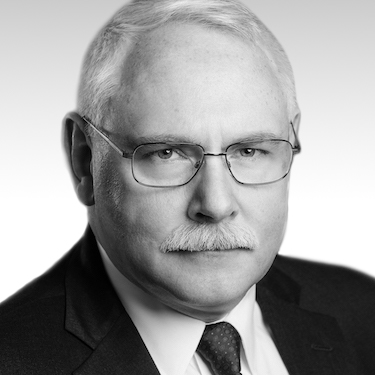
Cipher Brief Expert Norm Roule served for 34-years in the Central Intelligence Agency, managing numerous programs relating to Iran and the Middle East. He served as the National Intelligence Manager for Iran (NIM-I) at the Office of the Director of National Intelligence from November 2008 until September 2017.  As NIM-I, he was the principal Intelligence Community (IC) official responsible for overseeing all aspects of national intelligence policy and activities related to Iran, to include IC engagement on Iran issues with senior policy makers in the National Security Council and the Department of State.

The Cipher Brief: How would you characterize the international community’s response to the Taliban victory in Afghanistan?

Roule:  Historians of the future will likely describe the response to the Taliban victory as a strange mix of apathy and confusion.

In terms of apathy, there is extraordinary irony in the fact that after spending so much blood and treasure to defeat Da’esh efforts to establish an extremist Islamic Republic in Syria and impose its oppression over Iraqis and Syrians, the international community failed to prevent the creation of an Islamic Republic in Afghanistan. Many of the arguments behind our involvement in Syria – from a refugee crisis to the need to deny international Islamic militants a home to birth new terror groups – apply to Afghanistan. Whether or not one supported this decision, it is hard to avoid thinking that this episode will embolden militants worldwide.

In terms of confusion, we seem to be unable to accept that no one can predict the course and pace of crowd dynamics that so quickly eroded Afghan resistance. We live in a world where people acknowledge their inability to predict who will win our presidential elections but insist the Intelligence Community can somehow predict the day events will occur in a denied environment. But such a worst-case possibility should have been part of the planning deck and resourced on the ground accordingly.

The Cipher Brief: How would you expect the international community to respond in the coming days?

Roule: Absent a Taliban attack, operations at the airport should proceed more smoothly as our response architecture grows. Beyond that, much depends on how the Taliban act in the coming weeks. The group is not a monolith. Their success was highly likely as much a surprise to them as anyone. As they define their path and choose their leaders, there will be internal debates, jockeying for power, and perhaps some violent infighting.

In terms of indicators of the regime’s direction, we may want to consider the following questions:

First and foremost, how will the Taliban respond to our ongoing evacuation? Thus far, they seem willing to let us leave untouched, probably believing that the sooner we get out, the easier it will be for them to take control. At the same time, international media coverage of the evacuation will impose a strategic embarrassment on Washington.

Second, to what extent have the Taliban changed? They certainly understand that diplomacy played a role in their victory. Some of their leaders have spent hundreds of hours with foreign diplomats and traveled to multiple foreign capitals. How will these leaders merge such experiences into governance with more insular colleagues? They are likely to talk initially about compromise regarding women’s rights and inclusion of opponents in the government, but this may well be another effort to buy time. The international community has few pressure points over the group. How this plays out will be a good indicator of how they plan to run the country.

Next, how will they handle the issue of al-Qaida and other terrorists? We cannot overlook the deep connections between the Taliban and al-Qaida. If they believe the international community will limit its response to demarches, press statements, and empty sanctions, many in the group will be inclined to allow al-Qaida to reorganize.

Last, I would look at the refugee issue. They are likely to welcome external aid and allow at least some humanitarian groups to remain in country. Doing so requires no political concessions, addresses a domestic headache, and provides an opportunity for corruption. Humanitarian groups also offer a lever the Taliban can use against the West, i.e., refrain from criticizing us, or we will block your humanitarian operations. The Houthis have done this with great effect in Yemen.


The Cipher Brief hosts private briefings with the world’s most experienced national and global security experts.  Become a member today.


The Cipher Brief: How do you think will China, Russia, and other adversaries will respond to the withdrawal? 

Roule: Chinese propagandists have aggressively exploited our evacuation from Afghanistan. Its media is already claiming that these events show Taiwan that “once war breaks out in the Straits, the island’s defense will collapse in hours, and the US military won’t come to respond.” China’s press has also reportedly announced that the U.S. will not stand by Hong Kong activists.

Beijing, Tehran, and their proxies will likely point to the withdrawal as evidence that the U.S. is a declining power, unwilling or incapable of defending its friends. It will be lost on no one that whereas the U.S. has abandoned Afghanistan, Russia, China, and Iran have not wavered in support of their – admittedly few and otherwise isolated – allies.

In a worse case, if our adversaries believe the withdrawal reflects a lack of national resolve, they may be tempted to test our will on other issues. In this case, a miscalculation could lead to a conventional war in another theater.

The Cipher Brief: What would you say to those who say that the withdrawal demonstrates that the U.S. will only focus on strategic interests?

Roule:  Certainly, this argument has an appeal. It is true that our strategic adversaries like nothing better than the U.S. expending resources and diplomatic energy in such areas as Afghanistan, in part because we are, in essence, protecting their interests for free. But it does beg two questions.

First, what will happen differently next year regarding China, Russia, efforts to combat climate change, and cyber actors, now that we are out of Afghanistan? Second, what exactly is a U.S. strategic interest that we would protect? Estonia? Bahrain? Taiwan?

This argument also glosses over how others respond to such a posture. If a country perceives itself outside the international community’s protection, it will likely accommodate an aggressor. Our next call for a coalition of the willing will likely meet with less enthusiasm.

U.S. influence depends on the respect shown to us in multiple arenas. The echoes of this localized respect become self-reinforcing. We should think about what happens to collective international security if these echoes are silenced.

Last, this argument inherently argues that values are strategic interests. Unless violence directly touches Americans, we will limit our response to diplomacy and public statements. Such protests are unlikely to stop those behind a future Srebrenica massacre or the Rwandan genocide. Indeed, one can make a case that such a response might even encourage such events.

The Cipher Brief: How can the U.S. now best demonstrate its national resolve?

Roule:  As the saying goes, the best way to demonstrate national resolve is to demonstrate national resolve. Fair or not, this episode will tar the Biden administration. It doesn’t help that some allies reportedly have complained that the U.S. did not sufficiently consult with them on its decision to withdraw. Public criticism of the withdrawal decision by some of our closest European partners is growing. Adversaries will now consider their action through the lens of Afghanistan, much as the post-Vietnam malaise encouraged Soviet aggression in the 1970s.

I am not saying that we can’t reverse this situation. The U.S. withdrawal from Lebanon in 1984 caused many to question U.S. resolve. Although it did signal an end to U.S. (and international) efforts to eradicate Hezbollah, Reagan’s actions in other arenas (to include Afghanistan) restored the image of U.S. national resolve. Difficult diplomacy and a demonstration of our willingness to use military power when needed lay ahead.


Go beyond the headlines with expert perspectives on today’s news with The Cipher Brief’s Daily Open-Source Podcast.  Listen here or wherever you listen to podcasts.


The Cipher Brief: What does the return of the Taliban mean for al-Qaeda?

Roule:  There is little reason to believe the Taliban-Al-Qaida relationship will not resume, although al-Qaeda is a fragmented and a pale version of its original stature. Nonetheless, it is easy to imagine the delight of its remaining leadership and cadres. Elements in Iran will likely seek to return to Afghanistan, perhaps assuring Iran that in exchange for tolerance of periodic transit of Iranian territory, the group will use its influence with the Taliban to protect Iran’s interests. We should watch for any signs of a return to Afghanistan by Zawahiri’s deputy, Sayf al-Adel, who is currently in Iran with other members of the group’s leadership council.

But al-Qaeda is not the only actor on this stage. Its leader Ayman al-Zawahiri has not appeared for months and has far less influence than Osama Bin Laden. Afghanistan also hosts al-Qaeda in the Indian Subcontinent (AQIS), ISIS, and other groups. The Taliban have emptied Afghanistan’s prisons which held deeply committed and dangerous militants who may gravitate to whatever new militant leadership might arise. But a lethal threat to Americans is sure to appear. The only questions are its size, goals, and reach.

The Cipher Brief: What does the U.S. withdrawal mean for China and Russia?

Roule: Both countries have sought to undercut U.S. influence in Afghanistan. They will each be delighted with the rhetorical violence of our internal debate over the withdrawal. But they also enjoyed the stability our engagement provided in a country so close to their borders.

Both countries have developed relations with the Taliban. I believe each hosted a Taliban delegation in recent weeks. It shouldn’t be lost on us that neither country felt compelled to withdraw its personnel from Kabul. That’s a pretty good sign of their confidence in the relationship.

Outside of Afghanistan, each will use the withdrawal to increase their influence with Central Asian actors – including Turkey. Coordination on terrorism and narcotics issues will come most easily. For example, Uzbekistan will worry that the Taliban will renew support of the violent Islamic Movement of Uzbekistan, which has long maintained a presence in Afghanistan.

China’s concerns will be threefold. Beijing will use economic and diplomatic inducements to ensure that the Taliban do not encourage unrest among China’s oppressed Uighur population, let alone support the East Turkistan Islamic Movement or other Chinese militants in Xinjiang province. Next, Beijing will want to explore the Belt and Road access Afghanistan offers. Last, China will likely test whether it can achieve a commercially viable deal to mine Lithium and other minerals. In that mine operations require many years to develop and a vast amount of capital to construct, such arrangements are likely to be few given Afghanistan’s unpredictable political and security environment.

As for Russia, the U.S. withdrawal offers a chance for greater influence in Central Asia. We should watch for signs of new Russian military bases in the region. Moscow’s concern that Afghanistan will once more become a sanctuary for anti-Russian terrorists will also drive its relationship with the Taliban.

The Cipher Brief: What about Iran and Pakistan?

Roule: Iran has long maintained a relationship with Taliban elements. Reportedly, this involved sanctuary and provision of some weaponry. Tehran’s goals were to hedge its bets in Afghanistan, influence the enemies of the U.S., and protect the Shi’a of Afghanistan.

On the last point, Iran may have much work to do. Taliban personnel reportedly tore down Shi’a posters as they entered Kabul. Tehran must now contend with the consequences of refugees and the rise of warlords on its border.

The current head of Iran’s Qods Force, Esmail Qaani, has considerable experience on Afghan issues, and I expect he will play a prominent role in Iran’s response. We should watch to see how the Qods Force deploys its seasoned Afghan Fatemiyoun proxies from Syria.

Pakistan’s long-time relationship with the Taliban will give it more influence over the group than other countries. But Islamabad also will be on the receiving end of a flood of refugees, renewed militant terrorism in its loosely-controlled border areas, and Western pressure for its support of the Taliban. Ties to the Taliban may also complicate Islamabad’s relationship with India and China.

The Cipher Brief: What does this mean for the U.S. intelligence community?

Roule: The counterterrorism cadre of the US intelligence community and its partners have achieved extraordinary successes in the last years. But their work is now more complicated but no less urgent. For example, our withdrawal has reduced collection streams and potential access when the Afghanistan-based terrorist threat has only begun to grow. This challenge arrives as we shift counterterrorism resources from al-Qaeda to domestic extremists, cyber threats, and China.

The Cipher Brief: Any final comments?

Roule: If I may, I would like to close with a couple of brief comments.

First, we need to do everything we can to support personnel on the ground in Afghanistan. They – and their support teams at home – are trying to restore order in the middle of a hurricane. We are watching heroism at its best.

Next, the narrative of Afghanistan is unsurprisingly partisan. But politics shouldn’t obscure the truth. For more than twenty years, thousands of American and coalition partners volunteered to risk their lives in Afghanistan. We didn’t come to colonize. We didn’t steal Afghan resources. The operational goals were to bring Bin Laden to justice, destroy al-Qaeda, and prevent Afghanistan from becoming a haven for the group in the future. We also worked to transform Afghan society. The need for this last effort wasn’t apparent at the outset of our invasion. But it was likely unavoidable if we hoped to satisfy our values and enable Afghan society to confront its militant population. This effort represents the best of our values, and we owe all who served in this arena our most profound respect. Afghans who have participated in their country’s efforts during the past two decades will endure tremendous suffering. But they remain Afghanistan’s best hope and they deserve our support. Last, we need to end the fiction that Afghans didn’t fight for their country. Tens of thousands of Afghans were killed and wounded in the fight against al-Qaeda. Many involved in this fight are reportedly being sought door-to-door by the Taliban. Discounting their efforts may serve a political narrative, but it does them a terrible injustice.

Read more expert-driven national security insights, perspective and analysis in The Cipher Brief


The post What Should the U.S. Expect from the ‘New’ Taliban Regime? appeared first on The Cipher Brief.

find more fun & mates at SoShow now !

EXPERT OPINION — More than 200 U.S. officers have been hunted around the globe and targeted by an adversary using a mysterious weapon that causes permanent brain injury. It’s time to get serious about fighting back.

The Authors:

Paul Kolbe served for 25 years in the CIA’s Directorate of Operations. He is currently Director of the Intelligence Project at Harvard Kennedy School’s Belfer Center for Science and International Affairs.

Marc Polymeropoulos worked for the CIA for 26 years. He is author of “Clarity in Crisis: Leadership Lessons from the CIA.

John Sipher worked for the CIA’s clandestine service for 28 years. He is now a nonresident senior fellow at the Atlantic Council and a co-founder of Spycraft Entertainment.

Prior to 9/11, al Qaida declared war on the United States, bombed the USS Cole, and blew up U.S. embassies in Nairobi and Dar es Salam. Despite heavy casualties, America viewed successive al Qaida terrorist attacks as somehow unique, not representative of a larger threat or state of war. We went about our business and failed to take hard action against al Qaida despite clear warning. Our failure to respond forcefully led to 9/11 and the two decades of war that followed.

Fast forward to today.  Since 2016, more than 200 U.S. officials have reportedly suffered from a mysterious series of symptoms which have caused long-lasting, debilitating injuries. Suffering from searing headaches, vertigo, vision impairment, and nausea, many victims have been formally diagnosed with traumatic brain injuries (TBI) at the Walter Reed National Military Medical Center and other leading hospitals. Family members and young children have suffered as well. Some medical tests can now confirm the markers of brain injury, similar to those suffered by victims of concussive injuries in Iraq and Afghanistan.

These injuries began with a cluster of reports from Cuba in 2016 and have become commonly referred to as Havana Syndrome. Moscow, Vienna, Belgrade, and Hanoi are among more than a dozen cities where U.S. officials reportedly have been attacked and injured. In residences, on the street, in vehicles, and even at secure U.S. facilities, U.S. officers are being hunted. Stunningly, even a close aide to CIA Director Bill Burns was reportedly attacked on a trip to India just this past August.

The CIA, after a period of confusion, delay, and even denial at times, now appears to take these threats very seriously. CIA Director Burns and Deputy Director David Cohen have publicly stated that U.S. officials are being “attacked.” They have improved health care for CIA officers who are hurt. And an agency task force is hard at work trying to obtain additional intelligence on those responsible. We credit Director Burns for his solid leadership.

The cause of these injuries? The National Academy of Sciences has pointed to Directed Energy Weapons – devices which emit microwave pulses which can inflict pain and damage tissue. The United States, Russia, China, and others have all developed Directed Energy Weapons to destroy equipment, counter drones, and control crowds. This is not science fiction.

Directed energy weapons would account for the highly directional and locational nature of these incidents. When victims can “move off the x,” the signature sounds, sensations, and pain that goes with the attacks often stop, though damage has already occurred. The amount of exposure seems to affect the degree of injury. Other technologies could be at play and are being investigated, but microwaves appear to be the most likely vector. Russia has used them before, flooding the U.S. Embassy in Moscow with microwave radiation for decades.

Regardless of form, the weapons being used in these attacks are nothing less than weapons of terror, designed to cause injury to non-combatants. Who would use such a weapon to attack U.S. intelligence officers, diplomats, and military personnel, and to what conceivable end?


The Cipher Brief hosts private briefings with the world’s most experienced national and global security experts.  Become a member today.


CIA Deputy Director Cohen stated at a recent intelligence summit, that the U.S. was closer to identifying the culprit, and Politico has reported that members of the Senate Intelligence Committee are increasingly convinced that Russia or another hostile adversary is behind the attack, although reportedly, no smoking gun has been found.

As former CIA operations officers with extensive experience dealing with both counterterrorism and counterintelligence issues, we have few doubts about who will be named as the culprit. For at least a decade, Russia has conducted itself as in a state of conflict with the West in general and the United States in particular. Russia has launched cyberattacks impacting critical infrastructure and supply chains, assassinated opponents with nuclear poisons and chemical weapons, gunned down people in the streets using criminal proxies, sabotaged a Czech ammunition depot, and mounted a violent coup attempt in Montenegro. It has also bombarded the U.S. embassy in Moscow with microwave radiation and used carcinogenic “spy dust” without regard to health effects. The attacks on U.S. officials would fit this pattern of behavior.

We recognize that it is important to let the intelligence community do its job and its findings must inform policy action. Congress and the administration must work together to formulate a range of possible responses and it is not too early to begin. As Senator Collins and others have stated, these attacks are “an act of war,” and as such, preparation for a future attribution call by the national security establishment is in order. So how could the U.S. respond?

Let’s start with what doesn’t work – sanctions. Sanctions feel good and satisfy an action imperative but they are feckless. Sanctions have not stopped Russia from killing dissidents, halted the Nordstream II pipeline, compelled a pull back from occupied territories, reduced support for tyrants, or hindered oil and gas production. Sanctions have simply forced Russia to develop more creative money laundering and sanction circumvention mechanisms.

So, what would work? For starters, we must understand that the Putin regime considers itself in a state of conflict with the U.S., short of war, but nonetheless deadly real. We are dealing with a state sponsor of terror which conducts operations across the globe to weaken the U.S. abroad, divide it from its allies, and sow discord at home. Our policy must be calibrated to win this conflict, without sparking a shooting war, but at risk of one.

Russia understands reciprocity and strength. When four Russian diplomats were kidnapped by extremists in Beirut in 1985, and one of them was killed, Russia reportedly responded by kidnapping and gruesomely killing a relative of the group’s leader. The surviving diplomats were released immediately. The story may be apocryphal, but it does illustrate the Russian approach. Tempting as it may be for America to retaliate tit for tat, we need not mirror Russia’s actions. Instead, we should play to our greater economic, diplomatic, and military advantages.

We offer five elements to frame a response: enlist U.S. allies, expand forward deterrence, limit the adversary’s reach, choke off money, and bring those accountable to justice.

NATO: With proof of the attacks on U.S. officials, we should activate NATO’s Article Five collective defense clause. The only other time this was enacted was after 9/11. As justification, in addition to the Havana Syndrome attacks, (which also caused Canadian casualties), we would include GRU and FSB assassination operations across Europe, deadly sabotage in the Czech Republic, a coup attempt in Montenegro, persistent cyberattacks, and a litany of other actions that can only be described as irregular warfare directed against NATO members.


Go beyond the headlines with expert perspectives on today’s news with The Cipher Brief’s Daily Open-Source Podcast.  Listen here or wherever you listen to podcasts.


Forward Presence: A crystal clear signal that we understand the nature of Russian hybrid warfare and are responding would be to enhance our deployed military presence in Poland, the Baltic States, and in the Black Sea region. These units would pose no offensive threat to Russia but would be a clear signal that the U.S. is prepared to counter any Russian shenanigans. We should also significantly ramp up our lethal aid and training to the Ukraine, where the nature of Russian aggression is well known. Weakness in Eastern Europe is an invitation to conflict.

Travel and Presence: We should drastically limit Russian business and tourist travel which is being used as cover for FSB and GRU operations. We would reduce Russian diplomatic presence in each capital to the bare minimum – handfuls not hundreds. American and European counterintelligence experts believe there are more Russian intelligence officers operating from embassies than during the Cold War. Limiting the size of Russia’s espionage infrastructure will complicate the planning and execution of all of its intelligence operations.

Finance: A key tool in counterterrorism operations is the ability to target sources of finance which constitute material support to terrorism. In this case, we would apply that principle to the Russian government, state enterprises, and individuals who provide cover, tools, and sources of funding to Russia’s campaign to undermine the West with violence, terror, and media manipulation. Russia’s dirty money has been used to undermine the west and poison our politics. We should limit the easy access of shady money to western banks.

Criminal Cases: We need bring war crime cases to the International Court of Justice (ICJ) in the Hague. Following a decade of conflict in the Balkans, the ICJ brought to justice 161 indicted Serbian, Croatian, and Bosnian war criminals. This was an astounding success – a manhunt which included American and European law enforcement and intelligence services. Just as in Nuremberg after World War II, these actions to hold war criminals accountable drew a line in the sand.

This is a start.  Successive Democratic and Republican administrations have pursued Russia policies which represent the triumph of hope over experience. We have treated the symptoms of malign Russian actions rather than the underlying pathology. It is now time to finally acknowledge that we are in a long-term hybrid conflict and forget the fantasy of changing Putin’s behavior. Only a new regime in the Kremlin would hold the hope of bringing about a change in actions. Eventually, the Putin regime will wither or collapse, but until it does, we and our allies must do a better job of defending ourselves.

Read more expert-driven national security insights, perspective and analysis in The Cipher Brief

The post Havana and the Global Hunt for U.S. Officers appeared first on The Cipher Brief.

find more fun & mates at SoShow now !

The International Criminal Court has halted an investigation into alleged rights abuses carried out by Philippines authorities as part of a harsh crackdown on the drug trade, saying it is reviewing a deferral request from Manila.

The ICC’s chief prosecutor Karim Khan said the probe was suspended after the Philippines government filed a request to defer the case earlier this month, according to court documents cited by Reuters on Friday. 

“The prosecution has temporarily suspended its investigative activities while it assesses the scope and effect of the deferral request,” he wrote, adding that the court is seeking more information from the government in Manila.

Based in The Hague, the ICC allows states to ask for postponements if they conduct their own investigations into the charges in question. President Rodrigo Duterte’s administration filed its deferral request on November 10, while the country’s Justice Ministry announced its own investigation into the alleged abuses late last month.

Read more

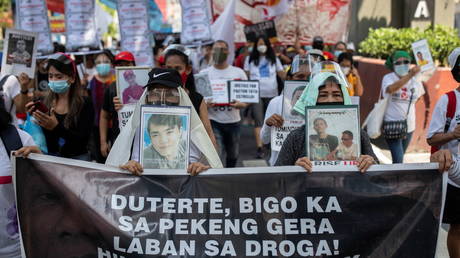
Relatives of drug war victims hold photographs of their slain loved ones with placards calling for justice (FILE PHOTO) © REUTERS/Eloisa Lopez
Philippines announces probe into thousands of killings during Duterte’s war on drugs as initial review suggests abuses took place

The court initially opened the probe in September over allegations that Philippines police had carried out thousands of extrajudicial executions and used other brutal tactics against suspected drug dealers, and that Duterte gave implicit backing to those actions. Activists have accused authorities of killing innocent people, including children, though the police insist they only use violence in self-defense.

While Duterte has declined to cooperate with the ICC probe, saying it has no authority on the island nation, and even pulled the Philippines out of the international body in 2019, the court has jurisdiction to investigate alleged violations committed by the country while it was still a member.

The president’s chief legal counsel, Salvador Panelo, confirmed the deferral request in brief comments to Reuters, saying “There is no inconsistency with the request for suspension of action,” though he did not elaborate.

Since its founding some 20 years ago, the ICC has successfully convicted just five people of war crimes or crimes against humanity – all leaders of armed movements in Africa, including in Mali, Uganda and the Democratic Republic of the Congo.

Think your friends would be interested? Share this story!

find more fun & mates at SoShow now !
Behind the Headlines brings you expert perspectives on today’s headlines by telling you more than what happened, but also what it means.  You can also listen to The Cipher Brief’s Daily Open-Source Collection Podcast wherever you listen to podcasts.

Jack Devine, Former Acting Director, National Clandestine Service, CIA

Cipher Brief Expert Jack Devine, a 32-year CIA veteran. Devine served as both Acting Director and Associate Director of CIA’s operations from 1993-1995.  He is a founding partner and President of The Arkin Group, which specializes in international crisis management, strategic intelligence and investigative research. Devine is the author of Spymaster’s Prism: The Fight Against Russian Aggression.

Russia’s multi-pronged support of Myanmar is a microcosm of its strategy in Southeast Asia.

In the months since Myanmar’s February military coup, Russia and China have been the junta’s most powerful allies, but Russia has exploited regional instability to position itself as a third path between China and the West. While China was closer with the former Myanmar government than the military, it was also concerned about the government’s ties with the West and potential interference in its development efforts, particularly its Belt and Road Initiative. Russia, on the other hand, doesn’t depend on stability in Southeast Asia to the same degree as China and can instead take advantage of warring factions. Last month, on his first trip outside of the immediate region since February, Myanmar’s junta leader Min Aung Hlaing went to Moscow to meet with high-level Russian defense officials instead of heading to Beijing. Hlaing has reportedly visited Russia seven times within the past decade and previously stated that over 6,000 Myanmar officers have studied at Russian military academies. According to data from the Stockholm International Peace Research Institute (SIPRI), Russia was responsible for almost 40% of arms sales to Myanmar from 1999-2018, second only to China. SIPRI data further indicates that Russia has been Southeast Asia’s largest arms supplier over the past two decades, counting Vietnam and Laos as top customers. But Russia is offering the region more than arms and has promised Myanmar two million Covid-19 vaccines and assistance in the nation’s own vaccine production efforts. Russia has also been trying to expand free trade agreements between its Eurasian Economic Union (EAEU) and Southeast Asian countries, most recently getting Indonesia to sign on to the deal. Stepping even further into soft power efforts, last week Russia’s foreign minister met with his Bangladeshi counterpart and agreed to encourage Myanmar to engage in dialogue with Bangladesh on the Rohingya crisis.


Get your free daily Open-Source Collection report in The Cipher Brief newsletter or take it on the go as a podcast.  Listen here or wherever you listen to podcasts.


Leftist, former schoolteacher Pedro Castillo is declared President of a divided Peru, projected economic growth could play in his favor. 

Peru, like many of its neighbors, has been battling the triple and interwoven threat of Covid-19, social unrest, and severe economic downturn. But for the past several years Peru has also been challenged by sharp divisions between its executive and legislative powers. Last November, Peru’s unicameral legislature voted to impeach then-President Martín Vizcarra, citing mismanagement of the pandemic and corruption, in a move that outraged thousands. The June presidential elections were likewise fraught. Castillo’s right-wing rival Keiko Fujimori, who is also under investigation for corruption, alleged electoral fraud and the Peruvians initiated a six-week long investigation, eventually finding Castillo the rightful victor. The EU, U.S. and 14 electoral missions deemed the elections legitimate, and the U.S. called the election a “model of democracy” for the region. Castillo, who previously worked as an elementary school teacher and has never held public office, will be greeted by a political establishment that is almost entirely against him. Peruvian citizens are also deeply divided, and many urban elites reportedly moved their money overseas out of fear for Castillo’s economic policies. But Castillo’s Peru Libre party holds fewer than 40 of 130 seats in the legislature and Castillo has already recruited several moderate advisors. Further, he has backed away from talk of nationalizing Peru’s lucrative multinational mining, oil, gas, and hydrocarbon companies, instead pledging to raise taxes on mining firms. Prices of copper and gold, two of Peru’s most critical exports, remain high and Covid-related trade obstacles are expected to ease over the coming months. While it is uncertain how effective Castillo will be, or where he will ultimately fall on his policies, positive projections for Peru’s export-based economy will likely play in his favor.


The Cipher Brief hosts private briefings with the world’s most experienced national and global security experts.  Become a member today.


Enjin becomes first blockchain platform to gain acceptance into the United Nations Global Compact, signaling widespread range of corporate sustainability efforts.

On Tuesday, Enjin, an innovative blockchain technology company focused on non-fungible tokens (NFTs), became the first such company to join the United Nations Global Compact. Upon admission, Enjin stated that it hopes to use NFTs to promote sustainability and equality in line with the UN pact that encourages businesses and firms worldwide to adopt more environmentally friendly and socially responsible practices. NFTs have surged in popularity in the past two years, and during the first quarter of 2021 NFT sales reportedly exceeded US $2 billion. In essence, an NFT is a way to prove ownership of a unique virtual item. It’s a unit of data that’s stored on a blockchain, or digital ledger, that certifies exclusive ownership of digital files ranging from photos to sports trading cards. Enjin, which is headquartered in Singapore, has focused its NFT efforts on games and apps and is reportedly able to operate with a lower carbon footprint than Bitcoin due to a slimmed-down verification model that requires less energy. This week, the UN Global Compact not only included Enjin as a member, but gave the company its highest membership rank, sending a signal that it’s interested in promoting such an environmental effort by crypto and blockchain entrepreneurs. For its part, Enjin has stated that it wants to employ the technology in carbon capture companies, fighting climate change in the process. The Head of the UN AI and Robotics Center remarked that during the global struggle to recover from the pandemic we should take advantage of new technologies like AI and blockchain to better equip ourselves for the future.

Read more expert-driven national security insights, perspective and analysis in The Cipher Brief


The post Behind the Headlines: Russia in Myanmar, Peru’s New President and what Enjin means for the United Nations Global Compact appeared first on The Cipher Brief.

find more fun & mates at SoShow now !

Scientists have used artificial intelligence to “predict” formulas for new designer drugs, with the stated goal of helping to improve their regulation. The AI generated formulas for nearly nine million potential new drugs.

Researchers with the University of British Columbia (UBC) used a deep neural net for the job, teaching it to make up chemical structures of potential new drugs. According to their study, released this week, the computer intelligence fared better at the task than the scientists had expected.

The research team used a database of known designer drugs – synthetic psychoactive substances – to train the AI on their structures. The market for designer drugs is ever-changing, since their manufacturers are constantly tweaking their formulas to circumvent restrictions and produce new “legal” substances, while cracking their structure takes months for law enforcement agencies, the researchers said.

Read more

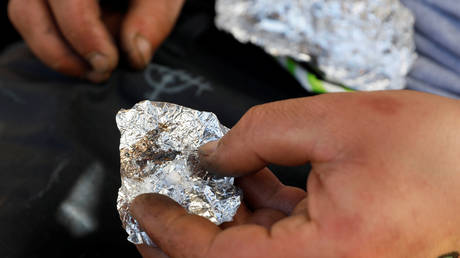
FILE PHOTO: A man living on the streets displays what he says is the synthetic drug fentanyl, in the Tenderloin section of San Francisco, California, February 27, 2020 © Reuters / Shannon Stapleton
Drug overdose deaths in US hit all-time record

“The vast majority of these designer drugs have never been tested in humans and are completely unregulated. They are a major public-health concern to emergency departments across the world,” one of the researchers, UBC medical student Dr. Michael Skinnider has said.

After its training, the AI was able to generate some 8.9 million potential designer drugs. Afterwards, researchers ran a data sheet of some 196 new drugs, which had emerged in real life after the model was trained, and found that more than 90% of these have been already predicted by the computer.

“The fact that we can predict what designer drugs are likely to emerge on the market before they actually appear is a bit like the 2002 sci-fi movie, Minority Report, where foreknowledge about criminal activities about to take place helped significantly reduce crime in a future world,” senior author Dr. David Wishart, a professor of computing science at the University of Alberta, has said.

Identifying completely unknown substances remains an issue for the AI, the research team has noted, but they hope it might potentially help with that task, since the computer was also able to predict which formulas of designer drugs were more likely to be created and hit the market. The model “ranked the correct chemical structure of an unidentified designer drug among the top 10 candidates 72 percent of the time,” while throwing in spectrometry analysis, which is an easily obtained measurement, bumped the accuracy to some 86%.

“It was shocking to us that the model performed this well, because elucidating entire chemical structures from just an accurate mass measurement is generally thought to be an unsolvable problem,” Skinnider stated.

Think your friends would be interested? Share this story!

find more fun & mates at SoShow now !
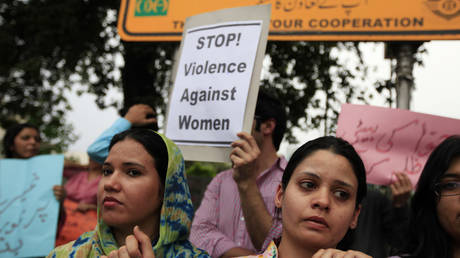
Criminals convicted of multiple cases of rape could face chemical castration in Pakistan as the country’s parliament supported new legislation aimed at tackling the rise in sexual offenses there.

The amendments to existing legislation, which allow for speedy conviction and harsher punishments for rapists, have been voted in by the MPs on Wednesday.

They introduce the death penalty or a life sentence for gang rape as well as chemical castration for repeat sex offenders, with the consent of the convict.

Chemical castration was described in the bill as a process through which “a person is rendered incapable of performing sexual intercourse for any period of his life, as may be determined by the court through administration of drugs.”

Read more

RT
High court rules Pakistan’s ‘two-finger’ virginity test for rape victims unconstitutional

It’s planned to establish special courts across the country to make sure that verdicts in sexual assault cases are delivered “expeditiously, preferably within four months.” If chemical castration is assigned as a punishment, it “shall be conducted through a notified medical board,” according to the new legislation.

Mushtaq Ahmed, a senator for the religious Jamaat-i-Islami party, had earlier denounced the bill as un-Islamic. Ahmed argued that there was no mention of chemical castration in Sharia law and that rapists are to be hanged in public.

By resorting to drugs to reduce the libido of repeat sex offenders, Pakistan joins South Korea, Poland, the Czech Republic and some US states, where chemical castration has been introduced.

The measure was put on the table a year ago by Pakistani President Arif Alvi in response to a vast public outcry over a spike across the country in cases of rape involving both women and children.

Back then, Amnesty International decried chemical castration as a “cruel, inhumane” treatment, advising Islamabad to instead focus on reforming its “flawed” justice system and to ensure justice for the victim.

Local NGO War Against Rape told Reuters last year that less than 3% of sexual assault or rape prosecutions in Pakistan result in a conviction.

If you like this story, share it with a friend!

find more fun & mates at SoShow now !
Scientists have used an AI tool to identify which animals are most likely to contract and spread mutated versions of Covid-19. The model highlighted both pets and wild animals as likely reservoirs for the virus.

Using information about their habitats and various biological traits, researchers at the Cary Institute of Ecosystem Studies in New York developed the machine learning tool to figure out which animals had the particular ACE2 protein that the coronavirus was most likely to latch onto. 

Out of 5,400 tested, the scientists narrowed it down to 540 mammalian species.

Some of its predictions have been previously documented as transmission risks, for instance, dogs, cats and bats, while farm animals like pigs and exotic zoo animals were surprise additions.

Read more

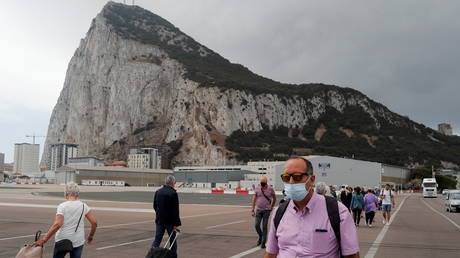
FILE PHOTO: People cross the tarmac of the airport in front of the Rock of Gibraltar in the British Overseas territory of Gibraltar, June 24, 2021 © Reuters / Jon Nazca
‘Most vaccinated’ place on earth cancels Christmas

Other expected additions are minks, Sunda pangolins, and 35 species of bats – which are together ranked among the top 10% of animals most likely to spread the virus, in line with lab results. 

The study, published in the Proceedings of the Royal Society journal, also ranked water buffalo, a number of primates, including gorillas and 76 rodent species as being more susceptible to infection.

The researchers taught the AI to identify patterns between rates of transmission and some 60 ecological and biological traits collected by earlier studies, including the overlap between the animal and human habitats as well as their respective lifespans, diets, and sizes.

Previously, the specific amino acid sequences had only been mapped out in around 300 species, including about 143 mammals — and figuring out which ones are more prone to infection is key to predicting the spread of the virus, researchers said.

Arinjay Banerjee at the University of Saskatchewan in Canada told the New Scientist that the results will help researchers “track viral infections and the possible emergence of animal-adapted coronavirus variants” around the world. Barbara Han, who led the study, said predictions needed to be followed up with systematic surveillance and lab studies.

Think your friends would be interested? Share this story!

find more fun & mates at SoShow now !
After vowing to retaliate against Lithuania’s move to allow Taiwan open a “representative office” in Vilnius, Beijing has announced it is downgrading diplomatic relations with the Baltic state.

In a statement on Sunday, the Chinese foreign ministry said that China’s diplomatic relations with Lithuania will be formally lowered to the level of charge d’affaires, while blasting Vilnius for setting a “bad international precedent” by giving the island the green light to open its mission in the Lithuanian capital.

The ministry went on to accuse Vilnius of undermining the One China principle and the principle of neutrality in bilateral relations, explaining its decision to demote relations by citing the need to “safeguard its sovereignty and the basic norms of international relations.”

Read more

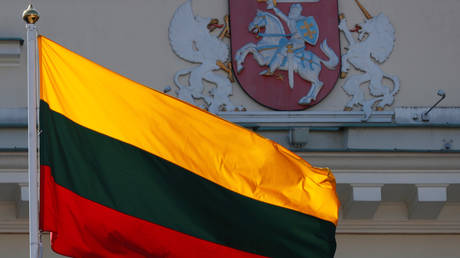
The Lithuanian flag (FILE PHOTO) © REUTERS/Ints Kalnins
China reveals whether it’ll ‘punish’ Lithuania over Taiwan

“The Lithuanian government must bear all the consequences arising from this,” the ministry said, while calling on Vilnius to “correct its mistakes immediately.”

“No matter how the ‘Taiwan independence’ forces distort facts and reverse black and white, they cannot change the historical fact that the mainland and Taiwan belong to the same China,” the ministry asserted.

The move comes just two days after Beijing went on a verbal offensive against the Baltic country, warning that pushback for its cozying up to Taiwan would be imminent. “As to what necessary measures China will take, you may wait and see,” it said at the time.

Lithuania and China have been embroiled in a diplomatic row and have not maintained relations at ambassadorial level since September. After the Baltic state revealed that it would be opening a de facto Taiwanese embassy, China withdrew its ambassador from the country in August. Vilnius followed suit the following month.

Think your friends would be interested? Share this story!

find more fun & mates at SoShow now !