An adviser to the EU’s top court has claimed that citizens’ information in Germany is being illegally harvested, after telecom companies challenged bulk data collection.

The German data retention law was criticized on Thursday by an adviser to the Court of Justice of the European Union (CJEU), who stated that general and indiscriminate retention of traffic and location data is only allowed in exceptional cases, such as a threat to national security.

According to the adviser, bulk collection of data generates a ‘serious risk’ of leaks or improper access. It also entails a ‘serious interference’ with citizens’ fundamental rights to privacy and the protection of personal data.

Read more

(FILE PHOTO) © REUTERS/Russell Cheyne
Google won’t pay for spying on UK iPhone users

This comes after two companies, SpaceNet and Telekom Deutschland, challenged the obligation to store their customers’ telecommunications traffic data in 2016. The Administrative Court of Cologne ruled that the two companies were not obliged to retain data because such an obligation violated Union law. Germany then appealed to the Federal Administrative Court, who asked the CJEU about the compatibility of the data retention obligation.

The CJEU has often stated that indiscriminate mass surveillance does not fit within the general principles of EU law. Over a year ago it saw a similar case involving legal challenges around national bulk data collection under UK and French law. The court then ruled that only limited data collection and temporary retention were allowed. France seeks to bypass the CJEU on data retention and has asked the country’s highest administrative court (the Council of State) not to follow the EU ruling. France is waiting for the conclusion of the procedure launched by the Council of State before “assessing to what extent” national law should be changed. 

Despite recent EU court attempts to curb surveillance powers, leaked papers from June 2021 show that the national governments of the Netherlands, France, Spain, Luxembourg, Slovakia, and Estonia are pushing for a new pan-EU data retention law. They claim that data retention is essential for safeguarding public security and ensuring effective criminal investigations.

Think your friends would be interested? Share this story!

find more fun & mates at SoShow now !

The Robert Koch Institute, Germany’s disease control agency, has warned that the country will face a “really terrible Christmas” unless steps are taken to mitigate a huge rise in Covid-19 cases.

Speaking on Thursday, the director of the Robert Koch Institute, Lothar Wieler, reiterated the case for new, strict countermeasures to prevent the spread of Covid-19.

Read more

(FILE PHOTO) © REUTERS/David W Cerny
Czechia rolls out new restrictions for unvaccinated

“We are currently heading toward a serious emergency,” Wieler stated, adding we are going to have a really terrible Christmas if we don’t take countermeasures now.” He added that hospitals were already struggling to find enough beds.

Wieler has called for a campaign for a further increase in vaccine uptake, from the current 67% to well over 75%.

The diseases institute director also believes bars, nightclubs, and other large-scale venues should be temporarily forced to close, and that other areas of public life should be off-limits to the unvaccinated.

His comments come as German leaders ponder new restrictions to replace the nationwide epidemic rules, which could include a lockdown of the unvaccinated, following measures already taken in neighboring Austria.

On Thursday, in an attempt to counter waning immunity levels, the country’s vaccine advisory board recommended that booster shots be made available to everyone aged 18 or above. 

If you like this story, share it with a friend!

find more fun & mates at SoShow now !

President Joe Biden commented on reports that US officials are planning to boycott the upcoming Olympics in Beijing over alleged human rights violations – but his answer left journalists perplexed.

When asked on Tuesday if an official US delegation will be traveling to the Winter Games in the Chinese capital in February, Biden responded: “I am the delegation.”

The president, however, did not elaborate, leaving the White House correspondents in a state of confusion, as his response could mean that Biden will attend the Winter Olympics alone or, as some reporters suggested, that he simply did not understand the question.

Read more

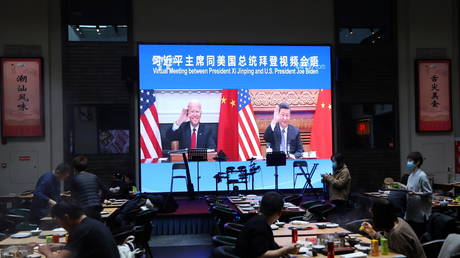
A screen at a restaurant in Beijing showing Chinese President Xi Jinping's virtual meeting with US President Joe Biden. © Reuters / Tingshu Wang
Biden & Xi agree to avoid conflict

A recent report by a Washington Post columnist claimed the US won’t be sending an official delegation to Beijing in 2022 over allegations of human rights violations by the Chinese government. According to the sources cited in the article, a formal recommendation for a diplomatic boycott of the Olympics has been already presented to Biden, with the move expected to be approved by the president by the end of November.

The piece was published on the day that Biden held a lengthy virtual meeting with Chinese leader Xi Jinping, in which they discussed a range of issues regarding the strained relations between the two nations – but not the Olympics.

The White House said that during the talks, President Biden challenged his Chinese counterpart over what Washington sees as persecution against the Uyghur population in the Xinjiang region, as well as human rights violations in Tibet and Hong Kong. China has strongly denied the claims, accusing the US of interfering in its internal affairs.

Calls for the Biden administration to boycott the Olympics and refrain from sending a political delegation to Beijing have recently been made by top Democratic and Republican lawmakers. 

If implemented, it won’t affect the American athletes, who will still be taking part in the Winter Olympics.

Like this story? Share it with a friend!

find more fun & mates at SoShow now !

CIPHER BRIEF EXPERT PERSPECTIVE 

Cipher Brief Expert Tim Willasey-Wilsey served for over 27 years in the British Foreign and Commonwealth Office. He is now Visiting Professor of War Studies at King’s College, London.

Older Americans have Saigon 1975 and the helicopters from the Embassy roof seared into their memories. A previous generation of Britons was haunted by the image of General Percival surrendering vast numbers of troops and equipment in Singapore to the Japanese in 1942. How Kabul falls to the Taliban could have important practical and symbolic significance.

The announcement that the United States is sending 3,000 troops to Kabul alongside 600 British troops to manage the evacuation of their civilians and those Afghans who provided assistance, is a remarkably late response to a rapidly deteriorating situation. Unless carried out in the next 48 hours, it will also be risky. Taliban infiltrators are already inside Kabul and the forces which captured Ghazni and Kandahar on 12th August will be heading towards the capital on their Honda 125cc motorbikes.

The US must have extracted undertakings from the Taliban negotiators in Qatar not to launch their full assault on Kabul until the evacuations are complete, but elements of doubt remain. Previous Taliban assurances have proved worthless, and it is doubtful that individual Taliban commanders would wish to hold back while some of Ashraf Ghani’s ministers, senior army officers, judges and officials are spirited away to a life of exile.

It is hard not to be impressed by the speed and élan of the Taliban’s recent successes; taking 13 of Afghanistan’s 34 regional capitals in almost as many days. It is reminiscent of the extraordinary progress which the Japanese made down the Malaya Peninsula in 1942 with Singapore as the ultimate prize.

The Taliban’s success has not happened by chance. It is clearly the fruit of preparation and planning. Above all, they have learnt from the experience of 1994 to 1996 when they eventually took Kabul but failed to capture the north, thereby allowing space for the Northern Alliance parties to survive and then reassert themselves following the 9/11 terrorist attacks.

This time, the Taliban have focussed first on border posts with neighbouring countries (thereby denying the government vital supply routes and customs revenues) before taking outlying regional capitals and leaving Kabul (which is never easy to capture) until last. Above all, they have concentrated on the north where many rural Afghans are disenchanted with the Kabul government and regional warlords. The north is no longer the solid bastion of anti-Taliban sentiment it was in the 1990s.


The Cipher Brief hosts private briefings with the world’s most experienced national and global security experts.  Become a member today.


Taliban progress in the north has snuffed out any chance that the old Northern Alliance could be reborn out of the eventual collapse of the Ashraf Ghani government. Whereas in 1996, Ahmed Shah Massoud, its brilliant military leader, was able to abandon Kabul and beat a tactical retreat up the Panjshir Valley, that option barely exists today. Not only is Massoud dead but his former adherents are no longer guerrilla fighters but members of a stratified Afghan army which has struggled to perform without US air support.

The Taliban have also ruthlessly exploited the weak negotiating stance of the United States and its chief negotiator Zalmay Khalilzad. Whereas some of the Taliban team in Doha, such as Mullah Barader, may indeed have been ‘moderates’ there was never any doubt that the Taliban movement wanted to see the total defeat of the Kabul government and the expulsion of Western forces. Pakistan too, may have occasionally considered some form of negotiated deal but ultimately the only sure way of keeping Indian influence out of Afghanistan (it believes) is a Taliban government.

The Afghan army (and in particular its impressive Special Forces) will now be assembling in Kabul and should be able to repel initial attempts to overrun the city. Certainly, Gulbuddin Hekmatyar found it impossible to take Kabul in 1992 and 1993 even with help from Pakistan, which, in frustration, switched support to the newly-created Taliban movement in late 1994.

But from 1992 to 1996 there were frequent deliveries of supplies to Massoud and his Northern Alliance defenders from Russia, Iran, and India. In 2021, the position is very different. Russia has already decided to “back the winner” and believes it has extracted promises from the Taliban not to export Islamism northwards into the Central Asian Republics (CARs). Iran too has channels to the Taliban and will be watching carefully for any return to the Taliban’s persecution of the Shia Hazaras. And India has already made contact with the Taliban in Doha in the hope that the Taliban in power will prevent Kashmiri militant groups from setting up bases there.

The likelihood therefore is that Kabul will fall to the Taliban quite quickly. If the Americans and British do manage to insert their evacuation forces soon, they should be able to complete the operation successfully, although there are likely to be heart-rending scenes at the airport as crowds of refugees are turned away at gunpoint from departing aircraft. Regional powers, particularly Pakistan, will try and persuade the Taliban to hold back from intervening, conscious that a bloodbath in Kabul would be a disastrous start to the Taliban’s second spell in government. Ironically, however, the evacuation would almost certainly lead to the collapse of the Kabul government as senior officials are forced to decide whether to take the last aircraft out or face almost certain torture and death at the hands of the victors. It is doubtful whether any Western countries will choose to retain their embassies in Kabul. For President Biden, the memory of Benghazi will be too raw.

What is certain is that there will be new iconic images to rival those of Saigon and Singapore.


Go beyond the headlines with expert perspectives on today’s news with The Cipher Brief’s Daily Open-Source Podcast.  Listen here or wherever you listen to podcasts.


Read more expert-driven national security insights, perspective and analysis in The Cipher Brief.

The post How Does Kabul End? appeared first on The Cipher Brief.

find more fun & mates at SoShow now !
The Chinese foreign ministry has lashed out at Lithuania after the small Baltic Sea nation approved the opening of the Taiwan Representative Office in Vilnius. Beijing says it undermines its One China policy.

Beijing was disappointed that Lithuania had proceeded to grant Taiwan permission to open its ‘representative office’ in Vilnius despite “China’s strong opposition and repeated persuasion,” Chinese foreign ministry spokesman Zhao Lijian said at a press briefing on Friday. Taiwan had opened its mission in Vilnius the previous day. 

Read more

Chinese star Peng Shuai is reportedly missing. © Visual China Group via Getty Images
Peng Shuai: What do we know about Chinese tennis star at center of international storm?

Zhao called the move a violation of the One China principle, which he said is undermining China’s sovereignty and territorial integrity, while grossly interfering in its internal affairs. The spokesman reminded Lithuania that Taiwan is an inalienable part of China’s territory and the Beijing government has sole legal authority. 

As to what necessary measures China will take, you may wait and see. The Lithuanian side shall reap what it sows.

In a “stern warning” to the Taiwanese authorities, Zhao then added that “seeking ‘Taiwan independence’ by soliciting foreign support is a totally misguided attempt that is doomed to fail.”

In August, Lithuania announced that the diplomatic outpost would be named the “Taiwan Representative Office,” angering China. Taiwan’s diplomatic branches – in countries that have de facto relations with the island’s authorities – are normally called “Taipei Economic and Cultural Offices.”

China demanded that Lithuania recall its ambassador from China, which it did. Beijing then withdrew its envoy to the Baltic state.

Chinese officials have repeatedly called on Western nations, notably the UK and US, to stop interfering in Beijing’s internal affairs, stressing that they consider Taiwan to be part of China.

If you like this story, share it with a friend!

find more fun & mates at SoShow now !
Two climate activists in Australia have brought the world’s busiest coal port to a halt, strapping themselves to a massive piece of machinery and refusing to come down. The stunt follows more than a week of similar actions.

Blockade Australia, a climate group focused on “strategic direct action,” declared that two of its members had clambered atop equipment at the Port of Newcastle and stopped work there late Tuesday night, sharing footage captured by the activists as they suspended themselves from a large loading machine.

“Zianna and Hannah have shut down Newcastle coal port, abseiling from coal handling machinery. The port cannot resume operations until the pair are removed by police,” the group said, identifying the activists by their first names only, adding “This is the tenth consecutive day of disruption to Newcastle coal port and its supply rail network.”

The protest stunt follows at least 16 similar actions over the last week or so, the group said, some targeting the rail line near the port, the world’s largest for coal exports.

Another demonstration carried out on Tuesday saw a second pair of activists breach the port and “hit emergency stop buttons” on machines before strapping themselves to a different piece of equipment. They were brought down and arrested after “several hours” and are expected to appear in court in the coming days.

The disruptions have drawn the ire of state officials, with New South Wales Environment Minister Matt Kean calling them “completely out of line” and urging police to “throw the book” at the protesters, at least 19 of whom have already been arrested so far this month, according to ABC.

“Pull your heads in, get out of the way and stop hurting other people going about their lives, running their businesses,” the minister said during a radio interview on Wednesday. “There are hundreds of ways to make your views known and advocate for change, but risking the lives of rail workers is definitely not one of them.”

The activists could face charges that carry maximum sentences of 25 years in prison, NSW police commissioner Mick Fuller said, noting that local law enforcement has created a “strike force” to deal with future disturbances at the port.

READ MORE: The trillion dollar push to decarbonize global shipping

Like this story? Share it with a friend!

find more fun & mates at SoShow now !
American billionaire Bill Gates has claimed Covid-19 deaths and infections may drop below seasonal flu levels next year as more people get vaccinated and treatment improves, unless we encounter a new, more deadly variant.

Speaking on Thursday in a virtual interview at the Bloomberg New Economy Forum in Singapore, founder of Microsoft stated that vaccines, natural immunity and emerging oral treatments mean that “the death rate and the disease rate ought to be coming down pretty dramatically.”  

The tech mogul, who has been particularly vocal during the pandemic, said issues around vaccine-production capacity are likely to be replaced by distribution challenges and even waning demand.

“The vaccines are very good news, and the supply constraints will be largely solved as we get out in the middle of next year, and so we’ll be limited by the logistics and the demand,” he noted. 

He also told his audience that it remains to be seen how much demand there is for Covid-19 shots in places like Sub-Saharan Africa. 

Calling for more work to eradicate flu, Gates claimed Covid-19 rates and deaths would possibly fall below those of flu by the middle of next year, unless more deadly coronavirus variants emerge. 

The Bill and Melinda Gates Foundation has involved itself in the development of vaccines and virus surveillance, calling for a global response to the Covid-19 pandemic. The foundation has invested hundreds of millions dollars in the development and distribution of potentially lifesaving shots. 

According to the World Health Organization, influenza kills up to 650,000 people each year. At least five million people have died from Covid-19 since the pandemic began in late 2019.

If you like this story, share it with a friend!

find more fun & mates at SoShow now !

Scientists in Sweden claim that a single protein in the blood could predict the onset of Type 2 diabetes nearly 20 years in advance. The breakthrough potentially affects hundreds of millions of people worldwide.

Diabetes is the world’s ninth-leading cause of death, and affects nearly half a billion people worldwide, according to the World Health Organisation (WHO). The vast majority of diabetes patients suffer from Type 2 diabetes, a condition that can lead to blindness, kidney failure, heart attacks, strokes, and lower limb amputation. Cases of diabetes quadrupled worldwide between 1980 and 2014, with unhealthy diets and lack of exercise blamed for the rise.

Read more

© Getty Images / Peter Dazeley
NHS setting up fat camps for children

However, researchers at Lund University in Malmo, Sweden claim that elevated levels of a certain protein – follistatin – in the blood can predict the onset of Type 2 diabetes regardless of a person’s age, weight, diet or activity level. In a study published last week, the scientists wrote that high levels of follistatin can predict the condition up to 19 years before symptoms appear.

To discover the link between follistatin and diabetes, the researchers tracked 5,300 people from Sweden, Italy, and the UK for between four and 19 years. Follistatin helps break down body fat, while simultaneously leading to an increase in fat in the liver. This buildup can cause fatty liver disease and Type 2 diabetes.

“This study shows that follistatin has the potential to become an important biomarker to predict future Type 2 diabetes, and it also brings us one step closer to the understanding of the mechanisms behind the disease,” Dr. Yang De Marinis, associate professor at Lund University and lead author of the study, told a university newsletter. De Marinis added that the next step for her team would be to help develop an AI-based diagnostic tool that could analyze a patient’s blood sample and use their follistatin levels – and other biomarkers – to calculate their “risk score” for Type 2 diabetes.

As follistatin levels rise in response to food intake and activity levels, the same advice for prevention of diabetes still applies. “Balanced meals, eat[ing] healthy and regular exercise are important to decrease the risk of developing Type 2 diabetes,” De Marinis told StudyFinds.

Think your friends would be interested? Share this story!

find more fun & mates at SoShow now !