France’s education minister has announced plans to boost the teaching of ancient Greek and Latin in an effort to fight the proliferation of wokeism and “develop the culture” of the country’s younger generations.

Speaking on Monday, Education Minister Jean-Michel Blanquer, a leading figure in France’s war on woke, said that ancient Greek and Latin would become available to sixth formers pursuing vocational courses next year, as well as middle school students. 

Blanquer wants sixth formers to have the opportunity to “develop their culture” by reading ancient philosophers while gaining the technical qualifications that the economy demands. 

Read more

© Getty Images / Rattanakun Thongbun / EyeEm
I just graduated from a British university. They’re broken

Speaking at a charter signing, alongside counterparts from Italy, Greece, and Cyprus, the minister claimed their joint commitment to the promotion of the classics came at a time when ancient languages were being threatened by American wokeism.

The targeting of the dead languages has been most prominent in the US with Princeton University announcing this summer that it would no longer require classics students to study ancient Greek and Latin; the two vernaculars are often considered the core pillars of the discipline.

Dan-el Padilla Peralta, an associate professor of classics at Princeton, claimed the ancient languages had been used as a justification of slavery, colonialism, and fascism for 2,000 years.

In a similar move, a Massachusetts high school boasted that it had removed Homer’s Odyssey from the school curriculum as it conflicted with the anti-racist agenda it wanted to teach. “Very proud to say we got the Odyssey removed from the curriculum this year,” a teacher wrote on social media. 

Blanquer told Le Point that such interpretations of the classics were “completely mind boggling.” “To stick categories and a contemporary world view on writings dating back two millennia is an abyssal absurdity,” he added, noting that these civilizations brought us “openness and a search for the universal.”

The minister believes that ancient languages are a common bond for contemporary European nations, noting that the “common linguistic fund” would help spread “common values.”

Blanquer also claimed the classics respond to a demand for logos (language as a tool for reason), in a world where “a lack of reason is spreading like wildfire.”

Last month, the education minister set up a think tank dedicated to President Emmanuel Macron’s war on wokeism.

The liberal or woke agenda, which some in France claim is an Anglo-Saxon import, is likely to be a major feature in the 2022 presidential election, where Macron’s main competitor is likely to hail from the far right of the political spectrum.

If you like this story, share it with a friend!

find more fun & mates at SoShow now !

The children of families who were affected by the massive earthquake which devastated large parts of south-west Haiti in August this year are receiving free hot meals at school as part of an initiative by the UN’s World Food Programme (WFP) to support the recovery of the country’s most vulnerable communities.

Read the full story, “Hot meals helping Haiti’s children recover from the earthquake”, on globalissues.org

find more fun & mates at SoShow now !

Taiwan’s president unveiled the country’s combat wing of advanced US-made F-16 fighters in a ceremony on Thursday, showing its new Air Force capabilities against mainland China.

The event, held at an air base in the southern Taiwanese city of Chiayi, saw the island commission the first combat wing of F-16 fighters, developed with US support.

The F-16 upgrades, costing T$110 billion (USD$3.95 billion), have been jointly completed by American manufacturer Lockheed Martin Corp and Taiwan’s Aerospace Industrial Development Corp.

Taiwan’s leader, Tsai Ing-wen, touted the new F-16s as ensuring that the island’s defenses would be “even stronger” in the face of increased tensions with China.

In October, Beijing sent a record 150 warplanes into Taiwan’s air defense identification zone (ADIZ) in four straight days of incursions. Over the past year, China’s Air Force has increased military activity in and around Taiwan’s ADIZ, according to Taipei. 

Despite Taipei claiming it does not want to provoke a confrontation with China, the island’s president pledged that it will “do whatever it takes to defend itself.”

China has rejected claims that it is provoking conflict in Taiwan, which it sees as an integral part of its country, accusing America of “inflating” the island separatist movement, firmly stating that “Taiwan independence” is a dead end and Beijing will “take all steps” to ensure the island remains under its control. In recent years, China has become increasingly assertive about reuniting its wealthy island neighbor with the mainland.

The successful F-16 development process has been seen by Taiwan as the latest visible sign of the military partnership between Washington, DC and Taipei. Back in 2019, America approved an $8 billion sale of F-16s to Taiwan, which would bring the total number of jets in the island’s fleet to 200.

Read more

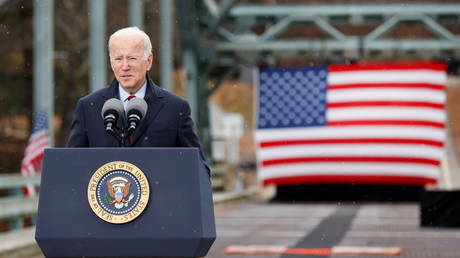
US President Joe Biden speaks in Woodstock, New Hampshire, November 16, 2021.
Biden reveals US Taiwan policy after call with Xi

During the event, the Taiwanese president praised America for remaining steadfast in its cooperation with the island despite opposition from China. “As long as we adhere to the values of democracy and freedom, there will be more like-minded countries standing on the same front with us,” Tsai said alongside US diplomat Sandra Oudkirk.

In 2019, after the US and Taiwan agreed to upgrade the F-16 fighter jets, then-Foreign Ministry spokesperson Geng Shuang threatened to sanction American firms unless the deal was halted. Beijing opposed the military partnership between Taipei and Washington, DC, arguing that the sale violated international law, harmed relations between the countries, and breached the One China policy, which America recognizes.

Think your friends would be interested? Share this story!

find more fun & mates at SoShow now !

Sports goods retailer Decathlon has said it won’t be selling canoes in its stores in northern France anymore because the light vessels are increasingly being used by migrants trying to cross into England.

“Given the current context… the purchase of canoes will no longer be possible” in Decathlon stores in Calais and Grande-Synthe, outside Dunkirk, the French retailer announced.

The two cities overlook the Strait of Dover, which is the narrowest point in the English Channel. Thousands of migrants have been using this spot in recent years to try to make the dangerous 34-kilometer-long sea journey from France to the UK.A lot of canoes aren’t being purchased for their original sporting purpose, Decathlon complained.

Read more

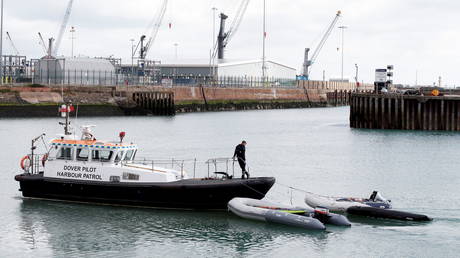
FILE PHOTO. ©REUTERS/Peter Cziborra
London & Paris trade barbs over Channel crossings

They “could be used to cross the Channel” and as a result of this, “people’s lives would be endangered,” it pointed out.

“We are committed to never putting our customers at risk in the use of our products, whatever the circumstances,” the company said. 

The initiative to remove canoes from the shelves came from the stores themselves and was backed by the head office, according to the retailer. However, Decathlon will keep selling the vessels online and in its other shops across France.

Last Thursday, two canoes were found adrift in the Channel near Calais, while two migrants were rescued from the water. The next day, three more people were reported missing after attempting to get to England using canoes.

Tensions between London and Paris are high after a record number of migrants – 1,185 – were able to cross the Channel a week ago. 

Britain said it was unacceptable” that France had let so many people slip through, but the French government insisted they were “neither their collaborators nor their assistants” and blamed the soaring crossings on the smugglers and the UK’s labor market, which makes the country attractive to people eager to work at low cost.”

Like this story? Share it with a friend!

find more fun & mates at SoShow now !

UK Home Secretary Priti Patel has acted to proscribe the Palestinian group Hamas “in its entirety,” stating that it has significant capacity to carry out terrorist acts and has facilities to train attackers.

In a tweet on Friday, Patel stated that she had banned the Palestinian group Hamas and designated it a terrorist organization, as she reiterated the British government’s commitment to “tackling extremism and terrorism wherever it occurs.”

Read more

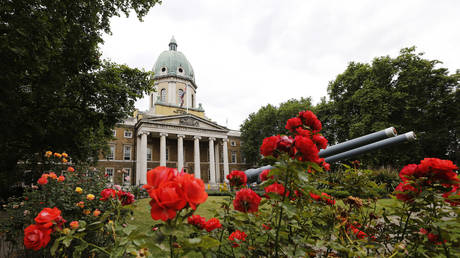
The Imperial War Museum (FILE PHOTO) © REUTERS/Suzanne Plunkett
Woke rap after moment of silence lands museum in trouble

“Hamas has significant terrorist capability, including access to extensive and sophisticated weaponry, as well as terrorist training facilities,” she wrote.  

The home secretary’s tweet came during her visit to Washington and followed speculation on Friday morning that she was soon to outlaw the group.

Pre-empting Patel’s announcement, Israeli Prime Minister Naftali Bennett welcomed Britain’s intention” on Twitter.

“Hamas is a radical Islamic group that targets innocent Israelis & seeks Israel’s destruction. I welcome the UK’s intention to declare Hamas a terrorist organization in its entirety – because that’s exactly what it is,” Bennett wrote, thanking the leadership of Prime Minister Boris Johnson.  

Yair Lapid, Israel’s foreign minister, also hailed the expected move against Hamas, saying it was part of strengthening ties with Britain.” 

Until now, only Hamas’ military wing, the Izz al-Din al-Qassam Brigades, had been outlawed by the British government. The EU and the US have already proscribed all of Hamas.

Hamas political official Sami Abu Zuhri rejected Britain’s move, claiming it showed absolute bias toward the Israeli occupation and is a submission to Israeli blackmail and dictations.” 

In a separate statement, the group claimed it had a right to resist occupation by all available means, “including armed resistance.”

Hamas seized total control of Gaza in 2007, on the back of an election victory in 2006.

If you like this story, share it with a friend!

find more fun & mates at SoShow now !

CIPHER BRIEF EXPERT PERSPECTIVE 

Cipher Brief Expert Tim Willasey-Wilsey served for over 27 years in the British Foreign and Commonwealth Office. He is now Visiting Professor of War Studies at King’s College, London.

Older Americans have Saigon 1975 and the helicopters from the Embassy roof seared into their memories. A previous generation of Britons was haunted by the image of General Percival surrendering vast numbers of troops and equipment in Singapore to the Japanese in 1942. How Kabul falls to the Taliban could have important practical and symbolic significance.

The announcement that the United States is sending 3,000 troops to Kabul alongside 600 British troops to manage the evacuation of their civilians and those Afghans who provided assistance, is a remarkably late response to a rapidly deteriorating situation. Unless carried out in the next 48 hours, it will also be risky. Taliban infiltrators are already inside Kabul and the forces which captured Ghazni and Kandahar on 12th August will be heading towards the capital on their Honda 125cc motorbikes.

The US must have extracted undertakings from the Taliban negotiators in Qatar not to launch their full assault on Kabul until the evacuations are complete, but elements of doubt remain. Previous Taliban assurances have proved worthless, and it is doubtful that individual Taliban commanders would wish to hold back while some of Ashraf Ghani’s ministers, senior army officers, judges and officials are spirited away to a life of exile.

It is hard not to be impressed by the speed and élan of the Taliban’s recent successes; taking 13 of Afghanistan’s 34 regional capitals in almost as many days. It is reminiscent of the extraordinary progress which the Japanese made down the Malaya Peninsula in 1942 with Singapore as the ultimate prize.

The Taliban’s success has not happened by chance. It is clearly the fruit of preparation and planning. Above all, they have learnt from the experience of 1994 to 1996 when they eventually took Kabul but failed to capture the north, thereby allowing space for the Northern Alliance parties to survive and then reassert themselves following the 9/11 terrorist attacks.

This time, the Taliban have focussed first on border posts with neighbouring countries (thereby denying the government vital supply routes and customs revenues) before taking outlying regional capitals and leaving Kabul (which is never easy to capture) until last. Above all, they have concentrated on the north where many rural Afghans are disenchanted with the Kabul government and regional warlords. The north is no longer the solid bastion of anti-Taliban sentiment it was in the 1990s.


The Cipher Brief hosts private briefings with the world’s most experienced national and global security experts.  Become a member today.


Taliban progress in the north has snuffed out any chance that the old Northern Alliance could be reborn out of the eventual collapse of the Ashraf Ghani government. Whereas in 1996, Ahmed Shah Massoud, its brilliant military leader, was able to abandon Kabul and beat a tactical retreat up the Panjshir Valley, that option barely exists today. Not only is Massoud dead but his former adherents are no longer guerrilla fighters but members of a stratified Afghan army which has struggled to perform without US air support.

The Taliban have also ruthlessly exploited the weak negotiating stance of the United States and its chief negotiator Zalmay Khalilzad. Whereas some of the Taliban team in Doha, such as Mullah Barader, may indeed have been ‘moderates’ there was never any doubt that the Taliban movement wanted to see the total defeat of the Kabul government and the expulsion of Western forces. Pakistan too, may have occasionally considered some form of negotiated deal but ultimately the only sure way of keeping Indian influence out of Afghanistan (it believes) is a Taliban government.

The Afghan army (and in particular its impressive Special Forces) will now be assembling in Kabul and should be able to repel initial attempts to overrun the city. Certainly, Gulbuddin Hekmatyar found it impossible to take Kabul in 1992 and 1993 even with help from Pakistan, which, in frustration, switched support to the newly-created Taliban movement in late 1994.

But from 1992 to 1996 there were frequent deliveries of supplies to Massoud and his Northern Alliance defenders from Russia, Iran, and India. In 2021, the position is very different. Russia has already decided to “back the winner” and believes it has extracted promises from the Taliban not to export Islamism northwards into the Central Asian Republics (CARs). Iran too has channels to the Taliban and will be watching carefully for any return to the Taliban’s persecution of the Shia Hazaras. And India has already made contact with the Taliban in Doha in the hope that the Taliban in power will prevent Kashmiri militant groups from setting up bases there.

The likelihood therefore is that Kabul will fall to the Taliban quite quickly. If the Americans and British do manage to insert their evacuation forces soon, they should be able to complete the operation successfully, although there are likely to be heart-rending scenes at the airport as crowds of refugees are turned away at gunpoint from departing aircraft. Regional powers, particularly Pakistan, will try and persuade the Taliban to hold back from intervening, conscious that a bloodbath in Kabul would be a disastrous start to the Taliban’s second spell in government. Ironically, however, the evacuation would almost certainly lead to the collapse of the Kabul government as senior officials are forced to decide whether to take the last aircraft out or face almost certain torture and death at the hands of the victors. It is doubtful whether any Western countries will choose to retain their embassies in Kabul. For President Biden, the memory of Benghazi will be too raw.

What is certain is that there will be new iconic images to rival those of Saigon and Singapore.


Go beyond the headlines with expert perspectives on today’s news with The Cipher Brief’s Daily Open-Source Podcast.  Listen here or wherever you listen to podcasts.


Read more expert-driven national security insights, perspective and analysis in The Cipher Brief.

The post How Does Kabul End? appeared first on The Cipher Brief.

find more fun & mates at SoShow now !

Hospitals in the Netherlands have begun delaying certain operations to free-up ICU beds during a record wave of Covid-19 infections, while an infectious diseases researcher has warned of an impending ‘Code Black’ in the sector.

The country set a daily national record for new Covid infections on Thursday, registering around 23,600 cases. It was the third day in a row of the figure topping 20,000.

To make more staff available for Covid wards, a number of operations, including those for cancer and heart patients, are being canceled from this week on, Dutch healthcare officials have said. Fewer than 200 beds remained available in Dutch ICUs as of Thursday, while Friday figures show almost half (47.8%) of occupied ICU beds were being used by Covid patients.

Read more

FILE PHOTO. A woman wearing a protective mask walks past a store in Amsterdam, Netherlands.
Netherlands re-introduces facemasks & other restrictions as Covid-19 cases surge

“These are cancer patients that should actually be operated-on within six weeks of diagnosis, and that won’t be met in all cases. It’s also heart patients,” said a spokesperson for the National Coordination Center for Patient Distribution (LCPS).

Meanwhile, new calculations by an infectious disease modeller at Wageningen University & Research suggest that a so-called ‘Code Black’ in hospitals is looming. The emergency designation means that patient safety is at risk and, if declared, would mean many people with life-threatening illnesses cannot go to the ICU, while doctors have to prioritize who to treat.

According to recent estimates from the Dutch Healthcare Authority (NZa), up to 200,000 operations were not performed as a result of urgently needed Covid care since the start of the pandemic. On Thursday, the NZa revealed that almost a quarter of operating rooms across the country are not currently in use due to a combination of Covid patient pressures and rising staff absences due to illness.

It is not yet clear what impact the delayed care will have on public health. In December 2020, the Dutch National Institute for Public Health and the Environment (RIVM) calculated that an estimated 34,000 to 50,000 ‘healthy life years’ had been lost due to the first Covid-19 wave alone.

Think your friends would be interested? Share this story!

find more fun & mates at SoShow now !
Israeli and UAE defense suppliers have agreed to jointly develop unmanned vessels that can be tailored for a range of military roles, including anti-sub warfare. The move comes after the two countries held naval drills last week.

Emirati state-owned weapons maker EDGE group and the government-run Israel Aerospace Industries (IAI) announced the partnership in Dubai on Thursday. In a joint statement, the firms said they would design the 170 m-USV (modular-unmanned surface vessels) series for both military and commercial applications.

The vessels, which can apparently operate remotely or with partial and complete autonomy, are expected to be used for “maritime security operations,” intelligence-gathering, surveillance, detecting and countering submarines and mines, and as a deployment platform for vertical take-off and landing (VTOL) aircraft such as helicopters and certain types of drones.

Read more

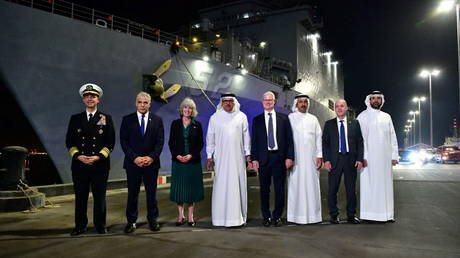
FILE PHOTO: Israeli Foreign Minister Yair Lapid, US Navy Vice Admiral Brad Cooper and Bahrain's Foreign Minister Abdullatif Al-Zayani at the US 5th Fleet base in Bahrain on September 30, 2021. © Israel Ministry of Foreign Affairs/Handout via REUTERS
Israel holds first navy drills with ‘frenemies’ from Persian Gulf

For commercial use, the manufacturers noted that they can be customized to serve in a variety of roles, including oceanography, pollution monitoring, oil and gas exploration, transportation, search and rescue, firefighting, and first interventions.

While not specifying the sources and amount of the project’s funding, or when production would begin, EDGE Chief Executive Faisal Al Bannai described the deal as an “important milestone” that would “open many doors” for the company in “local and global markets, military and commercial alike.”

According to the statement, the EDGE-owned Abu Dhabi Ship Building (ADSB) will design the vessel and integrate the platform’s control systems and payload. IAI will develop the autonomous control systems and provide various mission-requirement payloads to the control system units.

In March, the two companies had partnered up to develop an autonomous drone defense system to “detect, identify and intercept a broad range of threats.”

Last week, the UAE and Bahrain conducted their first-ever joint maritime drill with Israel’s navy. The US Fifth Fleet also participated in the five-day show of force in the Red Sea, which was reported by Israeli media outlets as sending a message to Iran.

The naval exercises came a little more than a year after Israel and the UAE established diplomatic ties in normalization agreements brokered by the Trump administration. The Abraham Accords broke decades of Arab consensus to not formally recognize Israel until the issue of a Palestinian state was settled.

If you like this story, share it with a friend!

find more fun & mates at SoShow now !
Behind the Headlines brings you expert perspectives on today’s headlines by telling you more than what happened, but also what it means.  You can also listen to The Cipher Brief’s Daily Open-Source Collection Podcast wherever you listen to podcasts.

Jack Devine, Former Acting Director, National Clandestine Service, CIA

Cipher Brief Expert Jack Devine, a 32-year CIA veteran. Devine served as both Acting Director and Associate Director of CIA’s operations from 1993-1995.  He is a founding partner and President of The Arkin Group, which specializes in international crisis management, strategic intelligence and investigative research. Devine is the author of Spymaster’s Prism: The Fight Against Russian Aggression.

Russia’s multi-pronged support of Myanmar is a microcosm of its strategy in Southeast Asia.

In the months since Myanmar’s February military coup, Russia and China have been the junta’s most powerful allies, but Russia has exploited regional instability to position itself as a third path between China and the West. While China was closer with the former Myanmar government than the military, it was also concerned about the government’s ties with the West and potential interference in its development efforts, particularly its Belt and Road Initiative. Russia, on the other hand, doesn’t depend on stability in Southeast Asia to the same degree as China and can instead take advantage of warring factions. Last month, on his first trip outside of the immediate region since February, Myanmar’s junta leader Min Aung Hlaing went to Moscow to meet with high-level Russian defense officials instead of heading to Beijing. Hlaing has reportedly visited Russia seven times within the past decade and previously stated that over 6,000 Myanmar officers have studied at Russian military academies. According to data from the Stockholm International Peace Research Institute (SIPRI), Russia was responsible for almost 40% of arms sales to Myanmar from 1999-2018, second only to China. SIPRI data further indicates that Russia has been Southeast Asia’s largest arms supplier over the past two decades, counting Vietnam and Laos as top customers. But Russia is offering the region more than arms and has promised Myanmar two million Covid-19 vaccines and assistance in the nation’s own vaccine production efforts. Russia has also been trying to expand free trade agreements between its Eurasian Economic Union (EAEU) and Southeast Asian countries, most recently getting Indonesia to sign on to the deal. Stepping even further into soft power efforts, last week Russia’s foreign minister met with his Bangladeshi counterpart and agreed to encourage Myanmar to engage in dialogue with Bangladesh on the Rohingya crisis.


Get your free daily Open-Source Collection report in The Cipher Brief newsletter or take it on the go as a podcast.  Listen here or wherever you listen to podcasts.


Leftist, former schoolteacher Pedro Castillo is declared President of a divided Peru, projected economic growth could play in his favor. 

Peru, like many of its neighbors, has been battling the triple and interwoven threat of Covid-19, social unrest, and severe economic downturn. But for the past several years Peru has also been challenged by sharp divisions between its executive and legislative powers. Last November, Peru’s unicameral legislature voted to impeach then-President Martín Vizcarra, citing mismanagement of the pandemic and corruption, in a move that outraged thousands. The June presidential elections were likewise fraught. Castillo’s right-wing rival Keiko Fujimori, who is also under investigation for corruption, alleged electoral fraud and the Peruvians initiated a six-week long investigation, eventually finding Castillo the rightful victor. The EU, U.S. and 14 electoral missions deemed the elections legitimate, and the U.S. called the election a “model of democracy” for the region. Castillo, who previously worked as an elementary school teacher and has never held public office, will be greeted by a political establishment that is almost entirely against him. Peruvian citizens are also deeply divided, and many urban elites reportedly moved their money overseas out of fear for Castillo’s economic policies. But Castillo’s Peru Libre party holds fewer than 40 of 130 seats in the legislature and Castillo has already recruited several moderate advisors. Further, he has backed away from talk of nationalizing Peru’s lucrative multinational mining, oil, gas, and hydrocarbon companies, instead pledging to raise taxes on mining firms. Prices of copper and gold, two of Peru’s most critical exports, remain high and Covid-related trade obstacles are expected to ease over the coming months. While it is uncertain how effective Castillo will be, or where he will ultimately fall on his policies, positive projections for Peru’s export-based economy will likely play in his favor.


The Cipher Brief hosts private briefings with the world’s most experienced national and global security experts.  Become a member today.


Enjin becomes first blockchain platform to gain acceptance into the United Nations Global Compact, signaling widespread range of corporate sustainability efforts.

On Tuesday, Enjin, an innovative blockchain technology company focused on non-fungible tokens (NFTs), became the first such company to join the United Nations Global Compact. Upon admission, Enjin stated that it hopes to use NFTs to promote sustainability and equality in line with the UN pact that encourages businesses and firms worldwide to adopt more environmentally friendly and socially responsible practices. NFTs have surged in popularity in the past two years, and during the first quarter of 2021 NFT sales reportedly exceeded US $2 billion. In essence, an NFT is a way to prove ownership of a unique virtual item. It’s a unit of data that’s stored on a blockchain, or digital ledger, that certifies exclusive ownership of digital files ranging from photos to sports trading cards. Enjin, which is headquartered in Singapore, has focused its NFT efforts on games and apps and is reportedly able to operate with a lower carbon footprint than Bitcoin due to a slimmed-down verification model that requires less energy. This week, the UN Global Compact not only included Enjin as a member, but gave the company its highest membership rank, sending a signal that it’s interested in promoting such an environmental effort by crypto and blockchain entrepreneurs. For its part, Enjin has stated that it wants to employ the technology in carbon capture companies, fighting climate change in the process. The Head of the UN AI and Robotics Center remarked that during the global struggle to recover from the pandemic we should take advantage of new technologies like AI and blockchain to better equip ourselves for the future.

Read more expert-driven national security insights, perspective and analysis in The Cipher Brief


The post Behind the Headlines: Russia in Myanmar, Peru’s New President and what Enjin means for the United Nations Global Compact appeared first on The Cipher Brief.

find more fun & mates at SoShow now !