Apple has finally caved to users demanding the ‘right to repair’, allowing owners of iPhones, MacBooks, and other devices to tinker with their electronics at home instead of bringing them to notoriously expensive service centers.
Called Self Service Repair, the feature is set to launch “early next year” in the US before expanding to other countries. Some 200 parts are expected to be available, along with instructions on how to replace them.
Initially, the company will offer repairs for the iPhone 12 and 13, to be followed by Macs with M1 chips. Users will be able to replace the phones’ display, battery, and camera – some of the earliest parts to cease functioning – using original equipment from the company. While Apple encourages only “individual technicians with the knowledge and experience to repair electronic devices,” urging users to take their devices to a professional before cracking them open themselves, the move nevertheless represents a major step for a company that has long been resistant to allowing users to even swap out a battery.
After rolling out repair instructions and parts for the iPhone 12 and 13, the company will gradually expand users’ abilities to fix their phones themselves without having to wait in line at the Apple Store. Users who attempt to make these repairs on their own will not void their warranty, according to TechCrunch, representing another major change for the tech giant.
Even this week, Apple was sealing off users’ ability to fix their own phones, barring users who replaced their own screens from being able to use Face ID recognition going forward. However, the various departments seem to be coordinating among themselves – users will receive a recycling credit for returning their used or broken part after completing the repair, and the company plans to sell “more than 200 individual parts and tools,” as well as repair manuals customers can peruse before attempting to repair their devices.
The decision to open up Apple’s “right to repair” might not have been entirely that of the company – the Federal Trade Commission wrote to the corporation earlier this year vowing to “address unlawful repair restrictions,” adding it would also “stand ready to work with legislators, either at the state or federal level, in order to ensure that consumers have choices when they need to repair products that they purchase and own.”
The number of musk deer in Mongolia has plummeted by some 83 per cent since the 1970s, landing them on the country’s red list of critically endangered species. A UN-supported biodiversity initiative is helping to stop the deer from disappearing altogether.
Once you’ve reached optimal cat lady status, there comes a time in your life where you think it’s necessary to start massaging your cat’s head. Luckily, someone has already created a cat head massager, and it is most likely the most specific niche product you could think of. You can get it on Amazon or AliExpress.
If your cat didn’t love you before, rest assured he will love you now. Your cat will be so thankful for the head massage that he might even ignore you for less time throughout the day, and if you’re really lucky, your cat may even acknowledge your existence. …Or you can use it on yourself if you have a particularly small head.
In case you feel like you should have this thing in your (and your cat’s) life, you can get it on Amazon or AliExpress.
Carving the turkey for Thanksgiving is a true honor for any man, and should be taken extremely seriously. Assuming you have no backup turkey, you have one opportunity to slice and carve it just perfectly, or your reputation with your family with be tainted forever. What better way to ensure you carve your Thanksgiving turkey properly and in the most manly way possible than with a chainsaw carving tool?
The electric chainsaw turkey carving tool looks and acts like a real chainsaw, except it won’t actually cut wood, and it’s a much smaller version of its larger counterpart. Though a chain doesn’t wrap around the blade and spin like a real chainsaw, a small electric knife is on the bottom of the blade to make it look like it’s working like a real chainsaw.
Made with stainless steel cutting blades along with an ABS plastic body, the chainsaw inspired turkey carving tool is not only great for cutting turkeys and other birds, but is also useful for cutting melons, pineapples, potatoes, breads, and more.
For the first time since the start of the pandemic, the number of new daily Covid cases in Germany has exceeded 60,000, according to the country’s disease control and prevention agency, the Robert Koch Institute.
Authorities fear that in reality the figure is even higher, as not all cases are immediately reported or detected. Just a week ago, the number of daily infections across Germany surpassed the 50,000 mark.
Among the country’s Covid hotspots are Thuringia, Saxony and Bavaria. In the latter region, hospitals are so overwhelmed with Covid patients that they have had to put off any non-emergency surgery.
Against this grim backdrop, lawmakers in the Bundestag on Thursday backed a new set of measures aimed at containing the spread of the disease. The package was proposed by Germany’s Social Democrats, the Green and Free Democratic parties, which are expected to form a new coalition government as early as next week.
If passed by the upper house, the rules would include mandatory daily Covid testing for employees of, and visitors to, care homes, regardless of vaccination status. Germans would also be required to show proof of full vaccination, recovery or a fresh negative Covid test in order to enter their workplace or use public transport.
On top of that, those caught selling and forging fake certificates and tests could face up to five years behind bars. Just like the Covid regulations currently in place, the new plan gives some leeway to regional authorities in terms of restrictions so that, for instance, the banning of recreational, cultural, and sporting events will be at their discretion. However, things like travel bans, curfews and massive closures of businesses would now be off-limits to local government.
Those making and knowingly using fake vaccination certificates in Germany could soon face up to five years behind bars, as the country’s likely future coalition government is looking to tighten the screws.
Coming under the same category are also fake test results and Covid recovery certificates, with similar penalties for the counterfeiters and the holders. Everything envisaged in the new guidelines was drafted by the Social Democrats, along with the Free Democratic and Green Parties. The three are currently in coalition talks and expected to form a new government as early as next week.
The German Parliament will decide on the regulations this Thursday, though a draft has already been seen by the media outlet DPA.
According to German media, the manufacturing and sale of fake certificates has become a booming black-market industry in the country. In just one such case reported by Der Spiegel in late October, a counterfeiter working at a pharmacy in Munich and her accomplice had churned out more than 500 fake digital certificates in the span of one month, raking in €350 for each one sold.
Meanwhile, Berlin authorities are planning to further ramp up restrictions in the city, where, starting Monday, having either a vaccination or recovery certificate is a must to enter restaurants, cinemas, theaters, museums, galleries, swimming pools, gyms, as well as hairdressers and beauty salons. On Tuesday, Berlin Mayor Michael Müller confirmed that authorities want to “have an additional instrument” to contain the spread of the virus. However, he declined to elaborate on what the new measures will be. Local media speculate that starting next week, in addition to the requirement to have a vaccination or recovery certificate to enter public places, people inside the venues will also need to practice social distancing and wear a mask, or have a recent negative test result.
This comes after Covid-19 numbers in Berlin hit an all-time high last Thursday, with 2,874 new cases reported that day.
Think your friends would be interested? Share this story!
Greece will soon prohibit unvaccinated residents from entering a litany of public spaces, the country’s prime minister has announced, claiming its current Covid outbreak is largely fueled by those who haven’t received the jab.
Starting next week, the unvaccinated will be barred from entry to restaurants, cafes, theaters, bars, gyms and museums, among other indoor public places, PM Kyriakos Mitsotakis said on Thursday, noting that a negative Covid-19 test will no longer be accepted as an alternative to proof of vaccination.
“This is indeed a pandemic of the unvaccinated,” he said as he announced the move in a televised address, adding “Greece is mourning unnecessary losses because it simply does not have the vaccination rates of other European countries.”
The new rules are set to take effect on Monday, and will require Greeks to present vaccine certificates to businesses and other indoor establishments to be allowed inside. Those attending religious services mark a rare exception, however, as they will only be asked to present a negative test in order to enter a church or other place of worship.
In a bid to encourage booster vaccinations among the elderly – a population much more vulnerable to Covid-19 – citizens over the age of 60 will be made to renew their certificate after a period of seven months.
While officials had hoped to hit a full vaccination figure of 70% for Greece’s population of 11 million by autumn, the number currently stands at about 62%, according to Reuters. As its weekly case counts continue to soar to record highs, the country reported 7,317 new Covid-19 infections and 63 deaths on Thursday, bringing the totals to more than 860,000 cases and some 17,000 fatalities since the pandemic kicked off in late 2019.
The new restrictions in Greece mirror similar policies implemented elsewhere in Europe, with Austria, Germany, Italy, France, the Czech Republic and Slovakia each imposing limits on public life for the unvaccinated. Though the Austrian government recently imposed a full lockdown for millions of residents who have not received the shot, some officials in that country are pushing for even harsher policies, including a national stay-at-home order on the jabbed and non-jabbed alike.
Think your friends would be interested? Share this story!
Libyan military commander Khalifa Haftar is set to challenge Gaddafi’s son for the top job, announcing his presidential bid. The election will take place on December 24.
“I declare my candidacy for the presidential election, not because I am chasing power but because I want to lead our people towards glory, progress and prosperity,” the de facto leader of Eastern Libya said in a televised speech.
Haftar added that the election is the only way out of the severe crisis the country has been plunged into.
The announcement was expected; in September, Haftar announced that he was temporarily stepping down as head of the force known as the Libyan National Army, fulfilling the requirement for presidential hopefuls to suspend public work three months before an election.
Haftar will run against the son of former leader Muammar Gaddafi, Saif al-Islam Gaddafi, who represents the Popular Front for the Liberation of Libya.
Haftar’s presidential bid is likely to anger many who consider him a war criminal responsible for the indiscriminate killing of civilians during his military campaign. A number of civil lawsuits have been filed against him in a US federal court for alleged war crimes. Haftar has both US and Libyan citizenship, and owns property in Virginia.
Following years of civil war and political chaos after the NATO-backed intervention that saw Muammar Gaddafi deposed and brutally murdered, the upcoming election is widely viewed as an opportunity for political settlement and the long-awaited unification of the country, divided now between Haftar’s forces and the Tripoli-based Government of National Accord. However, there is still no consensus on the legal grounds for the election, which could become an obstacle for the peace process.
Any apology for Nazism is unacceptable, Colombia’s president Ivan Duque has insisted, after photos of police academy cadets dressed up in Third Reich uniforms were uploaded online, causing outrage.
“Any apology for Nazism is unacceptable,” Duque stated in a tweet on Friday. The president said he condemned any references to those who were “responsible for the Jewish Holocaust that claimed the lives of more than 6 million people,” adding that “anti-Semitism has no place in the world.”
Policía colombiana homenajea a Alemania con una fiesta ‘nazi’
Indignación en Colombia por la fiesta que organizó un grupo de estudiantes de la Escuela de Policía Simón Bolívar en Tuluá, en la que varios uniformados recrearon escenas alusivas a la Alemania nazi pic.twitter.com/UnF4ajUd8z
Duque had earlier made demands for “heads to roll” at an academy that “promotes such criminal practices,” with its director, Lieutenant Colonel Jorge Ferney Bayona Sanchez, already having been sacked.
Toda una polémica ha provocado el evento realizado en las últimas horas en la escuela de Policía Simón Bolívar de Tuluá. Los uniformados se disfrazaron de Adolf Hitler, haciendo alusión al nazismo durante la semana de la internacionalización. #VocesySonidospic.twitter.com/EoS4JqvzrC
Colombia’s defense ministry, which oversees the country’s police, also insisted in a statement that that its training programs “don’t envisage in any way an activity such as the one which took place” at the academy.
The images of police cadets in Nazi uniforms caused anger and bewilderment among internet users.
The German and Israeli embassies in the country reacted by issuing a joint statement, in which they expressed “total rejection of any form of apology or demonstration of Nazism.” The US embassy in Bogota also said that it was “shocked and deeply disappointed” by the development.
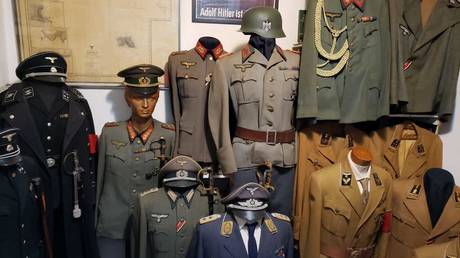
The controversial images, in which aspiring officers were caught sporting black SS outfits with red swastika armbands and grey Wehrmacht uniforms from the World War II era, weren’t revealed in some bombshell media report, but were actually published on the official Twitter account of the Colombian police this Thursday.
The photos were taken as part of a “cultural exchange” event at the police academy in the city of Tulua, aimed at commemorating Germany and “strengthening the knowledge of our police students.” The cosplay was apparently intended to illustrate the history of German law enforcement, with more cadets pictured wearing more modern versions of the country’s police uniforms in the pictures.
France has imposed a curfew on its overseas territory of Guadeloupe and is sending extra police to the island, citing days of “violence,” unrest and vandalism in response to harsh pandemic restrictions.
“Given the ongoing social unrest and acts of vandalism, the prefect of Guadeloupe has decided to establish a curfew starting today from 6pm to 5am,” Alexandre Rochatte, who represents the archipelago as prefect, said on Friday.
Earlier on Friday, the French Interior Ministry noted that 200 French police officers and gendarmes would be shipped into Guadeloupe in the coming days to crack down on the “violence” and “restore republican order.”
The move comes after nearly a week of heated protests over local Covid-19 policies – which include mandatory vaccinations for healthcare staff and other ‘essential’ workers, among other things. Demonstrators have torched cars and erected burning barricades in the streets, while doctors, firefighters and other professionals have walked off their jobs in protest, according to Reuters.
Barrages incendiées et affront*ments cette nuit en #Guadeloupe où la grève générale illimitée, enclenchée contre le pass sanitaire et l’obligation vaccinale exprime désormais une colère plus large contre les problématiques sociales, économiques et environnementales de l’île. pic.twitter.com/gXToww1gXZ
In footage circulating online earlier this week, men purported to be protesting firefighters were seen soaking police with a water hose hooked up to a nearby fire hydrant. Officers quickly shut off the spigot.
A firefighter sprinkles the gendarmes during the evacuation of a dam in #Guadeloupe where an unlimited general strike began today against the health pass and compulsory vaccination under penalty of suspension but also to denounce other problems of the territory . pic.twitter.com/lDtDkMx4YZ
As in mainland France, residents are also required to present proof of vaccination, a negative PCR test or show they recently recovered from the virus in order to enter a number of public establishments, including restaurants and museums.
Those policies have proven unpopular for many locals, with trade unions launching indefinite strikes in protest over the past week, joined by other residents in street demonstrations.