EXPERT OPINION — More than 200 U.S. officers have been hunted around the globe and targeted by an adversary using a mysterious weapon that causes permanent brain injury. It’s time to get serious about fighting back.

The Authors:

Paul Kolbe served for 25 years in the CIA’s Directorate of Operations. He is currently Director of the Intelligence Project at Harvard Kennedy School’s Belfer Center for Science and International Affairs.

Marc Polymeropoulos worked for the CIA for 26 years. He is author of “Clarity in Crisis: Leadership Lessons from the CIA.

John Sipher worked for the CIA’s clandestine service for 28 years. He is now a nonresident senior fellow at the Atlantic Council and a co-founder of Spycraft Entertainment.

Prior to 9/11, al Qaida declared war on the United States, bombed the USS Cole, and blew up U.S. embassies in Nairobi and Dar es Salam. Despite heavy casualties, America viewed successive al Qaida terrorist attacks as somehow unique, not representative of a larger threat or state of war. We went about our business and failed to take hard action against al Qaida despite clear warning. Our failure to respond forcefully led to 9/11 and the two decades of war that followed.

Fast forward to today.  Since 2016, more than 200 U.S. officials have reportedly suffered from a mysterious series of symptoms which have caused long-lasting, debilitating injuries. Suffering from searing headaches, vertigo, vision impairment, and nausea, many victims have been formally diagnosed with traumatic brain injuries (TBI) at the Walter Reed National Military Medical Center and other leading hospitals. Family members and young children have suffered as well. Some medical tests can now confirm the markers of brain injury, similar to those suffered by victims of concussive injuries in Iraq and Afghanistan.

These injuries began with a cluster of reports from Cuba in 2016 and have become commonly referred to as Havana Syndrome. Moscow, Vienna, Belgrade, and Hanoi are among more than a dozen cities where U.S. officials reportedly have been attacked and injured. In residences, on the street, in vehicles, and even at secure U.S. facilities, U.S. officers are being hunted. Stunningly, even a close aide to CIA Director Bill Burns was reportedly attacked on a trip to India just this past August.

The CIA, after a period of confusion, delay, and even denial at times, now appears to take these threats very seriously. CIA Director Burns and Deputy Director David Cohen have publicly stated that U.S. officials are being “attacked.” They have improved health care for CIA officers who are hurt. And an agency task force is hard at work trying to obtain additional intelligence on those responsible. We credit Director Burns for his solid leadership.

The cause of these injuries? The National Academy of Sciences has pointed to Directed Energy Weapons – devices which emit microwave pulses which can inflict pain and damage tissue. The United States, Russia, China, and others have all developed Directed Energy Weapons to destroy equipment, counter drones, and control crowds. This is not science fiction.

Directed energy weapons would account for the highly directional and locational nature of these incidents. When victims can “move off the x,” the signature sounds, sensations, and pain that goes with the attacks often stop, though damage has already occurred. The amount of exposure seems to affect the degree of injury. Other technologies could be at play and are being investigated, but microwaves appear to be the most likely vector. Russia has used them before, flooding the U.S. Embassy in Moscow with microwave radiation for decades.

Regardless of form, the weapons being used in these attacks are nothing less than weapons of terror, designed to cause injury to non-combatants. Who would use such a weapon to attack U.S. intelligence officers, diplomats, and military personnel, and to what conceivable end?


The Cipher Brief hosts private briefings with the world’s most experienced national and global security experts.  Become a member today.


CIA Deputy Director Cohen stated at a recent intelligence summit, that the U.S. was closer to identifying the culprit, and Politico has reported that members of the Senate Intelligence Committee are increasingly convinced that Russia or another hostile adversary is behind the attack, although reportedly, no smoking gun has been found.

As former CIA operations officers with extensive experience dealing with both counterterrorism and counterintelligence issues, we have few doubts about who will be named as the culprit. For at least a decade, Russia has conducted itself as in a state of conflict with the West in general and the United States in particular. Russia has launched cyberattacks impacting critical infrastructure and supply chains, assassinated opponents with nuclear poisons and chemical weapons, gunned down people in the streets using criminal proxies, sabotaged a Czech ammunition depot, and mounted a violent coup attempt in Montenegro. It has also bombarded the U.S. embassy in Moscow with microwave radiation and used carcinogenic “spy dust” without regard to health effects. The attacks on U.S. officials would fit this pattern of behavior.

We recognize that it is important to let the intelligence community do its job and its findings must inform policy action. Congress and the administration must work together to formulate a range of possible responses and it is not too early to begin. As Senator Collins and others have stated, these attacks are “an act of war,” and as such, preparation for a future attribution call by the national security establishment is in order. So how could the U.S. respond?

Let’s start with what doesn’t work – sanctions. Sanctions feel good and satisfy an action imperative but they are feckless. Sanctions have not stopped Russia from killing dissidents, halted the Nordstream II pipeline, compelled a pull back from occupied territories, reduced support for tyrants, or hindered oil and gas production. Sanctions have simply forced Russia to develop more creative money laundering and sanction circumvention mechanisms.

So, what would work? For starters, we must understand that the Putin regime considers itself in a state of conflict with the U.S., short of war, but nonetheless deadly real. We are dealing with a state sponsor of terror which conducts operations across the globe to weaken the U.S. abroad, divide it from its allies, and sow discord at home. Our policy must be calibrated to win this conflict, without sparking a shooting war, but at risk of one.

Russia understands reciprocity and strength. When four Russian diplomats were kidnapped by extremists in Beirut in 1985, and one of them was killed, Russia reportedly responded by kidnapping and gruesomely killing a relative of the group’s leader. The surviving diplomats were released immediately. The story may be apocryphal, but it does illustrate the Russian approach. Tempting as it may be for America to retaliate tit for tat, we need not mirror Russia’s actions. Instead, we should play to our greater economic, diplomatic, and military advantages.

We offer five elements to frame a response: enlist U.S. allies, expand forward deterrence, limit the adversary’s reach, choke off money, and bring those accountable to justice.

NATO: With proof of the attacks on U.S. officials, we should activate NATO’s Article Five collective defense clause. The only other time this was enacted was after 9/11. As justification, in addition to the Havana Syndrome attacks, (which also caused Canadian casualties), we would include GRU and FSB assassination operations across Europe, deadly sabotage in the Czech Republic, a coup attempt in Montenegro, persistent cyberattacks, and a litany of other actions that can only be described as irregular warfare directed against NATO members.


Go beyond the headlines with expert perspectives on today’s news with The Cipher Brief’s Daily Open-Source Podcast.  Listen here or wherever you listen to podcasts.


Forward Presence: A crystal clear signal that we understand the nature of Russian hybrid warfare and are responding would be to enhance our deployed military presence in Poland, the Baltic States, and in the Black Sea region. These units would pose no offensive threat to Russia but would be a clear signal that the U.S. is prepared to counter any Russian shenanigans. We should also significantly ramp up our lethal aid and training to the Ukraine, where the nature of Russian aggression is well known. Weakness in Eastern Europe is an invitation to conflict.

Travel and Presence: We should drastically limit Russian business and tourist travel which is being used as cover for FSB and GRU operations. We would reduce Russian diplomatic presence in each capital to the bare minimum – handfuls not hundreds. American and European counterintelligence experts believe there are more Russian intelligence officers operating from embassies than during the Cold War. Limiting the size of Russia’s espionage infrastructure will complicate the planning and execution of all of its intelligence operations.

Finance: A key tool in counterterrorism operations is the ability to target sources of finance which constitute material support to terrorism. In this case, we would apply that principle to the Russian government, state enterprises, and individuals who provide cover, tools, and sources of funding to Russia’s campaign to undermine the West with violence, terror, and media manipulation. Russia’s dirty money has been used to undermine the west and poison our politics. We should limit the easy access of shady money to western banks.

Criminal Cases: We need bring war crime cases to the International Court of Justice (ICJ) in the Hague. Following a decade of conflict in the Balkans, the ICJ brought to justice 161 indicted Serbian, Croatian, and Bosnian war criminals. This was an astounding success – a manhunt which included American and European law enforcement and intelligence services. Just as in Nuremberg after World War II, these actions to hold war criminals accountable drew a line in the sand.

This is a start.  Successive Democratic and Republican administrations have pursued Russia policies which represent the triumph of hope over experience. We have treated the symptoms of malign Russian actions rather than the underlying pathology. It is now time to finally acknowledge that we are in a long-term hybrid conflict and forget the fantasy of changing Putin’s behavior. Only a new regime in the Kremlin would hold the hope of bringing about a change in actions. Eventually, the Putin regime will wither or collapse, but until it does, we and our allies must do a better job of defending ourselves.

Read more expert-driven national security insights, perspective and analysis in The Cipher Brief

The post Havana and the Global Hunt for U.S. Officers appeared first on The Cipher Brief.

find more fun & mates at SoShow now !

Corin Stone, Washington College of Law

Corin Stone is a Scholar-in-Residence and Adjunct Professor at the Washington College of Law.  Stone is on leave from the Office of the Director of National Intelligence (ODNI) where, until August 2020, she served as the Deputy Director of National Intelligence for Strategy & Engagement, leading Intelligence Community (IC) initiatives on artificial intelligence, among other key responsibilities. From 2014-2017, Ms. Stone served as the Executive Director of the National Security Agency (NSA).

(Editor’s Note: This article was first published by our friends at Just Security and is the third in a series that is diving into the foundational barriers to the broad integration of AI in the IC – culture, budget, acquisition, risk, and oversight.)

OPINION — As I have written earlier, there is widespread bipartisan support for radically improving the nation’s ability to take advantage of artificial intelligence (AI). For the Intelligence Community (IC), that means using AI to more quickly, easily, and accurately analyze increasing volumes of data to produce critical foreign intelligence that can warn of and help defuse national security threats, among other things. To do that, the IC will have to partner closely with the private sector, where significant AI development occurs. But despite the billions of dollars that may ultimately flow toward this goal, there are basic hurdles the IC still must overcome to successfully transition and integrate AI into the community at speed and scale.

Among the top hurdles are the U.S. government’s slow, inflexible, and complex budget and acquisition processes. The IC’s rigid budget process follows the standard three-year cycle for the government, which means it takes years to incorporate a new program and requires confident forecasting of the future. Once a program overcomes the necessary hurdles to be included in a budget, it must follow a complex sequence of regulations to issue and manage a contract for the actual goods or services needed. These budget and acquisition processes are often considered separately as they are distinct, but I treat them together because they are closely related and inextricably intertwined in terms of the government’s purchasing of technology.

Importantly, these processes were not intended to obstruct progress; they were designed to ensure cautious and responsible spending, and for good reason. Congress, with its power of the purse, and the Office of Management and Budget (OMB), as the executive branch’s chief budget authority, have the solemn duty to ensure wise and careful use of taxpayer dollars. And their roles in this regard are vital to the U.S. government’s ability to function.

Unfortunately, despite the best of intentions, as noted by some in Congress itself, the budget process has become so “cumbersome, frustrating, and ineffective” that it has weakened the power of the purse and Congress’ capacity to govern. And when complicated acquisition processes are layered on top of the budget process, the result is a spider web of confusion and difficulty for anyone trying to navigate them.

The Need for Speed … and Flexibility and Simplicity

As currently constructed, government budget and acquisition processes cause numerous inefficiencies for the purchase of AI capabilities, negatively impacting three critical areas in particular: speed, flexibility, and simplicity. When it comes to speed and flexibility, the following difficulties jump out:

  • The executive branch has a methodical and deliberate three-year budget cycle that calls for defined and steady requirements at the beginning of the cycle. Changing the requirements at any point along the way is difficult and time-consuming.
  • The IC’s budgeting processes require that IC spending fit into a series of discrete sequential steps, represented by budget categories like research, development, procurement, or sustainment. Funds are not quickly or easily spent across these categories.
  • Most appropriations expire at the end of each fiscal year, which means programs must develop early on, and precisely execute, detailed spending plans or lose the unspent funds at the end of one year.
  • Government agencies expend significant time creating detailed Statements of Work (SOWs) that describe contract requirements. Standard contract vehicles do not support evolving requirements, and companies are evaluated over the life of the contract based on strict compliance with the original SOW created years earlier.

These rules make sense in the abstract and result from well-intentioned attempts to buy down the risk of loss or failure and promote accountability and transparency. They require the customer to know with clarity and certainty the solution it seeks in advance of investment and they narrowly limit the customer’s ability to change the plan or hastily implement it. These rules are not unreasonably problematic for the purchase of items like satellites or airplanes, the requirements for which probably should not and will not significantly change over the course of many years.

However, because AI technology is still maturing and the capabilities themselves are always adapting, developing, and adding new functionality, the rules above have become major obstacles to the quick integration of AI across the IC. First, AI requirements defined with specificity years in advance of acquisition – whether in the budget or in a statement of work – are obsolete by the time the technology is delivered. Second, as AI evolves there is often not a clear delineation between research, development, procurement, and sustainment of the technology – it continuously flows back and forth across these categories in very compressed timelines. Third, it is difficult to predict the timing of AI breakthroughs, related new requirements, and funding impacts, so money might not be spent as quickly as expected and could be lost at the end of the fiscal year. Taken together, these processes are inefficient and disruptive, cause confusion and delay, and discourage engagement from small businesses, which have neither the time nor the resources to wait years to complete a contract or to navigate laborious, uncertain processes.


Engage personally with experts on Artificial Intelligence and national security  at The Cipher Brief Threat Conference October 24-26.  If you are an actively working in the national security field, we invite you to apply to attend.  Seats are limited.  


Simply put, modern practices for fielding AI have outpaced the IC’s decades-old approach to budgeting and acquisition. That AI solutions are constantly evolving, learning, and improving both undermines the IC’s ability to prescribe a specific solution and, in fact, incentivizes the IC to allow the solution to evolve with the technology. The lack of flexibility and speed in how the IC manages and spends money and acquires goods and services is a core problem when it comes to fully incorporating AI into the IC’s toolkit.

Even while we introduce more speed and agility into these processes, however, the government must continue to ensure careful, intentional, and appropriate spending of taxpayer dollars. The adoption of an IC risk framework and modest changes to congressional oversight engagements, which I address in upcoming articles, will help regulate these AI activities in the spirit of the original intent of the budget and acquisition rules.

As for the lack of simplicity, the individually complex budget and acquisition rules are together a labyrinth of requirements, regulations, and processes that even long-time professionals have trouble navigating. In addition:

  • There is no quick or simple way for practitioners to keep current with frequent changes in acquisition rules.
  • The IC has a distributed approach that allows each element to use its various acquisition authorities independently rather than cohesively, increasing confusion across agency lines.
  • Despite the many federal acquisition courses aimed at demystifying the process, there is little connection among educational programs, no clear path for IC officers to participate, and no reward for doing so.

The complexity of the budget and acquisition rules compounds the problems with speed and flexibility, and as more flexibility is introduced to support AI integration, it is even more critical that acquisition professionals be knowledgeable and comfortable with the tools and levers they must use to appropriately manage and oversee contracts.

Impactful Solutions: A Target Rich Environment

Many of these problems are not new; indeed, they have been highlighted and studied often over the past few years in an effort to enable the Department of Defense (DOD) and the IC to more quickly and easily take advantage of emerging technology. But to date, DOD has made only modest gains and the IC is even further behind. While there are hundreds of reforms that could ease these difficulties, narrowing and prioritizing proposed solutions will have a more immediate impact. Moreover, significant change is more likely to be broadly embraced if the IC first proves its ability to successfully implement needed reforms on a smaller scale. The following actions by the executive and legislative branches – some tactical and some strategic – would be powerful steps to ease and speed the transition of AI capabilities into the IC.

Statements of Objectives

A small but important first step to deal with the slow and rigid acquisition process is to encourage the use of Statements of Objectives (SOO) instead of SOWs, when appropriate. As mentioned, SOWs set forth defined project activities, deliverables, requirements, and timelines, which are used to measure contractor progress and success. SOWs make sense when the government understands with precision exactly what is needed from the contractor and how it should be achieved.

SOOs, on the other hand, are more appropriate when the strategic outcome and objectives are clear, but the steps to achieve them are less so. They describe “what” without dictating “how,” thereby encouraging and empowering industry to propose innovative solutions. SOOs also create clarity about what is important to the government, leading companies to focus less on aggressively low pricing of specific requirements and more on meeting the ultimate outcomes in creative ways that align with a company’s strengths. This approach requires knowledgeable acquisition officers as part of the government team, as described below, to ensure the contract includes reasonable milestones and decision points to keep the budget within acceptable levels.


The Cipher Brief hosts private briefings with the world’s most experienced national and global security experts.  Become a member today.


New Authorities for the IC

Two new authorities would help the IC speed and scale its use of AI capabilities: Other Transaction Authority (OTA)  and Commercial Solutions Openings (CSO). Other Transaction Authority allows specific types of transactions to be completed outside of the traditional federal laws and regulations that apply to standard government procurement contracts, providing significantly more speed, flexibility, and accessibility than traditional contracts. While OTA is limited in scope and not a silver bullet for all acquisition problems, OTA has been used to good effect since 1990 by the Defense Advanced Research Projects Activity (DARPA), DOD’s over-the-horizon research and development organization, among others.

CSOs are a simplified and relatively quick solicitation method to award firm fixed price contracts up to $100 million. CSOs can be used to acquire innovative commercial items, technologies, or services that close capability gaps or provide technological advances through an open call for proposals that provide offerors the opportunity to respond with technical solutions of their own choosing to a broadly defined area of government interest. CSOs are considered competitively awarded regardless of how many offerors respond.

Both OTA and CSO authority should be immediately granted to the IC to improve the speed and flexibility with which the IC can acquire and transition AI into the IC.

Unclassified Sandbox

The predictive nature of the IC’s work and the need to forecast outcomes means the IC must be able to acquire AI at the point of need, aligned to the threat. Waiting several years to acquire AI undermines the IC’s ability to fulfill its purpose. But with speed comes added risk that new capabilities might fail. Therefore, the IC should create an isolated unclassified sandbox, not connected to operational systems, in which potential IC customers could test and evaluate new capabilities alongside developers in weeks-to-months, rather than years. Congress should provide the IC with the ability to purchase software quickly for test and evaluation purposes only to buy down the risk that a rapid acquisition would result in total failure. The sandbox process would allow the IC to test products, consider adjustments, and engage with developers early on, increasing the likelihood of success.

Single Appropriation for Software

DOD has a pilot program that funds software as a single budget item – allowing the same money to be used for research, production, operations, and sustainment – to improve and speed software’s unique development cycle. AI, being largely software, is an important beneficiary of this pilot. Despite much of the IC also being part of DOD, IC-specific activities do not fall within this pilot. Extending DOD’s pilot to the IC would not only speed the IC’s acquisition of AI, but it would also increase interoperability and compatibility of IC and DOD projects.

No-Year Funds

Congress should reconsider the annual expiration of funds as a control lever for AI. Congress already routinely provides no-year funding when it makes sense to do so. In the case of AI, no-year funds would allow the evolution of capabilities without arbitrary deadlines, drive more thoughtful spending throughout the lifecycle of the project, and eliminate the additional overhead required to manage the expiration of funds annually. Recognizing the longer-term nature of this proposal, however, the executive branch also must seek shorter-term solutions in the interim.

A less-preferable alternative is to seek two-year funding for AI. Congress has a long history of proposing biennial budgeting for all government activities. Even without a biennial budget, Congress has already provided nearly a quarter of the federal budget with two-year funding. While two-year funding is not a perfect answer in the context of AI, it would at a minimum discourage parties from rushing to outcomes or artificially burning through money at the end of the first fiscal year and would provide additional time to fulfill the contract. This is presumably why DOD recently created a new budget activity under their Research, Development, Test and Evaluation (RDT&E) category, which is typically available for two years, for “software and digital technology pilot programs.”

AI Technology Fund

Congress should establish an IC AI Technology Fund (AITF) to provide kick-starter funds for priority community AI efforts and enable more flexibility to get those projects off the ground. To be successful, the AITF must have no-year funds, appropriated as a single appropriation, without limits on usage throughout the acquisition lifecycle. The AITF’s flexibility and simplicity would incentivize increased engagement by small businesses, better allowing the IC to tap into the diversity of the marketplace, and would support and speed the delivery of priority AI capabilities to IC mission users.


Go beyond the headlines with expert perspectives on today’s news with The Cipher Brief’s Daily Open-Source Podcast.  Listen here or wherever you listen to podcasts.


ICWERX  

To quickly take advantage of private sector AI efforts at scale, the IC must better understand the market and more easily engage directly with the private sector. To do so, the IC should create an ICWERX, modeled after AFWERX, an Air Force innovation organization that drives agile public-private sector collaboration to quickly leverage and develop cutting-edge technology for the Air Force. AFWERX aggressively uses innovative, flexible, and speedy procurement mechanisms like OTA and the Small Business Innovation Research and Small Business Technology Transfer programs (SBIR/STTR) to improve the acquisition process and encourage engagement from small businesses. AFWERX is staffed by acquisition and market research experts who are comfortable using those authorities and understand the market. While the IC’s needs are not identical, an ICWERX could serve as an accessible “front door” for prospective partners and vendors, and enable the IC to more quickly leverage and scale cutting-edge AI.

De-mystify Current Authorities

While there is much complaining about a lack of flexible authorities in the IC (and a real need for legal reform), there is flexibility in existing rules that has not been fully utilized. The IC has not prioritized the development or hiring of people with the necessary government acquisition and contracts expertise, so there are insufficient officers who know how to use the existing authorities and those who do are overworked and undervalued. The IC must redouble its efforts to increase its expertise in, and support the use of, these flexibilities in several ways.

First, the IC should create formal partnerships and increase engagement with existing U.S. government experts. The General Services Administration’s Technology Transformation Services (TTS) and FEDSIM, for example, work across the federal government to build innovative acquisition solutions and help agencies more quickly adopt AI. In addition, DOD’s Joint AI Center has built significant acquisition expertise that the IC must better leverage. The IC also should increase joint duty rotations in this area to better integrate and impart acquisition expertise across the IC.

Second, the IC must prioritize training and education of acquisition professionals. And while deep acquisition expertise is not necessary for everyone, it is important for lawyers, operators, technologists, and innovators to have a reasonable understanding of the acquisition rules, and the role they each play in getting to successful outcomes throughout the process. Collaboration and understanding across these professions and up and down the chain of command will result in more cohesive, speedy, and effective outcomes.

To that end, the Office of the Director of National Intelligence (ODNI) should work with the many existing government acquisition education programs, as well as the National Intelligence University, to develop paths for IC officers to grow their understanding of and ability to navigate and successfully use acquisition rules. The ODNI also should strengthen continuing education requirements and create incentive pay for acquisition professionals.

Third, the IC should prioritize and use direct hire authority to recruit experts in government acquisition, to include a mix of senior term-limited hires and junior permanent employees with room to grow and the opportunity for a long career in the IC. Such a strategy would allow the IC to quickly tackle the current AI acquisition challenges and build a bench of in-house expertise.

Finally, practitioners should have an easily accessible reference book to more quickly discover relevant authorities, understand how to use them, and find community experts. A few years ago, the ODNI led the creation of an IC Acquisition Playbook, which describes common IC acquisition authorities, practices, and usages. The ODNI should further develop and disseminate this Playbook as a quick win for the IC.

Incentivize Behavior

To encourage creative and innovative acquisition practices, as well as interdisciplinary collaboration, the IC must align incentives with desired outcomes and create in acquisition professionals a vested interest in the success of the contract. Acquisition officers today are often brought into projects only in transactional ways, when contracts must be completed or money must be obligated, for example. They are rarely engaged early as part of a project team, so they are not part of developing the solutions and have minimal investment in the project’s success. Reinforcing this, acquisition professionals are evaluated primarily on the amount of money they obligate by the end of the fiscal year, rather than on the success of a project.

Therefore, to start, project teams should be required to engage acquisition officers early and often, both to seek their advice and to ensure they have a good understanding of the project’s goals. In addition, evaluation standards for acquisition officers should incorporate effective engagement and collaboration with stakeholders, consideration of creative alternatives and options, and delivery of mission outcomes. If an officer uses innovative practices that fail, that officer also should be evaluated on what they learned from the experience that may inform future success.

Lastly, the ODNI should reinvigorate and highlight the IC acquisition awards to publicly reward desired behavior, and acquisition professionals should be included in IC mission team awards as a recognition of their impact on the ultimate success of the mission.

Conclusion

Between the government’s rigid budget and acquisition processes and confusion about how to apply them, there is very little ability for the IC to take advantage of a fast-moving field that produces new and updated technology daily. Tackling these issues through the handful of priority actions set forth above will begin to drive the critical shift away from the IC’s traditional, linear processes to the more dynamic approaches the IC needs to speed and transform the way it purchases, integrates, and manages the use of AI.

Read more expert-driven national security insights, perspective and analysis in The Cipher Brief


The post AI and the IC: The Tangled Web of Budget and Acquisition appeared first on The Cipher Brief.

find more fun & mates at SoShow now !
When The Washington Post reported this week that CIA Director William Burns slipped into Afghanistan on Monday to meet with Taliban leader Abdul Ghani Baradar, it was described as the highest-level face-to-face encounter between the Taliban and the Biden Administration.  WaPo cited anonymous sources for the information and the CIA offered no immediate comment on the reporting.  If the reporting is accurate, it doesn’t answer any immediate questions about why the President would dispatch the CIA director for such a meeting.

What we do know, is that the unexpected advances of the Taliban that have dominated the headlines over the past week and a half were initially blamed on an intelligence failure by many.  Early on, Cipher Brief Expert and former Acting Director of CIA John McLaughlin tweeted that “The ‘intelligence failure’ drumbeat is starting. People should be careful about the charge if they have not actually seen/read the intelligence…”

So, what intelligence did the US have that would have led to a different outcome in Kabul and throughout the country?

  • The New York Times reported last week that “classified assessments by American spy agencies over the summer painted an increasingly grim picture of the prospect of a Taliban takeover of Afghanistan and warned of the rapid collapse of the Afghan military, even as President Biden and his advisers said publicly that was unlikely to happen as quickly.” The paper cited current and former US government officials, saying, “By July, many intelligence reports grew pessimistic, questioning whether Afghan security forces would muster serious resistance and whether the government could hold on in Kabul, the capital.”
  • On August 15, The Wall Street Journal reported that administration officials said they knew that a “total capitulation of the Taliban was a possibility, and they planned their withdrawal efforts accordingly.” But they also cited an administration official, saying “it wasn’t so much a failure in intelligence in which the administration based its decision, but rather, a change in circumstances brought about by the swift U.S. withdrawal.”

But private sector analysts were watching as well. Here’s an inside look at what The Cipher Brief has been publishing since January with key outtakes from Cipher Brief Expert Tim Willasey-Wilsey:

Brief: January 25, 2021

“The Afghans themselves are also monitoring the Washington newsfeeds in forensic detail and will be encouraged by Sullivan’s statement. Recently, all too many conversations in Kabul have been about when to leave and which route to take. Some wealthier Afghans already have their money in Dubai and children in foreign universities. Some even have passports and property in the United States, UK or Germany. For those who are less fortunate, the discussions are about which route to take out. The Uzbekistan border is favoured because a visa costs just $30 and there is a variety of onward routes via Turkey or Russia to the West whereas the routes via Iran or Pakistan are more restrictive or liable to interference.”

Brief: March 11, 2021

“Saleh will advise Ghani not to take Taliban or Pakistani promises on trust. Instead, Ghani may decide to call Washington’s bluff. He may doubt that Washington is really willing to abandon Afghanistan on 1st May with the risk of a rapid Taliban victory jeopardising all the hard-won advances in areas such as women’s rights and counterterrorism over the past 20 years. The spectre of Al Qaida re-establishing camps in Afghanistan would surely be too much for Biden and Blinken.”

“Even if there were no helicopters from the US Embassy roof, the TV pictures of the Taliban entering Kabul, and of Afghan refugees fleeing their advance could evoke memories of Saigon in 1975. The reimposition of Taliban curbs on women would provoke international opprobrium. And subsequent reports of AQ training camps being re-established in Afghanistan would bring back recent and painful memories. After all the blood and treasure expended in Afghanistan that would be a disastrous outcome.”

Brief: April 19, 2021

“The Afghan government may be able to hold on to power for a few years as the Najibullah administration survived after the Soviet departure. However, there is a danger that there will be a sudden dam-burst in confidence with senior officials and politicians leaving en masse and hundreds of thousands of refugees fleeing westwards through Iran, Pakistan and the Central Asian Republics. As the Taliban re-enter Kabul, we could see disturbing scenes of retribution and, in time, the return of Al Qa’ida figures from their hiding-places in the tribal borderlands in Pakistan. Only then will people re-examine this decision and recognise that the Afghan deployments since 2014 have not been that onerous.”


The Cipher Brief hosts private briefings with the world’s most experienced national and global security experts.  Become a member today.


Brief: June 1, 2021

“According to my sources, the Taliban are convinced they can take Kabul “within days” of the NATO withdrawal and they believe the Afghan army is “in a shambles and demoralised”. Although the Taliban will not disrupt departing US troops (unless attacked) they are not willing to wait until September to continue their campaign against Kabul government forces.”

“But we should not take much comfort from the Najibullah example. The comparisons with today’s Afghanistan are misleading. Najibullah’s government was able to reach and supply all the major towns by military convoy. The Afghan army was deployed to protect towns and road communications. By contrast, in 2021, only the route between Kabul and Jalalabad is reasonably safe. Convoys cannot get through from Kabul to Kandahar, Kandahar to Herat, or Kabul to Mazar-e-Sharif. The Afghan army is spread across the country in piecemeal district centres (often surrounded by Taliban-controlled countryside) and have to be resupplied by air. This is not a sustainable model.”

“Furthermore, a number of today’s Afghan leaders, officials and military officers have received offers to relocate to the United States, Germany and elsewhere. As the security situation continues to deteriorate, the gradual trickle of departures is likely to gather pace. In such circumstances, the government could implode quite suddenly.”

“To some, this may evoke images of the 1975 fall of Saigon with the big losers being the Afghans who remain, particularly the women, who face a future of uncertainty and anxiety. There could also be a migration crisis reminiscent of Syria in the last decade.”

Brief: June 28, 2021

“One key indicator is that Afghan security forces have begun to surrender to the Taliban. The procedure is quick and simple. Tribal elders are used to deliver a stark message to Afghan troops often holding positions in district centres. The message is often; “The non-believers are leaving Afghanistan. They are defeated. Your leaders are corrupt. You can surrender now, and we will protect you; or you can fight, and we will kill you.” Recently, the Taliban appear to have honoured their promise not to punish Afghan soldiers who surrender. News of this new-found leniency is likely to encourage other units to follow suit and lay down their arms. In several provinces, including in the north, the Taliban are tightening their grip on those cities which are still held by the government. The Taliban will soon be in a position to cut off food supplies and demand their surrender, possibly offering a similarly lenient dispensation to the population. Now that the Taliban possesses captured armoured vehicles and artillery, their ability to exert pressure on the cities is enhanced. In Kabul, a sense of panic has begun to grip the capital. There are desperate attempts to sell family homes but there are no buyers even when houses are on the market at one tenth of their previous value. Some families have departed to Tajikistan, conscious that several of the land border crossing-points with the Central Asian Republics have been captured by Taliban forces in recent weeks.”

Read also Putin’s Calculated Afghanistan Play from Cipher Brief Expert Robert Dannenberg


The Cipher Brief hosts private briefings with the world’s most experienced national and global security experts.  Become a member today. 


Read more expert-driven national security insight, perspective and analysis in The Cipher Brief


The post What Intelligence was there on Afghanistan? appeared first on The Cipher Brief.

find more fun & mates at SoShow now !

The stars of the Harry Potter films will reunite for a 20-year anniversary special on HBO, minus author JK Rowling. Fans and commenters wondered if Rowling’s absence had anything to do with her views on transgender issues.

‘Harry Potter and the Sorcerer’s Stone’ premiered 20 years ago this week, catapulting actors Daniel Radcliffe, Rupert Grint, and Emma Watson to superstardom. Warner Bros announced on Tuesday that the three stars – ​​as well as a whole range of supporting actors from the franchise – will travel back to Hogwarts for an “enchanting making-of story” airing on New Year’s Day, entitled ‘Harry Potter 20th Anniversary: Return to Hogwarts’. 

Conspicuously absent from the production is author JK Rowling. A Warner Bros’ press release made no mention of Rowling, and a lengthy Instagram post by actress Emma Watson thanked fans and fellow cast members, but also made no mention of Rowling, whom other Harry Potter actors said they “owe everything” to.

Rowling’s PR team did not comment on the author’s absence, and the Hollywood Reporter claimed that the author will only appear in the show in archival footage. 

Commentators online reckoned that Rowling had been canceled from the retrospective special due to her high-profile clashes with transgender activists. A self-described feminist, Rowling has spoken out against gender-neutral language, arguing that it “erases” the concept of sex and therefore the concept of womanhood. She has also stated that sex is a binary concept, and argued against gender-neutral bathrooms, claiming that by allowing men into women’s bathrooms, women are made less safe.

Rowling’s comments on gender issues generated intense backlash from LGBT organizations, and death and rape threats from the most zealous transgender ideologues online. Actors Daniel Radcliffe and Emma Watson also both spoke out against Rowling’s defense of biological sex last year, with Radcliffe declaring that “transgender women are women,” and apologizing to upset fans “for the pain [Rowling’s] comments have caused you.”

“Trans people are who they say they are and deserve to live their lives without being constantly questioned or told they aren’t who they say they are,” Watson chimed in.

Rowling has repeatedly stated that she is against anti-trans discrimination, but would not change her position on sex. “I refuse to bow down to a movement that I believe is doing demonstrable harm in seeking to erode ‘woman’ as a political and biological class and offering cover to predators like few before it,” she wrote last year.

Think your friends would be interested? Share this story!

find more fun & mates at SoShow now !

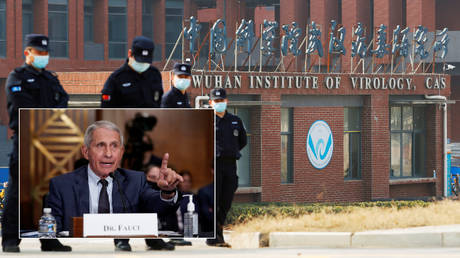
An American nonprofit behind the US-funded bat virus research in China has denied ever sending virus samples from Laos – a place where SARS-CoV-2 closest natural relative was found – to Wuhan in response to fresh allegations.

“No work was ever conducted in Laos as a part of this collaborative research project,” EcoHealth Alliance – a group that conducted experiments on coronaviruses while receiving funding from the National Institutes of Health (NIH) – said in a series of tweets on Sunday, responding to media reports alleging that the group might have transported a potentially dangerous virus from Laos to the laboratory in Wuhan.

The group’s name surfaced in October when the NIH principal deputy director, Lawrence Tabak, revealed EcoHealth Alliance did experiment on the viruses with the agency’s financial help. At that time, White House Medical Advisor Dr. Anthony Fauci stated that the viruses studied as part of the project “were distant enough molecularly that no matter what you did to them, they could never, ever become SARS-CoV-2.”

EcoHealth has come under renewed scrutiny after its emails, obtained through a Freedom of Information request, appeared to suggest that the group was discussing the prospect of collecting viral samples from bats in Laos and sending them to the Wuhan Institute of Virology. The emails were initially obtained by the White Coat Waste Project and sparked a flurry of reports over the weekend, including in the Spectator by British science writer Matt Ridley.

Read more

FILE PHOTOS.
Fauci DID fund Wuhan virus experiments, but officials insist virus involved ‘could not have been’ cause of Covid-19 pandemic

The emails shared between EcoHealth Alliance and its US government funders reportedly reveal that the scientists discussed collecting viral samples from bats in eight countries, including in Laos, between 2016 and 2019, and toyed with the idea of transporting them to Wuhan, ostensibly, to avoid red tape. One email from 2016 cited by the Spectator reportedly reads: “All samples collected would be tested at the Wuhan Institute of Virology.”

Laos is the birthplace of at least one virus that seems to be very close to SARS-Cov-2. A bat viral strain called Banal-52 discovered in Laos in September shares 96.8 percent of its genome with the virus behind the Covid-19 pandemic

On Sunday, EcoHealth Alliance claimed that the emails cited by Ridley “do not show…that we were sampling bats in Laos and sending the results to Wuhan.”

The group acknowledged, however, that it requested NIH permission to work in Southeast Asian countries, including in Laos, and that this permission was granted. 

However, the nonprofit claimed it ended focusing on China instead.

 The response failed to satisfy Ridley, who is also a co-author of a book on Covid’s origin, who demanded “evidence” proving that  his report was not “fully accurate.”

Think your friends would be interested? Share this story!

find more fun & mates at SoShow now !

Behind the Headlines brings you expert perspectives on today’s headlines by telling you more than what happened, but also what it means.  You can also listen to The Cipher Brief’s Daily Open-Source Collection Podcast wherever you listen to podcasts.

Jack Devine, Former Acting Director, National Clandestine Service, CIA

Cipher Brief Expert Jack Devine, a 32-year CIA veteran. Devine served as both Acting Director and Associate Director of CIA’s operations from 1993-1995.  He is a founding partner and President of The Arkin Group, which specializes in international crisis management, strategic intelligence and investigative research. Devine is the author of Spymaster’s Prism: The Fight Against Russian Aggression.

Russia’s multi-pronged support of Myanmar is a microcosm of its strategy in Southeast Asia.

In the months since Myanmar’s February military coup, Russia and China have been the junta’s most powerful allies, but Russia has exploited regional instability to position itself as a third path between China and the West. While China was closer with the former Myanmar government than the military, it was also concerned about the government’s ties with the West and potential interference in its development efforts, particularly its Belt and Road Initiative. Russia, on the other hand, doesn’t depend on stability in Southeast Asia to the same degree as China and can instead take advantage of warring factions. Last month, on his first trip outside of the immediate region since February, Myanmar’s junta leader Min Aung Hlaing went to Moscow to meet with high-level Russian defense officials instead of heading to Beijing. Hlaing has reportedly visited Russia seven times within the past decade and previously stated that over 6,000 Myanmar officers have studied at Russian military academies. According to data from the Stockholm International Peace Research Institute (SIPRI), Russia was responsible for almost 40% of arms sales to Myanmar from 1999-2018, second only to China. SIPRI data further indicates that Russia has been Southeast Asia’s largest arms supplier over the past two decades, counting Vietnam and Laos as top customers. But Russia is offering the region more than arms and has promised Myanmar two million Covid-19 vaccines and assistance in the nation’s own vaccine production efforts. Russia has also been trying to expand free trade agreements between its Eurasian Economic Union (EAEU) and Southeast Asian countries, most recently getting Indonesia to sign on to the deal. Stepping even further into soft power efforts, last week Russia’s foreign minister met with his Bangladeshi counterpart and agreed to encourage Myanmar to engage in dialogue with Bangladesh on the Rohingya crisis.


Get your free daily Open-Source Collection report in The Cipher Brief newsletter or take it on the go as a podcast.  Listen here or wherever you listen to podcasts.


Leftist, former schoolteacher Pedro Castillo is declared President of a divided Peru, projected economic growth could play in his favor. 

Peru, like many of its neighbors, has been battling the triple and interwoven threat of Covid-19, social unrest, and severe economic downturn. But for the past several years Peru has also been challenged by sharp divisions between its executive and legislative powers. Last November, Peru’s unicameral legislature voted to impeach then-President Martín Vizcarra, citing mismanagement of the pandemic and corruption, in a move that outraged thousands. The June presidential elections were likewise fraught. Castillo’s right-wing rival Keiko Fujimori, who is also under investigation for corruption, alleged electoral fraud and the Peruvians initiated a six-week long investigation, eventually finding Castillo the rightful victor. The EU, U.S. and 14 electoral missions deemed the elections legitimate, and the U.S. called the election a “model of democracy” for the region. Castillo, who previously worked as an elementary school teacher and has never held public office, will be greeted by a political establishment that is almost entirely against him. Peruvian citizens are also deeply divided, and many urban elites reportedly moved their money overseas out of fear for Castillo’s economic policies. But Castillo’s Peru Libre party holds fewer than 40 of 130 seats in the legislature and Castillo has already recruited several moderate advisors. Further, he has backed away from talk of nationalizing Peru’s lucrative multinational mining, oil, gas, and hydrocarbon companies, instead pledging to raise taxes on mining firms. Prices of copper and gold, two of Peru’s most critical exports, remain high and Covid-related trade obstacles are expected to ease over the coming months. While it is uncertain how effective Castillo will be, or where he will ultimately fall on his policies, positive projections for Peru’s export-based economy will likely play in his favor.


The Cipher Brief hosts private briefings with the world’s most experienced national and global security experts.  Become a member today.


Enjin becomes first blockchain platform to gain acceptance into the United Nations Global Compact, signaling widespread range of corporate sustainability efforts.

On Tuesday, Enjin, an innovative blockchain technology company focused on non-fungible tokens (NFTs), became the first such company to join the United Nations Global Compact. Upon admission, Enjin stated that it hopes to use NFTs to promote sustainability and equality in line with the UN pact that encourages businesses and firms worldwide to adopt more environmentally friendly and socially responsible practices. NFTs have surged in popularity in the past two years, and during the first quarter of 2021 NFT sales reportedly exceeded US $2 billion. In essence, an NFT is a way to prove ownership of a unique virtual item. It’s a unit of data that’s stored on a blockchain, or digital ledger, that certifies exclusive ownership of digital files ranging from photos to sports trading cards. Enjin, which is headquartered in Singapore, has focused its NFT efforts on games and apps and is reportedly able to operate with a lower carbon footprint than Bitcoin due to a slimmed-down verification model that requires less energy. This week, the UN Global Compact not only included Enjin as a member, but gave the company its highest membership rank, sending a signal that it’s interested in promoting such an environmental effort by crypto and blockchain entrepreneurs. For its part, Enjin has stated that it wants to employ the technology in carbon capture companies, fighting climate change in the process. The Head of the UN AI and Robotics Center remarked that during the global struggle to recover from the pandemic we should take advantage of new technologies like AI and blockchain to better equip ourselves for the future.

Read more expert-driven national security insights, perspective and analysis in The Cipher Brief


The post Behind the Headlines: Russia in Myanmar, Peru’s New President and what Enjin means for the United Nations Global Compact appeared first on The Cipher Brief.

find more fun & mates at SoShow now !

Colder weather is settling in around much of the globe and after a year and a half of managing a global pandemic, energy markets are more complicated than ever.  The U.S. petroleum inventory is at its lowest level since 2015, the UK is experiencing a severe energy crisis, Russia continues to push Germany on the Nordstream II pipeline and winter has already come to China, which has experienced weeks of rolling blackouts. What does all of this mean as both state and non-state cyber actors continue to take aim at energy infrastructure?

The Cipher Brief spoke with energy expert Norm Roule, a top adviser on energy issues, to get a sense of where we’re headed.

Norman T. Roule served for 34-years in the Central Intelligence Agency, managing numerous programs relating to Iran and the Middle East.  He served as the National Intelligence Manager for Iran (NIM-I) at the Office of the Director of National Intelligence from November 2008 until September 2017.  As NIM-I, he was the principal Intelligence Community (IC) official responsible for overseeing all aspects of national intelligence policy and activities related to Iran, to include IC engagement on Iran issues with senior policy makers in the National Security Council and the Department of State.

The Cipher Brief: Give us a brief snapshot of the global energy market today and what you think we will see in the coming months.

Roule: The energy market is working through what will hopefully be the final phase of a perfect storm of market distortions ignited by the pandemic and influenced by shifts in capital markets and climate change initiatives. I say the final phase because most countries are returning to growth and pre-pandemic energy consumption. Most of the drivers of this final phase will likely push prices upward in the near term. A few involve long-known issues that are now coming into play. A few remain unpredictable. Ancillary industries that rely on oil, gas, or distillates as significant feedstocks will either raise prices or shift production to areas with less exposure to hydrocarbons. In short, in the coming weeks, consumers should expend to not only pay more at the gas pump but at the supermarket and mall.  We are likely to see relief in the Spring as the pandemic and supply chain distortions wane, seasonal demands on oil and gas pass, and energy producers ramp up operations to exploit high prices. China’s economy also shows signs of slowing, and financial packages meant to jump-start global economies will run their course.

The Cipher Brief: Energy markets seem more complicated than ever. What are the primary variables at play?

Roule: Global oil consumption is now back to 100 million barrels per day, a statistic last seen when the pandemic hit. Production is up, but the most crucial trend in recent months has been the deep draw on the glut of oil stocks during the pandemic. Producers – especially OPEC – have constrained production to reflect their cautious approach to market stability and their desire to reduce the stockpiles accumulated during the pandemic. As a result, stocks are now lower than before the pandemic. If you exclude the strategic petroleum reserve, the U.S. petroleum inventory is at a level not seen since 2014-2015. Stockpiles at Cushing are at a similar level. U.S. gasoline stocks are around five million barrels below pre-pandemic seasonal averages.

U.S. producers have consolidated, and the industry prioritizes return on equity over expansion, particularly in a political environment that is increasingly hostile to hydrocarbon production. As a result, U.S. oil production is still about 1.7 million barrels a day below pre-pandemic levels. Add to this the push to reduce carbon emissions, gas supply cuts, and some supply chain distortions, and you get a surge in gas prices and a need for oil (and coal) to replace gas in electricity production, as we see in China.

The Cipher Brief: The administration seems to be blaming OPEC plus for high oil prices. What’s happening within the cartel?  How does the cartel see the current energy market?

Roule: OPEC’s role in oil markets remains deeply significant. The cartel produces 40 percent of the world’s oil, but 60 percent of the world’s total traded exports. That inevitably gives it an important voice. It is also clear that OPEC+ leaders remain confident in their strategy to maintain market stability and benefit from prices that are not so high that they ignite demand destruction. OPEC discipline during this turbulent period has been quite good, especially given that it is far from a monolith of views and capabilities. For example, the UAE would likely support additional production. Moscow makes positive noises about its willingness to increase production, but it follows Riyadh’s lead for the revenue and political advantage it derives from the current market.  

Riyadh remains the architect of OPEC’s approach. Kuwait and Baghdad seem comfortable with this strategy. Production restraint is made easier because about half of OPEC’s members reportedly are unable to meet production quotas due to technical problems, mismanagement, or a lack of capital investment. This list includes Angola, Gabon, Equatorial Guinea, Nigeria, Libya, and Venezuela.  

OPEC decision-making likely rests on a handful of variables, some predictable, others not. The cartel has done well in its assessments of global recovery and pandemic impact. But questions remain on aviation recovery. Likewise, even their best analysts have a tough time predicting the impact of speculators, weather trends, and the future of sanctions on Iran and Venezuela. Riyadh and Abu Dhabi will do what they can to avoid the financial and political consequences of inflation and any energy-instigated recession.

The strains in US-Saudi relations appear to have undermined Riyadh’s sympathy for Washington’s challenges. The Saudis are tired of being a political target within the U.S. They also seem to believe that while the U.S. touts itself as being interested in only renewable energy sources, it has no problem criticizing the Kingdom when high gas prices become a political issue. Last, we should recall that it was only in May 2020 that a group of Republican Senators publicly called on Saudi Arabia, demanding that it stabilize the energy market. From Riyadh’s perspective, it has done precisely that.

The Cipher Brief: Are the Gulf oil producers serious about renewable energy? 

Roule: Absolutely. Regional leaders certainly understand the consequences of climate change for their people. In recent years, the region has experienced some of the highest temperatures on record, causing concern that, if unchecked, the trend could make portions of the Middle East unlivable.

But their approach is different from ours and as we all know, Gulf economies rely heavily on revenues from hydrocarbons. To varying degrees, all the Gulf states are trying to diversify their economies. But they also want to avoid a situation in which they are stuck with stranded strategic assets. In the West, our climate narrative tends to focus on ending the use of hydrocarbons. As with Norway, Gulf producers claim that they will use the resources from their oil revenues to fund the transition to a new energy economy.


Join The Cipher Brief for Members Only expert conversations on issues related to economic and global security.  Become a member for just $10 a month and then join us for a Members Only Brief with Norm Roule on Thursday, November 18 at 1:30p.  Members receive invitations via email.


Their focus tends to be a balance between a reduction of emissions and reduction of hydrocarbon use. Recent weeks have seen multiple significant events in the Gulf in which they tried to highlight their decision to expend resources and political bandwidth on green technologies, hydrogen production, and carbon capture solutions. We will also see increasing efforts to plant trees and to rely on natural gas instead of oil for power generation. They also claim they will try to end gas flaring and reduce methane emissions. I don’t think these efforts will satisfy Western environmental activists who demand an end to oil use, but the trend is undeniable.

The Cipher Brief: What is happening with U.S. oil and gas producers?  How are they responding to changing conditions?

Roule: Much has changed in the last two years. First, the sector underwent significant consolidation. The larger publicly-held companies must satisfy investors and financial institutions with a steady return on equity over the growth. Washington has cooled on its support for the industry. The decision to kill the Keystone Pipeline and limit drilling on federal property has contributed to industry reluctance on expansion. Last, some investors are pushing for companies to devote more attention to renewable energy sources.  During the pandemic, this reduced capital investment to about half of average expenditure, thus producing our current limited production capacity. U.S. rig count has significantly improved over the past year, but not on a scale that would return U.S. production to pre-pandemic levels. In the near term, smaller privately-held firms are likely to spend the resources to expand production with public firms following once they get a sense of what 2022 will bring.

The results speak for themselves. At the beginning of the pandemic, the U.S. produced around 12.8 million barrels of oil per day (BPD). By May 2020, production declined to 9.7 million BPD, and with recovery is now approximately 11.3 million BPD.  We are once again a net importer, bringing in about 1.3 million BPD in October.

We have seen a broader recovery in gas production, particularly in Texas. But a lack of production, low stockpiles, and unprecedented demand from abroad means consumers will face high bills if winter is severe or the risk of short supplies. Beyond heating, gas-fired power plants produce more than 50% of New England’s electricity, for example, so that any price spike will play out elsewhere in the economy.

The Cipher Brief: Is there a policy response to this situation?

Roule: I think policymakers globally are praying for a mild winter. But beyond this, policy options are few in the near term. A release from the strategic petroleum reserve (SPR) is conceivable. Still, we should remember the SPR was established for national emergencies and not a piggy bank to manage gas prices in an election year. Domestic producers will take a while to ramp up production, but policymakers will find this tough to seek in the current political environment. The administration could ban oil and gas exports or allow Congress to pass legislation enabling the federal government to sue OPEC for its cartel activities. Either step would invite predictable and unwelcome diplomatic consequences. 

Although the American public demands cheap energy, it isn’t enthusiastic about supporting the infrastructure needed to achieve this, even if the power is produced elsewhere.  Let me cite a couple of recent examples:

• Maine voters just rejected the construction of a billion-dollar electric line that would have delivered Canadian hydro-power electricity to New England.

• The administration is wrestling with a decision as to whether it should shut a pipeline that carries crude oil from Canada to refineries across Wisconsin, Michigan, and the Great Lakes region. 

If the administration hopes to convince OPEC members to increase production, it will improve relations with Gulf Arabs. It might be possible to convince Saudi Arabia, Kuwait, and the UAE to lift production to cover the exports of OPEC members unable to meet their production quotas. In an extreme situation, the administration might consider a temporary oil export waiver to Iran as a sign of goodwill. I think the political blowback on the latter rules it out, but the possibility is there. 

The Cipher Brief: The United Kingdom seems to be working its way through a severe energy crisis. How did this happen, and what are its policymakers doing in response?

Roule: The United Kingdom’s energy challenge is significant. As with other countries, it faces consequences of production limitation and the need to turn to more climate-friendly energy sources.

A few basics.  Gas produces about 40% of the country’s electricity and heats many of its homes. Once London could rely on the North Sea for its gas; it now imports about half of its gas requirements.  Norway is its primary gas source, but it also depends on gas producers in the U.S., Russia, Qatar, Belgium, and the Netherlands. To add to its woes, the U.K.’s storage capacity would survive only a short period of peak consumption. In 2017, London closed a massive Rough, which accounted for 70% of the country’s entire gas storage system. At the time, London believed it could rely on the global LNG market for reliable and cheap gas. Unfortunately, most LNG tankers head to Asia, a trend that can only increase as power-hungry Asian countries wean themselves from coal and oil.

The exploitation of new energy sources in the U.K. is no less contentious than in the U.S. A good illustration of this would be the tussle over the development of the Cambo oil and gas field in the waters near Scotland. Opposed by environmentalists who cite the inevitable carbon emissions the project and its oil would produce, the project offers to ease London’s energy woes and provide around a thousand jobs. The Johnson government has yet to indicate whether it will approve the project.

London’s options are few and leaving the country reliant on market conditions means risking shortages. For this reason, it has reportedly asked Qatar to agree to become the “supplier of last resort” in case global suppliers are unavailable. 


Go beyond the headlines with expert perspectives on today’s news with The Cipher Brief’s Daily Open-Source Podcast.  Listen here or wherever you listen to podcasts.


The Cipher Brief: What’s the Russian angle to the energy story?

Roule: Upfront, I think we should worry whether Russia will perceive the energy crisis as offering an opportunity for aggression. What if Moscow decides its gas hold over Europe allows it to invade Ukraine without penalty? Or as a means of pushing German regulators to accelerate their approval of the Nordstream II pipeline?

Moscow insists that it is meeting contractual obligations and that its exports have increased in the past year. At the same time, there are routine reports that Russia’s gas supplies to Europe have not only not met requirements, but that gas flow reversed in the Yamal-Europe pipeline. Russia also maintains eight gas storage sites in Europe to help manage supply during high-demand periods. Gas levels at these sites are currently low. Critics claim Gazprom diverted production to Russian domestic storage and that exports in October fell to the lowest level since 2014. When pressed, Moscow explains shortages saying that it must fill its winter supply stocks and expects to send Europe additional gas this week. 

But if the current energy dynamic seems to be in Russia’s interest, Moscow’s long-term prospects are dim. A global shift to renewable energy sources forces Moscow to reckon with the prospect of holding a massive oil infrastructure of little commercial value. If so, future historians may look at the recent Glasgow climate summit as a significant step in accelerating Russia’s decline, possibly a new era of aggression as it seeks to accumulate power ahead of this decline or a more competitive race for market share against OPEC members.

The Cipher Brief: What about China?

Roule: No major country has endured such energy problems in recent months as China. After weeks of rolling blackouts, China looks well on its way to solving its coal problems that partially contributed to this situation. That won’t delight environmentalists, but it should ease China’s electricity problems and ensure its citizens stay warm this winter. Winter arrived early, and Beijing is about to see its first snow of the season. China’s efforts will be put to the test in a winter that many expect to be colder than 2020.

Longer-term, China still must work through the causes of this crisis. If the global economy continues to surge demand for Chinese products, its energy requirements will grow. Weather problems cut wind production; floods shut mines. We shouldn’t be surprised if such problems continue. Inevitably, China can only meet its climate goals by shifting from coal to natural gas, raising prices for other consumers.

The Cipher Brief: Let’s shift to North Africa.  Algeria recently closed a long-established pipeline that transited Morocco to deliver gas to Spain.  Will this impact Europe’s already tight gas situation? What’s the story here? 

Roule: Over the past year, Algerian relations with Morocco have steadily deteriorated.  In addition to their traditional disagreement over the status of Western Sahara and the Polisario, Algiers criticized Morocco’s renewed ties with Israel and accused Rabat of supporting an opposition group that Algeria claims ignited forest fires. Algiers closed its airspace to Moroccan flights and accused Morocco of killing several Algerian citizens in the Sahara region.

Here’s how it touches the energy picture. On 31 October, Algiers closed an 800-mile pipeline that carried Algerian gas to Spain via Morocco and the Strait of Gibraltar.  The closure cost Morocco a portion of the gas it used from the pipeline. Morocco used this gas to produce about a tenth of its electricity. Rabat claims it can use other energy sources for this purpose. However, Spain has little gas and derives a significant portion of its electricity from that which it must import. Algiers claims it will make up the loss through a secondary pipeline, but the loss of gas will compound the energy problems of Spain and Europe in general.

The Cipher Brief: Any other issues on the horizon we should consider?

Roule: A growing number of aging refineries in the West will be closed in the coming years.  However, Asia is the new center for refinery construction. This expansion will draw even more crude to the region for processing with the inherent impact on local economies and global consumers.

The Cipher Brief: Last, let’s touch on wild cards. What are the grey swans that might impact markets in 2022?

Roule: With low stockpiles and supplies, the energy topography is ill-prepared to sudden shocks to its production or distribution architecture. Yet, it faces three threats that have grown in the last decade.

First, we have climate change issues.  Increasingly harsh weather events have shut down large portions of the production and refinery sectors in the United States and Mexico, sometimes taking weeks to restore normal production. Second, we have the universe of cyber threats.  State and non-state cyber actors routinely probe or attack every aspect of the energy industry. Last, we have new geopolitical pressures.  Tensions are rising with China as well as Iran and its proxies. Three of the world’s six most significant shipping channels are in the Middle East and a fourth in Asia.

Join us for a Members Only Brief with Norm Roule on Thursday, November 18 at 1:30p.  Cipher Brief Members receive invitations via email.

Read more expert-driven national security insights, perspective and analysis in The Cipher Brief

The post Winter is Coming: Global Energy Markets and the Impact on National Security appeared first on The Cipher Brief.

find more fun & mates at SoShow now !

The Chinese foreign ministry has lashed out at Lithuania after the small Baltic Sea nation approved the opening of the Taiwan Representative Office in Vilnius. Beijing says it undermines its One China policy.

Beijing was disappointed that Lithuania had proceeded to grant Taiwan permission to open its ‘representative office’ in Vilnius despite “China’s strong opposition and repeated persuasion,” Chinese foreign ministry spokesman Zhao Lijian said at a press briefing on Friday. Taiwan had opened its mission in Vilnius the previous day. 

Read more

Chinese star Peng Shuai is reportedly missing. © Visual China Group via Getty Images
Peng Shuai: What do we know about Chinese tennis star at center of international storm?

Zhao called the move a violation of the One China principle, which he said is undermining China’s sovereignty and territorial integrity, while grossly interfering in its internal affairs. The spokesman reminded Lithuania that Taiwan is an inalienable part of China’s territory and the Beijing government has sole legal authority. 

As to what necessary measures China will take, you may wait and see. The Lithuanian side shall reap what it sows.

In a “stern warning” to the Taiwanese authorities, Zhao then added that “seeking ‘Taiwan independence’ by soliciting foreign support is a totally misguided attempt that is doomed to fail.”

In August, Lithuania announced that the diplomatic outpost would be named the “Taiwan Representative Office,” angering China. Taiwan’s diplomatic branches – in countries that have de facto relations with the island’s authorities – are normally called “Taipei Economic and Cultural Offices.”

China demanded that Lithuania recall its ambassador from China, which it did. Beijing then withdrew its envoy to the Baltic state.

Chinese officials have repeatedly called on Western nations, notably the UK and US, to stop interfering in Beijing’s internal affairs, stressing that they consider Taiwan to be part of China.

If you like this story, share it with a friend!

find more fun & mates at SoShow now !

Austria will introduce a full lockdown that could last for three weeks on Monday in an attempt to tackle a new wave of Covid-19 infections. The government has also ordered the entire population to get vaccinated from February 1.

On Friday, conservative Chancellor Alexander Schallenberg told a news conference that a complete lockdown of the nation would begin on Monday and last for an initial 10 days.

Read more

French President Emmanuel Macron (FILE PHOTO) © REUTERS/Sarah Meyssonnier
Macron discloses whether lockdown for unvaccinated will be necessary in France

He stated that the restrictions could be extended if infection rates did not start to fall, but he insisted the lockdown would not exceed 20 days.

The measures concern the entire Austrian population. The government has already imposed a partial lockdown on the unvaccinated in an effort to reduce hospitalization rates amid a surge in Covid-19 cases.

When the full lockdown ends, restrictions will remain in place for the unvaccinated.

Schallenberg’s announcement came after a meeting of nine state governors, two of whom had already vowed to introduce full lockdowns in their regions on Monday, in the western province of Tyrol.

The chancellor also announced that vaccinations would be mandatory from February 1. “We haven’t been able to convince enough people to vaccinate. For too long, I and others have assumed that you can convince people to get vaccinated,” he added, giving his rationale for the mandate.

Schallenberg said he lamented the political forces, radical opposition, and fake news fighting against vaccination.

Austria has one of the lowest vaccination rates in western Europe, with only 65% inoculated against the deadly virus according to data from Johns Hopkins university.

Infection rates are almost among the highest on the continent. The seven-day incidence rate stands at 971.5 per 100,000 people.

Think your friends would be interested? Share this story!

find more fun & mates at SoShow now !