Palestinian Islamist group Hamas has called on Canadian singer Justin Bieber to cancel his upcoming concert in what it calls the “Zionist occupation state” of Israel.

Bieber announced his 2022 world tour dates this week, with a concert in Tel Aviv planned for next October. On Thursday, Hamas’ Artistic Production Department issued a statement, cited by the Palestinian Sawa news outlet, “condemning and denouncing” the performer. It called on the star to cancel the show and “boycott the Zionist occupation state in protest at its repeated crimes against the Palestinian people.” 

Read more

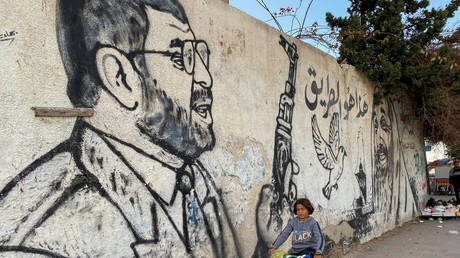
A Palestinian boy rides a bicycle past a mural depicting late Hamas leader Abdel-Aziz Al-Rantissi in Gaza City (FILE PHOTO) © REUTERS/Mohammed Salem
UK outlaws Hamas as terrorist organization

Bieber has performed in Israel multiple times, his last performance there having been in 2017 at Park HaYarkon – the same venue slated for next year. Since the announcement of the ‘Justice’ tour dates, calls for him to cancel the Tel Aviv show have gained momentum across social media, with many posters condemning the singer for supporting what one called an “apartheid state.”

Some noted that Bieber was set to arrive in Israel after performing in South Africa. “Justin Bieber is really going straight from SA to Israel. From a country that fought apartheid to a country that’s practicing apartheid,” one Twitter user complained.

A petition asking the singer to boycott Israel and exclude it from his tour has been launched online, and had garnered some 3,700 signatures by Friday. 

In 2018, the New Zealand singer Lorde canceled a concert in Israel, subsequently thanking fans for “educating” her on the issue, and, the same year, US artist Lana Del Rey at first defended her decision to perform in the country, saying her appearance would not be a “political statement,” before backtracking and canceling the gig.

Hamas has been designated a terrorist group by the US, the EU, and, as of Friday, the UK. In April 2021, international non-governmental organization Human Rights Watch concluded in a report that Israel had committed “crimes against humanity of apartheid and persecution.”

If you like this story, share it with a friend!

find more fun & mates at SoShow now !

Robert Dannenberg, Former Senior CIA Officer
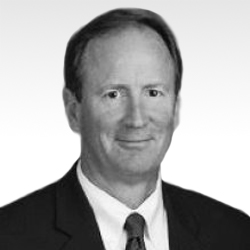
Cipher Brief Expert Rob Dannenberg is a 24-year veteran of the CIA, where he served in several senior leadership positions, including chief of operations for the Counterterrorism Center, chief of the Central Eurasia Division and chief of the CIA’s Information Operations Center. Dannenberg is a member of the Board of Advisors to the Director of the National Counterterrorism Center and is a senior fellow at the GWU Center for Cyber and Homeland Security. He is now an independent consultant on geopolitical and security risk, after serving as the managing director and head of the Office of Global Security for Goldman Sachs, and director of International Security Affairs at BP.

EXPERT PERSPECTIVE — The images from Kabul are demoralizing and depressing—unless you are sitting in the Kremlin, where they are certainly being viewed in a quite different light. Probably something close to giddiness and glee.

From Russian President Vladimir Putin’s perspective, this likely reinforces his view that President Joe Biden and his national security team are weak and naïve.  ‘This is Obama’s third term’, Putin must be thinking. And of course, the images of US helicopters desperately trying to evacuate thousands from Kabul also resonate in Kiev, Tbilisi, and probably Tallinn, Riga, and Vilnius and beyond—think Taipei.  The appalling mismanagement of the withdrawal from Afghanistan will have consequences that will affect American credibility globally and linger well beyond the end of Biden’s presidency.

A first order consequence concerns Russia.

It is highly likely there was practical cooperation between the Kremlin and the Taliban in the preparation for the American withdrawal and this may have included direct support to Taliban forces. We don’t need to revisit the narrative of Russian bounties for dead American soldiers in Afghanistan, but the evidence of Russian energetic engagement with the Taliban in recent months is manifest and the fact the Russian embassy in Kabul is currently protected by Taliban fighters is significant.

For both Russia and the Taliban there was a clear shared strategic objective: Get the Americans and their allies out of Afghanistan and ideally in the most humiliating fashion possible.  The Russian-Taliban honeymoon may not last long, but for the moment it has served both sides well.

For over a decade and a half of his tenure as Russia’s president, Putin has been preaching the gospel that you can’t trust the Americans to back you in the long run or when the chips are down, but you can count on the Russia he leads (think the Russian intervention in Syria and support for Assad or their intervention—whether acknowledged or not—in Libya on the side of Khalifa Haftar among other examples). This messaging is important in current times and reinforces Putin’s narrative about the decline of the West and the waning relevance of western liberal systems of governance.

In recent years, Chinese President Xi Jinping has picked up the trumpet to echo this message that American power is in decline and that American security guarantees cannot be relied on in East Asia and beyond.

Putin has been Russia’s Czar for over two decades without meaningful interruption and is likely to remain so for the foreseeable future. He has seen US Presidents come and go and he has been quick to size them up and adjust his moves accordingly. He was genuinely scared of what George W. Bush might do in the immediate aftermath of 9/11 and the speed and efficacy of the US response made a deep impression on him.  He adjusted his approach to the US to one of partner and ally against Islamic extremism (Putin was also busy consolidating his control over the Russian Federation in the immediate post-Yeltsin period).

Putin also sized up then-President Barack Obama after Obama’s failure to act when Syrian President Bashar al-Assad blithely crossed the “no use of chemical weapons” red line.  That opened the door for the annexation of Crimea as well as the Russian military intervention in Syria (and later Libya). Joe Biden was Vice President at the time. Putin likely has a very good book on Joe Biden and was quite confident of what the end result for the US in Afghanistan would look like.  Putin may even have a better feel for Joe Biden than many realize, if any of the Hunter Biden material is true.  One leader’s assessment of another, matters in geopolitical relations. Putin has a high level of confidence in his ability to read his international opposition.

As recently as July 2021 President Biden said, “There’s going to be no circumstance where you see people being lifted off the roof of the US embassy in Afghanistan.”  He went on to add, “The likelihood there’s going to be the Taliban overrunning everything and owning the whole country is highly unlikely.”  President Biden made these statements knowing perfectly or should have known—from intelligence briefings and expert commentary—as well as historical precedent—that when the US announces a withdrawal of forces with a hard deadline, in this case 9/11, our adversaries use the time to prepare for their offensive military action. Our Afghan allies knew this as well and prepared accordingly.  Now the Taliban will celebrate the twentieth anniversary of the September 11 attacks in the US embassy in Kabul, probably with their ISIS and Al Qaeda friends as honored guests.  If you think the videos from Afghanistan have been troubling to this point, just wait for the anniversary celebrations.

Perhaps of more near term geopolitical significance, Putin will use the Taliban takeover of Afghanistan to support a narrative that Russia needs to defend its interests from the spread of Islamic extremism from Afghanistan by strengthening “security and counterterrorism” cooperation with Turkmenistan, Uzbekistan, Tajikistan, Kyrgyzstan. Does anyone want an excuse to get – and keep – those pesky Americans out of Central Asia and start rebuilding that corner of the Soviet Union?

Putin’s use of terrorism risk as justification for military action is well-rehearsed and goes back to the Moscow apartment bombings (which the FSB almost certainly organized) in September 1999, which Putin used both to consolidate political power and to justify the brutal military campaign in Chechnya. Putin is acutely aware of the risks of Islamic extremism spreading from Afghanistan to Central Asia, the Caucasus, and into the Russian Federation. In fact, Russian, Uzbek, and Tajik troops conducted exercises in July, which appear to have been designed to prepare to respond to cross border incursions from Afghanistan. This is only the first step in his plan for consolidation of Russian power and influence in Central Asia and the Caucasus.


The Cipher Brief hosts private briefings with the world’s most experienced national and global security experts.  Become a member today.


Some might ask – given the risk of the spread of Islamic extremism from Afghanistan to the Russian Federation – why would Putin would want to partner with the Taliban?  Those who ask this question are misunderstanding the depth of Putin’s enmity toward the United States and the West and everything for which we stand.  Putin views the world as a “zero sum” game.  What hurts the US must serve Russia’s interests. The debacle in Afghanistan clearly qualifies. A short-term deal with the Taliban is a risk with taking in Putin’s mind.  Putin plays on the superpower chessboard using the only tools he has at hand, military power, cyber and disinformation capability and US ineptitude and lack of strategic thought.  He has taken clever advantage of President Trump’s four years of thoughtless estrangement of US allies around the world.

Beyond the propaganda value and regional leverage our withdrawal has given adversaries like Russia and China, there is the impact of our withdrawal on the many nations among our allies who contributed to the Afghanistan mission. The images of Afghans clinging to a departing US Air Force C-17 and falling to their deaths will not fade easily. How easy will it be to assemble their support when we inevitably have to go in again to deal with a resurgent Al Qaeda, a globally ambitious Taliban, or an even more dangerous embedded ISIS in the hills of Afghanistan?

We should also consider the impact on Pakistan.  Pakistan has nurtured Islamic extremism in Afghanistan for decades.  While a part of the Pakistani security establishment partnered with the US effectively after 9/11, other parts simultaneously were nurturing relations with extremists including the Taliban. The “Great Game” is still being played in that part of the world, and neither the Pakistanis, nor the Indians or Chinese have forgotten it.

Pakistan also still certainly chafes from the US raid to kill bin Ladin in Abbottabad a little over ten years ago.  One wonders if the waning of US influence in Islamabad has opened the door for Islamic extremists to enter the security establishment there. Pakistan is a nuclear power and has in recent years, increased its development of tactical nuclear weapons. Does the Taliban now have a path to nuclear weapons?  This is an important question and it’s answer casts a shadow over our withdrawal from Afghanistan.

The Biden Administration, for all its vaunted claims of “return to competence” in Washington, has fallen flat in its first serious challenge. One could argue that Biden’s capitulation on Nord Stream 2 and Putin’s mocking rejection in Geneva of charges of US election interference and cyberattacks on the US, foretold the debacle in Afghanistan. The challenge for the US now will be to manage the airlift of those Afghans who were willing to partner with the US and carefully look for opportunities to rebuild the credibility of US security guarantees around the world.

Taiwan and South Korea would seem good places to start.

At the same time, we need to recognize that Afghanistan will once again become the training ground for those who hope to replicate 9/11 attacks on the US. A strong and robust intelligence capability will be essential in mitigating that risk.

Read more expert-driven national security insight, perspective and analysis in The Cipher Brief

The post Putin’s Calculated Afghanistan Play appeared first on The Cipher Brief.

find more fun & mates at SoShow now !
The Islamic State terrorist group is tearing a path across Afghanistan, establishing itself in “nearly all” of its provinces while increasing attacks more than five-fold in the past year, the UN’s envoy to the country has warned.

Addressing the UN Security Council on Wednesday, the body’s special representative for Afghanistan Deborah Lyons spoke of a major Islamic State (IS, formerly ISIS) surge through the war-torn country, claiming the jihadist group has now expanded nationwide.

“Once limited to a few provinces and the capital, ISKP now seems to be present in nearly all provinces, and increasingly active,” Lyons said, referring to the group’s Afghanistan-based ‘Khorasan’ faction. She added that so far in 2021, IS has carried out 334 attacks, up from just 60 last year.

The envoy’s comments came just hours after an Islamic State bombing erupted in a Shiite Muslim neighborhood of the Afghan capital, killing one and wounding six others, according to Reuters.

Since taking over as the government following a chaotic US withdrawal and the outright collapse of the American-backed administration in Kabul last summer, the Taliban has struggled to keep the terrorist group at bay, Lyons said. Though she noted that the Taliban insists it is “waging a concerted campaign” against IS and is making “genuine efforts to present itself as a government,” she said its response “appears to rely heavily on extrajudicial detentions and killings.”

READ MORE: ‘Ghost soldiers’ to blame for Afghan government’s quick defeat – ex-minister

Despite the rise in IS attacks in recent months, however, Lyons said the overall security situation in Afghanistan has improved since the end of the US war, which stretched on for two decades.

In addition to the terrorism issue, the UN representative also cited broader concerns for the country in the coming months, warning of a looming “humanitarian catastrophe” driven by a litany of causes, including foreign sanctions – which she said have “paralyzed” the local banking system – as well as growing levels of food shortages due to famine and a failing economy, among other factors.

Think your friends would be interested? Share this story!

find more fun & mates at SoShow now !
A stream literally flowing with booze emitting a strong beery odor has been discovered in one of the tropical islands of Hawaii. Its waters have been apparently contaminated with alcohol after a leak at a beverage warehouse.

A small river with a distinctive alcoholic smell was recently found on the island of Oahu, some 15 miles (24 kilometers) away from Honolulu, Hawaiian capital. Its waters have been flowing through the Waipio valley and even turned into a 100-foot (30 meters) waterfall on their way.  

Read more

Image from geosociety.org
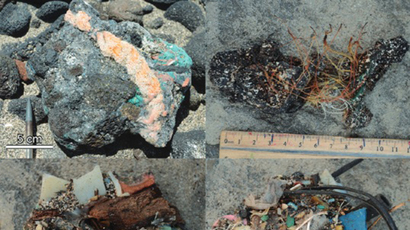
​‘Plastic stones’ found at remote Hawaii beach

The stream caught the attention of local environmental activists, who noticed the smell in the area.

The other day we came here you would think it was a beer pub that hadn’t opened its doors for three or four days,” activist Carroll Cox told local Hawaii News Now. She also contacted the Department of Health about the issue.

Local media took samples from the unusual stream and had them checked at a private laboratory. It tested positive for alcohol, containing 1.2% percent of the substance in its waters – nearly a quarter the content in regular beer and strong enough to cause a buzz.

Local health authorities got involved, and an investigation into the source of contamination was launched. It was learned that the stream was coming from a drain pipe that was traced back to a warehouse of Hawaii’s largest liquor distributor, Paradise Beverages. Its representatives told local media they were working with officials to eliminate a possible spill, with the booze river apparently closing its free drinks service.

Like this story? Share it with a friend!

find more fun & mates at SoShow now !
Scientists have used artificial intelligence to “predict” formulas for new designer drugs, with the stated goal of helping to improve their regulation. The AI generated formulas for nearly nine million potential new drugs.

Researchers with the University of British Columbia (UBC) used a deep neural net for the job, teaching it to make up chemical structures of potential new drugs. According to their study, released this week, the computer intelligence fared better at the task than the scientists had expected.

The research team used a database of known designer drugs – synthetic psychoactive substances – to train the AI on their structures. The market for designer drugs is ever-changing, since their manufacturers are constantly tweaking their formulas to circumvent restrictions and produce new “legal” substances, while cracking their structure takes months for law enforcement agencies, the researchers said.

Read more

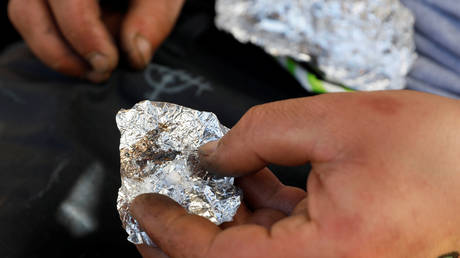
FILE PHOTO: A man living on the streets displays what he says is the synthetic drug fentanyl, in the Tenderloin section of San Francisco, California, February 27, 2020 © Reuters / Shannon Stapleton
Drug overdose deaths in US hit all-time record

“The vast majority of these designer drugs have never been tested in humans and are completely unregulated. They are a major public-health concern to emergency departments across the world,” one of the researchers, UBC medical student Dr. Michael Skinnider has said.

After its training, the AI was able to generate some 8.9 million potential designer drugs. Afterwards, researchers ran a data sheet of some 196 new drugs, which had emerged in real life after the model was trained, and found that more than 90% of these have been already predicted by the computer.

“The fact that we can predict what designer drugs are likely to emerge on the market before they actually appear is a bit like the 2002 sci-fi movie, Minority Report, where foreknowledge about criminal activities about to take place helped significantly reduce crime in a future world,” senior author Dr. David Wishart, a professor of computing science at the University of Alberta, has said.

Identifying completely unknown substances remains an issue for the AI, the research team has noted, but they hope it might potentially help with that task, since the computer was also able to predict which formulas of designer drugs were more likely to be created and hit the market. The model “ranked the correct chemical structure of an unidentified designer drug among the top 10 candidates 72 percent of the time,” while throwing in spectrometry analysis, which is an easily obtained measurement, bumped the accuracy to some 86%.

“It was shocking to us that the model performed this well, because elucidating entire chemical structures from just an accurate mass measurement is generally thought to be an unsolvable problem,” Skinnider stated.

Think your friends would be interested? Share this story!

find more fun & mates at SoShow now !

The longest lunar eclipse in over 500 years will occur in the early hours of November 19, lasting several hours.

The peak of the partial eclipse will take place in the predawn hours on Friday when 97% of the moon will be eclipsed by the Earth’s shadow. The previous longest partial eclipse took place in 2018 and lasted less than two hours, while this will last for several hours.

The eclipse will be visible from all 50 US states, Canada, and Mexico, as well as parts of South America, Polynesia, Australia, and China, according to NASA.

The moon will be at its farthest point from Earth during the eclipse, slowing its orbit and extending the time it takes to move out of the darkest part of the planet’s shadow, known as the umbra, as the moon, Earth, and sun will all be aligned. The Holcomb Observatory has released a video detailing what the eclipse will look like. 

The event will begin shortly after midnight and unlike a solar eclipse, no one will need special eyewear to view the phenomenon.

When the eclipse occurs, the moon will take on a reddish hue, with only a sliver of the actual moon visible. The event will last for several hours, making it the longest of its kind in 580 years, with the next lunar eclipse not occurring until May of 2022.

If you like this story, share it with a friend!

find more fun & mates at SoShow now !
This piece was first published by RUSI in London.  The views do not represent those of RUSI.

EXPERT PERSPECTIVE –The international community is coming under increasing pressure to recognise the Taliban and to unfreeze Afghan funds held by the IMF or to risk a humanitarian crisis over the winter and a resurgence of international terrorism.

As Afghanistan heads deeper into winter the desperate need is to avoid a humanitarian crisis. The World Food Programme has launched an appeal to feed up to 23 million people and Médecins sans Frontières have followed suit in the healthcare field. Fortunately, the distribution mechanisms are in place inside Afghanistan; what is needed is for the international community to ensure that UN humanitarian programmes are fully funded. This will require Western capitals to get over the shock of their recent defeat. It goes without saying that hunger and health should not be used as instruments of political leverage.

Meanwhile, it is becoming ever more apparent that the Taliban do not have the skills to administer a country which is far more complex than the Afghanistan of 1996 – when they began their previous and disastrous spell in office. They will need international assistance to stabilise the economy, get people back to work and, in time, continue the gradual infrastructure improvements which have been underway since 2002. China will doubtless be willing to assist in some areas but Beijing has already made clear that it is adopting a cautious, gradualist approach. However, there are emerging indications that the Taliban’s intransigent views are beginning to relax; such as their approval of the polio vaccination scheme and their willingness to work with UN humanitarian agencies.

The Taliban will also need outside help in defeating the threat from the Islamic State’s Khorasan Province (ISK). Already the Taliban are finding it difficult to counter similar asymmetric tactics which they used so successfully against Western forces. This is likely one of the subjects which CIA Director William Burns discussed with the Taliban during his visit on 24 August and where there is a mutual interest.

What can the international community (not just the West) realistically expect from the Taliban, following the militant group’s stunning victory? Maximalist demands will inevitably get short shrift.


The Cipher Brief hosts private briefings with the world’s most experienced national and global security experts.  Become a member today.


First, the Taliban should form a more inclusive government. According to multiple sources, the Taliban were intending to form such an administration had Ashraf Ghani not fled the country on 15 August. I am sceptical that this was ever their intention but former president Hamid Karzai and former reconciliation chief Abdullah Abdullah may have remained in Kabul on this understanding and Fatima Gailani, a former negotiator, insists this was the Taliban’s intention.

An inclusive government would need to include women and non-Taliban representatives from the Hazara, Uzbek and Tajik communities. It need not comprise the failed politicians and bloodstained warlords of the past, least of all Gulbuddin Hekmatyar and Abdul Rashid Dostum. It is surely time for a new generation of more technocratic Afghans to become involved in government. Some may be persuaded to return from abroad but they will need assurances for their safety.

Second, the international community should insist on female education at all levels be restored and for women to play a fuller role in society. The Taliban will baulk at this but they only need to look at Pakistan where women play an important role in an avowedly Islamic, if not Islamist, society.

Third, all neighbouring countries, as well as the wider world, want Afghanistan to commit to removing all terrorist bases and terrorists from its soil; not just ISK and Al-Qa’ida but also the Eastern Turkistan Islamic Movement, the Pakistani Taliban (TTP), anti-Iranian and anti-Indian groups, and Central Asian militant movements including the Islamic Movement of Uzbekistan.

Fourth, the Taliban should commit to allow people to join their families in exile if they wish and also cease the continuing search for and punishment of those Afghans who served the Afghan government and Western allies since 2001.


Go beyond the headlines with expert perspectives on today’s news with The Cipher Brief’s Daily Open-Source Podcast.  Listen here or wherever you listen to podcasts.


In an ideal world there would also be a fifth request: to remove Haqqani network members from the Taliban administration. However, that pass was sold when the US negotiator Zalmay Khalilzad engaged with the Haqqanis in Doha – another result of that calamitous dialogue. Furthermore, the current reality is that the Haqqanis control both Kabul and its airport and Sirajuddin Haqqani holds the key position of interior minister.

Instead, the Haqqanis need to be persuaded to prevent Al-Qa’ida regrouping in Afghanistan. Sirajuddin’s father was close to Osama bin Laden and the group retains its Al-Qa’ida connections. Pakistan is already using the Haqqanis to bring the TTP to the negotiating table. It remains to be seen how successful this will be. It is doubtful that the Haqqanis would be willing to take military action against a group from a similar area in the tribal borderlands. However, the Haqqanis could be useful as intermediaries, if not as enforcers.

Meanwhile, the wider Taliban, usually referred to as the ‘Kandaharis’, are increasingly exasperated by the entryist Haqqanis. Although they have worked together, there was never much love lost between the two. The Kandaharis have always distrusted the Haqqanis’ proximity to the Pakistani military. Since the Taliban takeover of Afghanistan, Mullah Abdul-Ghani Baradar, whose willingness to negotiate with the Kabul government in 2008 and 2010 earned him eight years in a Pakistani prison, has been sidelined. There will doubtless be a reckoning

A lasting regret of the US’s careless withdrawal is that Washington did not conclude a broader settlement for Afghanistan involving China, Iran, Russia, India and the Central Asian Republics. From now on it is essential to include all the neighbours in the discussion of recognition and the conditions required. But first the Afghans must be helped to survive the winter.

Read more expert-driven national security insights, perspective and analysis in The Cipher Brief

The post What Stands Between the Taliban and Recognition appeared first on The Cipher Brief.

find more fun & mates at SoShow now !

Japan’s fifth wave of Covid-19 has virtually disappeared so dramatically that some scientists are puzzled as to why it happened. One team suggests the highly infectious Delta strain mutated into extinction on the island nation.

In mid-August, Japan experienced a peak in Covid-19 infections, recording over 23,000 new cases per day. Now the metric is just around 170, with deaths attributed to the disease mostly remaining in single digits this month.

The decline has been attributed by many to high vaccination rates, public acceptance of masks, and other factors, but some researchers say the drop was uniquely significant, compared to other nations with similar conditions.

Ituro Inoue, a geneticist at the National Institute of Genetics, believes that Japan had the good fortune of witnessing the Delta strain mostly rooting out other variants of the SARS-CoV-2 virus before then eradicating itself. He explained his team’s theory to the Japan Times newspaper this week.

For some time now, Inoue and his fellow scientists were researching mutations of SARS-CoV-2 and how they are affected by the protein nsp14, which is crucial for the reproduction of the virus.

RNA viruses, like the one causing Covid-19, tend to have a very high mutation rate, which helps them quickly adapt to changes in the environment. However, this opens the door for a so-called “error catastrophe,” when bad mutations pile up and finally cause the full extinction of a strain. The protein nsp14 appears to offer a form of error proofreading that helps the virus genome to stay below the threshold of the “error catastrophe.”

Read more

© Getty Images / Morsa Images
Fighting for our lives: Humanity’s weapons against Covid-19

In the case of Japan’s fifth wave of Covid-19, the Delta variant’s nsp14 failed at this job, Inoue believes, based on the genetic study of specimens collected from June to October. Contrary to his team’s expectations, there was a lack of genetic diversity, while many samples had many genetic changes in the site called A394V, which is linked to the error-fixing protein.

“We were literally shocked to see the findings,” the researcher told the Japan Times. “The Delta variant in Japan was highly transmissible and [was] keeping other variants out. But as the mutations piled up, we believe it eventually became a faulty virus and it was unable to make copies of itself.”

The theory could be relevant to the previous SARS strain, which was identified in 2003, explaining why it didn’t cause a pandemic. But that would be hard to confirm, since the outbreak ended relatively quickly and didn’t result in the massive collection of genetic data necessary to test the hypothesis.

It’s not clear why Japan had this lucky turn of events, but nothing comparable happened in other East Asian countries like South Korea, where populations are genetically close to that of Japan. Virus mutations similar to those flagged by the scientists have been discovered in at least 24 countries, Inoue said. He and his team plan to publish a paper detailing their findings by the end of November.

Even if the natural extinction theory is confirmed, it is at best a temporary reprieve for the Japanese people. New, more successful strains are likely to eventually find their way into the country, though quarantine measures and immigration control could delay the emergence of new variants in Japan, Inoue believes.

Meanwhile, Tokyo is bracing for a new wave of Covid-19 this winter and is preparing to live with the virus. The government reportedly plans to ease travel restrictions by increasing the number of people it allows to enter the country per day from 3,500 to 5,000.

Like this story? Share it with a friend!

find more fun & mates at SoShow now !

France’s best-known book of words, Le Petit Robert dictionary, has caused a stir by including the non-binary personal pronoun as an alternative to the existing masculine and feminine terms.

While the annual update of the Petit Robert dictionary is often a topic of considerable debate in French media, the latest edition has caused quite the backlash, with some, including a cabinet member, accusing it of pandering to wokeism.

The word “iel,” a neologism combining the French words for he and she (“il” and “elle“), is described as the personal pronoun for a person of any gender. “Personal pronoun subject to the third person singular and plural, used to evoke a person of any gender. The use of the pronominal in inclusive communication,” the dictionary’s entry reads. 

Read more

(FILE PHOTO) © REUTERS/Costas Baltas
France turns to Ancient Greece for war on woke

Striking out at the latest inclusion, François Jolivet, an MP in President Emmanuel Macron’s LREM party took his protest to the Académie Française, the official guardians of the French language.  

Describing the move as “wokeism,” Jolivet said in a letter to the Académie that the word “iel” had no place in the French language and claimed it would be a precursor to the rise of ‘woke’ ideology, which undermines the values of the Gallic nation.

Outspoken Education Minister Jean-Michel Blanquer also chimed in. “Inclusive writing is not the future of the French language,” he tweeted, sharing Jolivet’s letter. “Just as our schoolchildren are consolidating their basic skills, they don’t need to have this as a reference,” he added.

The head of Gaullist party Debout La France, Nicolas Dupont-Aignan, further criticized Petit Robert’s “woke” addition. “Let’s defend our language against these ridiculous fanatics of deconstruction and let’s boycott the collaborators who give into them,” he tweeted.  

Le Petit Robert has responded to the “lively debate” by claiming that the pronoun has been used increasingly in society in recent months and they chose to reflect this by adding it to their latest update. The publication also said that some have welcomed the addition.

France’s offensive against wokeism, which has been described by some as an Anglo-Saxon import, recently saw Blanquer vow to increase the teaching of ancient Greek and Latin languages. The education minister claims that the classical vernaculars respond to a demand for logos (language as a tool for reason), in a world where “a lack of reason is spreading like wildfire.” 

If you like this story, share it with a friend!

find more fun & mates at SoShow now !

Planetary alignment on Friday has offered sky-gazers around the globe a chance to witness a spectacular near-total lunar eclipse, the longest since the 1440s.

The fascinating astronomical phenomenon lasted three hours and 28 minutes – the longest in centuries, according to international space agencies. On Thursday and Friday, depending on local time zones, the Earth, Sun and Moon aligned in such a way that 97.4% of our natural satellite’s surface was darkened in shadow.

When the Moon came out of the shroud, it turned bloody or rusty red in sunlight.

The dramatic celestial show was visible in those parts of the globe where the Moon appeared above the horizon during the eclipse.

Sky watchers in North and South America, parts of Eastern Asia and Australia had a chance to witness the phenomenon.

In Russia, the partial eclipse could be seen in Siberia and the Far East. Russian space agency Roscosmos also shared images of the shadowed moon as seen from the International Space Station (ISS).

Adding to the astonishment, the Moon was very low in the sky for much of the eclipse, causing an optical illusion that made it seem larger.

While the full Moon travels through Earth’s shadow roughly two times a year, lunar eclipses are usually far shorter.

The latest event, due to its rare duration, might have affected people not only visually, but also emotionally, astrologers cautioned.

Like this story? Share it with a friend!

find more fun & mates at SoShow now !