Marx, Lenin, and Ho Chi Minh – the revolutionaries’ namesakes – have gathered for a wedding in India’s state of Kerala. Friedrich Engels was the one walking down the aisle.

Read more

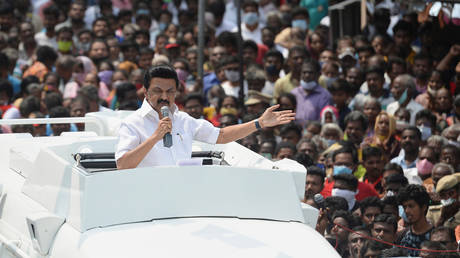
FILE PHOTO. M.K. Stalin in Chennai. © AFP / Arun SANKAR
Stalin fulfills political destiny, comes to power in Indian state assembly elections

And this has nothing to do with time travel. In India’s southwestern state of Kerala parents have often named their children after prominent figures in the hammer and sickle movement. The local communist party has been at the helm there for much of the past 60 years, and is still quite popular with voters.

In the town of Athirappilly on Sunday the groom, Friedrich Engels, a namesake of the 19th century German philosopher who helped conceive Marxism, tied the knot with the bride, Bismitha. In attendance were also Engels’s brother Lenin, named after the man behind the 1917 Russian Revolution, as well as the groom’s friends, Marx and Ho Chi Minh, who bear the names of Marxism’s founding father and the Vietnamese revolutionary leader respectively.

All four men are members of India’s Communist Party. Incidentally, Marx is currently working and residing in ultra-capitalist Dubai, but flew back to see his friend exchange wedding vows with his betrothed, as reported by local media. 

Another wedding ceremony that took place in June in the state of Tamil Nadu, saw Socialism getting married in front of his brothers, Communism and Leninism, as well as nephew, Marxism.

Think your friends would be interested? Share this story!

find more fun & mates at SoShow now !

The International Criminal Court has halted an investigation into alleged rights abuses carried out by Philippines authorities as part of a harsh crackdown on the drug trade, saying it is reviewing a deferral request from Manila.

The ICC’s chief prosecutor Karim Khan said the probe was suspended after the Philippines government filed a request to defer the case earlier this month, according to court documents cited by Reuters on Friday. 

“The prosecution has temporarily suspended its investigative activities while it assesses the scope and effect of the deferral request,” he wrote, adding that the court is seeking more information from the government in Manila.

Based in The Hague, the ICC allows states to ask for postponements if they conduct their own investigations into the charges in question. President Rodrigo Duterte’s administration filed its deferral request on November 10, while the country’s Justice Ministry announced its own investigation into the alleged abuses late last month.

Read more

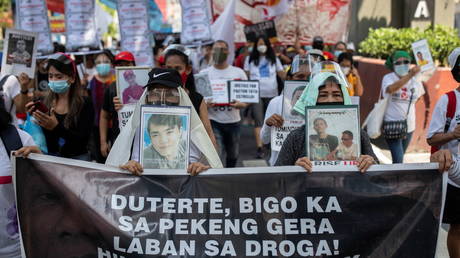
Relatives of drug war victims hold photographs of their slain loved ones with placards calling for justice (FILE PHOTO) © REUTERS/Eloisa Lopez
Philippines announces probe into thousands of killings during Duterte’s war on drugs as initial review suggests abuses took place

The court initially opened the probe in September over allegations that Philippines police had carried out thousands of extrajudicial executions and used other brutal tactics against suspected drug dealers, and that Duterte gave implicit backing to those actions. Activists have accused authorities of killing innocent people, including children, though the police insist they only use violence in self-defense.

While Duterte has declined to cooperate with the ICC probe, saying it has no authority on the island nation, and even pulled the Philippines out of the international body in 2019, the court has jurisdiction to investigate alleged violations committed by the country while it was still a member.

The president’s chief legal counsel, Salvador Panelo, confirmed the deferral request in brief comments to Reuters, saying “There is no inconsistency with the request for suspension of action,” though he did not elaborate.

Since its founding some 20 years ago, the ICC has successfully convicted just five people of war crimes or crimes against humanity – all leaders of armed movements in Africa, including in Mali, Uganda and the Democratic Republic of the Congo.

Think your friends would be interested? Share this story!

find more fun & mates at SoShow now !

Libyan military commander Khalifa Haftar is set to challenge Gaddafi’s son for the top job, announcing his presidential bid. The election will take place on December 24.

Read more

Saif al-Islam al-Gaddafi at the registration centre in Sebha. ©Khaled Al-Zaidy / Handout via REUTERS
Gaddafi heir runs for Libyan presidency despite arrest warrant

I declare my candidacy for the presidential election, not because I am chasing power but because I want to lead our people towards glory, progress and prosperity,” the de facto leader of Eastern Libya said in a televised speech.

Haftar added that the election is the only way out of the severe crisis the country has been plunged into.

The announcement was expected; in September, Haftar announced that he was temporarily stepping down as head of the force known as the Libyan National Army, fulfilling the requirement for presidential hopefuls to suspend public work three months before an election.

Haftar will run against the son of former leader Muammar Gaddafi, Saif al-Islam Gaddafi, who represents the Popular Front for the Liberation of Libya.

Haftar’s presidential bid is likely to anger many who consider him a war criminal responsible for the indiscriminate killing of civilians during his military campaign. A number of civil lawsuits have been filed against him in a US federal court for alleged war crimes. Haftar has both US and Libyan citizenship, and owns property in Virginia.

Following years of civil war and political chaos after the NATO-backed intervention that saw Muammar Gaddafi deposed and brutally murdered, the upcoming election is widely viewed as an opportunity for political settlement and the long-awaited unification of the country, divided now between Haftar’s forces and the Tripoli-based Government of National Accord. However, there is still no consensus on the legal grounds for the election, which could become an obstacle for the peace process.

Like this story? Share it with a friend!

find more fun & mates at SoShow now !

CIPHER BRIEF EXPERT PERSPECTIVE 

Cipher Brief Expert Tim Willasey-Wilsey served for over 27 years in the British Foreign and Commonwealth Office. He is now Visiting Professor of War Studies at King’s College, London.

Older Americans have Saigon 1975 and the helicopters from the Embassy roof seared into their memories. A previous generation of Britons was haunted by the image of General Percival surrendering vast numbers of troops and equipment in Singapore to the Japanese in 1942. How Kabul falls to the Taliban could have important practical and symbolic significance.

The announcement that the United States is sending 3,000 troops to Kabul alongside 600 British troops to manage the evacuation of their civilians and those Afghans who provided assistance, is a remarkably late response to a rapidly deteriorating situation. Unless carried out in the next 48 hours, it will also be risky. Taliban infiltrators are already inside Kabul and the forces which captured Ghazni and Kandahar on 12th August will be heading towards the capital on their Honda 125cc motorbikes.

The US must have extracted undertakings from the Taliban negotiators in Qatar not to launch their full assault on Kabul until the evacuations are complete, but elements of doubt remain. Previous Taliban assurances have proved worthless, and it is doubtful that individual Taliban commanders would wish to hold back while some of Ashraf Ghani’s ministers, senior army officers, judges and officials are spirited away to a life of exile.

It is hard not to be impressed by the speed and élan of the Taliban’s recent successes; taking 13 of Afghanistan’s 34 regional capitals in almost as many days. It is reminiscent of the extraordinary progress which the Japanese made down the Malaya Peninsula in 1942 with Singapore as the ultimate prize.

The Taliban’s success has not happened by chance. It is clearly the fruit of preparation and planning. Above all, they have learnt from the experience of 1994 to 1996 when they eventually took Kabul but failed to capture the north, thereby allowing space for the Northern Alliance parties to survive and then reassert themselves following the 9/11 terrorist attacks.

This time, the Taliban have focussed first on border posts with neighbouring countries (thereby denying the government vital supply routes and customs revenues) before taking outlying regional capitals and leaving Kabul (which is never easy to capture) until last. Above all, they have concentrated on the north where many rural Afghans are disenchanted with the Kabul government and regional warlords. The north is no longer the solid bastion of anti-Taliban sentiment it was in the 1990s.


The Cipher Brief hosts private briefings with the world’s most experienced national and global security experts.  Become a member today.


Taliban progress in the north has snuffed out any chance that the old Northern Alliance could be reborn out of the eventual collapse of the Ashraf Ghani government. Whereas in 1996, Ahmed Shah Massoud, its brilliant military leader, was able to abandon Kabul and beat a tactical retreat up the Panjshir Valley, that option barely exists today. Not only is Massoud dead but his former adherents are no longer guerrilla fighters but members of a stratified Afghan army which has struggled to perform without US air support.

The Taliban have also ruthlessly exploited the weak negotiating stance of the United States and its chief negotiator Zalmay Khalilzad. Whereas some of the Taliban team in Doha, such as Mullah Barader, may indeed have been ‘moderates’ there was never any doubt that the Taliban movement wanted to see the total defeat of the Kabul government and the expulsion of Western forces. Pakistan too, may have occasionally considered some form of negotiated deal but ultimately the only sure way of keeping Indian influence out of Afghanistan (it believes) is a Taliban government.

The Afghan army (and in particular its impressive Special Forces) will now be assembling in Kabul and should be able to repel initial attempts to overrun the city. Certainly, Gulbuddin Hekmatyar found it impossible to take Kabul in 1992 and 1993 even with help from Pakistan, which, in frustration, switched support to the newly-created Taliban movement in late 1994.

But from 1992 to 1996 there were frequent deliveries of supplies to Massoud and his Northern Alliance defenders from Russia, Iran, and India. In 2021, the position is very different. Russia has already decided to “back the winner” and believes it has extracted promises from the Taliban not to export Islamism northwards into the Central Asian Republics (CARs). Iran too has channels to the Taliban and will be watching carefully for any return to the Taliban’s persecution of the Shia Hazaras. And India has already made contact with the Taliban in Doha in the hope that the Taliban in power will prevent Kashmiri militant groups from setting up bases there.

The likelihood therefore is that Kabul will fall to the Taliban quite quickly. If the Americans and British do manage to insert their evacuation forces soon, they should be able to complete the operation successfully, although there are likely to be heart-rending scenes at the airport as crowds of refugees are turned away at gunpoint from departing aircraft. Regional powers, particularly Pakistan, will try and persuade the Taliban to hold back from intervening, conscious that a bloodbath in Kabul would be a disastrous start to the Taliban’s second spell in government. Ironically, however, the evacuation would almost certainly lead to the collapse of the Kabul government as senior officials are forced to decide whether to take the last aircraft out or face almost certain torture and death at the hands of the victors. It is doubtful whether any Western countries will choose to retain their embassies in Kabul. For President Biden, the memory of Benghazi will be too raw.

What is certain is that there will be new iconic images to rival those of Saigon and Singapore.


Go beyond the headlines with expert perspectives on today’s news with The Cipher Brief’s Daily Open-Source Podcast.  Listen here or wherever you listen to podcasts.


Read more expert-driven national security insights, perspective and analysis in The Cipher Brief.

The post How Does Kabul End? appeared first on The Cipher Brief.

find more fun & mates at SoShow now !

Hospitals in the Netherlands have begun delaying certain operations to free-up ICU beds during a record wave of Covid-19 infections, while an infectious diseases researcher has warned of an impending ‘Code Black’ in the sector.

The country set a daily national record for new Covid infections on Thursday, registering around 23,600 cases. It was the third day in a row of the figure topping 20,000.

To make more staff available for Covid wards, a number of operations, including those for cancer and heart patients, are being canceled from this week on, Dutch healthcare officials have said. Fewer than 200 beds remained available in Dutch ICUs as of Thursday, while Friday figures show almost half (47.8%) of occupied ICU beds were being used by Covid patients.

Read more

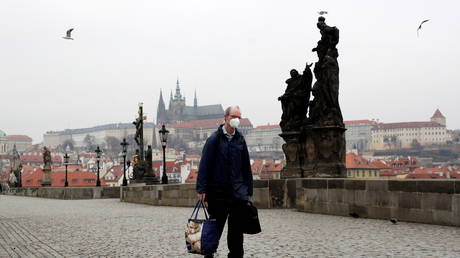
FILE PHOTO. A woman wearing a protective mask walks past a store in Amsterdam, Netherlands.
Netherlands re-introduces facemasks & other restrictions as Covid-19 cases surge

“These are cancer patients that should actually be operated-on within six weeks of diagnosis, and that won’t be met in all cases. It’s also heart patients,” said a spokesperson for the National Coordination Center for Patient Distribution (LCPS).

Meanwhile, new calculations by an infectious disease modeller at Wageningen University & Research suggest that a so-called ‘Code Black’ in hospitals is looming. The emergency designation means that patient safety is at risk and, if declared, would mean many people with life-threatening illnesses cannot go to the ICU, while doctors have to prioritize who to treat.

According to recent estimates from the Dutch Healthcare Authority (NZa), up to 200,000 operations were not performed as a result of urgently needed Covid care since the start of the pandemic. On Thursday, the NZa revealed that almost a quarter of operating rooms across the country are not currently in use due to a combination of Covid patient pressures and rising staff absences due to illness.

It is not yet clear what impact the delayed care will have on public health. In December 2020, the Dutch National Institute for Public Health and the Environment (RIVM) calculated that an estimated 34,000 to 50,000 ‘healthy life years’ had been lost due to the first Covid-19 wave alone.

Think your friends would be interested? Share this story!

find more fun & mates at SoShow now !

EXPERT OPINION — More than 200 U.S. officers have been hunted around the globe and targeted by an adversary using a mysterious weapon that causes permanent brain injury. It’s time to get serious about fighting back.

The Authors:

Paul Kolbe served for 25 years in the CIA’s Directorate of Operations. He is currently Director of the Intelligence Project at Harvard Kennedy School’s Belfer Center for Science and International Affairs.

Marc Polymeropoulos worked for the CIA for 26 years. He is author of “Clarity in Crisis: Leadership Lessons from the CIA.

John Sipher worked for the CIA’s clandestine service for 28 years. He is now a nonresident senior fellow at the Atlantic Council and a co-founder of Spycraft Entertainment.

Prior to 9/11, al Qaida declared war on the United States, bombed the USS Cole, and blew up U.S. embassies in Nairobi and Dar es Salam. Despite heavy casualties, America viewed successive al Qaida terrorist attacks as somehow unique, not representative of a larger threat or state of war. We went about our business and failed to take hard action against al Qaida despite clear warning. Our failure to respond forcefully led to 9/11 and the two decades of war that followed.

Fast forward to today.  Since 2016, more than 200 U.S. officials have reportedly suffered from a mysterious series of symptoms which have caused long-lasting, debilitating injuries. Suffering from searing headaches, vertigo, vision impairment, and nausea, many victims have been formally diagnosed with traumatic brain injuries (TBI) at the Walter Reed National Military Medical Center and other leading hospitals. Family members and young children have suffered as well. Some medical tests can now confirm the markers of brain injury, similar to those suffered by victims of concussive injuries in Iraq and Afghanistan.

These injuries began with a cluster of reports from Cuba in 2016 and have become commonly referred to as Havana Syndrome. Moscow, Vienna, Belgrade, and Hanoi are among more than a dozen cities where U.S. officials reportedly have been attacked and injured. In residences, on the street, in vehicles, and even at secure U.S. facilities, U.S. officers are being hunted. Stunningly, even a close aide to CIA Director Bill Burns was reportedly attacked on a trip to India just this past August.

The CIA, after a period of confusion, delay, and even denial at times, now appears to take these threats very seriously. CIA Director Burns and Deputy Director David Cohen have publicly stated that U.S. officials are being “attacked.” They have improved health care for CIA officers who are hurt. And an agency task force is hard at work trying to obtain additional intelligence on those responsible. We credit Director Burns for his solid leadership.

The cause of these injuries? The National Academy of Sciences has pointed to Directed Energy Weapons – devices which emit microwave pulses which can inflict pain and damage tissue. The United States, Russia, China, and others have all developed Directed Energy Weapons to destroy equipment, counter drones, and control crowds. This is not science fiction.

Directed energy weapons would account for the highly directional and locational nature of these incidents. When victims can “move off the x,” the signature sounds, sensations, and pain that goes with the attacks often stop, though damage has already occurred. The amount of exposure seems to affect the degree of injury. Other technologies could be at play and are being investigated, but microwaves appear to be the most likely vector. Russia has used them before, flooding the U.S. Embassy in Moscow with microwave radiation for decades.

Regardless of form, the weapons being used in these attacks are nothing less than weapons of terror, designed to cause injury to non-combatants. Who would use such a weapon to attack U.S. intelligence officers, diplomats, and military personnel, and to what conceivable end?


The Cipher Brief hosts private briefings with the world’s most experienced national and global security experts.  Become a member today.


CIA Deputy Director Cohen stated at a recent intelligence summit, that the U.S. was closer to identifying the culprit, and Politico has reported that members of the Senate Intelligence Committee are increasingly convinced that Russia or another hostile adversary is behind the attack, although reportedly, no smoking gun has been found.

As former CIA operations officers with extensive experience dealing with both counterterrorism and counterintelligence issues, we have few doubts about who will be named as the culprit. For at least a decade, Russia has conducted itself as in a state of conflict with the West in general and the United States in particular. Russia has launched cyberattacks impacting critical infrastructure and supply chains, assassinated opponents with nuclear poisons and chemical weapons, gunned down people in the streets using criminal proxies, sabotaged a Czech ammunition depot, and mounted a violent coup attempt in Montenegro. It has also bombarded the U.S. embassy in Moscow with microwave radiation and used carcinogenic “spy dust” without regard to health effects. The attacks on U.S. officials would fit this pattern of behavior.

We recognize that it is important to let the intelligence community do its job and its findings must inform policy action. Congress and the administration must work together to formulate a range of possible responses and it is not too early to begin. As Senator Collins and others have stated, these attacks are “an act of war,” and as such, preparation for a future attribution call by the national security establishment is in order. So how could the U.S. respond?

Let’s start with what doesn’t work – sanctions. Sanctions feel good and satisfy an action imperative but they are feckless. Sanctions have not stopped Russia from killing dissidents, halted the Nordstream II pipeline, compelled a pull back from occupied territories, reduced support for tyrants, or hindered oil and gas production. Sanctions have simply forced Russia to develop more creative money laundering and sanction circumvention mechanisms.

So, what would work? For starters, we must understand that the Putin regime considers itself in a state of conflict with the U.S., short of war, but nonetheless deadly real. We are dealing with a state sponsor of terror which conducts operations across the globe to weaken the U.S. abroad, divide it from its allies, and sow discord at home. Our policy must be calibrated to win this conflict, without sparking a shooting war, but at risk of one.

Russia understands reciprocity and strength. When four Russian diplomats were kidnapped by extremists in Beirut in 1985, and one of them was killed, Russia reportedly responded by kidnapping and gruesomely killing a relative of the group’s leader. The surviving diplomats were released immediately. The story may be apocryphal, but it does illustrate the Russian approach. Tempting as it may be for America to retaliate tit for tat, we need not mirror Russia’s actions. Instead, we should play to our greater economic, diplomatic, and military advantages.

We offer five elements to frame a response: enlist U.S. allies, expand forward deterrence, limit the adversary’s reach, choke off money, and bring those accountable to justice.

NATO: With proof of the attacks on U.S. officials, we should activate NATO’s Article Five collective defense clause. The only other time this was enacted was after 9/11. As justification, in addition to the Havana Syndrome attacks, (which also caused Canadian casualties), we would include GRU and FSB assassination operations across Europe, deadly sabotage in the Czech Republic, a coup attempt in Montenegro, persistent cyberattacks, and a litany of other actions that can only be described as irregular warfare directed against NATO members.


Go beyond the headlines with expert perspectives on today’s news with The Cipher Brief’s Daily Open-Source Podcast.  Listen here or wherever you listen to podcasts.


Forward Presence: A crystal clear signal that we understand the nature of Russian hybrid warfare and are responding would be to enhance our deployed military presence in Poland, the Baltic States, and in the Black Sea region. These units would pose no offensive threat to Russia but would be a clear signal that the U.S. is prepared to counter any Russian shenanigans. We should also significantly ramp up our lethal aid and training to the Ukraine, where the nature of Russian aggression is well known. Weakness in Eastern Europe is an invitation to conflict.

Travel and Presence: We should drastically limit Russian business and tourist travel which is being used as cover for FSB and GRU operations. We would reduce Russian diplomatic presence in each capital to the bare minimum – handfuls not hundreds. American and European counterintelligence experts believe there are more Russian intelligence officers operating from embassies than during the Cold War. Limiting the size of Russia’s espionage infrastructure will complicate the planning and execution of all of its intelligence operations.

Finance: A key tool in counterterrorism operations is the ability to target sources of finance which constitute material support to terrorism. In this case, we would apply that principle to the Russian government, state enterprises, and individuals who provide cover, tools, and sources of funding to Russia’s campaign to undermine the West with violence, terror, and media manipulation. Russia’s dirty money has been used to undermine the west and poison our politics. We should limit the easy access of shady money to western banks.

Criminal Cases: We need bring war crime cases to the International Court of Justice (ICJ) in the Hague. Following a decade of conflict in the Balkans, the ICJ brought to justice 161 indicted Serbian, Croatian, and Bosnian war criminals. This was an astounding success – a manhunt which included American and European law enforcement and intelligence services. Just as in Nuremberg after World War II, these actions to hold war criminals accountable drew a line in the sand.

This is a start.  Successive Democratic and Republican administrations have pursued Russia policies which represent the triumph of hope over experience. We have treated the symptoms of malign Russian actions rather than the underlying pathology. It is now time to finally acknowledge that we are in a long-term hybrid conflict and forget the fantasy of changing Putin’s behavior. Only a new regime in the Kremlin would hold the hope of bringing about a change in actions. Eventually, the Putin regime will wither or collapse, but until it does, we and our allies must do a better job of defending ourselves.

Read more expert-driven national security insights, perspective and analysis in The Cipher Brief

The post Havana and the Global Hunt for U.S. Officers appeared first on The Cipher Brief.

find more fun & mates at SoShow now !
Marx, Lenin, and Ho Chi Minh – the revolutionaries’ namesakes – have gathered for a wedding in India’s state of Kerala. Friedrich Engels was the one walking down the aisle.

Read more

FILE PHOTO. M.K. Stalin in Chennai. © AFP / Arun SANKAR
Stalin fulfills political destiny, comes to power in Indian state assembly elections

And this has nothing to do with time travel. In India’s southwestern state of Kerala parents have often named their children after prominent figures in the hammer and sickle movement. The local communist party has been at the helm there for much of the past 60 years, and is still quite popular with voters.

In the town of Athirappilly on Sunday the groom, Friedrich Engels, a namesake of the 19th century German philosopher who helped conceive Marxism, tied the knot with the bride, Bismitha. In attendance were also Engels’s brother Lenin, named after the man behind the 1917 Russian Revolution, as well as the groom’s friends, Marx and Ho Chi Minh, who bear the names of Marxism’s founding father and the Vietnamese revolutionary leader respectively.

All four men are members of India’s Communist Party. Incidentally, Marx is currently working and residing in ultra-capitalist Dubai, but flew back to see his friend exchange wedding vows with his betrothed, as reported by local media. 

Another wedding ceremony that took place in June in the state of Tamil Nadu, saw Socialism getting married in front of his brothers, Communism and Leninism, as well as nephew, Marxism.

Think your friends would be interested? Share this story!

find more fun & mates at SoShow now !
Slovakia has become the latest European country to implement lockdown restrictions on people who haven’t had the Covid vaccine, as it seeks to prevent a resurgence in infections and hospital admissions over the winter.

Slovakian Prime Minister Eduard Heger announced the new measures in a press conference on Thursday, declaring a “lockdown for the unvaccinated” after the country reported a record number of new cases.

The new restrictions in Slovakia, which come into effect on Monday, will require people to have been vaccinated or have recovered from Covid in the past six months to enter restaurants, non-essential shops, or public events.

In the past few days, the European nation has seen record numbers of new infections, including over 8,000 on Tuesday, with hospitals running out of space to treat Covid patients.

Slovakia has one of the lowest rates of vaccination in the European Union, with over 50% of individuals still not jabbed. The country of around 5.5 million has so far only inoculated 2.5 million people against the virus.

Read more

(FILE PHOTO) © REUTERS/David W Cerny
Czechia rolls out new restrictions for unvaccinated

Earlier this week, Austria became the first nation to impose restrictions on unvaccinated individuals, as it sought to limit pressure on hospitals and emergency care units. The move came into effect at midnight on Monday for anyone aged 12 and older who has not received their Covid vaccine or recently recovered from the virus.

The German state of Bavaria and the Czech Republic followed Austria in restricting access for unvaccinated individuals. Only people who can show proof of vaccination or that they have recently recovered from Covid will be allowed to enter public spaces, such as restaurants and shops. 

If you like this story, share it with a friend!

find more fun & mates at SoShow now !

Behind the Headlines brings you expert perspectives on today’s headlines by telling you more than what happened, but also what it means.  You can also listen to The Cipher Brief’s Daily Open-Source Collection Podcast wherever you listen to podcasts.

Jack Devine, Former Acting Director, National Clandestine Service, CIA

Cipher Brief Expert Jack Devine, a 32-year CIA veteran. Devine served as both Acting Director and Associate Director of CIA’s operations from 1993-1995.  He is a founding partner and President of The Arkin Group, which specializes in international crisis management, strategic intelligence and investigative research. Devine is the author of Spymaster’s Prism: The Fight Against Russian Aggression.

Russia’s multi-pronged support of Myanmar is a microcosm of its strategy in Southeast Asia.

In the months since Myanmar’s February military coup, Russia and China have been the junta’s most powerful allies, but Russia has exploited regional instability to position itself as a third path between China and the West. While China was closer with the former Myanmar government than the military, it was also concerned about the government’s ties with the West and potential interference in its development efforts, particularly its Belt and Road Initiative. Russia, on the other hand, doesn’t depend on stability in Southeast Asia to the same degree as China and can instead take advantage of warring factions. Last month, on his first trip outside of the immediate region since February, Myanmar’s junta leader Min Aung Hlaing went to Moscow to meet with high-level Russian defense officials instead of heading to Beijing. Hlaing has reportedly visited Russia seven times within the past decade and previously stated that over 6,000 Myanmar officers have studied at Russian military academies. According to data from the Stockholm International Peace Research Institute (SIPRI), Russia was responsible for almost 40% of arms sales to Myanmar from 1999-2018, second only to China. SIPRI data further indicates that Russia has been Southeast Asia’s largest arms supplier over the past two decades, counting Vietnam and Laos as top customers. But Russia is offering the region more than arms and has promised Myanmar two million Covid-19 vaccines and assistance in the nation’s own vaccine production efforts. Russia has also been trying to expand free trade agreements between its Eurasian Economic Union (EAEU) and Southeast Asian countries, most recently getting Indonesia to sign on to the deal. Stepping even further into soft power efforts, last week Russia’s foreign minister met with his Bangladeshi counterpart and agreed to encourage Myanmar to engage in dialogue with Bangladesh on the Rohingya crisis.


Get your free daily Open-Source Collection report in The Cipher Brief newsletter or take it on the go as a podcast.  Listen here or wherever you listen to podcasts.


Leftist, former schoolteacher Pedro Castillo is declared President of a divided Peru, projected economic growth could play in his favor. 

Peru, like many of its neighbors, has been battling the triple and interwoven threat of Covid-19, social unrest, and severe economic downturn. But for the past several years Peru has also been challenged by sharp divisions between its executive and legislative powers. Last November, Peru’s unicameral legislature voted to impeach then-President Martín Vizcarra, citing mismanagement of the pandemic and corruption, in a move that outraged thousands. The June presidential elections were likewise fraught. Castillo’s right-wing rival Keiko Fujimori, who is also under investigation for corruption, alleged electoral fraud and the Peruvians initiated a six-week long investigation, eventually finding Castillo the rightful victor. The EU, U.S. and 14 electoral missions deemed the elections legitimate, and the U.S. called the election a “model of democracy” for the region. Castillo, who previously worked as an elementary school teacher and has never held public office, will be greeted by a political establishment that is almost entirely against him. Peruvian citizens are also deeply divided, and many urban elites reportedly moved their money overseas out of fear for Castillo’s economic policies. But Castillo’s Peru Libre party holds fewer than 40 of 130 seats in the legislature and Castillo has already recruited several moderate advisors. Further, he has backed away from talk of nationalizing Peru’s lucrative multinational mining, oil, gas, and hydrocarbon companies, instead pledging to raise taxes on mining firms. Prices of copper and gold, two of Peru’s most critical exports, remain high and Covid-related trade obstacles are expected to ease over the coming months. While it is uncertain how effective Castillo will be, or where he will ultimately fall on his policies, positive projections for Peru’s export-based economy will likely play in his favor.


The Cipher Brief hosts private briefings with the world’s most experienced national and global security experts.  Become a member today.


Enjin becomes first blockchain platform to gain acceptance into the United Nations Global Compact, signaling widespread range of corporate sustainability efforts.

On Tuesday, Enjin, an innovative blockchain technology company focused on non-fungible tokens (NFTs), became the first such company to join the United Nations Global Compact. Upon admission, Enjin stated that it hopes to use NFTs to promote sustainability and equality in line with the UN pact that encourages businesses and firms worldwide to adopt more environmentally friendly and socially responsible practices. NFTs have surged in popularity in the past two years, and during the first quarter of 2021 NFT sales reportedly exceeded US $2 billion. In essence, an NFT is a way to prove ownership of a unique virtual item. It’s a unit of data that’s stored on a blockchain, or digital ledger, that certifies exclusive ownership of digital files ranging from photos to sports trading cards. Enjin, which is headquartered in Singapore, has focused its NFT efforts on games and apps and is reportedly able to operate with a lower carbon footprint than Bitcoin due to a slimmed-down verification model that requires less energy. This week, the UN Global Compact not only included Enjin as a member, but gave the company its highest membership rank, sending a signal that it’s interested in promoting such an environmental effort by crypto and blockchain entrepreneurs. For its part, Enjin has stated that it wants to employ the technology in carbon capture companies, fighting climate change in the process. The Head of the UN AI and Robotics Center remarked that during the global struggle to recover from the pandemic we should take advantage of new technologies like AI and blockchain to better equip ourselves for the future.

Read more expert-driven national security insights, perspective and analysis in The Cipher Brief


The post Behind the Headlines: Russia in Myanmar, Peru’s New President and what Enjin means for the United Nations Global Compact appeared first on The Cipher Brief.

find more fun & mates at SoShow now !