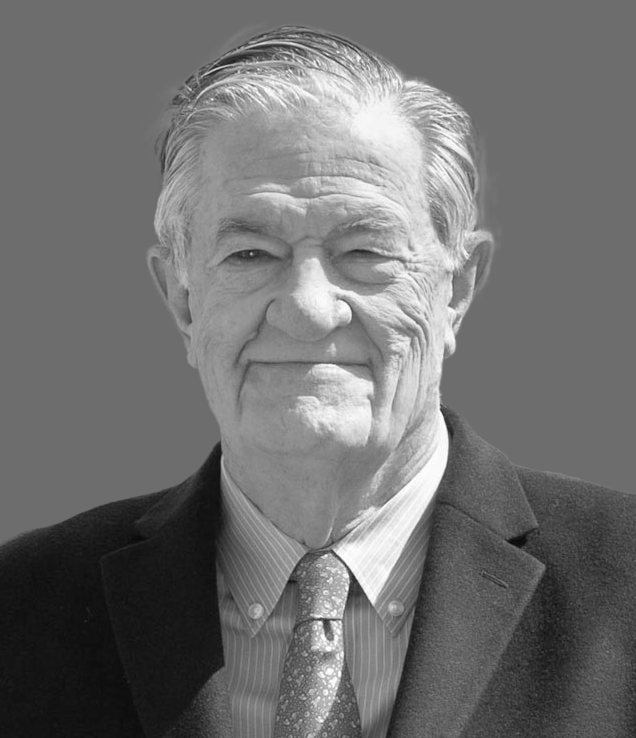
Cipher Brief Expert Tim Willasey-Wilsey is a Visiting Professor at King’s College, London and a former senior British diplomat. From 1996 to 1999 he was senior advisor to the British government on overseas counterterrorism.  This piece was first published by RUSI in London.  The views do not represent those of RUSI.


Analysis of openly available sources indicates that a British report shared with the US in December 1998 described an early stage of the 9/11 plot.


EXPERT PERSPECTIVE — Two extracts from Presidential Daily Briefs (PDB) are given some prominence in the 9/11 Commission report into the terrorist attacks in New York and Washington on 11 September 2001. One is from a PDB delivered to President Bill Clinton on 4 December 1998, and the other is from a PDB given to President George W Bush on 6 August 2001. Both are presented inside a textbox and both contain intelligence ‘from a friendly government’ which provided the first and only significant suggestion that Al-Qa’ida (AQ) planned to hijack aircraft in the US.

Eight months after the attacks, under Congressional pressure, the Bush administration was obliged to reveal some details of the PDBs, and on 17 May 2002 the New York Times disclosed that ‘the report provided to the president on Aug. 6, which warned him that Mr. bin Laden’s followers might hijack airplanes, was based on 1998 intelligence data drawn from a single British source, government officials said today’. The British government was obliged to acknowledge that the intelligence came from British sources. The Guardian reported on 18 May that ‘The memo received by Bush on 6 August contained unconfirmed information passed on by British intelligence in 1998’. The Independent ran much the same story with additional detail.

Both PDBs quoted from one British report from December 1998. The key question is whether this report, with its significant deviations from what actually happened on the day, actually referred to the 9/11 operation. Subsequently published evidence points compellingly to this indeed being an early version of the 9/11 plan.

The heavily redacted British contribution was shown on pages 127 and 128 of the 9/11 Commission’s report. It reads:

‘On Friday December 4 1998 the CIA included an article in the Presidential Daily Brief (PDB) describing intelligence received from a friendly government about a hijacking in the United States.

‘SUBJECT. Bin Laden preparing to hijack US aircraft. Reporting [passage redacted] suggests bin Laden and his allies are preparing for attacks in the US including an aircraft hijacking to obtain the release of Sheikh Omar Abdal Rahman,  Ramzi Yousef and Muhammad Sadiq Awda. One source quoted a senior member of the Gamaat Al-Islamiya (GI) saying that “as of late October the GI had completed planning for an operation in the US on behalf of bin Laden but that the operation was on hold. A senior bin Laden operative from Saudi Arabia was to visit GI counterparts in the US soon thereafter to discuss options – perhaps including an aircraft hijacking. GI leader Islambouli in late September was planning to hijack a US airliner during “the next couple of weeks” to free Abdal Rahman and the other prisoners according to what may be another source. The same source late last month said that bin Laden might implement plans to hijack aircraft before the beginning of Ramadan on 20 December and that two members of the operational team had evaded security checks during a recent trial run at an unidentified New York airport.’


The Cipher Brief hosts private briefings with the world’s most experienced national and global security experts.  Become a member today.


In May 2002 the US National Security Advisor Condoleezza Rice issued a statement observing (correctly) that the report had mentioned ‘hijacking in the traditional sense’ with no indication that aircraft would be used as weapons of mass destruction. Her testimony to the 9/11 Commission made broadly the same point.

Indeed, even in late 1998, there was a profusion of threat reports of which the aviation strand was just one. The MI5 official history comments aptly that the Service was puzzled as to why there were so many more reports of threats than actual attacks: ‘Even the most reliably sourced intelligence received on this question usually consists of a snapshot of a proposed plan being discussed. Most of the reporting does not make clear how far advanced the plan is’ (Christopher Andrew, The Defence of the Realm, pp. 802–806). What MI5 did not realise at the time was that AQ operations could take up to three years from inception to execution.

Steve Coll writes that ‘Within the morass of intelligence lay ominous patterns. One was an interest by bin Laden’s operatives in the use of aircraft … yet at the counter terrorism security group meetings and at the CIA’s counter terrorist centre there was no special emphasis placed on bin Laden’s threat to civil aviation or on the several exposed plots where his followers had considered turning hijacked airplanes into cruise missiles’ (Steve Coll, Ghost Wars, pp. 419–420).

Although the December 1998 report appears fragmentary, there were a number of aspects of particular interest. The first was the name Ramzi Yousef. Yousef had studied electrical engineering at Swansea Institute from 1986 to 1990 before exploding a massive bomb under the World Trade Centre in February 1993 and then planning the Bojinka Plot against airliners in the Philippines in 1994. Yousef had been arrested in Islamabad in February 1995 and sent to the US, where he was tried and imprisoned for life. He was an energetic and imaginative terrorist, and his uncle Khalid Sheikh Mohammed was also known to move in terrorist circles.

The aviation link must have struck a chord, too. The British were also interested in Hussain Kherchtou, who had been in Kenya at the time of the Embassy bombings and was himself a pilot. He later provided a debrief to the FBI. His story and his courtship by the British came into the public domain because of a subsequent US court case and a talkative FBI officer.

The Egyptian angle also would have provoked little surprise. On 19 November 1995 Egyptian terrorists had blown up the Egyptian Embassy in Islamabad, killing 13 – only yards from the British High Commission compound with its exposed staff housing and kindergarten. The British had a miraculous escape that day.

The concern for the release of Sheikh Abdal Rahman, ‘the Blind Sheikh’, was consistent with the widespread devotion which the preacher inspired among Islamist radicals and particularly Egyptians. His imprisonment in New York for his part in Yousef’s attack on the World Trade Centre had caused significant distress among his many adherents, who all wanted his release.

The idea that AQ would strike the US had first surfaced in 1997 and felt like the logical next step. Only a month beforehand (in November 1998), AQ had attacked two US Embassies in Kenya and Tanzania, killing 224 people including 12 US citizens. These operations had served as a wake-up call for those who thought the AQ threat was being exaggerated, and some who even conceived of Osama bin Laden himself as a benign figure who had somehow got out of his depth.

There were also some puzzling elements in the report. The first was the rather outdated idea of hijacking an aircraft to demand the release of the Blind Sheikh. It felt more in tune with Palestinian terrorist methods of the 1970s, and it was already known that Ramzi Yousef had developed the idea of exploding full airliners in flight.

The involvement of Gama’at Islamiya (GI) seemed odd. Bin Laden was known to be close to Ayman Al-Zawahiri of Egyptian Islamic Jihad (EIJ), with whom GI were usually at daggers drawn. At the time GI were conceived of more as domestic Egyptian terrorists compared to the internationalist EIJ. Indeed, GI’s most recent operation had been the Luxor Massacre of November 1997, which killed 56 foreign tourists.


Go beyond the headlines with expert perspectives on today’s news with The Cipher Brief’s Daily Open-Source Podcast.  Listen here or wherever you listen to podcasts.


The name Islambouli carried great resonance. This was Mohammed Shawqi Islambouli, who had tried to assassinate Egyptian President Hosni Mubarak in Addis Ababa in 1995. His brother Khalid had been one of the assassins of President Anwar Sadat in October 1981 and had been tried and executed in Cairo. However, although Mohammed was thought to be in Afghanistan, he was not then known to be close to bin Laden, let alone Al-Zawahiri.

The dates made little sense. On the one hand an attack seemed imminent, but on the other hand it was ‘on hold’. But such is the nature of counterterrorist reporting: small fragments of a much bigger jigsaw.

Nonetheless, the report was taken very seriously on its receipt in the US. President Bill Clinton’s counterterrorism advisor Richard Clarke summoned his Counterterrorism Security Group. ‘To address the hijacking warning, the group agreed that New York airports should go to maximum security starting that weekend. They agreed to boost security at other East coast airports. The CIA agreed to distribute versions of the report to the FBI and FAA to pass to the New York Police Department and the airlines. The FAA issued a security directive on December 8, with specific requirements for more intensive air carrier screening of passengers and more oversight of the screening process, at all three New York City area airports.’

Of course, when 9/11 happened nearly three years later, there were two very significant differences. Although aircraft were indeed hijacked, they were used as missiles rather than as bargaining chips, and the terrorists were mainly Saudi and not Egyptian. So what happened between December 1998 and September 2001 which could explain these changes?

The 9/11 Commission report (drawing on material from the interrogation of Khalid Sheikh Mohammed) provides a fascinating section on AQ’s development of aviation methodology. Even before bin Laden had left Sudan in mid-1996, he had allegedly discussed the use of aircraft with Mohammed Atef: ‘(1) they rejected hijackings aimed at gaining the release of imprisoned comrades as too complex, because al Qaeda had no friendly countries in which to land a plane and then negotiate; (2) they considered the bombing of commercial flights in midair, as carried out against Pan Am Flight 103 over Lockerbie, Scotland, a promising means to inflict massive casualties; and (3) they did not yet consider using hijacked aircraft as weapons against other targets.’

So, why was the idea of a traditional hijacking still being discussed as late as December 1998? The answer must lie in the Egyptian jihadists’ determination to win the release of the Blind Sheikh. Mustafa Hamid, a journalist who was with bin Laden in Afghanistan, provides illuminating insight into the wrangling between EIJ and GI in Afghanistan. Hamid documents the tortuous process by which GI, with some reluctance, formed a union (‘The World Islamic Front against Jews and Crusaders’) with AQ, EIJ and others, but recounts how GI insisted on secrecy about their involvement. Hamid also describes GI’s determination to obtain the Blind Sheikh’s release and the involvement of one of their operatives in the African Embassy bombings (Mustafa Hamid and Leah Farrall, The Arabs at War in Afghanistan, p. 241 and pp. 263–266). So GI was indeed part of bin Laden’s group in Afghanistan and was involved in operations at the time of the December 1998 report.

However, bin Laden became increasingly irritated by the endless squabbling among the two Egyptian groups. Lawrence Wright, drawing upon a variety of sources, chronicles the disastrous attack on Luxor, which had the effect of alienating the Egyptian population from both groups. When on 23 February 1998 bin Laden’s second fatwa announcing the ‘World Islamic Front’ was published in an Arabic newspaper in London, GI were appalled, and some members tried to have Rahman pronounced emir instead of bin Laden. No wonder that Wright concludes that ‘bin Laden had had enough of the in-fighting between the Egyptian factions. He told both groups that their operations in Egypt were ineffectual and too expensive and that it was time for them to turn their guns on the United States and Israel’ (Lawrence Wright, The Looming Tower, pp. 290–296). This may explain why the December 1998 report mentions the operation being ‘on hold’. Between December and the spring of 1999, the GI team and Islambouli must have been stood down.

According to the 9/11 Commission report, in March or April 1999, Khalid Sheikh Mohammed (KSM) – who had hitherto allegedly been on the fringes of AQ – was summoned to Kandahar, where he discussed the aircraft plan with bin Laden and Mohammed Atef. Four operatives were chosen to begin work on the US project. However, ‘travel issues … played a part in al Qaeda’s operational planning from the very start. During the spring and summer of 1999, KSM realized that Khallad and Abu Bara, both of whom were Yemenis, would not be able to obtain US visas as easily as Saudi operatives like Mihdhar and Hazmi’. And so, the 9/11 plot developed with 15 of the 19 terrorists being Saudi nationals. Only Mohammed Atta was Egyptian.

KSM’s key involvement in the 9/11 plot makes it evident that there could not have been a second GI plot running in parallel, because KSM and Islambouli were close associates. Robert Baer and the 9/11 Commission report agree that KSM and Islambouli were working together in Qatar in the mid-1990s. For KSM it must have been difficult to abandon the rescue of his nephew, but he would have known that a traditional hostage release operation had none of the ambition or scale of bin Laden’s new thinking.

On 6 August 2001, only five weeks before the attacks, the December 1998 report featured once again in the PDB given to George W Bush at Crawford, Texas, entitled ‘Bin Laden determined to strike in US’. It began: ‘Clandestine foreign government and media reports indicate bin Laden since 1997 has wanted to conduct terrorist attacks in the US’, and concluded: ‘We have not been able to corroborate some of the more sensational threat reporting such as that from a [redacted] Service in 1998 saying that bin Laden wanted to hijack a US aircraft to gain the release of “blind Sheikh” Omar Abdal Rahman and other US-held extremists … Nevertheless, FBI information since that time indicates patterns of suspicious activity in this country consistent with preparations for hijackings or other types of attacks.’

The PDB of 6 August caused some discomfort to the Bush administration and led to a National Security Archive page devoted to that one PDB (of which the December 1998 British report was just one constituent part).

The CIA Director George Tenet, who had been a tireless pursuer of the AQ threat before 9/11 and a regular correspondent with and visitor to London, regretted that more had not been done ‘to protect the United States against the threat. To cite two obvious and tragic failures, only after 9/11 were cockpit doors hardened and passengers forbidden from carrying box-cutters aboard US commercial airliners’ (George Tenet, At the Centre of the Storm, p. 205).

The British report of December 1998 was fragmentary, and while it was certainly ‘sensational’, it was not half as sensational as the actual events of that unforgettable and tragic day.

The views expressed in this Commentary are the authors, and do not represent those of RUSI or any other institution.

Read more expert-driven national security insights, perspective and analysis in The Cipher Brief

The post The British and 9/11 appeared first on The Cipher Brief.
find more fun & mates at SoShow now !

Greece will soon prohibit unvaccinated residents from entering a litany of public spaces, the country’s prime minister has announced, claiming its current Covid outbreak is largely fueled by those who haven’t received the jab.

Starting next week, the unvaccinated will be barred from entry to restaurants, cafes, theaters, bars, gyms and museums, among other indoor public places, PM Kyriakos Mitsotakis said on Thursday, noting that a negative Covid-19 test will no longer be accepted as an alternative to proof of vaccination.

“This is indeed a pandemic of the unvaccinated,” he said as he announced the move in a televised address, adding “Greece is mourning unnecessary losses because it simply does not have the vaccination rates of other European countries.”

The new rules are set to take effect on Monday, and will require Greeks to present vaccine certificates to businesses and other indoor establishments to be allowed inside. Those attending religious services mark a rare exception, however, as they will only be asked to present a negative test in order to enter a church or other place of worship.

Read more

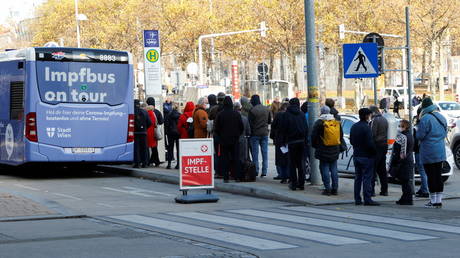
People wait in front of a vaccination after Austria's government has imposed a lockdown on people who are not fully vaccinated, in Vienna, Austria, November 18, 2021. © Reuters /Leonhard Foeger
Austria may lock down the vaccinated too

In a bid to encourage booster vaccinations among the elderly – a population much more vulnerable to Covid-19 – citizens over the age of 60 will be made to renew their certificate after a period of seven months.

While officials had hoped to hit a full vaccination figure of 70% for Greece’s population of 11 million by autumn, the number currently stands at about 62%, according to Reuters. As its weekly case counts continue to soar to record highs, the country reported 7,317 new Covid-19 infections and 63 deaths on Thursday, bringing the totals to more than 860,000 cases and some 17,000 fatalities since the pandemic kicked off in late 2019.

The new restrictions in Greece mirror similar policies implemented elsewhere in Europe, with Austria, Germany, Italy, France, the Czech Republic and Slovakia each imposing limits on public life for the unvaccinated. Though the Austrian government recently imposed a full lockdown for millions of residents who have not received the shot, some officials in that country are pushing for even harsher policies, including a national stay-at-home order on the jabbed and non-jabbed alike.

Think your friends would be interested? Share this story!

find more fun & mates at SoShow now !

Apple has finally caved to users demanding the ‘right to repair’, allowing owners of iPhones, MacBooks, and other devices to tinker with their electronics at home instead of bringing them to notoriously expensive service centers.

Called Self Service Repair, the feature is set to launch “early next year” in the US before expanding to other countries. Some 200 parts are expected to be available, along with instructions on how to replace them.

Initially, the company will offer repairs for the iPhone 12 and 13, to be followed by Macs with M1 chips. Users will be able to replace the phones’ display, battery, and camera – some of the earliest parts to cease functioning – using original equipment from the company. While Apple encourages only “individual technicians with the knowledge and experience to repair electronic devices,” urging users to take their devices to a professional before cracking them open themselves, the move nevertheless represents a major step for a company that has long been resistant to allowing users to even swap out a battery.

Read more

Apple Chief Executive Officer Tim Cook at the Apple Store on University Avenue,  Palo Alto, California, September 20, 2013.
Apple’s labor breach results in huge payments for employees

After rolling out repair instructions and parts for the iPhone 12 and 13, the company will gradually expand users’ abilities to fix their phones themselves without having to wait in line at the Apple Store. Users who attempt to make these repairs on their own will not void their warranty, according to TechCrunch, representing another major change for the tech giant.

Even this week, Apple was sealing off users’ ability to fix their own phones, barring users who replaced their own screens from being able to use Face ID recognition going forward. However, the various departments seem to be coordinating among themselves – users will receive a recycling credit for returning their used or broken part after completing the repair, and the company plans to sell “more than 200 individual parts and tools,” as well as repair manuals customers can peruse before attempting to repair their devices.

The decision to open up Apple’s “right to repair” might not have been entirely that of the company – the Federal Trade Commission wrote to the corporation earlier this year vowing to “address unlawful repair restrictions,” adding it would also “stand ready to work with legislators, either at the state or federal level, in order to ensure that consumers have choices when they need to repair products that they purchase and own.”

If you like this story, share it with a friend!

find more fun & mates at SoShow now !

Covid-19 variants keep emerging in different parts of the world, causing experts to ask how long the pandemic will last, and how effective the current methods of protection really are.

Since the pandemic started in 2019, people have referred to the disease which has paralyzed the world simply as ‘coronavirus’. Now, in 2021, when we talk about it, we mean not just the original variant, but also its numerous mutations. 

Read more

© Getty Images / sasacvetkovic33
Drastic drop in Covid vaccine effectiveness – study

In May, the WHO decided to label the key variants with Greek letters. Since then, the Delta variant has been proclaimed the predominant strain across the world, and now we have titles that look like codes to detail the differences between variants. Last month, the UK was put on high alert over a fast-spreading Delta AY.4.2 variant. This week, Norway reported finding one more version of the Delta strain – AY. 63. The country’s experts suggest it’s not more dangerous than the Delta mutation itself. Meanwhile, another Covid variant, discovered in France (B.1.640), brought the researchers an unpleasant surprise: they said they’d never seen mutations like it. 

Professor David Dockrell, from the Center for Inflammation Research of the University of Edinburgh, described to RT the reasons for the constant mutation of the coronavirus. “The areas in the virus that are most likely to change are those that come into contact with what we call ‘selective pressures’ – or factors that make them need to change,” he explains. “So, a version of the virus which mutates and changes to give it a selective advantage to escape from the immune system is more likely to prosper and become a dominant strain.” 

That’s how it works: The part of the virus many of the immune responses (or antibodies, T-cells etc.) are responding to is called the spike protein (or the S-protein). So, the virus tries to change it in order to survive. 

“We know that a variety of different viruses are able to mutate and change when exposed to the selective pressure of the immune system, whether it would be the human immune system or other species in which these viruses have evolved,” Prof. Dockrell says. “And of course, we’ve seen it most clearly with HIV, which is particularly good at changing and evolving. It does something called ‘reverse transcription’ – it copies material in the reversed direction from DNA to RNA.” 

Covid is still seemingly running faster than humanity’s efforts to curb it, but Prof. Dockrell has some good news. “The coronavirus – and viruses like it – are not as able to make these changes. They are going to do it to some extent, but they are not going to be as successful as retroviruses and HIV.” 

And the other major thing to say: When the viruses make changes, there’s always what we call ‘a fitness cost’. Many of the potential changes that the virus could make will actually not favor its survival. So there are only a certain number, potentially, of changes that the virus can make, before it starts affecting its fitness. 

Now, unfortunately, we are still in a phase where Covid19 can continue to evolve and change. It’s not time to panic, though, because across the world various ways to adapt the current anti-Covid strategies are already in place. First of all, people should keep getting vaccines – maybe receiving slightly altered booster doses, Prof. Dockrell suggests, “in a way, that we, after all, have to do with influenza, by providing a seasonal influenza vaccine and changing it every year.” 

Read more

RT
WHO sounds alarm over looming Covid-19 catastrophe in Europe

“And maybe we have to keep changing some of the treatments like these new monoclonal antibodies against the virus, because they also may be limited by the emergence of a mutation of the virus evolving the S-protein,” he adds. 

Sounds promising – but won’t it become a never-ending race against constantly emerging mutations? 

Hopefully not. According to Prof. Dockrell, there are parts of viruses that scientists call ‘conserved areas’. With time, vaccines and monoclonal antibodies will target these areas, which the virus finds very hard to change. “Clearly, the direction of travel is to develop either vaccine responses that affect more different kinds of virus, or these ‘monoclonal antibodies’ that we could use to prevent or treat infection, that they will target more conserved areas and therefore will be less limited by the ability of these virus to evolve and change,” he concludes.

Think your friends would be interested? Share this story!


find more fun & mates at SoShow now !

The children of families who were affected by the massive earthquake which devastated large parts of south-west Haiti in August this year are receiving free hot meals at school as part of an initiative by the UN’s World Food Programme (WFP) to support the recovery of the country’s most vulnerable communities.

Read the full story, “Hot meals helping Haiti’s children recover from the earthquake”, on globalissues.org

find more fun & mates at SoShow now !

Scientists have used artificial intelligence to “predict” formulas for new designer drugs, with the stated goal of helping to improve their regulation. The AI generated formulas for nearly nine million potential new drugs.

Researchers with the University of British Columbia (UBC) used a deep neural net for the job, teaching it to make up chemical structures of potential new drugs. According to their study, released this week, the computer intelligence fared better at the task than the scientists had expected.

The research team used a database of known designer drugs – synthetic psychoactive substances – to train the AI on their structures. The market for designer drugs is ever-changing, since their manufacturers are constantly tweaking their formulas to circumvent restrictions and produce new “legal” substances, while cracking their structure takes months for law enforcement agencies, the researchers said.

Read more

FILE PHOTO: A man living on the streets displays what he says is the synthetic drug fentanyl, in the Tenderloin section of San Francisco, California, February 27, 2020 © Reuters / Shannon Stapleton
Drug overdose deaths in US hit all-time record

“The vast majority of these designer drugs have never been tested in humans and are completely unregulated. They are a major public-health concern to emergency departments across the world,” one of the researchers, UBC medical student Dr. Michael Skinnider has said.

After its training, the AI was able to generate some 8.9 million potential designer drugs. Afterwards, researchers ran a data sheet of some 196 new drugs, which had emerged in real life after the model was trained, and found that more than 90% of these have been already predicted by the computer.

“The fact that we can predict what designer drugs are likely to emerge on the market before they actually appear is a bit like the 2002 sci-fi movie, Minority Report, where foreknowledge about criminal activities about to take place helped significantly reduce crime in a future world,” senior author Dr. David Wishart, a professor of computing science at the University of Alberta, has said.

Identifying completely unknown substances remains an issue for the AI, the research team has noted, but they hope it might potentially help with that task, since the computer was also able to predict which formulas of designer drugs were more likely to be created and hit the market. The model “ranked the correct chemical structure of an unidentified designer drug among the top 10 candidates 72 percent of the time,” while throwing in spectrometry analysis, which is an easily obtained measurement, bumped the accuracy to some 86%.

“It was shocking to us that the model performed this well, because elucidating entire chemical structures from just an accurate mass measurement is generally thought to be an unsolvable problem,” Skinnider stated.

Think your friends would be interested? Share this story!

find more fun & mates at SoShow now !

Behind the Headlines brings you expert perspectives on today’s headlines by telling you more than what happened, but also what it means.  You can also listen to The Cipher Brief’s Daily Open-Source Collection Podcast wherever you listen to podcasts.

Jack Devine, Former Acting Director, National Clandestine Service, CIA

Cipher Brief Expert Jack Devine, a 32-year CIA veteran. Devine served as both Acting Director and Associate Director of CIA’s operations from 1993-1995.  He is a founding partner and President of The Arkin Group, which specializes in international crisis management, strategic intelligence and investigative research. Devine is the author of Spymaster’s Prism: The Fight Against Russian Aggression.

Russia’s multi-pronged support of Myanmar is a microcosm of its strategy in Southeast Asia.

In the months since Myanmar’s February military coup, Russia and China have been the junta’s most powerful allies, but Russia has exploited regional instability to position itself as a third path between China and the West. While China was closer with the former Myanmar government than the military, it was also concerned about the government’s ties with the West and potential interference in its development efforts, particularly its Belt and Road Initiative. Russia, on the other hand, doesn’t depend on stability in Southeast Asia to the same degree as China and can instead take advantage of warring factions. Last month, on his first trip outside of the immediate region since February, Myanmar’s junta leader Min Aung Hlaing went to Moscow to meet with high-level Russian defense officials instead of heading to Beijing. Hlaing has reportedly visited Russia seven times within the past decade and previously stated that over 6,000 Myanmar officers have studied at Russian military academies. According to data from the Stockholm International Peace Research Institute (SIPRI), Russia was responsible for almost 40% of arms sales to Myanmar from 1999-2018, second only to China. SIPRI data further indicates that Russia has been Southeast Asia’s largest arms supplier over the past two decades, counting Vietnam and Laos as top customers. But Russia is offering the region more than arms and has promised Myanmar two million Covid-19 vaccines and assistance in the nation’s own vaccine production efforts. Russia has also been trying to expand free trade agreements between its Eurasian Economic Union (EAEU) and Southeast Asian countries, most recently getting Indonesia to sign on to the deal. Stepping even further into soft power efforts, last week Russia’s foreign minister met with his Bangladeshi counterpart and agreed to encourage Myanmar to engage in dialogue with Bangladesh on the Rohingya crisis.


Get your free daily Open-Source Collection report in The Cipher Brief newsletter or take it on the go as a podcast.  Listen here or wherever you listen to podcasts.


Leftist, former schoolteacher Pedro Castillo is declared President of a divided Peru, projected economic growth could play in his favor. 

Peru, like many of its neighbors, has been battling the triple and interwoven threat of Covid-19, social unrest, and severe economic downturn. But for the past several years Peru has also been challenged by sharp divisions between its executive and legislative powers. Last November, Peru’s unicameral legislature voted to impeach then-President Martín Vizcarra, citing mismanagement of the pandemic and corruption, in a move that outraged thousands. The June presidential elections were likewise fraught. Castillo’s right-wing rival Keiko Fujimori, who is also under investigation for corruption, alleged electoral fraud and the Peruvians initiated a six-week long investigation, eventually finding Castillo the rightful victor. The EU, U.S. and 14 electoral missions deemed the elections legitimate, and the U.S. called the election a “model of democracy” for the region. Castillo, who previously worked as an elementary school teacher and has never held public office, will be greeted by a political establishment that is almost entirely against him. Peruvian citizens are also deeply divided, and many urban elites reportedly moved their money overseas out of fear for Castillo’s economic policies. But Castillo’s Peru Libre party holds fewer than 40 of 130 seats in the legislature and Castillo has already recruited several moderate advisors. Further, he has backed away from talk of nationalizing Peru’s lucrative multinational mining, oil, gas, and hydrocarbon companies, instead pledging to raise taxes on mining firms. Prices of copper and gold, two of Peru’s most critical exports, remain high and Covid-related trade obstacles are expected to ease over the coming months. While it is uncertain how effective Castillo will be, or where he will ultimately fall on his policies, positive projections for Peru’s export-based economy will likely play in his favor.


The Cipher Brief hosts private briefings with the world’s most experienced national and global security experts.  Become a member today.


Enjin becomes first blockchain platform to gain acceptance into the United Nations Global Compact, signaling widespread range of corporate sustainability efforts.

On Tuesday, Enjin, an innovative blockchain technology company focused on non-fungible tokens (NFTs), became the first such company to join the United Nations Global Compact. Upon admission, Enjin stated that it hopes to use NFTs to promote sustainability and equality in line with the UN pact that encourages businesses and firms worldwide to adopt more environmentally friendly and socially responsible practices. NFTs have surged in popularity in the past two years, and during the first quarter of 2021 NFT sales reportedly exceeded US $2 billion. In essence, an NFT is a way to prove ownership of a unique virtual item. It’s a unit of data that’s stored on a blockchain, or digital ledger, that certifies exclusive ownership of digital files ranging from photos to sports trading cards. Enjin, which is headquartered in Singapore, has focused its NFT efforts on games and apps and is reportedly able to operate with a lower carbon footprint than Bitcoin due to a slimmed-down verification model that requires less energy. This week, the UN Global Compact not only included Enjin as a member, but gave the company its highest membership rank, sending a signal that it’s interested in promoting such an environmental effort by crypto and blockchain entrepreneurs. For its part, Enjin has stated that it wants to employ the technology in carbon capture companies, fighting climate change in the process. The Head of the UN AI and Robotics Center remarked that during the global struggle to recover from the pandemic we should take advantage of new technologies like AI and blockchain to better equip ourselves for the future.

Read more expert-driven national security insights, perspective and analysis in The Cipher Brief


The post Behind the Headlines: Russia in Myanmar, Peru’s New President and what Enjin means for the United Nations Global Compact appeared first on The Cipher Brief.
find more fun & mates at SoShow now !

The French government has kicked off a €14 million national campaign to tackle underage prostitution and pimping. It comes months after a report found as many as 10,000 youngsters, mostly teen girls, are involved in the sex trade.

The campaign, launched by the Ministry for Solidarity and Health on Monday, is expected to be fully rolled out in 2022. The ministry described the problem as a “growing phenomenon that society can no longer ignore” and about which “too little is known.”

The government programme is expected to “increase awareness” while helping to “inform and provide a better understanding of the phenomenon.” It also aims to help “identify the young people involved” and “prosecute clients and pimps more effectively.”

Read more

© Unsplash / Dainis Graveris
Russian sex workers & Only Fans stars offered free therapy sessions

According to RFI, the prevalence of underage prostitution has increased by as much as 70% over the past five years, with social media believed to be compounding the problem. The public broadcaster noted that the situation had worsened during the Covid-19 pandemic when young people spent more time online.

In July, a working group produced a damning report that found between 7,000 and 10,000 young people were involved in prostitution across the country. The majority are young girls aged between 15 and 17, but a ministry statement noted that the “entry point” into prostitution was increasingly becoming younger at around 14-15 years.

“There’s really a normalisation of prostitution of young people because girls say that selling sex is a way of making lots of money easily and that it can help them reach their dream life,” deputy public prosecutor Raphaelle Wach told the news outlet France 24.

In its statement, the ministry noted that many minors did not consider themselves victims and valued the “financial autonomy” and feelings of “belonging to a group” and “regaining control” over their lives.

“These minors are however in danger, both physically and psychologically,” the ministry warned.

“Covid played a considerable role because social networking provided new ways of being able to hook in underage girls very easily,” Geneviève Collas, who runs an NGO fighting human trafficking, told RFI. She added that recruiting minors has been made “easier” with short-term apartment rental apps like Airbnb helping mask the scale of the problem on the streets.

Like this story? Share it with a friend!

find more fun & mates at SoShow now !

Scientists have used an AI tool to identify which animals are most likely to contract and spread mutated versions of Covid-19. The model highlighted both pets and wild animals as likely reservoirs for the virus.

Using information about their habitats and various biological traits, researchers at the Cary Institute of Ecosystem Studies in New York developed the machine learning tool to figure out which animals had the particular ACE2 protein that the coronavirus was most likely to latch onto. 

Out of 5,400 tested, the scientists narrowed it down to 540 mammalian species.

Some of its predictions have been previously documented as transmission risks, for instance, dogs, cats and bats, while farm animals like pigs and exotic zoo animals were surprise additions.

Read more

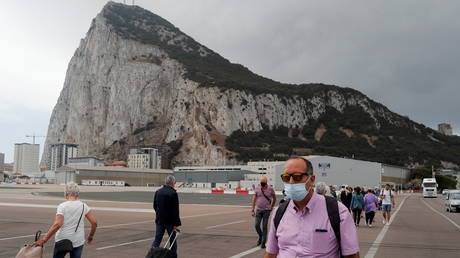
FILE PHOTO: People cross the tarmac of the airport in front of the Rock of Gibraltar in the British Overseas territory of Gibraltar, June 24, 2021 © Reuters / Jon Nazca
‘Most vaccinated’ place on earth cancels Christmas

Other expected additions are minks, Sunda pangolins, and 35 species of bats – which are together ranked among the top 10% of animals most likely to spread the virus, in line with lab results. 

The study, published in the Proceedings of the Royal Society journal, also ranked water buffalo, a number of primates, including gorillas and 76 rodent species as being more susceptible to infection.

The researchers taught the AI to identify patterns between rates of transmission and some 60 ecological and biological traits collected by earlier studies, including the overlap between the animal and human habitats as well as their respective lifespans, diets, and sizes.

Previously, the specific amino acid sequences had only been mapped out in around 300 species, including about 143 mammals — and figuring out which ones are more prone to infection is key to predicting the spread of the virus, researchers said.

Arinjay Banerjee at the University of Saskatchewan in Canada told the New Scientist that the results will help researchers “track viral infections and the possible emergence of animal-adapted coronavirus variants” around the world. Barbara Han, who led the study, said predictions needed to be followed up with systematic surveillance and lab studies.

Think your friends would be interested? Share this story!

find more fun & mates at SoShow now !