Extinction Rebellion has targeted Colombian diplomatic missions across several EU countries, including France and Italy, demanding that the nation address deforestation, coal mining, and indigenous peoples’ rights.

The hard-line climate activist group staged simultaneous protests outside several of Colombia’s diplomatic missions on Tuesday, calling on Bogota to protect biodiversity and stop deforestation. It also urged the country’s government to take action against the El Descanso open-pit coal mine, which is said to be threatening the Yukpa indigenous people.

The French branch of the activist group targeted the Colombian Embassy in Paris, vandalizing its entrance. Footage from the scene shows activists dousing the mission’s entrance in black paint, while plastering placards over its walls.

XR members then chanted slogans, lighting flares that emitted thick pink and black smoke. At least one activist was seen bathing in fake blood.

Another protest held outside Colombia’s consulate in Milan, Italy, saw that mission vandalized too. The building’s entrance was covered in fake blood, with a pile of a black substance, which looked like charcoal or coal, left by its doors.

Demonstrations also took place outside Colombia’s missions in Germany’s capital, Berlin, as well as in Madrid, Spain. Those protests appeared to be more civil, with activists rallying outside of the missions without vandalizing them.

Think your friends would be interested? Share this story!

find more fun & mates at SoShow now !

AstraZeneca has announced that its preventative antibody cocktail offers 83% protection against symptomatic Covid-19 for at least six months, making it more effective than its own vaccine.

In a statement on Thursday, AstraZeneca cemented its lead in the race to develop and market a preventative Covid-19 drug, which is delivered as a shot in the arm. 

The drug, named AZD7442, reduces the risk of symptomatic Covid-19 by 83% over the course of six months, according to data from a trial in which participants were given one 300mg dose. There were no deaths or severe infections recorded within the trial group, it said. 

Read more

Paxlovid, a Pfizer's coronavirus disease (Covid-19) pill, is seen manufactured in Ascoli, Italy (FILE PHOTO) © Pfizer/Handout via REUTERS
Pfizer gets new $5.3bn boost over Covid

A separate trial showed the drug reduced the risk of severe Covid-19 or death by 88% when administered within three days of the onset of symptoms. 

“These new data add to the growing body of evidence supporting AZD7442’s potential … We are progressing regulatory filings around the world and look forward to providing an important new option against SARS-CoV-2 [Covid-19] as quickly as possible,” AstraZeneca Executive Vice President Mene Pangalos said in the statement. 

The Anglo-Swedish firm has agreed to supply the US government with 700,000 doses of AZD7442 if the Food and Drug Administration grants it emergency use, which AstraZeneca requested on October 5. The firm has similar agreements with other nations. 

The drug is created using a combination of two antibodies originating from immune B-cells donated by a recovering Covid-19 patient. 

The treatment could be used in people who are known not to respond well to vaccines, such as cancer patients. Around 2% of people are considered to be at risk of not creating enough antibodies following the administration of a Covid-19 vaccine. 

Based on the numbers, the drug appears to be more effective than the firm’s first-generation Covid-19 vaccine. Britain’s Zoe Covid study showed the effectiveness of the vaccine dropped to around 67% after four to five months. 

If you like this story, share it with a friend!

find more fun & mates at SoShow now !

As information emerges about Islamic State of Khorasan, or ISIS-K – the terrorist group that claimed responsibility for last week’s suicide attack that killed 13 US service members and more than 160 Afghans – there is an increased effort to predict how Afghanistan, under Taliban rule, may emerge once again as a breeding ground for terrorist groups.

A United Nations report released in June estimates that thousands of fighters from the region had already poured into Afghanistan.  Many of them are believed to be affiliated with either the Taliban – still seen as a terrorist organization – or al Qaeda or ISIS-K.

The New York Times reports that ISIS-K was created six years ago by members of the Pakistani branch of the Taliban.  There is a range of thought among experts as to what their ability to successfully carry out a terrorist attack in a Taliban-ruled area means for the terrorist threat moving forward. 

The Cipher Brief spoke with respected terrorism experts Bruce Hoffman, Mitch Silber and Colin Clarke to get their thoughts on the current risk of terrorist attacks against Americans both home and abroad. 

Bruce Hoffman, Terrorism Expert and Professor, Georgetown University
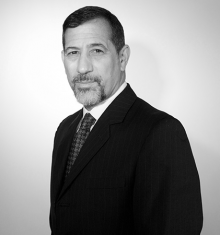
Cipher Brief Expert Bruce Hoffman is a professor at Georgetown University and served as a commissioner on the Independent Commission to Review the FBI’s Post-9/11 Response to Terrorism and Radicalization.  He is also a Scholar-in-Residence for Counterterrorism at CIA.

Mitch Silber, Former Director of Analysis, NYPD

Cipher Brief Expert Mitch Silber served as Director of Intelligence Analysis at the New York City Police Department and served as principal advisor to the Deputy Commissioner of Intelligence on counterterrorism policy and analysis. He is now executive director of the Community Security Initiative.

Colin Clarke, Director of Policy and Research, The Soufan Group

Colin P. Clarke, Ph.D., is the Director of Policy and Research at The Soufan Group. Clarke’s research focuses on domestic and transnational terrorism, international security, and geopolitics. He is also a senior research fellow at The Soufan Center.  

The Cipher Brief: If the United Nations Report issued in June is accurate, and there are thousands of fighters from the region who have poured into Afghanistan – many associated with known terrorist groups – is there any way that the administration can say ‘mission accomplished’ in terms of degrading terrorism’s presence in Afghanistan? 

Hoffman: No. As those numbers from the report released by the United Nations Support and Sanctions Monitoring Team highlight, Afghanistan is again becoming a jihadi magnet and will likely continue to be so into the future. The suicide bomb attacks outside the gates of Kabul International Airport last Thursday underscore the multiplicity of terrorist groups already present in that country.

In addition to ISIS-K, there is the Haqqani Network, al Qaeda and, of course, the Taliban. Terrorism thrives in conditions of chaos and instability which the terrorists hope to spread to other countries and eventually across regions.

Much as Salafi-Jihadi terrorists migrated from existing battlefields in South Asia back to the Middle East, North Africa, and the Caucasus in the 1990s; spread to East and West Africa in the early 2000s; blossomed during the Arab Spring to wage civil wars in Syria, Libya, and the Sahel, in the early twenty-teens; the same phenomenon is unfolding in Afghanistan.

Silber:  Frankly, I don’t think any of the four administrations can make the claim that the policy goal of making Afghanistan inhospitable to serve as a safe haven for Al Qaeda or other similarly oriented jihadist groups has been accomplished.  Certainly, at a number of times during the last twenty years, the threat that jihadist groups, most importantly — Al Qaeda — has presented, in terms of their ability to project a threat to the United States has been diminished, the degradation of the threat was only temporary.

The Cipher Brief: How confident are you that Al Qaeda and ISIS are unable to plan and execute attacks against the U.S. domestically? 

Hoffman:  The credulous Doha negotiations with the Taliban that led to the withdrawal of U.S. military forces from Afghanistan and subsequently to the Taliban’s blitzkrieg across Afghanistan and then to the shambolic evacuation of our diplomats and citizens, has painted a huge target on America’s back. Like sharks in the water, terrorists will smell blood. As my Council on Foreign Relations colleague, Jacob Ware, and I wrote in War on the Rocks, in May, every time terrorism has forced the U.S. to withdraw from a conflict zone where it had committed ground forces, whether in Lebanon in 1984; Somalia in 1993; and Iraq in 2011, it has led to more terrorism worldwide, not less, and thus made the U.S. less safe.

At a time when our country continues to grapple with the COVID pandemic; when climate change is pulverizing the Gulf States with Hurricane Ida and California with worsening wildfires; when the January 6th insurrection at the U.S. Capitol building continues to smolder with incidents such as the bomb threat that paralyzed the area near the Library of Congress and Cannon House Office Building earlier this month; coupled with ongoing cyberattacks and peer competition from China and Russia and concerns over Iran’s nuclear aspirations; our terrorist adversaries may well conclude that the U.S. is sufficiently preoccupied or distracted by any or all of the preceding and therefore conclude that the time to strike the homeland is opportune. It would very unlikely entail a repeat of the catastrophic September 11th 2001 attacks. But a terrorist strike along the lines of the 2019 shootings at Naval Air Station Pensacola; the 2017 suicide bombing of a concert venue in Manchester, England; the coordinated suicide attacks on London transport in 2005; the 2004 Madrid commuter train bombings; or any kind of significant lone wolf incident perpetrated in the name of some existing terrorist movement would likely re-create the widespread fear and anxiety that are terrorism’s stock-in-trade. Twice in the past three years, it should also be noted, members of al-Shabaab – perhaps al Qaeda’s least technologically proficient franchise – have been arrested both in the Philippines and in an undisclosed African country engaging in the same flight training that four of the 9/11 hijackers undertook before their fateful, history-changing coordinated attack.

Silber:  At this very moment, it is unlikely that Al Qaeda or ISIS-K have the infrastructure, resources, recruits and external planning ability to strike the United States based on statements by the IC and senior DoD officials to Congress.  However, without any, or only limited external pressure by the U.S. military as a result of the retreat from Afghanistan, these networks and capabilities can be reconstituted in the coming months and certainly groups like Al Qaeda have never given up their desire to strike the American homeland.

Clarke:  I think it is unlikely that AQ or ISIS will be able to attack the U.S. homeland.  We’ve spent the better part of the past two decades shoring up homeland defense. We’ve got CT tools now that we didn’t have twenty years ago. That said, the picture could look quite different 6, 12, 18 months from now. Both of those organizations are capable of regenerating an external operations planning capability. There is also the worry of inspired attacks.


The Cipher Brief hosts private briefings with the world’s most experienced national and global security experts.  Become a member today.


The Cipher Brief:  Some analysts have said that morale among terrorist or Islamic extremist groups is extremely high due to the circumstances surrounding the US pullout in Afghanistan, do you agree and if so what does that mean? 

Hoffman:  Yes. Of course. Both Sunni and Shi’a terrorist movements around the globe have applauded the Taliban’s re-conquest of Afghanistan and routing of the U.S. military. For Sunni Salafi-Jihadi terrorists, the events there this past month validate the strategy articulated by Usama bin Laden just before the 2004 U.S. presidential election, when he described the ease with which al-Qaeda had been able to “bled Russia for 10 years, until it went bankrupt and was forced to withdraw in defeat” from Afghanistan in 1989, and predicted that the same fate would eventually befall the U.S. And, Sayed Hassan Nasrallah, the Secretary-General of Hezbollah, a Shi’a terrorist organization, for instance, last week delivered a sermon where he described America’s “historic and humiliating defeat in Afghanistan as representing, “the moral downfall of America.”

Silber:  Jihadi chat rooms and online extremist networks are feeling like they have the wind behind them.  It took twenty years, but before the 20th anniversary of the attacks of 9/11 an Islamic emirate has been re-established in Afghanistan.  Suddenly, what seemed impossible has become possible and Islamist insurgencies all throughout the Middle East and South Asia can take inspiration by the determination of the Taliban in their efforts to overthrow a secular democratic government and replace it with an Islamist one.

Clarke:  I do expect morale to be high among terrorist and especially Islamic extremists given the turn of events we’ve seen in Afghanistan. We’re a week and a half out from the 20-year anniversary of 9/11, and Al Qaeda leaders are returning to Afghanistan (this is being displayed in AQ propaganda). We’ve seen al-Qaeda affiliates all over the globe congratulating the Taliban for their victory. I don’t want to overstate the case here, but I do believe that what has occurred in Afghanistan will be a serious boost for the global jihadist movement right at the same time the U.S. and its allies are shifting from counterterrorism to great power competition. There will be fewer resources and energy to deal with terrorists, right at the time we have major threats metastasizing in Afghanistan, potentially with both a reinvigorated al-Qaeda and a stubbornly resilient ISKP.

Read also Mike Leiter’s Why We’re Much Safer from Terrorism Now, Than We Were After 9/11 in The Cipher Brief 

Read also Why We Need a New National Defense Strategy (for terrorism) exclusively in The Cipher Brief 


Go beyond the headlines with expert perspectives on today’s news with The Cipher Brief’s Daily Open-Source Podcast.  Listen here or wherever you listen to podcasts.


The post The Risk of Terrorism at Home and Abroad appeared first on The Cipher Brief.

find more fun & mates at SoShow now !

When The Washington Post reported this week that CIA Director William Burns slipped into Afghanistan on Monday to meet with Taliban leader Abdul Ghani Baradar, it was described as the highest-level face-to-face encounter between the Taliban and the Biden Administration.  WaPo cited anonymous sources for the information and the CIA offered no immediate comment on the reporting.  If the reporting is accurate, it doesn’t answer any immediate questions about why the President would dispatch the CIA director for such a meeting.

What we do know, is that the unexpected advances of the Taliban that have dominated the headlines over the past week and a half were initially blamed on an intelligence failure by many.  Early on, Cipher Brief Expert and former Acting Director of CIA John McLaughlin tweeted that “The ‘intelligence failure’ drumbeat is starting. People should be careful about the charge if they have not actually seen/read the intelligence…”

So, what intelligence did the US have that would have led to a different outcome in Kabul and throughout the country?

  • The New York Times reported last week that “classified assessments by American spy agencies over the summer painted an increasingly grim picture of the prospect of a Taliban takeover of Afghanistan and warned of the rapid collapse of the Afghan military, even as President Biden and his advisers said publicly that was unlikely to happen as quickly.” The paper cited current and former US government officials, saying, “By July, many intelligence reports grew pessimistic, questioning whether Afghan security forces would muster serious resistance and whether the government could hold on in Kabul, the capital.”
  • On August 15, The Wall Street Journal reported that administration officials said they knew that a “total capitulation of the Taliban was a possibility, and they planned their withdrawal efforts accordingly.” But they also cited an administration official, saying “it wasn’t so much a failure in intelligence in which the administration based its decision, but rather, a change in circumstances brought about by the swift U.S. withdrawal.”

But private sector analysts were watching as well. Here’s an inside look at what The Cipher Brief has been publishing since January with key outtakes from Cipher Brief Expert Tim Willasey-Wilsey:

Brief: January 25, 2021

“The Afghans themselves are also monitoring the Washington newsfeeds in forensic detail and will be encouraged by Sullivan’s statement. Recently, all too many conversations in Kabul have been about when to leave and which route to take. Some wealthier Afghans already have their money in Dubai and children in foreign universities. Some even have passports and property in the United States, UK or Germany. For those who are less fortunate, the discussions are about which route to take out. The Uzbekistan border is favoured because a visa costs just $30 and there is a variety of onward routes via Turkey or Russia to the West whereas the routes via Iran or Pakistan are more restrictive or liable to interference.”

Brief: March 11, 2021

“Saleh will advise Ghani not to take Taliban or Pakistani promises on trust. Instead, Ghani may decide to call Washington’s bluff. He may doubt that Washington is really willing to abandon Afghanistan on 1st May with the risk of a rapid Taliban victory jeopardising all the hard-won advances in areas such as women’s rights and counterterrorism over the past 20 years. The spectre of Al Qaida re-establishing camps in Afghanistan would surely be too much for Biden and Blinken.”

“Even if there were no helicopters from the US Embassy roof, the TV pictures of the Taliban entering Kabul, and of Afghan refugees fleeing their advance could evoke memories of Saigon in 1975. The reimposition of Taliban curbs on women would provoke international opprobrium. And subsequent reports of AQ training camps being re-established in Afghanistan would bring back recent and painful memories. After all the blood and treasure expended in Afghanistan that would be a disastrous outcome.”

Brief: April 19, 2021

“The Afghan government may be able to hold on to power for a few years as the Najibullah administration survived after the Soviet departure. However, there is a danger that there will be a sudden dam-burst in confidence with senior officials and politicians leaving en masse and hundreds of thousands of refugees fleeing westwards through Iran, Pakistan and the Central Asian Republics. As the Taliban re-enter Kabul, we could see disturbing scenes of retribution and, in time, the return of Al Qa’ida figures from their hiding-places in the tribal borderlands in Pakistan. Only then will people re-examine this decision and recognise that the Afghan deployments since 2014 have not been that onerous.”


The Cipher Brief hosts private briefings with the world’s most experienced national and global security experts.  Become a member today.


Brief: June 1, 2021

“According to my sources, the Taliban are convinced they can take Kabul “within days” of the NATO withdrawal and they believe the Afghan army is “in a shambles and demoralised”. Although the Taliban will not disrupt departing US troops (unless attacked) they are not willing to wait until September to continue their campaign against Kabul government forces.”

“But we should not take much comfort from the Najibullah example. The comparisons with today’s Afghanistan are misleading. Najibullah’s government was able to reach and supply all the major towns by military convoy. The Afghan army was deployed to protect towns and road communications. By contrast, in 2021, only the route between Kabul and Jalalabad is reasonably safe. Convoys cannot get through from Kabul to Kandahar, Kandahar to Herat, or Kabul to Mazar-e-Sharif. The Afghan army is spread across the country in piecemeal district centres (often surrounded by Taliban-controlled countryside) and have to be resupplied by air. This is not a sustainable model.”

“Furthermore, a number of today’s Afghan leaders, officials and military officers have received offers to relocate to the United States, Germany and elsewhere. As the security situation continues to deteriorate, the gradual trickle of departures is likely to gather pace. In such circumstances, the government could implode quite suddenly.”

“To some, this may evoke images of the 1975 fall of Saigon with the big losers being the Afghans who remain, particularly the women, who face a future of uncertainty and anxiety. There could also be a migration crisis reminiscent of Syria in the last decade.”

Brief: June 28, 2021

“One key indicator is that Afghan security forces have begun to surrender to the Taliban. The procedure is quick and simple. Tribal elders are used to deliver a stark message to Afghan troops often holding positions in district centres. The message is often; “The non-believers are leaving Afghanistan. They are defeated. Your leaders are corrupt. You can surrender now, and we will protect you; or you can fight, and we will kill you.” Recently, the Taliban appear to have honoured their promise not to punish Afghan soldiers who surrender. News of this new-found leniency is likely to encourage other units to follow suit and lay down their arms. In several provinces, including in the north, the Taliban are tightening their grip on those cities which are still held by the government. The Taliban will soon be in a position to cut off food supplies and demand their surrender, possibly offering a similarly lenient dispensation to the population. Now that the Taliban possesses captured armoured vehicles and artillery, their ability to exert pressure on the cities is enhanced. In Kabul, a sense of panic has begun to grip the capital. There are desperate attempts to sell family homes but there are no buyers even when houses are on the market at one tenth of their previous value. Some families have departed to Tajikistan, conscious that several of the land border crossing-points with the Central Asian Republics have been captured by Taliban forces in recent weeks.”

Read also Putin’s Calculated Afghanistan Play from Cipher Brief Expert Robert Dannenberg


The Cipher Brief hosts private briefings with the world’s most experienced national and global security experts.  Become a member today. 


Read more expert-driven national security insight, perspective and analysis in The Cipher Brief


The post What Intelligence was there on Afghanistan? appeared first on The Cipher Brief.

find more fun & mates at SoShow now !

Greece will soon prohibit unvaccinated residents from entering a litany of public spaces, the country’s prime minister has announced, claiming its current Covid outbreak is largely fueled by those who haven’t received the jab.

Starting next week, the unvaccinated will be barred from entry to restaurants, cafes, theaters, bars, gyms and museums, among other indoor public places, PM Kyriakos Mitsotakis said on Thursday, noting that a negative Covid-19 test will no longer be accepted as an alternative to proof of vaccination.

“This is indeed a pandemic of the unvaccinated,” he said as he announced the move in a televised address, adding “Greece is mourning unnecessary losses because it simply does not have the vaccination rates of other European countries.”

The new rules are set to take effect on Monday, and will require Greeks to present vaccine certificates to businesses and other indoor establishments to be allowed inside. Those attending religious services mark a rare exception, however, as they will only be asked to present a negative test in order to enter a church or other place of worship.

Read more

People wait in front of a vaccination after Austria's government has imposed a lockdown on people who are not fully vaccinated, in Vienna, Austria, November 18, 2021. © Reuters /Leonhard Foeger
Austria may lock down the vaccinated too

In a bid to encourage booster vaccinations among the elderly – a population much more vulnerable to Covid-19 – citizens over the age of 60 will be made to renew their certificate after a period of seven months.

While officials had hoped to hit a full vaccination figure of 70% for Greece’s population of 11 million by autumn, the number currently stands at about 62%, according to Reuters. As its weekly case counts continue to soar to record highs, the country reported 7,317 new Covid-19 infections and 63 deaths on Thursday, bringing the totals to more than 860,000 cases and some 17,000 fatalities since the pandemic kicked off in late 2019.

The new restrictions in Greece mirror similar policies implemented elsewhere in Europe, with Austria, Germany, Italy, France, the Czech Republic and Slovakia each imposing limits on public life for the unvaccinated. Though the Austrian government recently imposed a full lockdown for millions of residents who have not received the shot, some officials in that country are pushing for even harsher policies, including a national stay-at-home order on the jabbed and non-jabbed alike.

Think your friends would be interested? Share this story!

find more fun & mates at SoShow now !
The Funniest Clothing Labels Ever – When was the last time you read the label on your favorite shirt or most comfortable pair of jeans? Maybe it’s time to take a look, your clothing tags may hide a funny message.

The Perfect Gift For Someone You Hate – Hungry AND tired? You can rest on this soft body pillow shaped like smoked pig’s feet! What really amazes us are the details, it looks so real… and so disgusting.

Every Cat at 3AM – If you currently have or have ever had a cat, you’ll be able to relate to Gus Johnson’s video, in which he demonstrates one of the many ways in which our furry friends can be a-holes.

The Funniest Dog Videos Of All Time – We understand the value of a good funny dog video, so here’s a list of our six best viral pup videos of all time. You’re welcome.

Mildly Infuriating Things In Life – Sometimes the internet shows you a photo that’s ever so slightly wrong that it sticks in your brain forever…

Funny Images Showing How Differently Men and Women Act – Yup, we’re different and there is no denying that fact. We have different bodies, different brains and different ways of using both.

Dads Who Didn’t Want The Damn Dogs In Their Lives – Dad logic is a weird thing. They say they hate dogs, and then you end up with a gallery like this…

Random Funny Pictures – What do you do when you are bored at work? You just mindlessly scroll through random funny pictures, of course!

Mr. Bean Playing Every Role In Hollywood – When one thinks of a rugged, versatile actor capable of elevating any role given to them, Mr. Bean naturally springs to mind. And yet he was never cast as Frodo Baggins or Indiana Jones, which in our eyes is one of the saddest tragedies of modern filmmaking.

Funny Thanksgiving Cake Fails – Thanksgiving is a day to reflect and enjoy time with family… and sometimes to FAIL.

Still bored to tears and want to see more funny and entertaining links? You should check out Linkiest, Leenks, or Fark!

The post This Month’s Funniest Internet Finds first appeared on .

find more fun & mates at SoShow now !
Palestinian Islamist group Hamas has called on Canadian singer Justin Bieber to cancel his upcoming concert in what it calls the “Zionist occupation state” of Israel.

Bieber announced his 2022 world tour dates this week, with a concert in Tel Aviv planned for next October. On Thursday, Hamas’ Artistic Production Department issued a statement, cited by the Palestinian Sawa news outlet, “condemning and denouncing” the performer. It called on the star to cancel the show and “boycott the Zionist occupation state in protest at its repeated crimes against the Palestinian people.” 

Read more

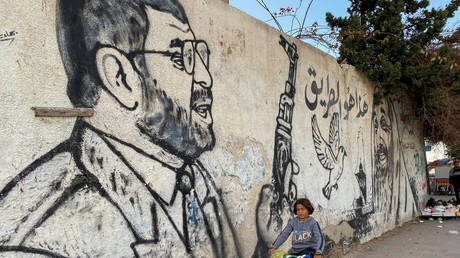
A Palestinian boy rides a bicycle past a mural depicting late Hamas leader Abdel-Aziz Al-Rantissi in Gaza City (FILE PHOTO) © REUTERS/Mohammed Salem
UK outlaws Hamas as terrorist organization

Bieber has performed in Israel multiple times, his last performance there having been in 2017 at Park HaYarkon – the same venue slated for next year. Since the announcement of the ‘Justice’ tour dates, calls for him to cancel the Tel Aviv show have gained momentum across social media, with many posters condemning the singer for supporting what one called an “apartheid state.”

Some noted that Bieber was set to arrive in Israel after performing in South Africa. “Justin Bieber is really going straight from SA to Israel. From a country that fought apartheid to a country that’s practicing apartheid,” one Twitter user complained.

A petition asking the singer to boycott Israel and exclude it from his tour has been launched online, and had garnered some 3,700 signatures by Friday. 

In 2018, the New Zealand singer Lorde canceled a concert in Israel, subsequently thanking fans for “educating” her on the issue, and, the same year, US artist Lana Del Rey at first defended her decision to perform in the country, saying her appearance would not be a “political statement,” before backtracking and canceling the gig.

Hamas has been designated a terrorist group by the US, the EU, and, as of Friday, the UK. In April 2021, international non-governmental organization Human Rights Watch concluded in a report that Israel had committed “crimes against humanity of apartheid and persecution.”

If you like this story, share it with a friend!

find more fun & mates at SoShow now !
The International Criminal Court has halted an investigation into alleged rights abuses carried out by Philippines authorities as part of a harsh crackdown on the drug trade, saying it is reviewing a deferral request from Manila.

The ICC’s chief prosecutor Karim Khan said the probe was suspended after the Philippines government filed a request to defer the case earlier this month, according to court documents cited by Reuters on Friday. 

“The prosecution has temporarily suspended its investigative activities while it assesses the scope and effect of the deferral request,” he wrote, adding that the court is seeking more information from the government in Manila.

Based in The Hague, the ICC allows states to ask for postponements if they conduct their own investigations into the charges in question. President Rodrigo Duterte’s administration filed its deferral request on November 10, while the country’s Justice Ministry announced its own investigation into the alleged abuses late last month.

Read more

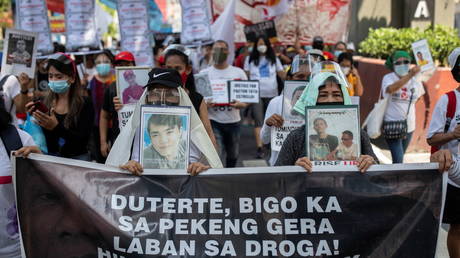
Relatives of drug war victims hold photographs of their slain loved ones with placards calling for justice (FILE PHOTO) © REUTERS/Eloisa Lopez
Philippines announces probe into thousands of killings during Duterte’s war on drugs as initial review suggests abuses took place

The court initially opened the probe in September over allegations that Philippines police had carried out thousands of extrajudicial executions and used other brutal tactics against suspected drug dealers, and that Duterte gave implicit backing to those actions. Activists have accused authorities of killing innocent people, including children, though the police insist they only use violence in self-defense.

While Duterte has declined to cooperate with the ICC probe, saying it has no authority on the island nation, and even pulled the Philippines out of the international body in 2019, the court has jurisdiction to investigate alleged violations committed by the country while it was still a member.

The president’s chief legal counsel, Salvador Panelo, confirmed the deferral request in brief comments to Reuters, saying “There is no inconsistency with the request for suspension of action,” though he did not elaborate.

Since its founding some 20 years ago, the ICC has successfully convicted just five people of war crimes or crimes against humanity – all leaders of armed movements in Africa, including in Mali, Uganda and the Democratic Republic of the Congo.

Think your friends would be interested? Share this story!

find more fun & mates at SoShow now !

Protesters thronged the streets of Australian cities on Saturday, demanding an end to what they called the “tyranny” and “oppression” of lockdowns, vaccine mandates, and the proposed expansion of the government’s pandemic powers.

In Melbourne, Sky News reporter Sophie Elsworth described “tens of thousands of people streaming through the streets.” The march came after a week of smaller protests aimed at Victoria Premier Dan Andrews’ controversial pandemic bill, which if approved by the state’s legislature would allow Andrews and Health Minister Martin Foley to declare an indefinite state of emergency and issue public health orders by decree – including “any order… that the minister believes is reasonably necessary to protect public health.”

Should the bill pass, it would allow Andrews to target certain classes of people with these orders, categorizing them by age, occupation, or vaccination status. Fines for noncompliance would range from up to AU$21,800 for people and AU$109,000 for businesses.

Alternative media sources claimed that more than 100,000 people showed up to protest. However, the demonstration remained free of the violent clashes seen at protests in Melbourne in recent months.

“Australia has been willing to send troops to all parts of the world to help people become free,” one military veteran told a crowd of listeners during the protest. “To now be fighting oppression here in our own country, it’s saddening.”

Huge numbers of protesters also turned out in Sydney, and although more than 600 police officers were deployed to watch over the gathering, no arrests were made, 9News reported.

Holding signs decrying state “tyranny,” the demonstrators chanted “freedom” and called for the firing of state politicians who have implemented a two-tier system where the unvaccinated are denied many of the privileges extended to the fully jabbed.

Similarly massive gatherings took place in Adelaide, Brisbane, and Perth, with no notable incidents of violence or police action. Further afield, protests are taking place in more than 120 cities around the world this weekend, in a loosely coordinated event dubbed the ‘Worldwide Rally For Freedom’ by activists.

Like this story? Share it with a friend!

find more fun & mates at SoShow now !

An exoplanet some 70% the mass of Jupiter and about 1.4 times its size has been discovered by astronomers at India’s Physical Research Laboratory (PRL). The behemoth is 752 light years away from Earth, and has an incredible orbit.

The new discovery was revealed by the Indian Space Research Organization on Tuesday in a statement saying the country’s PRL Advanced Radial-velocity Abu-sky Search (PARAS) had measured the movements of the newly-discovered exoplanet between December 2020 and March 2021.

The planet, named either HD 82139 or TOI 1789 depending on which cataloguing method is used, is ultra-hot – with a surface temperature up to 2,000 degrees Kelvin.

Read more

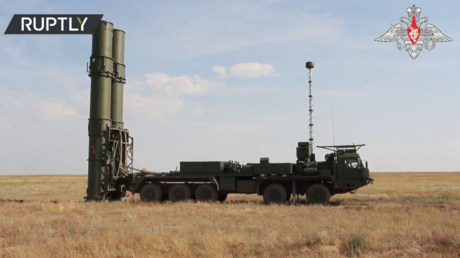
Russia’s Ministry of Defense
India may buy Russian S-500 anti-space-weapon defense system in world-first arms deal, despite risk of US sanctions, Moscow claims

India’s PRL Advanced Radial-velocity Abu-sky Search (PARAS), an optical fiber-fed spectrograph, observed t he exoplanet and its movements from the Mt. Abu Observatory, according to the space agency. Not only is the planet ultra-hot, but it is also one of the closest to an orbiting star yet discovered.

The measurements obtained via PARAS were confirmed by Germany’s TCES spectrograph in April, and further verified by independent photometric observations from the PRL’s 43cm telescope, also located at Mt. Abu.

The exoplanet has an unusually quick orbit – a mere 3.2 days. The pace indicates that its distance from its host star is one-tenth the distance between Mercury and the Sun. This makes the exoplanet one of fewer than 10 such solar systems discovered thus far. Given the closeness to its host star – an aging orb 1.5 times the mass of the Sun – the new planet is also one of the lowest density planets yet discovered.

Planets so close to their host stars, with a distance less than 0.1 AU and masses between 0.25 to several times the mass of Jupiter, are known as “hot-Jupiters.”

The Indian space agency hailed the detection of the new planet as an opportunity to “enhance our understanding of various mechanisms responsible for inflation in hot-Jupiters and the formation and evolution of planetary systems around evolving and aging stars.” It is the second planet to be discovered by PARAS, with a previous discovery taking place in 2018.

Like this story? Share it with a friend!

find more fun & mates at SoShow now !