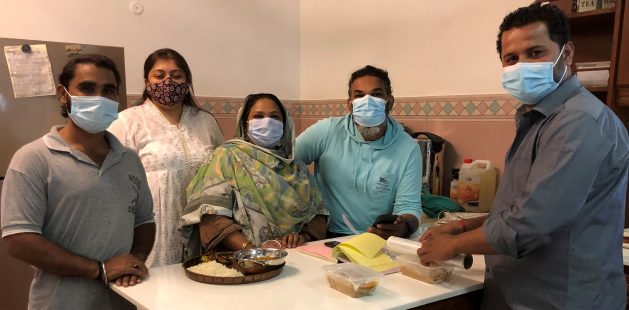
KARACHI, Nov 19 (IPS) – Balance is the absolute key, if you ask Alia Chughtai, a journalist who started a catering service with filmmaker Akhlaque Mahesar, by the name of Aur Chaawal (And Rice), two years ago.
The Chinese envoy to the European Union has reiterated Beijing’s goal of peacefully reuniting Taiwan with the mainland but stated the country’s preparedness to use “decisive measures.”
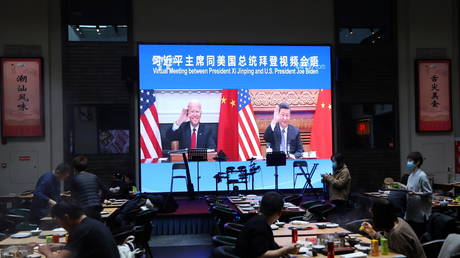
Speaking on Tuesday, China’s ambassador to the EU, Zhang Ming, said Beijing would never change its position on Taiwan. “If anything changes, it is that the Chinese people’s resolve to realize complete reunification of our country grows even stronger,” Ming told an online think tank event in Brussels.
“Some people in Europe seem to underestimate the Chinese people’s aspiration for a reunification of our country,” he added, noting also that the bloc must lift its sanctions if a new Sino-EU investment deal is to be ratified.
In May, Brussels halted an investment pact agreed with China last December, after Beijing imposed sanctions on several members of the European Parliament. The EU responded, introducing its own sanctions related to the treatment of the Uyghur people and alleged genocide in Xinjiang.
In recent years, China has become increasingly assertive about reuniting its wealthy island neighbor with the mainland. Beijing claims Taiwan is an inalienable part of the country and has called on Western parties to refrain from interfering in Chinese internal affairs. Western nations, notably the US and UK, have shown willingness to defend the democratic island.
Taiwan considers itself to be independent of China since 1949 when the communist forces overthrew the government of the Republic of China on the mainland, forcing the Kuomintang-ruled state to relocate there.
Austria will introduce a full lockdown that could last for three weeks on Monday in an attempt to tackle a new wave of Covid-19 infections. The government has also ordered the entire population to get vaccinated from February 1.
On Friday, conservative Chancellor Alexander Schallenberg told a news conference that a complete lockdown of the nation would begin on Monday and last for an initial 10 days.
He stated that the restrictions could be extended if infection rates did not start to fall, but he insisted the lockdown would not exceed 20 days.
The measures concern the entire Austrian population. The government has already imposed a partial lockdown on the unvaccinated in an effort to reduce hospitalization rates amid a surge in Covid-19 cases.
When the full lockdown ends, restrictions will remain in place for the unvaccinated.
Schallenberg’s announcement came after a meeting of nine state governors, two of whom had already vowed to introduce full lockdowns in their regions on Monday, in the western province of Tyrol.
The chancellor also announced that vaccinations would be mandatory from February 1. “We haven’t been able to convince enough people to vaccinate. For too long, I and others have assumed that you can convince people to get vaccinated,” he added, giving his rationale for the mandate.
Schallenberg said he lamented the political forces, radical opposition, and fake news fighting against vaccination.
Austria has one of the lowest vaccination rates in western Europe, with only 65% inoculated against the deadly virus according to data from Johns Hopkins university.
Infection rates are almost among the highest on the continent. The seven-day incidence rate stands at 971.5 per 100,000 people.
Think your friends would be interested? Share this story!
We’re starting a new segment on The Cipher Brief’s Open-Source Collection Podcast and adding to the line-up of curated headlines we bring you from around the world with expert insights on today’s news.
The Cipher Brief’s Brad Christian talked with former CIA Officer Marc Polymeropoulos this week about what’s next for the US Government when it comes to investigating ‘Havana Syndrome’, making sure Afghan interpreters aren’t left behind and why a White House visit by Jordan’s King Abdullah was a bigger deal than some may realize.
Cipher Brief Expert Marc Polymeropoulos served 26 years in the CIA before retiring from the Senior Intelligence Service in June 2019. His positions included field and headquarters operational assignments covering the Middle East, Europe, Eurasia and Counterterrorism.
Christian: What’s top of mind for you this week in the world of national security?
Polymeropoulos: Havana Syndrome, CIA’s response to the Afghan withdrawal, and the visit of Jordan’s King Abdullah to D.C. Let’s start with Havana Syndrome.
You saw in the press the last couple of days, the notion that the CIA’s inspector general is conducting a review of CIA’s handling of healthcare, of how officers were coming to them starting in 2016 after these attacks started in Cuba. I think that’s a good thing. It’s a necessary evil. I think a lot of your listeners and readers know that I was affected by this in December of 2017. It caused my retirement in July of 2019. I’ve been very vocal on the need for healthcare for our officers. We have to think about Havana Syndrome in three bins.
The first, is accountability and that’s good. It’s a necessary evil, but we have to look at how the agency responded to officers because that’s critical. The agency workforce is watching. I think the IG review by the CIA is good as well as a look at what’s happening in the House and Senate oversight committees as well.
The second, is continued healthcare for officers, the officers getting to Walter Reed’s National Intrepid Center of Excellence. CIA Director Bill Burns is doing that, so that’s positive.
And then the last piece is culpability. I think you also saw recently in the press, that a senior intelligence service officer who was integral in the hunt for Osama bin Laden, has been named to the task force. So, a lot of stuff is happening on Havana Syndrome, I think all of it is moving in a positive direction. I applaud Director Burns. This is something that I think is going to be at the top of the news cycle for days, weeks, and months to come.
Christian: Do you feel like now there’s a unified awareness at the entire government level outside of CIA? Is Congress focused on this? Is the White House focused on this in the ways that you think they need to be?
Polymeropoulos: What a great question. The White House for sure. Congress has been absolutely integral both in the Senate and the House. They’re about to pass the Havana Act, which is going to provide financial relief for officers affected, but in all US government agencies. I will say that the Department of State has been woefully behind and that’s a big concern of mine. I feel for my State colleagues. There are 41 State Department officers who have been affected by this. Secretary of State Blinken has not even met with them while Director Burns has met with nearly all of the CIA victims, so State’s got a long way to go. I think we’ll look to the White House and to Congress to keep the pressure on.
Christian: These are events that are still occurring, even as they’re being investigated. Tell us a little bit about the latest that’s happened on the attack front.
Polymeropoulos: I think you see what the press reports of what can only be considered a kind of slow-rolling mass casualty event in Vienna, Austria. There were numerous State Department and intelligence officers affected at our Embassy there. Again, this is coming out in the press, so it’s important to note that. But these things are still happening and I think that we have to look back to the old counter-terrorism model that CIA employed so effectively of detect, disrupt, and deter attacks by our terrorist adversaries. We have to apply that same type of mindset to this problem set.
Go beyond the headlines with expert perspectives on today’s news with The Cipher Brief’s Daily Open-Source Podcast. Listen here or wherever you listen to podcasts.
Christian: The Afghanistan withdrawal, there’s a lot going on there. We’ve seen reports of US airstrikes supporting Afghan forces in Kandahar. This week, it was reported that just under 50 Afghan troops requested refuge in Pakistan when their border posts near Chitral, which is a Pakistani city, was overrun. The Pakistani government let them in. And we’re seeing now an Afghan strategy focusing on protecting the capital regions and maybe ceding some of those provincial capitals.
Polymeropoulos: I look at this from a narrow optic. As a former CIA officer who was the base chief in Afghanistan between 2011 and 2012, I ran one of our paramilitary bases in eastern Afghanistan along the border with Pakistan. What is unique about life as a CIA officer out in the field, particularly in the bases, was that there were only a few of us. We had a very small number of Americans, yet we had hundreds, if not over 1,000 Afghanistan indigenous personnel, whether they were troops who were fighting with us or whether they were support personnel. We lived with them. I think this is a little bit different than perhaps big US military’s experience with the Afghan national army.
I trusted my life to these guys. They were armed in front of us all the time. We ate together at the mess hall. We sat around the fire pit together, certainly went on patrols together. So, it’s really personal for me. I remember our Afghan interpreters. I remember our indigenous personnel and I really worry about them. The future, I think is one that certainly is bleak. I don’t support the administration’s decision for a full withdrawal. I don’t understand why we couldn’t have left a residual force, but that policy decision has been made. I think that the things I’m looking to in the near future are even after the end of August, will the US military still conduct airstrikes in support of Afghan forces? There is something about betraying those who really made that pact with us. That’s just something as a CIA officer that’s ingrained in us that we don’t want to do that. So, this is something I really worry about. I remember the faces of our interpreters and indigenous personnel every day. These were great heroes. I think a lot of us at CIA wouldn’t be alive today without their heroism.
The Cipher Brief hosts private briefings with the world’s most experienced national and global security experts. Become a member today.
Christian: The third issue you raised was interesting, the visit to D.C. by Jordan’s King Abdullah. It didn’t get a lot of press. But you say it’s a significant story. Tell us why.
Polymeropoulos: President Biden has had a long-standing relationship with King Abdullah. It’s a sign that Jordan is back. We call Jordan the lily pad for the United States for a lot of reasons. I mean, when you think back to 2006 and Jordan’s integral role in the Anbar Awakening, that’s when we were rallying the tribes in Iraq to fight terrorism. When you think about how the US has access to strategic bases in Jordan and when you think about the Jordanian General Intelligence Directorate as one of the US Government’s most critical counter-terrorism partners. But the fact of the matter is that under the last administration, Jordan was not treated well, so it’s really significant that Abdullah was here. I think this is a really good thing. Don’t forget that CIA Director Bill Burns was ambassador in Amman quite some time ago. I think this is a really positive development, not only for the United States going back to an old strategic partner, but also for Jordan as well, which has been a steadfast ally not only during King Abdullah’s reign, but also of course, under King Hussein before him.
Read more expert-driven national security insights, perspective and analysis in The Cipher Brief
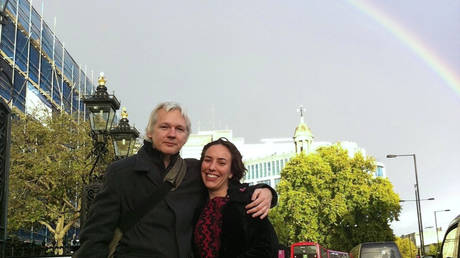
France shouldn’t remain silent on Julian Assange, leftist leader Jean-Luc Melenchon has said, after the imprisoned WikiLeaks co-founder’s father suggested that Paris could offer asylum to his son.
The life of Assange – who is being held in solitary confinement at London’s Belmarsh maximum security prison while a British court considers an extradition request by the US – is under threat, Melenchon wrote on Twitter on Tuesday.
“For years, we’ve been calling for France to accept him,” the head of the leftist La France Insoumise (France Unbowed) party said, insisting that “France shouldn’t remain silent.”
The statement by Melenchon, who won 19.6% of the ballot in the first round of the French presidential election in 2017, follows a visit by Assange’s father, John Shipton, to the Whistleblower Meeting in Paris on Monday.
During the event, Shipton told Sputnik news agency that it would be “an honorable thing” for the French government to grant his son asylum.
“I feel that France hasn’t attacked Julian over the last 12 years and consequently France is free to act in return for the information that WikiLeaks and Julian brought to France,” he said, referring to the website’s revelations of the US intelligence agencies spying on French presidents and hacking into local banks.
🔴 John #Shipton : «La France n’a pas attaqué #Julian pendant les dernières années difficiles, donc la France est libre d’agir en échange des informations que #WikiLeaks et Julian ont apportées à la France. Ce serait honorable pour la #France d’offrir [l’asile] à Julian #Assange» pic.twitter.com/ceZ7qTARua
Several dozen French lawmakers have also recently called upon Paris to take Assange in, with the Australian-born publisher’s legal team saying last year that their client was hoping to find asylum on French soil.
Assange could face up to 175 years behind bars if he’s extradited to the US, where he’s wanted on espionage charges over the release by WikiLeaks of classified documents on Iraq, Afghanistan, Guantanamo Bay, and others.
He was placed in Belmarsh in April 2019 over breach of bail, after being holed up in the Ecuadorian Embassy in London for seven years.
The publisher had been fleeing an arrest warrant issued over sexual assault allegations which he has always denied, and which failed to result in any actual charges due to lack of evidence.
Assange’s supporters insist that he has actually been persecuted over his legitimate journalistic activities and revealing the truth to the public.
The UK High Court is expected to rule on the appeal by the US against a lower court decision to bar the WikiLeaks co-founder’s extradition to America due to the 50-year-old’s poor health condition and risk of suicide.
Assange’s team will then be able to challenge the ruling in the Supreme Court if it’s not favorable.
Think your friends would be interested? Share this story!
The stars of the Harry Potter films will reunite for a 20-year anniversary special on HBO, minus author JK Rowling. Fans and commenters wondered if Rowling’s absence had anything to do with her views on transgender issues.
‘Harry Potter and the Sorcerer’s Stone’ premiered 20 years ago this week, catapulting actors Daniel Radcliffe, Rupert Grint, and Emma Watson to superstardom. Warner Bros announced on Tuesday that the three stars – as well as a whole range of supporting actors from the franchise – will travel back to Hogwarts for an “enchanting making-of story” airing on New Year’s Day, entitled ‘Harry Potter 20th Anniversary: Return to Hogwarts’.
Conspicuously absent from the production is author JK Rowling. A Warner Bros’ press release made no mention of Rowling, and a lengthy Instagram post by actress Emma Watson thanked fans and fellow cast members, but also made no mention of Rowling, whom other Harry Potter actors said they “owe everything” to.
Rowling’s PR team did not comment on the author’s absence, and the Hollywood Reporter claimed that the author will only appear in the show in archival footage.
Commentators online reckoned that Rowling had been canceled from the retrospective special due to her high-profile clashes with transgender activists. A self-described feminist, Rowling has spoken out against gender-neutral language, arguing that it “erases” the concept of sex and therefore the concept of womanhood. She has also stated that sex is a binary concept, and argued against gender-neutral bathrooms, claiming that by allowing men into women’s bathrooms, women are made less safe.
If I owed my entire career to 1 person, if I’d known her since I was 8, if I was worth $90m because of her, then not only would I defend her when maligned but I would refuse to take part in any reunion that excluded her. But that’s just me. #JKRowlinghttps://t.co/0ay5mhQ1FE
I can’t believe they’re actually shunning JK Rowling
“No you can’t participate in something celebrating the world you made because we are the new Amish but with more Puritan soul and no redeeming features”.
Rowling’s comments on gender issues generated intense backlash from LGBT organizations, and death and rape threats from the most zealous transgender ideologues online. Actors Daniel Radcliffe and Emma Watson also both spoke out against Rowling’s defense of biological sex last year, with Radcliffe declaring that “transgender women are women,” and apologizing to upset fans “for the pain [Rowling’s] comments have caused you.”
“Trans people are who they say they are and deserve to live their lives without being constantly questioned or told they aren’t who they say they are,” Watson chimed in.
Rowling has repeatedly stated that she is against anti-trans discrimination, but would not change her position on sex. “I refuse to bow down to a movement that I believe is doing demonstrable harm in seeking to erode ‘woman’ as a political and biological class and offering cover to predators like few before it,” she wrote last year.
Think your friends would be interested? Share this story!
UK Home Secretary Priti Patel has acted to proscribe the Palestinian group Hamas “in its entirety,” stating that it has significant capacity to carry out terrorist acts and has facilities to train attackers.
In a tweet on Friday, Patel stated that she had banned the Palestinian group Hamas and designated it a terrorist organization, as she reiterated the British government’s commitment to “tackling extremism and terrorism wherever it occurs.”
“Hamas has significant terrorist capability, including access to extensive and sophisticated weaponry, as well as terrorist training facilities,” she wrote.
The home secretary’s tweet came during her visit to Washington and followed speculation on Friday morning that she was soon to outlaw the group.
Pre-empting Patel’s announcement, Israeli Prime Minister Naftali Bennett welcomed Britain’s “intention” on Twitter.
“Hamas is a radical Islamic group that targets innocent Israelis & seeks Israel’s destruction. I welcome the UK’s intention to declare Hamas a terrorist organization in its entirety – because that’s exactly what it is,” Bennett wrote, thanking the leadership of Prime Minister Boris Johnson.
Yair Lapid, Israel’s foreign minister, also hailed the expected move against Hamas, saying it was “part of strengthening ties with Britain.”
Until now, only Hamas’ military wing, the Izz al-Din al-Qassam Brigades, had been outlawed by the British government. The EU and the US have already proscribed all of Hamas.
Hamas political official Sami Abu Zuhri rejected Britain’s move, claiming it showed “absolute bias toward the Israeli occupation and is a submission to Israeli blackmail and dictations.”
In a separate statement, the group claimed it had a right to resist occupation by all available means, “including armed resistance.”
Hamas seized total control of Gaza in 2007, on the back of an election victory in 2006.
A gunman injured two civilians, one of them fatally, and two police officers before being shot dead by security forces near Jerusalem’s Western Wall on Sunday morning, Israeli police said.
The civilian victims were taken to Shaare Zedek Medical Center. One, who was in his 30s, succumbed to his injuries at the hospital. The other, a 46-year-old, is said to have suffered moderate injuries. Two police officers were hurt by shrapnel.
Two civilians were critically and seriously wounded this morning, Sunday, and two policemen were lightly wounded in a shooting attack in the area of the Chain Gate near the Western Wall and the entrance to the Temple Mount. pic.twitter.com/MRN6MLckj3
In a video clip shared on social media and purportedly filmed at the scene, multiple gunshots could be heard amid agitated shouting. Security officers could then be seen standing around what appears to be a dead body. Witnesses speculated it was that of a “terrorist.”
Scenes and sounds of shooting in the Old City of Jerusalem captured on Live Cam. Initial reports are attack is near the Temple Mount area 2 Israelis wounded one apparently seriously the terrorist has been neutralised pic.twitter.com/UKWSOqCu8D
— ElBluemountain MossadDolphin 🇮🇱🐬🇮🇱🐬🇮🇱 (@EBluemountain1) November 21, 2021
The gunman, whose identity was not immediately disclosed, was killed during the incident. Police said he had used a homemade submachine gun.
Any apology for Nazism is unacceptable, Colombia’s president Ivan Duque has insisted, after photos of police academy cadets dressed up in Third Reich uniforms were uploaded online, causing outrage.
“Any apology for Nazism is unacceptable,” Duque stated in a tweet on Friday. The president said he condemned any references to those who were “responsible for the Jewish Holocaust that claimed the lives of more than 6 million people,” adding that “anti-Semitism has no place in the world.”
Policía colombiana homenajea a Alemania con una fiesta ‘nazi’
Indignación en Colombia por la fiesta que organizó un grupo de estudiantes de la Escuela de Policía Simón Bolívar en Tuluá, en la que varios uniformados recrearon escenas alusivas a la Alemania nazi pic.twitter.com/UnF4ajUd8z
Duque had earlier made demands for “heads to roll” at an academy that “promotes such criminal practices,” with its director, Lieutenant Colonel Jorge Ferney Bayona Sanchez, already having been sacked.
Toda una polémica ha provocado el evento realizado en las últimas horas en la escuela de Policía Simón Bolívar de Tuluá. Los uniformados se disfrazaron de Adolf Hitler, haciendo alusión al nazismo durante la semana de la internacionalización. #VocesySonidospic.twitter.com/EoS4JqvzrC
Colombia’s defense ministry, which oversees the country’s police, also insisted in a statement that that its training programs “don’t envisage in any way an activity such as the one which took place” at the academy.
The images of police cadets in Nazi uniforms caused anger and bewilderment among internet users.
The German and Israeli embassies in the country reacted by issuing a joint statement, in which they expressed “total rejection of any form of apology or demonstration of Nazism.” The US embassy in Bogota also said that it was “shocked and deeply disappointed” by the development.
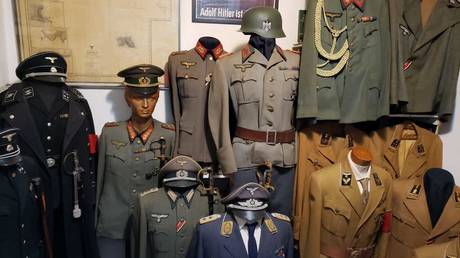
The controversial images, in which aspiring officers were caught sporting black SS outfits with red swastika armbands and grey Wehrmacht uniforms from the World War II era, weren’t revealed in some bombshell media report, but were actually published on the official Twitter account of the Colombian police this Thursday.
The photos were taken as part of a “cultural exchange” event at the police academy in the city of Tulua, aimed at commemorating Germany and “strengthening the knowledge of our police students.” The cosplay was apparently intended to illustrate the history of German law enforcement, with more cadets pictured wearing more modern versions of the country’s police uniforms in the pictures.