The EU’s drug regulator has backed the emergency use of Merck’s pill for the treatment for clinically vulnerable Covid-19 patients as cases surge across the continent.

On Friday, the European Medicines Agency (EMA) “issued advice” backing the emergency use of the drug developed by Merck in collaboration with Ridgeback Biotherapeutics, although it has not yet been authorized by national authorities.

Read more

© Reuters / Piroschka van de Wouw
EMA green lights new Covid treatments

In a statement, the drug regulator said the medicine called Lagevrio – also known as molnupiravir or MK 4482 – “can be used to treat adults with Covid-19 who do not require supplemental oxygen and who are at increased risk of developing severe Covid-19.

It said the treatment should be administered as soon as possible after Covid-19 is diagnosed and within five days of the start of symptoms. The medicine should be taken twice a day for a period of five days.

The EMA listed the potential side effects of the capsules, including mild or moderate diarrhea, nausea, dizziness and headache. The treatment is not recommended for pregnant women.

The watchdog announced earlier on Friday that it had begun reviewing Pfizer’s medicine Paxlovid for Covid-19 with the same goal “to support national authorities” who may decide on its early use prior to marketing authorization in light of rising cases and deaths in Europe.

On Friday, Austria announced it would enter a new nationwide lockdown from Monday and make vaccination mandatory, while Germany’s health authorities claimed the country had turned into “one big outbreak.”

Both Pfizer and Merck have requested approval for their coronavirus medicines from the US Food and Drug Administration, but it is unclear when it might be granted.

Think your friends would be interested? Share this story!

find more fun & mates at SoShow now !

Slovakia has become the latest European country to implement lockdown restrictions on people who haven’t had the Covid vaccine, as it seeks to prevent a resurgence in infections and hospital admissions over the winter.

Slovakian Prime Minister Eduard Heger announced the new measures in a press conference on Thursday, declaring a “lockdown for the unvaccinated” after the country reported a record number of new cases.

The new restrictions in Slovakia, which come into effect on Monday, will require people to have been vaccinated or have recovered from Covid in the past six months to enter restaurants, non-essential shops, or public events.

In the past few days, the European nation has seen record numbers of new infections, including over 8,000 on Tuesday, with hospitals running out of space to treat Covid patients.

Slovakia has one of the lowest rates of vaccination in the European Union, with over 50% of individuals still not jabbed. The country of around 5.5 million has so far only inoculated 2.5 million people against the virus.

Read more

(FILE PHOTO) © REUTERS/David W Cerny
Czechia rolls out new restrictions for unvaccinated

Earlier this week, Austria became the first nation to impose restrictions on unvaccinated individuals, as it sought to limit pressure on hospitals and emergency care units. The move came into effect at midnight on Monday for anyone aged 12 and older who has not received their Covid vaccine or recently recovered from the virus.

The German state of Bavaria and the Czech Republic followed Austria in restricting access for unvaccinated individuals. Only people who can show proof of vaccination or that they have recently recovered from Covid will be allowed to enter public spaces, such as restaurants and shops. 

If you like this story, share it with a friend!

find more fun & mates at SoShow now !

Libyan military commander Khalifa Haftar is set to challenge Gaddafi’s son for the top job, announcing his presidential bid. The election will take place on December 24.

Read more

Saif al-Islam al-Gaddafi at the registration centre in Sebha. ©Khaled Al-Zaidy / Handout via REUTERS
Gaddafi heir runs for Libyan presidency despite arrest warrant

I declare my candidacy for the presidential election, not because I am chasing power but because I want to lead our people towards glory, progress and prosperity,” the de facto leader of Eastern Libya said in a televised speech.

Haftar added that the election is the only way out of the severe crisis the country has been plunged into.

The announcement was expected; in September, Haftar announced that he was temporarily stepping down as head of the force known as the Libyan National Army, fulfilling the requirement for presidential hopefuls to suspend public work three months before an election.

Haftar will run against the son of former leader Muammar Gaddafi, Saif al-Islam Gaddafi, who represents the Popular Front for the Liberation of Libya.

Haftar’s presidential bid is likely to anger many who consider him a war criminal responsible for the indiscriminate killing of civilians during his military campaign. A number of civil lawsuits have been filed against him in a US federal court for alleged war crimes. Haftar has both US and Libyan citizenship, and owns property in Virginia.

Following years of civil war and political chaos after the NATO-backed intervention that saw Muammar Gaddafi deposed and brutally murdered, the upcoming election is widely viewed as an opportunity for political settlement and the long-awaited unification of the country, divided now between Haftar’s forces and the Tripoli-based Government of National Accord. However, there is still no consensus on the legal grounds for the election, which could become an obstacle for the peace process.

Like this story? Share it with a friend!

find more fun & mates at SoShow now !

Australia’s Jewish community has condemned the repeated displays of Nazi references at anti-vaccine and anti-lockdown rallies in Victoria, some of which saw the state premier depicted as Adolf Hitler.

Daniel Aghion, the president of the Jewish Community Council of Victoria, claims that references to the genocidal regime of the Nazis amid the current unrest over pandemic rules is a false equivalence.

“The Nazis had the intention of wiping from the face of the Earth a race or religion simply because of what they were,” Aghion told Guardian Australia. “Nothing in the current proposals is remotely like that, and the comparison to Nazi Germany is therefore shocking, inappropriate and wrong,” he added.

Aghion’s comments come after demonstrators, protesting against pandemic laws, referenced Nazi Germany in an effort to make their point. Some carried placards depicting state premier, Daniel Andrews, as Hitler. 

 Wendy Lovell, a Liberal MP, had also claimed laws proposed to govern future pandemics were similar to Germany’s 1933 Enabling Act – which allowed the Reich government to issue laws without the consent of parliament and preceded atrocities, most notably the Holocaust.

MP Bernie Finn had gone as far as to share a social media post depicting the state premier as Hitler. It was later deleted.Laws proposed by Andrews seek to grant powers to the state leaders in the event of another pandemic. Under the move, the minister “may make any order… that the minister believes is reasonably necessary to protect public health.” 

Opponents claim the legislation, which would see power concentrated with the head of state and health minister, is too broad and far reaching.

If you like this story, share it with a friend!

find more fun & mates at SoShow now !

President Joe Biden commented on reports that US officials are planning to boycott the upcoming Olympics in Beijing over alleged human rights violations – but his answer left journalists perplexed.

When asked on Tuesday if an official US delegation will be traveling to the Winter Games in the Chinese capital in February, Biden responded: “I am the delegation.”

The president, however, did not elaborate, leaving the White House correspondents in a state of confusion, as his response could mean that Biden will attend the Winter Olympics alone or, as some reporters suggested, that he simply did not understand the question.

Read more

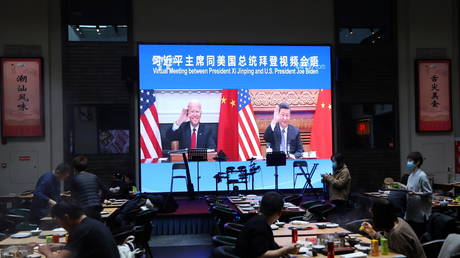
A screen at a restaurant in Beijing showing Chinese President Xi Jinping's virtual meeting with US President Joe Biden. © Reuters / Tingshu Wang
Biden & Xi agree to avoid conflict

A recent report by a Washington Post columnist claimed the US won’t be sending an official delegation to Beijing in 2022 over allegations of human rights violations by the Chinese government. According to the sources cited in the article, a formal recommendation for a diplomatic boycott of the Olympics has been already presented to Biden, with the move expected to be approved by the president by the end of November.

The piece was published on the day that Biden held a lengthy virtual meeting with Chinese leader Xi Jinping, in which they discussed a range of issues regarding the strained relations between the two nations – but not the Olympics.

The White House said that during the talks, President Biden challenged his Chinese counterpart over what Washington sees as persecution against the Uyghur population in the Xinjiang region, as well as human rights violations in Tibet and Hong Kong. China has strongly denied the claims, accusing the US of interfering in its internal affairs.

Calls for the Biden administration to boycott the Olympics and refrain from sending a political delegation to Beijing have recently been made by top Democratic and Republican lawmakers. 

If implemented, it won’t affect the American athletes, who will still be taking part in the Winter Olympics.

Like this story? Share it with a friend!

find more fun & mates at SoShow now !

Hard-line cleric Ebrahim Raisi won Iran’s presidential election on Saturday in a move that is expected to bolster the conservative legacy of the country’s supreme leader, Ayatollah Ali Khamenei.

The decision is not expected to derail ongoing negotiations aimed at restoring the Joint Comprehensive Plan of Action (JCPOA) nuclear deal, even though Mr. Raisi himself is under US sanctions over accusations of human rights abuses.  Many voters stayed away from the polls as the outcome had been predicted for months with many progressive candidates barred from running.

The Islamic Republic has entered a post-revolutionary dynamic in which a fading revolutionary generation seeks to ensure that the rising political leadership sustains their revolutionary ideals,” says Norman T. Roule, former National Intelligence Manager for Iran at ODNI and Cipher Brief Expert. “The regime’s decision to bar so many candidates and the low turnout make this election a historic embarrassment for the regime and its supporters.”

The Cipher Brief talked with Roule about what the election means and what it doesn’t mean when it comes to relations with the west, the progressive movement within Iran and the election’s impact on the oil markets.


“The Cipher Brief has become the most popular outlet for former intelligence officers; no media outlet is even a close second to The Cipher Brief in terms of the number of articles published by formers.” – Sept. 2018, Studies in Intelligence, Vol. 62 No.

Access all of The Cipher Brief’s national-security focused expert insight by becoming a  Cipher Brief Level I Member .  


The post What Iran’s Election Tells Us About Where It’s Headed appeared first on The Cipher Brief.

find more fun & mates at SoShow now !

As part of a special series on climate in partnership with The Intelligence Project at Harvard University’s Belfer Center for Science and International Affairs, and Cipher Brief Expert and Senior Editor Kristin Wood, The Cipher Brief is focusing on the national security implications of climate change. 

This report is derived from a half-day conference in April 2021 co-sponsored by the Intelligence Project and the Environment and Natural Resources Program at Harvard Kennedy School’s Belfer Center for Science and International Affairs, along with the Center for Climate and Security and The Cipher Brief. It explores the requirements of the U.S. IC to fulfill the mission prescribed by President Biden, DNI Haines, and Secretary Kerry. The IC must rise to challenge, unshackled from the past, to re-imagine its role in combatting climate change.

The Authors

Calder Walton, Asst. Director, Belfer Center’s Applied History Project and Intelligence Project, Harvard University

Calder Walton is Assistant Director of the Belfer Center’s Applied History Project and Intelligence Project. Calder’s research is broadly concerned with intelligence history, grand strategy, and international relations. The

Sean Power, Masters in Public Policy Candidate, Harvard Kennedy School

Sean Power is a Masters in Public Policy 2021 candidate at the Harvard Kennedy School. Prior to HKS, he managed the analyst program at Kobre & Kim LLP, where he assisted on matters involving government enforcement defense and internal investigations.

The Report

The U.S. Director of National Intelligence (DNI), Avril Haines, has stated that climate change needs to be at the center of U.S. foreign policy and national security. It is a threat multiplier that impacts every function of government and society: territorial integrity, economic well-being, social stability, and military capabilities are all impacted by climate change, directly and indirectly. However, in addressing climate change, the U.S. Intelligence Community (IC) is currently unsure of its mission space and hitherto has been relying on boilerplate responses to it. In an exclusive discussion, the U.S. Special Presidential Envoy for Climate, Secretary John Kerry, who should be a principal consumer of intelligence about climate change within the U.S. government, stated that the U.S. IC must deliver significantly more.

The increasing effects of climate change are arising at a moment when the nature of intelligence itself is undergoing a revolution—from the collection of hidden secrets to collation of non-obvious (but knowable) data frequently hiding out in the open. This watershed in intelligence and national security requires bold, innovative, ideas for the U.S. IC to adapt and anticipate security threats derived by climate change. It must establish its mission space and alter its own architecture to ensure it is providing its customers with intelligence about them needed. Its mission will not be about spies disseminating secrets to policymakers; rather, it will require a new intelligence and national security paradigm that must reach across society, allowing the general public to consume climate intelligence and hold policymakers to account.

Background

The twenty-first century presents globalized threats that will require globalized solutions, the greatest of which is climate change. As the Covid-19 pandemic has demonstrated, no country is immune from actor-less threats like novel disease outbreaks and climate change. When combined with other security threats like transnational terrorism and ubiquitous cyberattacks, it becomes clear that existing national security frameworks are insufficient. New relationships and lines of communication will need to be forged, both within the U.S. government, in the private sector, and internationally with allies and adversaries. The U.S. IC needs to determine the requirements of its customers regarding climate change and how its unique collection and analytical capabilities fit into this new mission space.

The IC has incorporated climate change into its analysis and threat assessments for decades, but climate has not received the attention it requires given the magnitude of the threat it poses. On January 27, 2021, President Biden issued an executive order on tackling the climate crisis at home and abroad, establishing that “climate considerations shall be an essential element of United States foreign policy and national security.” The order also called for the Director of National Intelligence to prepare a National Intelligence Estimate on the national and economic security impacts of climate change within 120 days.

The Climate Change, Intelligence, and Global Security conference at Harvard’s Belfer Center earlier this year, brought together senior climate experts, current and former intelligence officers, and leaders in the private sector and academia to discuss the climate threat and generate innovative ideas on role the IC will play in combatting that threat. Led by Paul Kolbe, Director of the Intelligence Project, Kristin Wood, Intelligence Project Non-Resident Fellow, and Erin Sikorsky, Deputy Director of the Center for Climate and Security, the conference facilitated an urgent opportunity for productive dialogue on the climate threat.

Climate change as a threat to international security

Policymakers and the public need to understand that climate change impacts seemingly unrelated challenges and magnifies existing threats. The direct effects of climate change are readily apparent around the world—melting glaciers, rising sea levels, thawing permafrost, longer droughts, hotter heat waves, persistent wildfires, torrential rains, and catastrophic storm systems. These effects create disastrous consequences for humans like crop failures, fishery collapses, water insecurity, and the inundation of coastal regions, all of which lead to mass migration and displacement. These situations lead to fragile states and regions where increased conflict over scarce resources allows malign actors thrive. In this way, climate change is a threat multiplier that touches every aspect of international security.

Professor John P. Holdren, the Teresa and John Heinz Professor of Environmental Policy at Harvard Kennedy School, noted that the big picture on how climate change will impact the planet is clear, but the detailed effects are difficult to predict with precision and confidence, in part because we do not know exactly how human societies will react. This uncertainty exacerbates the security threat posed by climate change. We know it will increase the number of displaced persons in the world, but we do not know when they will be displaced, how many there will be, or where they will go.

Climate change also impacts the effective functioning of the U.S. military: to meet traditional security threats and protect Americans at home and abroad. U.S. bases around the world function as launching pads for everything from quick tactical operations to large-scale disaster relief missions. When severe weather damages those bases or limits their ability to operate at full capacity, America’s security is put at risk. Disasters like the flooding at Offutt Air Force Base in Nebraska, headquarters for U.S. Strategic Command, and Hurricane Michael’s destruction of Tyndall Air Force Base in Florida show that this threat knows no geographic bounds. Their effects are costly as well—the Air Force requested nearly $5 billion to rebuild those two bases alone.

The overall impacts of climate change on international security are inevitable, consequential, and predictable. Previously the U.S. government has undertaken more extensive, and expensive, actions on the basis of proportionally less intelligence about security threats. The U.S. IC must give climate change the proportional attention it deserves.

Role of U.S. intelligence in addressing climate change

Climate change poses an existential, global, non-state security threat, making it fundamentally different from past threats. Its unprecedented nature will require unprecedented thinking by the U.S. IC and requirements from it. Former Principal Deputy Director of National Intelligence Sue Gordon stated clearly that it is not enough to just say that the U.S. IC should focus more on climate— rather, the challenge lies in determining what its specific contribution will be, and then evaluating what changes need to occur to make that contribution happen. Answering these questions will require difficult, but necessary, upfront work. Without that work, the U.S. IC is likely to lead with its current capabilities, rather than identifying and developing capabilities needed to meet the nature of the new threat we face.

The U.S. IC must play to its strengths in carving out its climate mission. Intelligence is no longer just about stealing secrets; it is about providing policymakers with decision advantages to influence events, which is the same as the past, but with a key difference that doing so now requires mastery of is a vast eco-space of openly-available information. To accomplish its mission, the U.S. IC must leverage its analytic tradecraft to present objective assessments about climate change to policymakers. This means collecting intelligence, assessing it, removing bias, and delivering timely and relevant assessments to customers. The U.S. IC must also leverage its global relationships with partners and competitors in performing these tasks. These relationships lie below politics and can help elicit understanding that allows policymakers to distinguish facts on the ground from prevailing political rhetoric of the day.

The U.S. IC’s workforce and technology will need to advance and adapt to serve the climate mission. It does not need to have the foremost climate experts, but it does need to have dialogue with them, and develop its own climate expertise. Like other threats, the IC needs personnel that are devoted to understanding this new threat and understand its place in larger risk frameworks. Predictive models are critical to understanding climate science, and the IC should invest more resources into artificial intelligence and machine learning capabilities (AI/ML) that can inform them. Intelligence professionals will not need to advance science, and scientists will not need to assess national security; but collaborations between the IC and the federal science community are necessary and will benefit both by allowing them to identify and meet shared objectives.

Climate change intelligence cannot be siloed. As DNI Haines promised, it must be integrated into traditional security threat assessments, and those emerging threats from other globalized challenges, bio-hazards, cyber capabilities, and weaponized information, if we want to understand how they interact and manifest around the globe. Compared to the twentieth century, when intelligence was dominated by governments, the twenty-first century offers more democratic forms of intelligence: the private sector offers major capabilities to collect and analyze intelligence. It has disrupted and transformed the nature of intelligence. The IC’s advantage in this new environment will come from thinking deeply about these issues and using its unique analytical and collection capabilities to identify patterns and trends others might overlook.

The future of intelligence cooperation and climate change

Climate change is an indiscriminating challenge unlike anything humanity has encountered before. Understanding how it is different helps illustrate the need for intelligence cooperation among states, large and small, to combat it. Carol Dumaine, Senior Fellow at the Atlantic Council, noted that the impact of the Covid-19 pandemic has highlighted many of the ways in which the climate threat is unique. It is non-state, non-adversarial, non-linear, boundary-less, and its root causes can be found in human economic activity. Unlike pandemics, however, combatting climate change will require something we have never done: decades of consistent cooperation across states with an eye towards tackling a systemic problem that will persist for centuries.

The U.S. IC needs to determine how it will work with other countries to combat the shared threat of climate change. The big first step is determining what the security collective is trying to accomplish. One area ripe for collaboration is foresight and early warning systems. During the Cold War the famous “red telephone” connected the White House and the Kremlin, enabling direct communication to avoid nuclear brinksmanship. Similar innovate thinking will be needed on climate change cooperation. Lt. Gen. Richard Nugee, Climate Change and Sustainability Strategy Lead for the UK Ministry of Defence, emphasized that the biggest danger on climate change is not a morass of bureaucracy, but instead a lack of imagination in understanding its impact and generating solutions for it.

Relying on existing partnerships, such as the Five Eyes alliance or NATO, will not be sufficient. Those agreements will play a role, but they do not include some of largest contributors to greenhouse gases or the countries that will suffer the largest initial impacts from climate change. Intelligence communities are by nature competitive and adversarial, but when it comes to climate change they will need to be cooperative. The U.S. IC needs to identify areas of cooperation even with adversaries like China and Russia. Rolf Mowatt-Larssen, Senior Fellow and former Director of the Intelligence Project, tasked the U.S. IC to look for a peace dividend—areas where collaboration on climate will yield multilateral benefits. Even though spying will still exist, as it always had, we cannot let espionage stand in the way of climate collaboration.

Any collaboration on climate intelligence will certainly require American leadership. That means America needs to treat the climate threat with the seriousness it deserves. Climate change is siloed into a one-page length analysis in the 27-page Annual Threat Assessment issued by the Office of the Director of National Intelligence in April 2021. The six pages focusing on China and Russia make no mention of how those are contributing to climate change or working to combat it. The IC must continually reinforce that climate is a serious and central threat. We cannot wait until the impacts are painfully obvious for every individual across the globe to treat it with the seriousness it requires.

The private sector, intelligence, and climate change

The threat from climate change reinforces the fact that intelligence is no longer a domain solely for governments. Mekala Krishnan, Partner at the McKinsey Global Institute, underscored that the private sector is also seeking to take climate risk out of a sustainability silo and integrate it into all aspects of decision making affected by risk and finance. Companies are thinking about how climate interacts with physical capital, natural resources, labor supply, and food supply—the factors of production in an economy that fundamentally affect our lives and livelihoods. One of the most important factors in a country’s national security is the health of its economy. The U.S. IC needs to be working with the private sector to understand what the economic effects of climate change will be.

In many respects, the U.S. government is still one of the few parties that can afford the costs to collect data on climate change, much like space exploration and early Internet research. The private sector can innovate ways to extract insights from that public data. Harnessing that with government capabilities will require innovative public-private partnerships with a shared strategy to help combat climate change. The U.S. IC must develop a level of transparency on climate data that will allow the private sector to identify where incentives for research and development exist. It will not matter how good the climate intelligence collected by the U.S. IC is if it does not get into the hands of public and private users in the right shape and form.

At the same time, the IC cannot be everywhere at once, collecting troves of climate data at significant cost. Richard Jenkins, CEO of Saildrone, noted that the private sector has the capability to deploy significant private money to develop and test new technologies that advance climate data collection, which the government can purchase at great value and incorporate into climate intelligence analysis. New technology is democratizing intelligence; it will force the U.S. IC to change how it interacts with the private sector— for the better.

Conclusion

In a moderated discussion with Dr. Calder Walton, Secretary Kerry stated unambiguously that the U.S. IC needs to start providing policymakers with a decision advantage on climate change in order for the U.S. government to lead the world on meeting this unprecedented threat. That starts with treating climate change seriously. The U.S. IC will need to determine its requirements, play to its strengths, and adapt its workforce to best serve its mission. It will need to cultivate deeper cooperation with allies and adversaries, develop new relationships with the private sector, and approach climate change with a fresh mindset to seek and find what others overlook.

When it comes to climate change, the U.S. IC should also reframe who its customers are, not just policymakers, to whom it gives secret briefings, but also the public. By publicly disseminating assessments, the U.S. IC can effectively democratize intelligence about climate change, with the public holding policymakers to account for their actions or inactions on the basis of shared intelligence.

The Cipher Brief is proud to be continuing our coverage on Climate with a series of webcast briefings beginning in July 2021.

Read also:

The Climate and US National Security Conversation with Admiral Jim Stavridis (Ret.)

How to Integrate Climate in Future National Security Risk

Russia’s Climate Problem and Opportunity

Why the Intelligence Community Needs a Climate Change Task Force


The post Defining the IC’s Mission Space for Climate Change appeared first on The Cipher Brief.

find more fun & mates at SoShow now !

This piece was first published by RUSI in London.  The views do not represent those of RUSI.

EXPERT PERSPECTIVE –The international community is coming under increasing pressure to recognise the Taliban and to unfreeze Afghan funds held by the IMF or to risk a humanitarian crisis over the winter and a resurgence of international terrorism.

As Afghanistan heads deeper into winter the desperate need is to avoid a humanitarian crisis. The World Food Programme has launched an appeal to feed up to 23 million people and Médecins sans Frontières have followed suit in the healthcare field. Fortunately, the distribution mechanisms are in place inside Afghanistan; what is needed is for the international community to ensure that UN humanitarian programmes are fully funded. This will require Western capitals to get over the shock of their recent defeat. It goes without saying that hunger and health should not be used as instruments of political leverage.

Meanwhile, it is becoming ever more apparent that the Taliban do not have the skills to administer a country which is far more complex than the Afghanistan of 1996 – when they began their previous and disastrous spell in office. They will need international assistance to stabilise the economy, get people back to work and, in time, continue the gradual infrastructure improvements which have been underway since 2002. China will doubtless be willing to assist in some areas but Beijing has already made clear that it is adopting a cautious, gradualist approach. However, there are emerging indications that the Taliban’s intransigent views are beginning to relax; such as their approval of the polio vaccination scheme and their willingness to work with UN humanitarian agencies.

The Taliban will also need outside help in defeating the threat from the Islamic State’s Khorasan Province (ISK). Already the Taliban are finding it difficult to counter similar asymmetric tactics which they used so successfully against Western forces. This is likely one of the subjects which CIA Director William Burns discussed with the Taliban during his visit on 24 August and where there is a mutual interest.

What can the international community (not just the West) realistically expect from the Taliban, following the militant group’s stunning victory? Maximalist demands will inevitably get short shrift.


The Cipher Brief hosts private briefings with the world’s most experienced national and global security experts.  Become a member today.


First, the Taliban should form a more inclusive government. According to multiple sources, the Taliban were intending to form such an administration had Ashraf Ghani not fled the country on 15 August. I am sceptical that this was ever their intention but former president Hamid Karzai and former reconciliation chief Abdullah Abdullah may have remained in Kabul on this understanding and Fatima Gailani, a former negotiator, insists this was the Taliban’s intention.

An inclusive government would need to include women and non-Taliban representatives from the Hazara, Uzbek and Tajik communities. It need not comprise the failed politicians and bloodstained warlords of the past, least of all Gulbuddin Hekmatyar and Abdul Rashid Dostum. It is surely time for a new generation of more technocratic Afghans to become involved in government. Some may be persuaded to return from abroad but they will need assurances for their safety.

Second, the international community should insist on female education at all levels be restored and for women to play a fuller role in society. The Taliban will baulk at this but they only need to look at Pakistan where women play an important role in an avowedly Islamic, if not Islamist, society.

Third, all neighbouring countries, as well as the wider world, want Afghanistan to commit to removing all terrorist bases and terrorists from its soil; not just ISK and Al-Qa’ida but also the Eastern Turkistan Islamic Movement, the Pakistani Taliban (TTP), anti-Iranian and anti-Indian groups, and Central Asian militant movements including the Islamic Movement of Uzbekistan.

Fourth, the Taliban should commit to allow people to join their families in exile if they wish and also cease the continuing search for and punishment of those Afghans who served the Afghan government and Western allies since 2001.


Go beyond the headlines with expert perspectives on today’s news with The Cipher Brief’s Daily Open-Source Podcast.  Listen here or wherever you listen to podcasts.


In an ideal world there would also be a fifth request: to remove Haqqani network members from the Taliban administration. However, that pass was sold when the US negotiator Zalmay Khalilzad engaged with the Haqqanis in Doha – another result of that calamitous dialogue. Furthermore, the current reality is that the Haqqanis control both Kabul and its airport and Sirajuddin Haqqani holds the key position of interior minister.

Instead, the Haqqanis need to be persuaded to prevent Al-Qa’ida regrouping in Afghanistan. Sirajuddin’s father was close to Osama bin Laden and the group retains its Al-Qa’ida connections. Pakistan is already using the Haqqanis to bring the TTP to the negotiating table. It remains to be seen how successful this will be. It is doubtful that the Haqqanis would be willing to take military action against a group from a similar area in the tribal borderlands. However, the Haqqanis could be useful as intermediaries, if not as enforcers.

Meanwhile, the wider Taliban, usually referred to as the ‘Kandaharis’, are increasingly exasperated by the entryist Haqqanis. Although they have worked together, there was never much love lost between the two. The Kandaharis have always distrusted the Haqqanis’ proximity to the Pakistani military. Since the Taliban takeover of Afghanistan, Mullah Abdul-Ghani Baradar, whose willingness to negotiate with the Kabul government in 2008 and 2010 earned him eight years in a Pakistani prison, has been sidelined. There will doubtless be a reckoning

A lasting regret of the US’s careless withdrawal is that Washington did not conclude a broader settlement for Afghanistan involving China, Iran, Russia, India and the Central Asian Republics. From now on it is essential to include all the neighbours in the discussion of recognition and the conditions required. But first the Afghans must be helped to survive the winter.

Read more expert-driven national security insights, perspective and analysis in The Cipher Brief

The post What Stands Between the Taliban and Recognition appeared first on The Cipher Brief.

find more fun & mates at SoShow now !

Criminals convicted of multiple cases of rape could face chemical castration in Pakistan as the country’s parliament supported new legislation aimed at tackling the rise in sexual offenses there.

The amendments to existing legislation, which allow for speedy conviction and harsher punishments for rapists, have been voted in by the MPs on Wednesday.

They introduce the death penalty or a life sentence for gang rape as well as chemical castration for repeat sex offenders, with the consent of the convict.

Chemical castration was described in the bill as a process through which “a person is rendered incapable of performing sexual intercourse for any period of his life, as may be determined by the court through administration of drugs.”

Read more

RT
High court rules Pakistan’s ‘two-finger’ virginity test for rape victims unconstitutional

It’s planned to establish special courts across the country to make sure that verdicts in sexual assault cases are delivered “expeditiously, preferably within four months.” If chemical castration is assigned as a punishment, it “shall be conducted through a notified medical board,” according to the new legislation.

Mushtaq Ahmed, a senator for the religious Jamaat-i-Islami party, had earlier denounced the bill as un-Islamic. Ahmed argued that there was no mention of chemical castration in Sharia law and that rapists are to be hanged in public.

By resorting to drugs to reduce the libido of repeat sex offenders, Pakistan joins South Korea, Poland, the Czech Republic and some US states, where chemical castration has been introduced.

The measure was put on the table a year ago by Pakistani President Arif Alvi in response to a vast public outcry over a spike across the country in cases of rape involving both women and children.

Back then, Amnesty International decried chemical castration as a “cruel, inhumane” treatment, advising Islamabad to instead focus on reforming its “flawed” justice system and to ensure justice for the victim.

Local NGO War Against Rape told Reuters last year that less than 3% of sexual assault or rape prosecutions in Pakistan result in a conviction.

If you like this story, share it with a friend!

find more fun & mates at SoShow now !