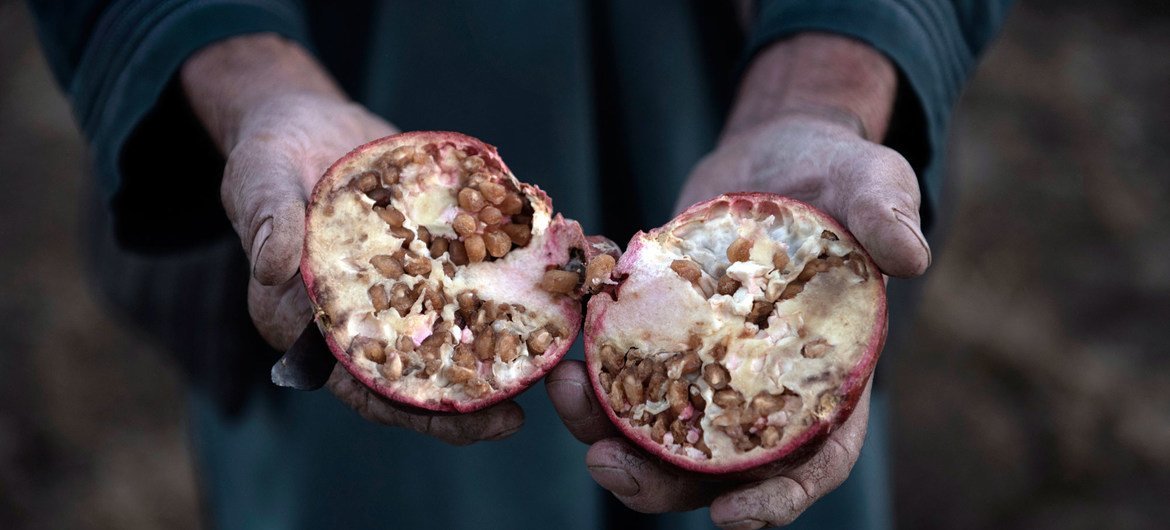
“Catastrophic and famine-like conditions” hang over Afghanistan’s farmers and herders, whose needs continue to worsen with the onset of winter, UN humanitarians said on Friday.
Cipher Brief Expert Tim Willasey-Wilsey served for over 27 years in the British Foreign and Commonwealth Office. He is now Visiting Professor of War Studies at King’s College, London.
Older Americans have Saigon 1975 and the helicopters from the Embassy roof seared into their memories. A previous generation of Britons was haunted by the image of General Percival surrendering vast numbers of troops and equipment in Singapore to the Japanese in 1942. How Kabul falls to the Taliban could have important practical and symbolic significance.
The announcement that the United States is sending 3,000 troops to Kabul alongside 600 British troops to manage the evacuation of their civilians and those Afghans who provided assistance, is a remarkably late response to a rapidly deteriorating situation. Unless carried out in the next 48 hours, it will also be risky. Taliban infiltrators are already inside Kabul and the forces which captured Ghazni and Kandahar on 12th August will be heading towards the capital on their Honda 125cc motorbikes.
The US must have extracted undertakings from the Taliban negotiators in Qatar not to launch their full assault on Kabul until the evacuations are complete, but elements of doubt remain. Previous Taliban assurances have proved worthless, and it is doubtful that individual Taliban commanders would wish to hold back while some of Ashraf Ghani’s ministers, senior army officers, judges and officials are spirited away to a life of exile.
It is hard not to be impressed by the speed and élan of the Taliban’s recent successes; taking 13 of Afghanistan’s 34 regional capitals in almost as many days. It is reminiscent of the extraordinary progress which the Japanese made down the Malaya Peninsula in 1942 with Singapore as the ultimate prize.
The Taliban’s success has not happened by chance. It is clearly the fruit of preparation and planning. Above all, they have learnt from the experience of 1994 to 1996 when they eventually took Kabul but failed to capture the north, thereby allowing space for the Northern Alliance parties to survive and then reassert themselves following the 9/11 terrorist attacks.
This time, the Taliban have focussed first on border posts with neighbouring countries (thereby denying the government vital supply routes and customs revenues) before taking outlying regional capitals and leaving Kabul (which is never easy to capture) until last. Above all, they have concentrated on the north where many rural Afghans are disenchanted with the Kabul government and regional warlords. The north is no longer the solid bastion of anti-Taliban sentiment it was in the 1990s.
The Cipher Brief hosts private briefings with the world’s most experienced national and global security experts. Become a member today.
Taliban progress in the north has snuffed out any chance that the old Northern Alliance could be reborn out of the eventual collapse of the Ashraf Ghani government. Whereas in 1996, Ahmed Shah Massoud, its brilliant military leader, was able to abandon Kabul and beat a tactical retreat up the Panjshir Valley, that option barely exists today. Not only is Massoud dead but his former adherents are no longer guerrilla fighters but members of a stratified Afghan army which has struggled to perform without US air support.
The Taliban have also ruthlessly exploited the weak negotiating stance of the United States and its chief negotiator Zalmay Khalilzad. Whereas some of the Taliban team in Doha, such as Mullah Barader, may indeed have been ‘moderates’ there was never any doubt that the Taliban movement wanted to see the total defeat of the Kabul government and the expulsion of Western forces. Pakistan too, may have occasionally considered some form of negotiated deal but ultimately the only sure way of keeping Indian influence out of Afghanistan (it believes) is a Taliban government.
The Afghan army (and in particular its impressive Special Forces) will now be assembling in Kabul and should be able to repel initial attempts to overrun the city. Certainly, Gulbuddin Hekmatyar found it impossible to take Kabul in 1992 and 1993 even with help from Pakistan, which, in frustration, switched support to the newly-created Taliban movement in late 1994.
But from 1992 to 1996 there were frequent deliveries of supplies to Massoud and his Northern Alliance defenders from Russia, Iran, and India. In 2021, the position is very different. Russia has already decided to “back the winner” and believes it has extracted promises from the Taliban not to export Islamism northwards into the Central Asian Republics (CARs). Iran too has channels to the Taliban and will be watching carefully for any return to the Taliban’s persecution of the Shia Hazaras. And India has already made contact with the Taliban in Doha in the hope that the Taliban in power will prevent Kashmiri militant groups from setting up bases there.
The likelihood therefore is that Kabul will fall to the Taliban quite quickly. If the Americans and British do manage to insert their evacuation forces soon, they should be able to complete the operation successfully, although there are likely to be heart-rending scenes at the airport as crowds of refugees are turned away at gunpoint from departing aircraft. Regional powers, particularly Pakistan, will try and persuade the Taliban to hold back from intervening, conscious that a bloodbath in Kabul would be a disastrous start to the Taliban’s second spell in government. Ironically, however, the evacuation would almost certainly lead to the collapse of the Kabul government as senior officials are forced to decide whether to take the last aircraft out or face almost certain torture and death at the hands of the victors. It is doubtful whether any Western countries will choose to retain their embassies in Kabul. For President Biden, the memory of Benghazi will be too raw.
What is certain is that there will be new iconic images to rival those of Saigon and Singapore.
Go beyond the headlines with expert perspectives on today’s news with The Cipher Brief’s Daily Open-Source Podcast. Listen here or wherever you listen to podcasts.
Read more expert-driven national security insights, perspective and analysis in The Cipher Brief.
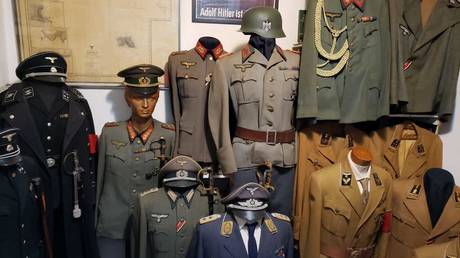
Any apology for Nazism is unacceptable, Colombia’s president Ivan Duque has insisted, after photos of police academy cadets dressed up in Third Reich uniforms were uploaded online, causing outrage.
“Any apology for Nazism is unacceptable,” Duque stated in a tweet on Friday. The president said he condemned any references to those who were “responsible for the Jewish Holocaust that claimed the lives of more than 6 million people,” adding that “anti-Semitism has no place in the world.”
Policía colombiana homenajea a Alemania con una fiesta ‘nazi’
Indignación en Colombia por la fiesta que organizó un grupo de estudiantes de la Escuela de Policía Simón Bolívar en Tuluá, en la que varios uniformados recrearon escenas alusivas a la Alemania nazi pic.twitter.com/UnF4ajUd8z
Duque had earlier made demands for “heads to roll” at an academy that “promotes such criminal practices,” with its director, Lieutenant Colonel Jorge Ferney Bayona Sanchez, already having been sacked.
Toda una polémica ha provocado el evento realizado en las últimas horas en la escuela de Policía Simón Bolívar de Tuluá. Los uniformados se disfrazaron de Adolf Hitler, haciendo alusión al nazismo durante la semana de la internacionalización. #VocesySonidospic.twitter.com/EoS4JqvzrC
Colombia’s defense ministry, which oversees the country’s police, also insisted in a statement that that its training programs “don’t envisage in any way an activity such as the one which took place” at the academy.
The images of police cadets in Nazi uniforms caused anger and bewilderment among internet users.
The German and Israeli embassies in the country reacted by issuing a joint statement, in which they expressed “total rejection of any form of apology or demonstration of Nazism.” The US embassy in Bogota also said that it was “shocked and deeply disappointed” by the development.
The controversial images, in which aspiring officers were caught sporting black SS outfits with red swastika armbands and grey Wehrmacht uniforms from the World War II era, weren’t revealed in some bombshell media report, but were actually published on the official Twitter account of the Colombian police this Thursday.
The photos were taken as part of a “cultural exchange” event at the police academy in the city of Tulua, aimed at commemorating Germany and “strengthening the knowledge of our police students.” The cosplay was apparently intended to illustrate the history of German law enforcement, with more cadets pictured wearing more modern versions of the country’s police uniforms in the pictures.
President Joe Biden commented on reports that US officials are planning to boycott the upcoming Olympics in Beijing over alleged human rights violations – but his answer left journalists perplexed.
When asked on Tuesday if an official US delegation will be traveling to the Winter Games in the Chinese capital in February, Biden responded: “I am the delegation.”
The president, however, did not elaborate, leaving the White House correspondents in a state of confusion, as his response could mean that Biden will attend the Winter Olympics alone or, as some reporters suggested, that he simply did not understand the question.
A recent report by a Washington Post columnist claimed the US won’t be sending an official delegation to Beijing in 2022 over allegations of human rights violations by the Chinese government. According to the sources cited in the article, a formal recommendation for a diplomatic boycott of the Olympics has been already presented to Biden, with the move expected to be approved by the president by the end of November.
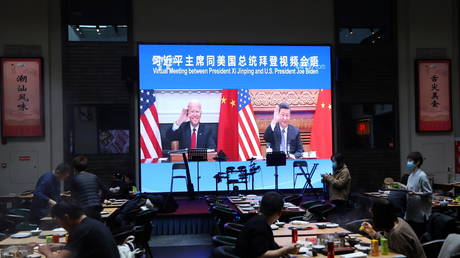
The piece was published on the day that Biden held a lengthy virtual meeting with Chinese leader Xi Jinping, in which they discussed a range of issues regarding the strained relations between the two nations – but not the Olympics.
The White House said that during the talks, President Biden challenged his Chinese counterpart over what Washington sees as persecution against the Uyghur population in the Xinjiang region, as well as human rights violations in Tibet and Hong Kong. China has strongly denied the claims, accusing the US of interfering in its internal affairs.
Calls for the Biden administration to boycott the Olympics and refrain from sending a political delegation to Beijing have recently been made by top Democratic and Republican lawmakers.
If implemented, it won’t affect the American athletes, who will still be taking part in the Winter Olympics.
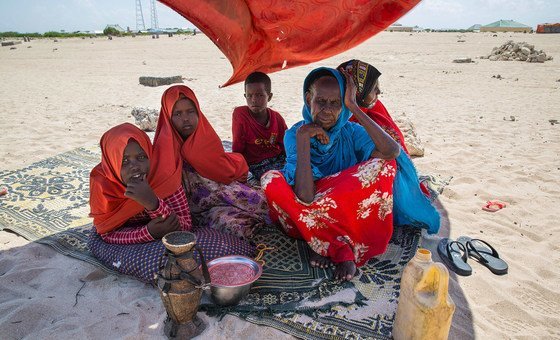
With about 2.3 million people already suffering with serious water, food and pasture shortages in Somalia, a rapidly worsening drought could lead to an “extreme situation” by April next year.
Clinics in the Austrian region of Salzburg have set up a special assessment team tasked with identifying Covid patients who have a higher chance of survival; the rest may soon have to take a back seat.
Amid a dramatic spike in Covid cases, medical personnel warn they may soon have to make the heart-wrenching choice of which patients get life-saving treatment and which ones will have to wait, Austrian media report. Intensive care units in the Salzburg region are packed, with the number of patients treated there setting a new grim record on Tuesday, reaching 33. The region ranks amid Austria’s hardest-hit, logging more than 1,500 new infections per 100,000 residents in a week. In an emotional plea for help to the local government, the head of Salzburg’s hospitals warned that soon clinics would likely not be able to guarantee the existing level of standards in terms of medical treatment. A representative for the city clinics likened the situation to “running into a wall.”
The region’s governor, Wilfried Haslauer, announced on Tuesday that some of the Covid patients whose condition was no longer life-threatening would be transferred from hospitals to rehabilitation centers to make room for more serious cases.
In neighboring Upper Austria, the situation is no better, with the number of deaths in intensive care units surpassing figures seen in all the previous Covid waves. Speaking to Austria’s Der Standard paper on condition of anonymity, healthcare workers there said they had free beds “because the infected are dying.”
For the time being, the creation of a so-called ‘triage team’ in Salzburg hospitals is being described as a “precautionary measure.” The panel is made up of six people: one legal expert and five providers from various medical disciplines. If push comes to shove, they will be deciding which patients stand a chance and which treatments have little prospect of success.
Instagram is looking to channel the anger of its users by introducing a new feature that allows them to report various problems with the app by shaking their phones.
“Have you ever used Instagram and it wasn’t working like it was supposed to? It was just really getting you… really just pissing you off?” Instagram’s head Adam Mosseri asked his followers in a clip uploaded to Twitter on Wednesday.
Well, precisely for infuriating situations like that, the platform has developed a feature it’s calling “rage shake,” he announced.
Shaking your phone will, from now on, cause a special form to pop up on screen, allowing you to instantly report issues such as photos not uploading or audio not playing.
The form is also the perfect place to let out “all the emotions and feels you’ve got going on,” Mosseri insisted, assuring Instagrammers that these reports would be promptly dealt with.
Thanks to their feedback, Instagram will be able to optimize its bug-fixing process, he said. The option, which he described as a “hidden gem,” is so far available only in the US, on both iOS and Android.
The Instagram boss gently shook his own cellphone in the clip to demonstrate the feature in action. However, it’s likely upset users may well end up rage-shaking with a good deal more passion, which could increase the risk of a gadget being damaged, or their owner or even a passerby being struck should the phone fly out of their hand.
Mosseri also didn’t advise the public what to do with their rage over media revelations about alleged shady practices by Instagram and the platform’s owner, Facebook.
Among the trove of papers recently leaked by former Facebook employee Frances Haugen was an internal study from 2020 reporting that Instagram was causing many of its young users, particularly teen girls, to suffer mental health issues and suicidal thoughts. However, the platform kept operating in the same manner despite this finding, with changes being promised only after the study made headlines this September.
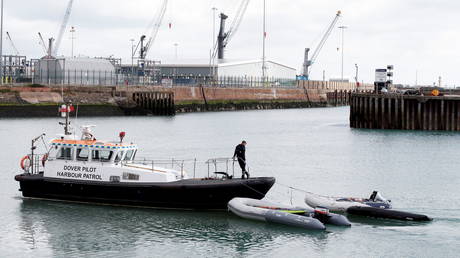
Sports goods retailer Decathlon has said it won’t be selling canoes in its stores in northern France anymore because the light vessels are increasingly being used by migrants trying to cross into England.
“Given the current context… the purchase of canoes will no longer be possible” in Decathlon stores in Calais and Grande-Synthe, outside Dunkirk, the French retailer announced.
The two cities overlook the Strait of Dover, which is the narrowest point in the English Channel. Thousands of migrants have been using this spot in recent years to try to make the dangerous 34-kilometer-long sea journey from France to the UK.A lot of canoes aren’t being purchased for their original sporting purpose, Decathlon complained.
They “could be used to cross the Channel” and as a result of this, “people’s lives would be endangered,” it pointed out.
“We are committed to never putting our customers at risk in the use of our products, whatever the circumstances,” the company said.
The initiative to remove canoes from the shelves came from the stores themselves and was backed by the head office, according to the retailer. However, Decathlon will keep selling the vessels online and in its other shops across France.
Last Thursday, two canoes were found adrift in the Channel near Calais, while two migrants were rescued from the water. The next day, three more people were reported missing after attempting to get to England using canoes.
Tensions between London and Paris are high after a record number of migrants – 1,185 – were able to cross the Channel a week ago.
Britain said it was “unacceptable” that France had let so many people slip through, but the French government insisted they were “neither their collaborators nor their assistants” and blamed the soaring crossings on the smugglers and the UK’s labor market, which makes the country attractive to people eager to “work at low cost.”
General Joseph L. Votel (Ret.) joined BENS as CEO & President in January 2020 following a 39-year military career where he commanded special operations and conventional forces at every level; last serving as the Commander of U.S. Central Command (CENTCOM) where he was responsible for U.S. and coalition military operations in the Middle East, Levant, and Central and South Asia. General Votel’s career included combat in Panama, Afghanistan, and Iraq and he led the 79-member coalition that successfully liberated Iraq and Syria from the Islamic State Caliphate. General Votel preceded his assignment at CENTCOM with service as the Commander of U.S. Special Operations Command and the Joint Special Operations Command.
The Cipher Brief: Did you ever envision that the U.S. would pull out so quickly or completely leaving the Afghan military on its own without U.S. air support?
General Votel: I did not anticipate this during my time – but once the President sets a hard departure date – then a fast withdrawal is inevitable. No Commander wants to accept unnecessary risk with troops on the ground when you are up against a clearly articulated departure date.
The Cipher Brief: Intelligence assessments wildly missed the mark on how fast Kabul would fall, what factors contributed most directly to this?
General Votel: Certainly, the departure of our own capabilities is a big part of this; the lack of direct contact with Afghan leaders is another important factor; and, of course, once it was clear that we were departing (and took our Commander out) — we lost priority and access with our normal and reliable Afghan intelligence sources.
The Cipher Brief: U.S. personnel are facing a deteriorating security situation at the Kabul airport while U.S. forces are still deploying for the contingency operation, another sign that the administration underestimated how fast the Taliban would reach Kabul. The U.S. could have chosen to slow the Taliban advance using airpower, why didn’t it happen, do you think?
The Cipher Brief hosts private briefings with the world’s most experienced national and global security experts. Become a member today.
General Votel: I think it is very clear that this was no longer a priority for our Government. The mission right now, at least articulated over the weekend, is about supporting evacuation of the diplomats and helping with the departure of those Afghans who assisted the US and meet the criteria for evacuation. While I don’t know this for certain — I believe what we were trying to do with over the horizon air support in a rapidly developing situation, was not optimal or overly effective. It doesn’t seem to have done much – if anything.
The Cipher Brief: The U.S. has allowed U.S. supplied military hardware, weapons and technology to fall into the hands of the Taliban, a group responsible for the deaths of U.S. personnel and thousands of innocent Afghans. The U.S. government holds private citizens and corporations accountable for far lesser violations of export violations involving dual-use technology or military equipment, etc. How should Americans think about this situation now, where the Taliban will use equipment, paid for the by the U.S. taxpayer, to potentially perpetrate acts of violence against U.S. interests, and erode democratic values that the U.S. tried to introduce to Afghanistan?
General Votel: Not sure on this. Unfortunately, it is not the first time we have seen this — remember ISIS in 2014, in Mosul? I suspect these will be more trophy pieces than they will be hard military capability – with the exception of small arms, mortars, and artillery. Most of this will be difficult for the Taliban to sustain – and they probably prefer their own gear, anyway.
The Cipher Brief: There is a lot of anger among the national security community right now. What would you say to individuals who have suffered because of the U.S. role in Afghanistan, who may be feeling anger and rage?
General Votel: I can’t really comment on anger in the national security community — I am sure that exists, but the sentiment that seems more strong to me, is disappointment. No one wants what we are seeing now. I think most security professionals can accept a decision to depart by the Commander in Chief — that is well within his authority, and everyone understands this; what is harder to accept is the manner in which this happened, and how it has played out. It was hard for me to watch Taliban sitting at a conference table that I once sat at with the Afghan President. In a number of public engagements, I have participated in lately – people have asked me if this whole effort was a waste. My response has been consistent. American military personnel, members of the IC and the diplomatic corps conducted themselves honorably throughout this war. They responded when the Nation called and did their best for our Country, each other, and the Afghan people. There will be plenty of time to place the blame – but the vast, vast majority of Americans who participated in some aspect of the Afghan War did so nobly and to the best of their ability. We should not lose sight of this. That this did not turn out the way we all hoped — is not their fault … and I would not want anyone (especially families of our wounded and killed) to think these efforts were in vain. That is not how I thought about them at the time, and it is not how I think about them now. They answered when the Nation called.
Have a perspective to share? Email Editor@thecipherbrief.com
Read more expert-driven national security insight, perspective and analysis in The Cipher Brief
Scientists have used artificial intelligence to “predict” formulas for new designer drugs, with the stated goal of helping to improve their regulation. The AI generated formulas for nearly nine million potential new drugs.
Researchers with the University of British Columbia (UBC) used a deep neural net for the job, teaching it to make up chemical structures of potential new drugs. According to their study, released this week, the computer intelligence fared better at the task than the scientists had expected.
The research team used a database of known designer drugs – synthetic psychoactive substances – to train the AI on their structures. The market for designer drugs is ever-changing, since their manufacturers are constantly tweaking their formulas to circumvent restrictions and produce new “legal” substances, while cracking their structure takes months for law enforcement agencies, the researchers said.
“The vast majority of these designer drugs have never been tested in humans and are completely unregulated. They are a major public-health concern to emergency departments across the world,” one of the researchers, UBC medical student Dr. Michael Skinnider has said.
After its training, the AI was able to generate some 8.9 million potential designer drugs. Afterwards, researchers ran a data sheet of some 196 new drugs, which had emerged in real life after the model was trained, and found that more than 90% of these have been already predicted by the computer.
“The fact that we can predict what designer drugs are likely to emerge on the market before they actually appear is a bit like the 2002 sci-fi movie, Minority Report, where foreknowledge about criminal activities about to take place helped significantly reduce crime in a future world,” senior author Dr. David Wishart, a professor of computing science at the University of Alberta, has said.
Identifying completely unknown substances remains an issue for the AI, the research team has noted, but they hope it might potentially help with that task, since the computer was also able to predict which formulas of designer drugs were more likely to be created and hit the market. The model “ranked the correct chemical structure of an unidentified designer drug among the top 10 candidates 72 percent of the time,” while throwing in spectrometry analysis, which is an easily obtained measurement, bumped the accuracy to some 86%.
“It was shocking to us that the model performed this well, because elucidating entire chemical structures from just an accurate mass measurement is generally thought to be an unsolvable problem,” Skinnider stated.
Think your friends would be interested? Share this story!