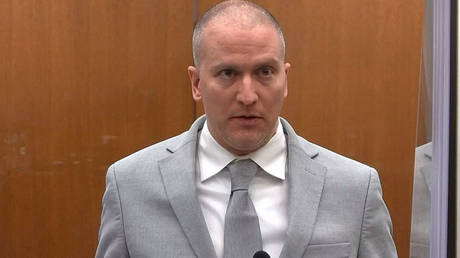
Judge accepts plea deal in federal civil-rights case against Derek Chauvin, who was convicted of murder in state court
Derek Chauvin, the former Minneapolis police officer who was convicted of killing George Floyd in an incident that triggered race riots across the US in 2020, has been spared the death penalty on federal civil-rights charges after a judge accepted his plea agreement.
US District Court Judge Paul Magnuson approved Chauvin’s December plea deal on Wednesday, confirming that the ex-officer will be sentenced to 20-25 years in prison. Chauvin could have faced a life sentence or even the death penalty – though the latter was considered unlikely – if he had been convicted at trial.
Magnuson hasn’t set a sentencing date for Chauvin, who infamously kneeled on the back of Floyd’s neck for more than eight minutes. The 19-year veteran of the Minneapolis Police Department was convicted of murder and manslaughter charges last year in state court and was sentenced to 22 ½ years in prison.
In the federal case against him, Chauvin pleaded guilty in December to deprivation of civil rights under color of law. He reportedly entered his plea, foregoing a trial, under the condition that he will serve his time in federal prison, rather than a state penitentiary, even though that will likely mean a longer time behind bars. Federal prisons tend to be less crowded and safer than state prisons in the US.
Chauvin will serve his state and federal sentences concurrently, meaning he won’t have to start over on one after finishing the other. The 46-year-old could have been paroled in Minnesota after less than 15 years, assuming maximum credits for good behavior, while his federal plea deal reportedly dictates that he be incarcerated for at least 17 years.
Ben Crump, a lawyer representing Floyd’s family, had called for Chauvin to get the maximum sentence in his federal civil rights case.
The war in Ukraine is having a disproportionate impact on women and minorities, who are facing immense hardship when it comes to health, safety, and access to food, according to a UN-backed report focused on the changing gender dynamics of the conflict.
Mario Draghi has argued that the bloc should make key decisions by qualified majority
Italian Prime Minister Mario Draghi has urged the EU to make key decisions by a qualified majority, rather than seeking unanimous consent of its member states. Draghi said that in the wake of the Covid-19 pandemic and Russia’s military campaign in Ukraine, the EU must learn to work more robustly and effectively.
“The geopolitical situation is undergoing rapid and profound change. We have to move, and move as quickly as possible,” Draghi told the European Parliament on Tuesday.
“Building a common defense must be accompanied by a united foreign policy, and effective decision-making mechanisms.”
We must move beyond the principle of unanimity, which gives rise to an intergovernmental approach based on mutual vetoes, and we must head towards qualified majority decision-making.
“A Europe able to make prompt decisions is more credible in the eyes of its citizens and in the eyes of the world,” Draghi said.
The PM urged to “streamline and optimize” military spending, and to process Ukraine’s application to join the EU “as quickly as possible.”
“We need pragmatic federalism, encompassing all areas affected by the ongoing transformations – from the economy to energy and security,” Draghi said.
The veto power allows the bloc’s individual members to strike down decisions that affect the EU as a whole. Most recently, Hungary said that it would not back a ban on Russian oil and gas because its economy is heavily dependent on energy supplies from Moscow.
Last week, the European Parliament approved draft proposals for a comprehensive EU reform, stating that most issues that are now “decided by way of unanimity should be decided by way of a qualified majority.”