Iran has said that explosions above the Bushehr nuclear power plant in the early hours of Monday morning were related to an air defense drill, as the military launches war games across the country.
Speaking to Iranian state media on Monday, the deputy governor of Bushehr province, Mohammadtaqi Irani, said the power plant had hosted early morning maneuvers to prepare for possible future aggression.
“This air defense exercise took place at 5am local time, with full preparation and coordination with the armed forces,” Irani stated.
Prior to Irani’s statement, there had been reports of anti-aircraft fire in the area around the power station. A video circulating online appears to show air defense drills in progress.
State media outlets reported that Iran had launched the 17th iteration of its annual five-day war games, Payambar-e Azam [The Great Prophet].
The joint drills are taking place along the shores of the Persian Gulf, in the Strait of Hormuz, and in the provinces of Hormozgan, Bushehr, and Khuzestan, and involve the Islamic Revolutionary Guard Corps’ ground, naval, and air force units.
To mark the start of the exercises, a senior Iranian military commander issued a menacing message directed at Israel. “If Israel carries out attacks against Iran, our armed forces will immediately attack all centers, bases, routes, and spaces used to carry out the aggression,” Major General Gholamali Rashid said, vowing a “crushing” response, according to Nournews.
Iran’s nuclear sites have long been the source of international attention. For the past year, parties have sporadically met in Vienna with the aim of bringing Iran and the US back in line with the terms of an Obama-era atomic deal, which put constraints on Tehran’s nuclear ambitions.
Then-President Donald Trump unilaterally pulled America out of the Joint Comprehensive Plan of Action in 2018, re-imposing harsh economic sanctions on Iran as part of a maximum pressure campaign. Iran responded by reneging on a series of commitments it had previously agreed to under the terms of the deal.
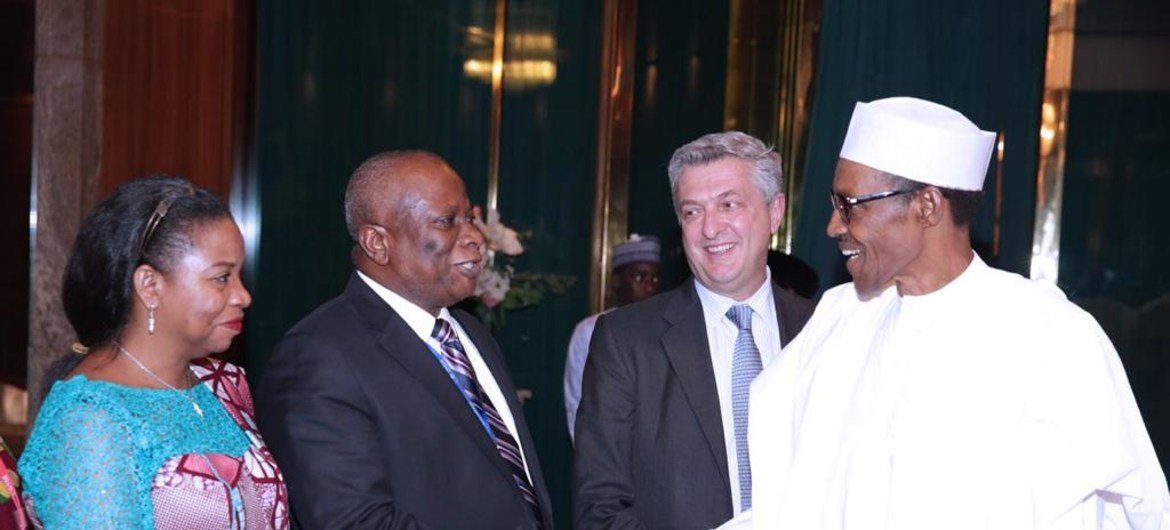
Edward Kallon, the outgoing UN Resident and Humanitarian Coordinator for Nigeria, is moving on after five years in the past. In this blog, Mr. Kallon reflects on the many challenges facing Africa’s most populous nation, the impact the UN has made on his watch, and the prospects for a prosperous, sustainable future.
The Afghan government’s biggest policy mistake leading up to the US withdrawal was its failure to grasp that the US was planning to leave no matter what, according to a former national security adviser to ex-president Ghani.
“I think not seeing that writing on the wall probably was one of the biggest” mistakes Afghani President Ashraf Ghani could have made as the end of the US occupation approached, former national security adviser Hamdullah Mohib told CBS’ Face the Nation on Sunday.
“We should have understood that the United States had made its decision and would withdraw under any circumstances. That probably is one of the reasons we were unable to secure another outcome.”
Asked, however, if the ousted Afghan government had actually believed the US would have stayed in the country longer if the situation on the ground had been different, Mohib said “no.”
Nevertheless, he blamed the US and other coalition partners for not putting more effort and resources into the maintenance of a “democratic Afghanistan.”
I felt that our partners, the US included, believed in a democratic Afghanistan, a place where we were going to preserve the gains of the last 20 years
“I thought those gains meant something,” he added.
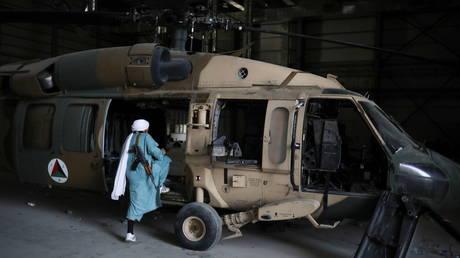
Kabul fell almost instantaneously to the Taliban once the Biden administration made its hasty exit, with some comparing chaotic evacuation scenes that followed to the US’ tail-between-the-legs rush departure from Saigon after losing the Vietnam War. Similar to the iconic images of people clinging to a helicopter lifting off from the roof of the US Embassy, the final days of the Afghan occupation saw Afghans who had worked with the US attempting to cling to the wings of a plane as it left the war-ravaged country.
While the Biden administration’s effort to end the ‘endless war’ in Afghanistan initially had bipartisan support, the chaotic manner in which it was executed – leaving hundreds of Afghan civilians who had collaborated with coalition troops behind – drew criticism from across the aisle. The Taliban, which at the time of the US’ departure controlled more territory than it had at the start of the US invasion, quickly routed the Afghan military. The withdrawal was plagued by apparent miscommunication between Afghan and US troops, with the new commander of Bagram Air Base claiming that the US military even failed to notify him of their departure from the base which once was the linchpin of the US-led NATO mission in Afghanistan.
President Joe Biden pushed back against allegations of incompetence at the time by blaming the Afghan military for refusing to stand and fight, noting that the US military had “trained and equipped with modern equipment over 300,000 Afghan forces.” The US had lost thousands of service members in the quagmire of nation-building, the president argued, calling for the Afghans to “fight for themselves, fight for their nation.”