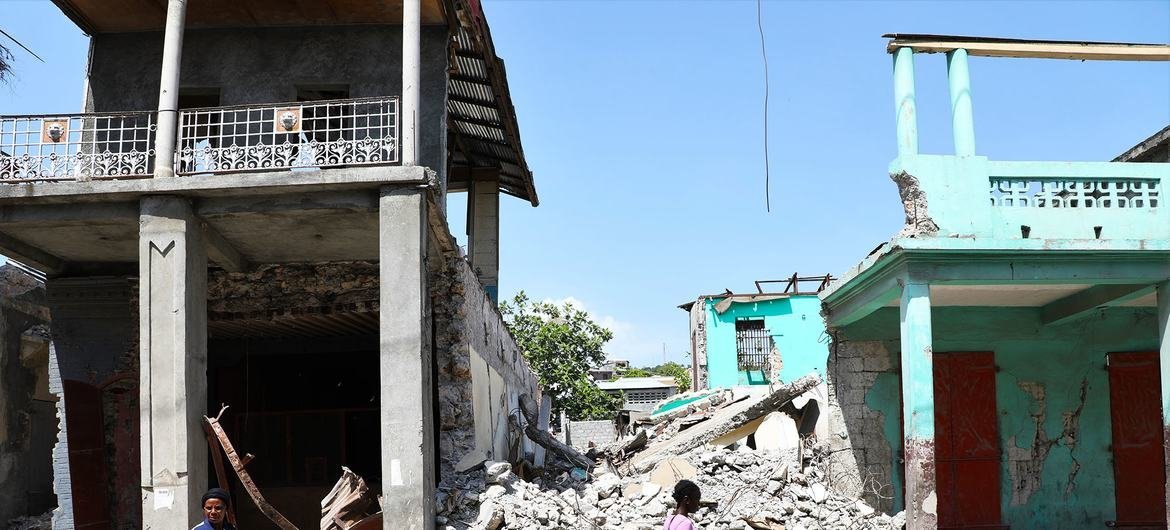
More than 300,000 people have been displaced and at least 31 were killed as Typhoon Rai tore through the Philippines. It was the archipelago’s 15th and strongest major storm this year.
The tropical storm, named Rai internationally but named Odette locally, gathered over the Philippines this week, later than most typhoons which typically develop between July and October. It intensified rapidly on Thursday and was classified as a super typhoon, and a category 5 storm, the highest level.
In the worst affected regions, “the monster storm” caused “utter destruction,” journalist David Santos tweeted, sharing images of the aftermath.
More scenes of utter destruction caused by Typhoon Odette in Dapa town in Siargao Island, as residents start cleanup. Govt forces flying in on hardest-hit areas in Surigao to survey the devastation in the aftermath of the monster storm | @cnnphilippines
With winds reaching 195kph (121mph), it ripped off roofs and uprooted trees, creating widespread destruction in its path and leaving houses and swathes of rice fields submerged.
At least 31 people were killed, the country’s disaster agency said on Saturday. Most of the fatalities reported were due to falling trees or drowning. Officials said the death toll was preliminary and might rise, as more information from provincial units is yet to come.
Cebu is currently being devastated by Typhoon #OdettePH. I can’t describe my feeling so scary outside. This is just inside but you can feel the wrath already. Cebu is home of millions Filipinos. Please pray for the Philippines. We need God during this time. Only miracle can save. pic.twitter.com/Z3DBHGrPOh
The typhoon ravaged the southern and central regions of the island country, also hitting popular tourist destinations, including Siargao and Cebu. More than 300,000 people fled their homes and beachfront resorts. Dozens of flights were canceled, leaving about 4,000 people stranded.
BREAKING: Typhoon #OdettePH (international name: Rai) intensifies further, slams into Surigao City in southern part of the Philippines. @cnnphilippines
A local official in the Dinagat Islands said “everything was destroyed,” including evacuation centers, and residents have nowhere to seek refuge. President Rodrigo Duterte announced he would visit the hardest-hit areas on Saturday, saying he doesn’t worry so much about damage to structures, but “fears if many people died.”
The estimate comes from scientists who examined the number of carcasses they found up to 48 hours after a fire event. The rate of climate change makes such wildfires inevitable, they say.
A German regulator’s depiction of RT DE as an “irritant” to be disposed of is both humorous and ignorant about the role of journalism in covering power, said Pulitzer Prize-winning American reporter Chris Hedges.
“Of course” the actions by German regulators to go after the Berlin-based production company look political, Hedges told RT on Friday, comparing it to the US interference with RT America and its removal from cable channels after the 2017 report by US spies.
The infamous intelligence community assessment “attacked RT for giving a voice to third-party candidates, anti-fracking activists, Black Lives Matter,” Hedges noted.
He also pointed out the treatment of WikiLeaks founder Julian Assange, and said his own coverage of Assange’s imprisonment and extradition has been suppressed by social networks.
Hedges said he “actually laughed” at the statement by Tobias Schmid, current chair of the European Regulators Group for Audiovisual Media Services (ERGA), who called RT DE a “nuisance” or an “irritant” that needed to be taken care of. According to the American, Schmid’s remark showed “how utterly naive and tone-deaf he was about the role of journalism.”
“Journalists who are not an ‘irritant’ to people in power are called propagandists,” Hedges said. “We should always have an adversarial relationship to power. It’s what journalism is about.”
Hedges spent 15 years at the New York Times and won a Pulitzer Prize in 2002 for coverage of the war on terrorism. He left the paper in 2005, after criticizing the US invasion of Iraq, and currently hosts ‘On Contact,’ a weekly show on RT America.
RT’s German-language service began broadcasting on Thursday from Moscow via Serbia. Authorities in Berlin-Brandenburg on Friday filed a complaint in court, alleging that RT DE Productions company based in Berlin was a broadcaster that needed a German license.
RT has countered that the company only produces content, and that satellite broadcasting through Serbia is entirely legal and appropriate under the European Convention of Transfrontier Television (ECTT), which Germany signed and ratified.