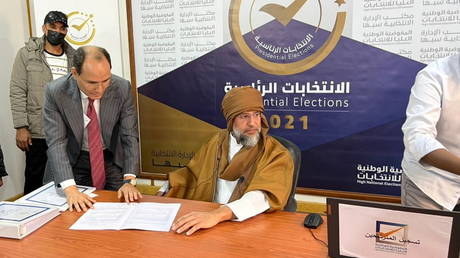
Libya’s election commission has disqualified 25 of the 98 candidates running for president, including Saif al-Islam Gaddafi, son of the leader whose 2011 overthrow plunged the North African country into a decade-long civil war.
Gaddafi had announced his candidacy on November 14 and looked like one of the front-runners in the contest, scheduled for December 24. On Wednesday, however, the election commission ruled him ineligible. It is a preliminary decision and can be appealed in court.
A military prosecutor in Tripoli had urged the commission to disqualify Gaddafi on grounds of his 2015 conviction in absentia for war crimes related to the 2011 insurrection that overthrew his father. Muammar Gaddafi had ruled Libya for over 40 years before he was ousted and killed by NATO-backed rebels.
Saif al-Islam was the chosen candidate of the Popular Front for the Liberation of Libya, a group of his father’s loyalists formally established in 2016. He also has a pending arrest warrant on behalf of the International Criminal Court (ICC) in The Hague.
Gaddafi reacted to the decision by pointing out that General Khalifa Haftar has two criminal convictions – a 1987 court-martial over his surrender to Chad, and a 1993 civilian conviction for plotting to overthrow the government – yet he has not been disqualified from running.
Haftar, who commands the armed forces of the Tobruk-based government that controls eastern Libya, was also accused by critics of holding a US citizenship and therefore ineligible. Meanwhile, the interim prime minister of the Tripoli-based national unity government, Abdul Hamid Dbeibeh, had promised not to run for president prior to taking on the role, and has refused to resign three months before the election, as required by the controversial election rules.
The UN Security Council on Wednesday issued a statement stressing the importance of the election for the peace and reconciliation in Libya and urged all parties to respect the rights of their political opponents “before, during and after” the vote.
The Geneva-based UN special envoy for Libya, Slovak diplomat Ján Kubiš, abruptly resigned on Tuesday for reasons not yet revealed, but will remain in the post until Secretary-General António Guterres appoints a replacement.
COVID-19 cases have increased in the last week with 3.6 million infections reported globally, as opposed to the 3.3 million over the previous seven days, the World Health Organization (WHO) said on Wednesday.
Nairobi, Nov 24 (IPS) – Kenya’s secondary schools’ administration has been in the eye of a storm since schools reopened in October 2021. Since then, students have set on fire 35 schools and counting, forcing the government to announce an unscheduled break from school – ahead of the planned December 23 closing.
Australia’s Great Barrier Reef is spawning in an explosion of color as the World Heritage-listed natural wonder recovers from life-threatening coral bleaching episodes in 2016, 2017 and last year.
Australia has designated all of Lebanon’s influential Hezbollah movement as a terrorist organization, expanding the earlier ban on its armed units to the political wing.
Hezbollah poses a “real” and “credible” threat to Australia, Karen Andrews, the country’s home affairs minister, said on Wednesday.
The Lebanon-based group “continues to threaten terrorist attacks and provide support to terrorist organizations,” Andrews added.
The move means that Australian citizens are now forbidden from becoming members of Hezbollah or providing funds for its operations. The group’s military wing has been on Australia’s terrorist list since 2003.
People from Lebanon make up the largest Middle Eastern community in Australia – estimated at around 230,000, mainly in the Greater Sydney area and Melbourne. Immigration to Australia peaked during the Lebanese Civil War between 1976 and 1981, but has declined significantly since then.
Hezbollah operates in various fields in Lebanon, acting as a political party, a military organization, and a provider of basic services to the population.
Israeli Prime Minister Naftali Bennett, who reportedly asked his Australian counterpart, Scott Morrison to ban Hezbollah’s political wing during the UN climate summit in Glasgow in early November, thanked Canberra for the move. He said the two countries will continue “to act in every way possible against terrorism, including in the international arena.”
Foreign Minister Yair Lapid also expressed his gratitude that Australia, which he described as “a close friend of Israel,” joined 17 other nations that realize “there are no separate wings to terrorist organizations.”
Israel, which waged a war against Hezbollah in 2006, considers the group, which has strong links to Iran, a threat to national security.
Hezbollah has been labeled a terrorist organization by the US, Israel, and the Arab League. The EU and many individual European nations have banned its military wing, but were reluctant to act against the political party over concerns it could further destabilize the situation in Lebanon.
Think your friends would be interested? Share this story!