KARACHI, Nov 19 (IPS) – Balance is the absolute key, if you ask Alia Chughtai, a journalist who started a catering service with filmmaker Akhlaque Mahesar, by the name of Aur Chaawal (And Rice), two years ago.
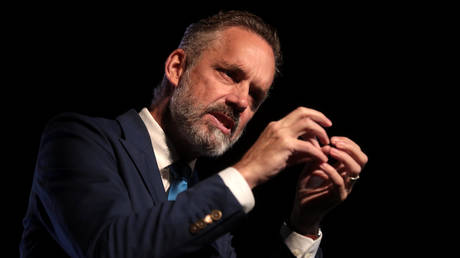
Controversial psychologist and author Jordan Peterson claimed Western countries had no “moral right” to force developing nations to reduce pollution output, noting instead that improving their economies was key.
During an appearance on the BBC’s ‘Question Time’ show on Thursday, the Canadian professor noted that the focus of climate change policies should be on incentivizing the development of cheap energy in poorer polluter countries.
“The best long term solution is to try to make developing countries as rich as possible, and the best way to do that is not control their pollution output, but to help them develop the cheapest energy they can possibly manage as fast as they possibly can,” Peterson said.
The debate saw UK undersecretary for employment Mims Davies suggest that measures taken to tackle climate change should not come at the “expense of developing countries.” But Peterson countered that it “absolutely, 100% will be [at their expense].”
I don’t think we have any moral right in the West at all to do that.
He also criticized the recent COP26 climate change conference for failing to explore ideas on how best to improve national economies in the developing world, noting that he saw “very little of that sort of idea” coming out of the UN summit.
In the final hours of the two-week conference, China and India had intervened to soften the wording around the use of coal in the Glasgow Pact. The two countries demanded a change in the final text of the agreement that called for coal to be phased out, revising this to “phasing down unabated coal.”
The move prompted COP26 president and UK minister Alok Sharma to declare that China and India would have to “justify” their actions to countries that were more vulnerable to global warming effects. However, officials in both Beijing and New Delhi have countered that the criticism was unfair.
When the PRC decides to move on Taiwan, it is unlikely to move in a manner that makes a US decision on intervention clear cut. Should China decide, initially at least, against a full-scale invasion of that island nation, it could instead opt to try to “win without fighting.” Beijing might do so by using its large, state-controlled fishing fleet to cut smaller Taipei-controlled islands off from Taiwan itself much as the PRC is now massing fishing boats to expand Chinese-controlled seas to press claims on the Japanese Senkakus and Whitsun Reef in Philippine waters. Chinese state-owned fisheries companies – part of the so-called ‘Maritime Militia’ – serve as fronts for PLA intelligence. Using their fleets to operate in a manner somewhere between peace and conflict in the gray zone of contested control around Taiwan would allow Beijing to test whether the US and its allies are willing to help defend the island’s independence without being seen to initiate open conflict.
“The Cipher Brief has become the most popular outlet for former intelligence officers; no media outlet is even a close second to The Cipher Brief in terms of the number of articles published by formers.” – Sept. 2018, Studies in Intelligence, Vol. 62 No.
Access all of The Cipher Brief’s national-security focused expert insight by becoming a Cipher Brief Level I Member .
President Joe Biden commented on reports that US officials are planning to boycott the upcoming Olympics in Beijing over alleged human rights violations – but his answer left journalists perplexed.
When asked on Tuesday if an official US delegation will be traveling to the Winter Games in the Chinese capital in February, Biden responded: “I am the delegation.”
The president, however, did not elaborate, leaving the White House correspondents in a state of confusion, as his response could mean that Biden will attend the Winter Olympics alone or, as some reporters suggested, that he simply did not understand the question.
A recent report by a Washington Post columnist claimed the US won’t be sending an official delegation to Beijing in 2022 over allegations of human rights violations by the Chinese government. According to the sources cited in the article, a formal recommendation for a diplomatic boycott of the Olympics has been already presented to Biden, with the move expected to be approved by the president by the end of November.
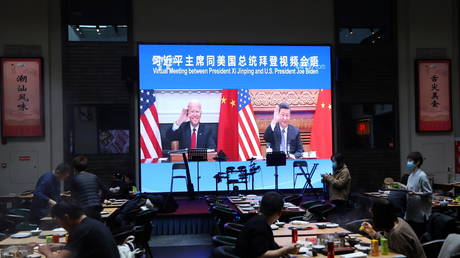
The piece was published on the day that Biden held a lengthy virtual meeting with Chinese leader Xi Jinping, in which they discussed a range of issues regarding the strained relations between the two nations – but not the Olympics.
The White House said that during the talks, President Biden challenged his Chinese counterpart over what Washington sees as persecution against the Uyghur population in the Xinjiang region, as well as human rights violations in Tibet and Hong Kong. China has strongly denied the claims, accusing the US of interfering in its internal affairs.
Calls for the Biden administration to boycott the Olympics and refrain from sending a political delegation to Beijing have recently been made by top Democratic and Republican lawmakers.
If implemented, it won’t affect the American athletes, who will still be taking part in the Winter Olympics.
An object lurking in the outer region of our solar system may well be the elusive Planet 9, a leading British astronomer has suggested after digging through the telescope archives of 250,000 point sources.
Possible evidence of a mysterious planet up to 10 times bigger than Earth, with a distant orbit around the Sun, has been unveiled by professor of astrophysics at Imperial College of London, Michael Rowan-Robinson. Aiming to prove – or rule out – the existence of another big planet beyond Neptune, the UK scientist decided to conduct a new analysis of data collected by the Infrared Astronomical Satellite (IRAS) in 1983.
The astronomer has looked through some 250,000 point sources detected by the telescope, which took a far-infrared survey of 96% of the sky. Having analyzed the data, keeping in mind the hypothetical planet’s size and distance, “at the very limit of the survey,” he singled out a moving object that the satellite picked out on three occasions.
The candidate for Planet 9 would be up to five times the mass of Earth, according to the IRAS data. Its orbital distance would be some 225 times farther than that of our planet, equaling about 33.7 billion kilometers (20.9 billion miles) from the Sun.
If the enigmatic object is indeed rotating around the Sun at such a distance, it would be extremely cold and not much sunlight would be reflected by it, making it even more elusive and harder to find. While the latest study is not a clear detection, it could be valuable as guidance for where exactly to search for the new planet, the astronomer concluded.
“Given the great interest of the Planet 9 hypothesis, it would be worthwhile to check whether an object with the proposed parameters and in the region of sky proposed, is inconsistent with the planetary ephemerides,” he wrote in the preprint paper, accepted for publication in the Monthly Notices of the Royal Astronomical Society.
A debate on the possible existence of an undiscovered planet in our solar system has been ongoing for decades. With no concrete evidence found, there has been speculation about its presence, mainly based on the gravitational clustering of objects in the system’s outer reaches. Several years ago, a suggestion was put forward that a group of icy objects that lie beyond the orbit of Neptune in the Kuiper Belt are possibly under the gravitational influence of a larger mysterious body, possibly Planet 9. The claim was based not on observation, but on modeling.
Currently, the eighth and farthest known planet from the Sun is Neptune. In the last century, Pluto, discovered in 1930, was regarded as the ninth planet, but a controversial vote at the International Astronomical Union (IAU) in 2006 formally excluded it from the solar system’s ‘planets’, and reclassified it as a dwarf planet.
Protesters thronged the streets of Australian cities on Saturday, demanding an end to what they called the “tyranny” and “oppression” of lockdowns, vaccine mandates, and the proposed expansion of the government’s pandemic powers.
In Melbourne, Sky News reporter Sophie Elsworth described “tens of thousands of people streaming through the streets.” The march came after a week of smaller protests aimed at Victoria Premier Dan Andrews’ controversial pandemic bill, which if approved by the state’s legislature would allow Andrews and Health Minister Martin Foley to declare an indefinite state of emergency and issue public health orders by decree – including “any order… that the minister believes is reasonably necessary to protect public health.”
Tens of thousands of people keep streaming through the streets. Many I’ve spoken to are concerned about the state govt, Premier, vaccine mandates, the pandemic bill & what future holds for their kids. #melbourneprotestpic.twitter.com/smexulQ4ts
Should the bill pass, it would allow Andrews to target certain classes of people with these orders, categorizing them by age, occupation, or vaccination status. Fines for noncompliance would range from up to AU$21,800 for people and AU$109,000 for businesses.
Alternative media sources claimed that more than 100,000 people showed up to protest. However, the demonstration remained free of the violent clashes seen at protests in Melbourne in recent months.
“Australia has been willing to send troops to all parts of the world to help people become free,” one military veteran told a crowd of listeners during the protest. “To now be fighting oppression here in our own country, it’s saddening.”
Melbourne Australia 🇦🇺
An Aussie veteran is calling former servicemen and cops who have sworn an oath to Australia to stand up against the tyranny 👊 pic.twitter.com/4RsoRMjoJE
Huge numbers of protesters also turned out in Sydney, and although more than 600 police officers were deployed to watch over the gathering, no arrests were made, 9News reported.
Holding signs decrying state “tyranny,” the demonstrators chanted “freedom” and called for the firing of state politicians who have implemented a two-tier system where the unvaccinated are denied many of the privileges extended to the fully jabbed.
Similarly massive gatherings took place in Adelaide, Brisbane, and Perth, with no notable incidents of violence or police action. Further afield, protests are taking place in more than 120 cities around the world this weekend, in a loosely coordinated event dubbed the ‘Worldwide Rally For Freedom’ by activists.
Thousands of people have descended across Rundle Park today as part of an Adelaide freedom rally. Some of those in the crowd say they have lost their job as a result of mandated vaccinations in their sector. @9NewsAdelpic.twitter.com/YdzvxYJhqF
The annual migration of red crabs has brought traffic to a standstill on an Australian island. Apart from the epic journey, the species is also notorious for eating its own young.
Tens of millions of crustaceans are swarming Canberra-governed Christmas Island, which is almost a thousand miles northwest of the Australian mainland. Parks Australia, a government body in charge of wildlife conservation on the island, has deployed its staff to manage traffic, rake crabs off roads and provide advisories to local residents regarding road closures. Authorities are well-prepared to deal with the epic crab march as it repeats every year, usually in October and November. There are even special bridges and tunnels in place, built over and under busy roads so as to minimize the number of crabs crushed by cars. The sight of millions of these creatures making their perilous trek has become one of Christmas Island’s main tourist attractions.
The exact timing of the red crabs’ journey from forest to ocean is defined by rainfall and lunar phases. The march is led by male crabs, which are later joined by females. On reaching the ocean, they mate and spawn, with each female capable of producing as many as 100,000 eggs. However, most of the young crabs never make it back to the forest as they end up being eaten by fish and whale sharks for whom this is a veritable feast. To make matters worse, the crab larvae that do make it to the beach are often devoured by returning adult crabs of the very same species, hence one of their names – the cannibal crab.
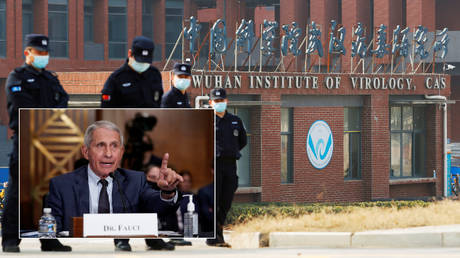
An American nonprofit behind the US-funded bat virus research in China has denied ever sending virus samples from Laos – a place where SARS-CoV-2 closest natural relative was found – to Wuhan in response to fresh allegations.
“No work was ever conducted in Laos as a part of this collaborative research project,” EcoHealth Alliance – a group that conducted experiments on coronaviruses while receiving funding from the National Institutes of Health (NIH) – said in a series of tweets on Sunday, responding to media reports alleging that the group might have transported a potentially dangerous virus from Laos to the laboratory in Wuhan.
However, we considered it a higher priority to continue our focus on China, and no work was ever conducted in Laos as a part of this collaborative research project.
The group’s name surfaced in October when the NIH principal deputy director, Lawrence Tabak, revealed EcoHealth Alliance did experiment on the viruses with the agency’s financial help. At that time, White House Medical Advisor Dr. Anthony Fauci stated that the viruses studied as part of the project “were distant enough molecularly that no matter what you did to them, they could never, ever become SARS-CoV-2.”
EcoHealth has come under renewed scrutiny after its emails, obtained through a Freedom of Information request, appeared to suggest that the group was discussing the prospect of collecting viral samples from bats in Laos and sending them to the Wuhan Institute of Virology. The emails were initially obtained by the White Coat Waste Project and sparked a flurry of reports over the weekend, including in the Spectator by British science writer Matt Ridley.
The emails shared between EcoHealth Alliance and its US government funders reportedly reveal that the scientists discussed collecting viral samples from bats in eight countries, including in Laos, between 2016 and 2019, and toyed with the idea of transporting them to Wuhan, ostensibly, to avoid red tape. One email from 2016 cited by the Spectator reportedly reads: “All samples collected would be tested at the Wuhan Institute of Virology.”
Laos is the birthplace of at least one virus that seems to be very close to SARS-Cov-2. A bat viral strain called Banal-52 discovered in Laos in September shares 96.8 percent of its genome with the virus behind the Covid-19 pandemic
On Sunday, EcoHealth Alliance claimed that the emails cited by Ridley “do not show…that we were sampling bats in Laos and sending the results to Wuhan.”
The group acknowledged, however, that it requested NIH permission to work in Southeast Asian countries, including in Laos, and that this permission was granted.
However, the nonprofit claimed it ended focusing on China instead.
The response failed to satisfy Ridley, who is also a co-author of a book on Covid’s origin, who demanded “evidence” proving that his report was not “fully accurate.”
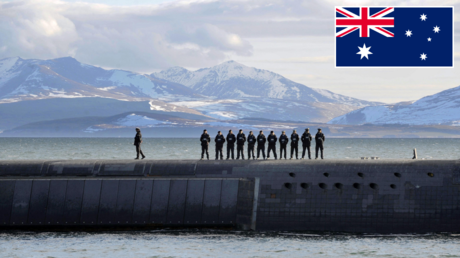
Australia’s Defense Minister derided a senior Chinese diplomat’s comments as “silly” and “comical,” after the latter dubbed Canberra’s trilateral nuclear-powered submarine pact with the US and UK a threat to peace.
During a television interview on Friday, Peter Dutton said acting Chinese Ambassador Wang Xining was “probably reading off a script from the Communist Party” when he warned that Australia would become the “naughty guy” if it procured the stealth-combat vessels through the AUKUS deal.
Wang, who is China’s most senior representative to the country after the previous ambassador’s term ended last month, told The Guardian on Thursday that Australia would be labeled a “sabre-wielder” rather than a “peace defender.” He said the Australian public “should be more worried” about the impact of the security pact their nation had made with the UK and the US.
There’s zero nuclear capacity, technologically, in Australia, that would guarantee you will be trouble free, that you will be incident free. And if anything happened, are the politicians ready to say sorry to people in Melbourne and in Adelaide?
However, Dutton “dismissed” the comments and countered that “most Australians [would] see through [their] non-productive nature.”
“We don’t see it from any other ambassador here in Australia. It’s quite remarkable,” the minister told the Nine Network, adding that “this type of diplomacy” was seen elsewhere in the world too.
“These provocative comical statements – it’s just so silly. It’s funny,” he added.
In September, Australian Prime Minister Scott Morrison announced the deal to obtain at least eight nuclear-powered vessels as part of its new defense alliance. The pact angered not only China but also France, which claimed it had been “stabbed in the back” after Canberra unilaterally scrapped a multi-billion-dollar diesel-electric submarine contract with Paris.
Last weekend, Dutton had irked Beijing by stating that he could not conceive of a situation in which Australia would hesitate to support the US should armed conflict with China break out over Taiwan. Under its ‘One China’ policy, Beijing has pledged to reunify the island with the mainland.
Wang warned Australian politicians on Thursday not to do anything that would be “destructive to our relationship.”