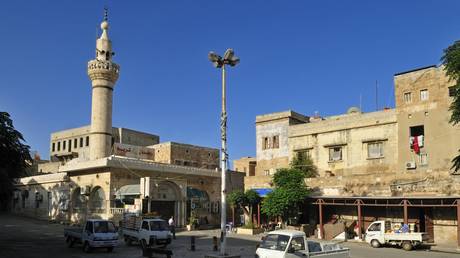
Palestinian Islamist group Hamas has called on Canadian singer Justin Bieber to cancel his upcoming concert in what it calls the “Zionist occupation state” of Israel.

Bieber announced his 2022 world tour dates this week, with a concert in Tel Aviv planned for next October. On Thursday, Hamas’ Artistic Production Department issued a statement, cited by the Palestinian Sawa news outlet, “condemning and denouncing” the performer. It called on the star to cancel the show and “boycott the Zionist occupation state in protest at its repeated crimes against the Palestinian people.” 

Read more

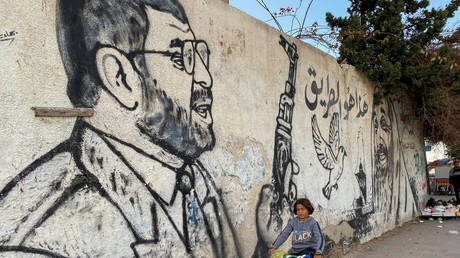
A Palestinian boy rides a bicycle past a mural depicting late Hamas leader Abdel-Aziz Al-Rantissi in Gaza City (FILE PHOTO) © REUTERS/Mohammed Salem
UK outlaws Hamas as terrorist organization

Bieber has performed in Israel multiple times, his last performance there having been in 2017 at Park HaYarkon – the same venue slated for next year. Since the announcement of the ‘Justice’ tour dates, calls for him to cancel the Tel Aviv show have gained momentum across social media, with many posters condemning the singer for supporting what one called an “apartheid state.”

Some noted that Bieber was set to arrive in Israel after performing in South Africa. “Justin Bieber is really going straight from SA to Israel. From a country that fought apartheid to a country that’s practicing apartheid,” one Twitter user complained.

A petition asking the singer to boycott Israel and exclude it from his tour has been launched online, and had garnered some 3,700 signatures by Friday. 

In 2018, the New Zealand singer Lorde canceled a concert in Israel, subsequently thanking fans for “educating” her on the issue, and, the same year, US artist Lana Del Rey at first defended her decision to perform in the country, saying her appearance would not be a “political statement,” before backtracking and canceling the gig.

Hamas has been designated a terrorist group by the US, the EU, and, as of Friday, the UK. In April 2021, international non-governmental organization Human Rights Watch concluded in a report that Israel had committed “crimes against humanity of apartheid and persecution.”

If you like this story, share it with a friend!

find more fun & mates at SoShow now !

The Islamic State terrorist group is tearing a path across Afghanistan, establishing itself in “nearly all” of its provinces while increasing attacks more than five-fold in the past year, the UN’s envoy to the country has warned.

Addressing the UN Security Council on Wednesday, the body’s special representative for Afghanistan Deborah Lyons spoke of a major Islamic State (IS, formerly ISIS) surge through the war-torn country, claiming the jihadist group has now expanded nationwide.

“Once limited to a few provinces and the capital, ISKP now seems to be present in nearly all provinces, and increasingly active,” Lyons said, referring to the group’s Afghanistan-based ‘Khorasan’ faction. She added that so far in 2021, IS has carried out 334 attacks, up from just 60 last year.

The envoy’s comments came just hours after an Islamic State bombing erupted in a Shiite Muslim neighborhood of the Afghan capital, killing one and wounding six others, according to Reuters.

Since taking over as the government following a chaotic US withdrawal and the outright collapse of the American-backed administration in Kabul last summer, the Taliban has struggled to keep the terrorist group at bay, Lyons said. Though she noted that the Taliban insists it is “waging a concerted campaign” against IS and is making “genuine efforts to present itself as a government,” she said its response “appears to rely heavily on extrajudicial detentions and killings.”

READ MORE: ‘Ghost soldiers’ to blame for Afghan government’s quick defeat – ex-minister

Despite the rise in IS attacks in recent months, however, Lyons said the overall security situation in Afghanistan has improved since the end of the US war, which stretched on for two decades.

In addition to the terrorism issue, the UN representative also cited broader concerns for the country in the coming months, warning of a looming “humanitarian catastrophe” driven by a litany of causes, including foreign sanctions – which she said have “paralyzed” the local banking system – as well as growing levels of food shortages due to famine and a failing economy, among other factors.

Think your friends would be interested? Share this story!

find more fun & mates at SoShow now !

Just three days after restrictions were announced for unvaccinated Austrians, a provincial governor is pressing for a nationwide lockdown of all residents as Covid-19 infections continue to hit record highs.

“If no national lockdown is ordered tomorrow, there will definitely have to be a lockdown of several weeks in Upper Austria, together with our neighboring province Salzburg as of next week,” Upper Austria Governor Thomas Stelzer told lawmakers on Thursday.

That will mean at least two of Austria’s nine provinces will be in full lockdown mode just days after the nation created a two-tier society by locking down approximately two million unvaccinated Austrians.

“We must raise the vaccination rate. It is shamefully low,” Chancellor Alexander Schallenberg said on Sunday, announcing that unvaccinated residents would only be allowed to leave their homes for “essential” purposes, such as to buy groceries or go to a doctor’s office.

Read more

FILE PHOTO: Health care workers exchange a fast PCR test sample in a mobile laboratory truck, amid the coronavirus disease (COVID-19) outbreak, in Soelden, Austria, October 15, 2020. REUTERS/Leonhard Foeger
Lockdown-ready Austria has its PCR system tricked

Police are now doing random checks for proof of vaccination on Austrian streets. Those unvaccinated residents who are found to be in violation of the lockdown order face steep fines of up to €500. Those who refuse to go through a vaccination status check will have to pay about three times as much.

Stelzer and other Austrian governors are scheduled to meet with Schallenberg and Health Minister Wolfgang Mueckstein on Friday, when a full lockdown will likely be considered.

New Covid-19 cases in the country passed the 15,000 mark for the first time on Thursday, far surpassing 2020’s daily high of 9,586, set when no vaccines were available. Upper Austria and Salzburg have been hit the hardest, putting hospitals at risk of bed shortages. With some 66% of its population fully vaccinated, Austria lags behind other Western European countries in terms of the Covid-19 vaccination rate.

While Austria is the first to impose a lockdown on the unvaccinated, other EU countries – including Slovakia, the Czech Republic and Greece – have imposed increasingly tight restrictions on people who haven’t accepted a Covid vaccine.

Think your friends would be interested? Share this story!

find more fun & mates at SoShow now !

Some voters in Germany’s capital, Berlin, may have to re-cast their ballots after the country’s federal election czar filed an official complaint over irregularities in a parliamentary vote held two months ago.

The election – which saw Berliners decide the makeup of the German parliament, the Bundestag, as well as select city representatives – was marred by irregularities at numerous polling stations, according to the official, Georg Thiel. 

Among the most common problems were ballot shortages and long lines, with waiting times of up to two hours. In some cases, voters were also seen casting their ballots past a 6pm cutoff – the time when all polling stations were supposed to have closed. Thiel, who was tasked with overseeing elections at federal level, saw all of the above as reason enough to raise an objection in the German capital, local media reported on Friday.

Read more

Workers remove a campaign poster showing Armin Laschet, the Christian Democratic Union’s candidate for chancellor, in Bad Segeberg, Germany, September 27, 2021. © Fabian Bimmer / Reuters
Conservative wing of Merkel’s bloc says party leadership must resign after ‘debacle’ in Germany’s general election

Thiel identified six Berlin constituencies where irregularities were allegedly rampant, potentially setting the stage for a re-do election in the city.  

It is now up to a special Bundestag committee to examine Thiel’s complaint and see if the reported violations ran afoul of German law or electoral procedures. For the vote to be repeated, however, at least one of those violations would have to be deemed serious enough to have affected the distribution of seats in the Bundestag.

The September 26 election saw outgoing Chancellor Angela Merkel’s conservatives take a historic beating, with the Social Democrats coming out on top. The Social Democratic Party (SPD) has been engaged in coalition talks with the Greens and the Free Democratic Party ever since, with the trio expected to announce a preliminary deal as early as next week.

Think your friends would be interested? Share this story!

find more fun & mates at SoShow now !

Hard-line cleric Ebrahim Raisi won Iran’s presidential election on Saturday in a move that is expected to bolster the conservative legacy of the country’s supreme leader, Ayatollah Ali Khamenei.

The decision is not expected to derail ongoing negotiations aimed at restoring the Joint Comprehensive Plan of Action (JCPOA) nuclear deal, even though Mr. Raisi himself is under US sanctions over accusations of human rights abuses.  Many voters stayed away from the polls as the outcome had been predicted for months with many progressive candidates barred from running.

The Islamic Republic has entered a post-revolutionary dynamic in which a fading revolutionary generation seeks to ensure that the rising political leadership sustains their revolutionary ideals,” says Norman T. Roule, former National Intelligence Manager for Iran at ODNI and Cipher Brief Expert. “The regime’s decision to bar so many candidates and the low turnout make this election a historic embarrassment for the regime and its supporters.”

The Cipher Brief talked with Roule about what the election means and what it doesn’t mean when it comes to relations with the west, the progressive movement within Iran and the election’s impact on the oil markets.


“The Cipher Brief has become the most popular outlet for former intelligence officers; no media outlet is even a close second to The Cipher Brief in terms of the number of articles published by formers.” – Sept. 2018, Studies in Intelligence, Vol. 62 No.

Access all of The Cipher Brief’s national-security focused expert insight by becoming a  Cipher Brief Level I Member .  


The post What Iran’s Election Tells Us About Where It’s Headed appeared first on The Cipher Brief.

find more fun & mates at SoShow now !

CIPHER BRIEF EXPERT PERSPECTIVE 

Cipher Brief Expert Tim Willasey-Wilsey served for over 27 years in the British Foreign and Commonwealth Office. He is now Visiting Professor of War Studies at King’s College, London.

Older Americans have Saigon 1975 and the helicopters from the Embassy roof seared into their memories. A previous generation of Britons was haunted by the image of General Percival surrendering vast numbers of troops and equipment in Singapore to the Japanese in 1942. How Kabul falls to the Taliban could have important practical and symbolic significance.

The announcement that the United States is sending 3,000 troops to Kabul alongside 600 British troops to manage the evacuation of their civilians and those Afghans who provided assistance, is a remarkably late response to a rapidly deteriorating situation. Unless carried out in the next 48 hours, it will also be risky. Taliban infiltrators are already inside Kabul and the forces which captured Ghazni and Kandahar on 12th August will be heading towards the capital on their Honda 125cc motorbikes.

The US must have extracted undertakings from the Taliban negotiators in Qatar not to launch their full assault on Kabul until the evacuations are complete, but elements of doubt remain. Previous Taliban assurances have proved worthless, and it is doubtful that individual Taliban commanders would wish to hold back while some of Ashraf Ghani’s ministers, senior army officers, judges and officials are spirited away to a life of exile.

It is hard not to be impressed by the speed and élan of the Taliban’s recent successes; taking 13 of Afghanistan’s 34 regional capitals in almost as many days. It is reminiscent of the extraordinary progress which the Japanese made down the Malaya Peninsula in 1942 with Singapore as the ultimate prize.

The Taliban’s success has not happened by chance. It is clearly the fruit of preparation and planning. Above all, they have learnt from the experience of 1994 to 1996 when they eventually took Kabul but failed to capture the north, thereby allowing space for the Northern Alliance parties to survive and then reassert themselves following the 9/11 terrorist attacks.

This time, the Taliban have focussed first on border posts with neighbouring countries (thereby denying the government vital supply routes and customs revenues) before taking outlying regional capitals and leaving Kabul (which is never easy to capture) until last. Above all, they have concentrated on the north where many rural Afghans are disenchanted with the Kabul government and regional warlords. The north is no longer the solid bastion of anti-Taliban sentiment it was in the 1990s.


The Cipher Brief hosts private briefings with the world’s most experienced national and global security experts.  Become a member today.


Taliban progress in the north has snuffed out any chance that the old Northern Alliance could be reborn out of the eventual collapse of the Ashraf Ghani government. Whereas in 1996, Ahmed Shah Massoud, its brilliant military leader, was able to abandon Kabul and beat a tactical retreat up the Panjshir Valley, that option barely exists today. Not only is Massoud dead but his former adherents are no longer guerrilla fighters but members of a stratified Afghan army which has struggled to perform without US air support.

The Taliban have also ruthlessly exploited the weak negotiating stance of the United States and its chief negotiator Zalmay Khalilzad. Whereas some of the Taliban team in Doha, such as Mullah Barader, may indeed have been ‘moderates’ there was never any doubt that the Taliban movement wanted to see the total defeat of the Kabul government and the expulsion of Western forces. Pakistan too, may have occasionally considered some form of negotiated deal but ultimately the only sure way of keeping Indian influence out of Afghanistan (it believes) is a Taliban government.

The Afghan army (and in particular its impressive Special Forces) will now be assembling in Kabul and should be able to repel initial attempts to overrun the city. Certainly, Gulbuddin Hekmatyar found it impossible to take Kabul in 1992 and 1993 even with help from Pakistan, which, in frustration, switched support to the newly-created Taliban movement in late 1994.

But from 1992 to 1996 there were frequent deliveries of supplies to Massoud and his Northern Alliance defenders from Russia, Iran, and India. In 2021, the position is very different. Russia has already decided to “back the winner” and believes it has extracted promises from the Taliban not to export Islamism northwards into the Central Asian Republics (CARs). Iran too has channels to the Taliban and will be watching carefully for any return to the Taliban’s persecution of the Shia Hazaras. And India has already made contact with the Taliban in Doha in the hope that the Taliban in power will prevent Kashmiri militant groups from setting up bases there.

The likelihood therefore is that Kabul will fall to the Taliban quite quickly. If the Americans and British do manage to insert their evacuation forces soon, they should be able to complete the operation successfully, although there are likely to be heart-rending scenes at the airport as crowds of refugees are turned away at gunpoint from departing aircraft. Regional powers, particularly Pakistan, will try and persuade the Taliban to hold back from intervening, conscious that a bloodbath in Kabul would be a disastrous start to the Taliban’s second spell in government. Ironically, however, the evacuation would almost certainly lead to the collapse of the Kabul government as senior officials are forced to decide whether to take the last aircraft out or face almost certain torture and death at the hands of the victors. It is doubtful whether any Western countries will choose to retain their embassies in Kabul. For President Biden, the memory of Benghazi will be too raw.

What is certain is that there will be new iconic images to rival those of Saigon and Singapore.


Go beyond the headlines with expert perspectives on today’s news with The Cipher Brief’s Daily Open-Source Podcast.  Listen here or wherever you listen to podcasts.


Read more expert-driven national security insights, perspective and analysis in The Cipher Brief.

The post How Does Kabul End? appeared first on The Cipher Brief.

find more fun & mates at SoShow now !
Once you’ve reached optimal cat lady status, there comes a time in your life where you think it’s necessary to start massaging your cat’s head. Luckily, someone has already created a cat head massager, and it is most likely the most specific niche product you could think of. You can get it on Amazon or AliExpress.

Cat head massager.

If your cat didn’t love you before, rest assured he will love you now. Your cat will be so thankful for the head massage that he might even ignore you for less time throughout the day, and if you’re really lucky, your cat may even acknowledge your existence. …Or you can use it on yourself if you have a particularly small head.

Cat head massage.

Cat massage.

Feels good, man.

Feels good.

In case you feel like you should have this thing in your (and your cat’s) life, you can get it on Amazon or AliExpress.

The post Cat Head Massager Is The Cutest Thing Ever first appeared on .

find more fun & mates at SoShow now !

Israel has allegedly launched two missiles targeting an area south of the Syrian capital, Damascus, Syria’s state media reported, noting that one of the projectiles was intercepted. There are no reports of damage.

The reported attack took place shortly after midnight on Wednesday local time, according to Syria’s SANA news agency. The projectiles came from the direction of the Israeli-occupied Golan Heights, the outlet noted. The strike targeted an “empty building” south of the capital and resulted in no losses, according to the report.

Read more

Historic town of the Crusader city of Tartus, Tartous, built on the antique citadel, Syria, Middle East, West Asia. © Global Look Press / imagebroker / Egmont Strigl
Syria accuses Israel of missile strikes near Russian base

Israel routinely makes incursions into Syria under the pretext of taking out alleged Iranian outposts there. The Israel Defense Forces (IDF) typically refrain from commenting on the raids, in line with its long-standing policy on military operations conducted outside its borders. Just over a week ago, two Syrian soldiers were injured in reported Israeli missile strikes on the cities of Tartus and Homs, near Russia’s naval base. The bombing also reportedly inflicted material losses. 

Damascus has repeatedly condemned Israeli attacks against its territory as violations of its sovereignty. Russia, Iran, and Turkey have also denounced the Israeli airstrikes in Syria as a breach of international law.

Think your friends would be interested? Share this story!

find more fun & mates at SoShow now !