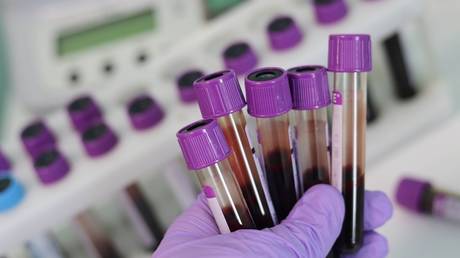
Germany has been plunged into a “nationwide state of emergency” because of its current high level of Covid infections, acting health minister Jens Spahn has said. He also refused to rule out further lockdowns.

Read more

FILE PHOTO © Reuters / Kai Pfaffenbach
Germany sets ‘grim’ Covid record & eyes new curbs

“The situation is serious, the dynamic is unbroken,” Spahn told a press conference Friday.

“The incidence has increased fivefold in four weeks. We see sadly high values in the death rate. We are in a national emergency.”

Spahn refused to rule out the possibility of another lockdown, saying that, in such a drastic health situation, “we can’t rule anything out.”

The head of the Robert Koch Institute (RKI), Lothar Wieler, added to the gloomy picture by saying that “all of Germany is one big outbreak,” with an estimated half a million active Covid cases in the country – and numbers rising. For the third day in a row, more than 50,000 cases have been registered in the country, while the death toll in Germany since the start of the pandemic is above 98,700, according to figures compiled by the RKI.

Wieler added that, with many hospitals already overwhelmed, more should be done to tackle the spread of the virus. Besides obvious measures such as vaccination and wearing masks, he also suggested closing poorly ventilated bars.

On Thursday, lawmakers in the Bundestag approved new measures in the fight against coronavirus, including requirements to prove vaccination status, a negative test, or proof of recovery from infection before employees can access communal workspaces or use public transport. The measures will have to be passed by the upper house before they can take effect.

Neighboring Austria announced on Friday that it would enter full lockdown as of Monday, November 22.

Think your friends would be interested? Share this story!

find more fun & mates at SoShow now !

Two climate activists in Australia have brought the world’s busiest coal port to a halt, strapping themselves to a massive piece of machinery and refusing to come down. The stunt follows more than a week of similar actions.

Blockade Australia, a climate group focused on “strategic direct action,” declared that two of its members had clambered atop equipment at the Port of Newcastle and stopped work there late Tuesday night, sharing footage captured by the activists as they suspended themselves from a large loading machine.

“Zianna and Hannah have shut down Newcastle coal port, abseiling from coal handling machinery. The port cannot resume operations until the pair are removed by police,” the group said, identifying the activists by their first names only, adding “This is the tenth consecutive day of disruption to Newcastle coal port and its supply rail network.”

The protest stunt follows at least 16 similar actions over the last week or so, the group said, some targeting the rail line near the port, the world’s largest for coal exports.

Another demonstration carried out on Tuesday saw a second pair of activists breach the port and “hit emergency stop buttons” on machines before strapping themselves to a different piece of equipment. They were brought down and arrested after “several hours” and are expected to appear in court in the coming days.

The disruptions have drawn the ire of state officials, with New South Wales Environment Minister Matt Kean calling them “completely out of line” and urging police to “throw the book” at the protesters, at least 19 of whom have already been arrested so far this month, according to ABC.

“Pull your heads in, get out of the way and stop hurting other people going about their lives, running their businesses,” the minister said during a radio interview on Wednesday. “There are hundreds of ways to make your views known and advocate for change, but risking the lives of rail workers is definitely not one of them.”

The activists could face charges that carry maximum sentences of 25 years in prison, NSW police commissioner Mick Fuller said, noting that local law enforcement has created a “strike force” to deal with future disturbances at the port.

READ MORE: The trillion dollar push to decarbonize global shipping

Like this story? Share it with a friend!

find more fun & mates at SoShow now !

People around the world will need to get a jab against Covid-19 once a year, at least when it comes to the Pfizer vaccine, BioNTech’s CEO Ugur Sahin said in an interview on Sunday, as he praised the quality of its booster shot.

In an interview with Germany’s Bild newspaper on Sunday, Sahin said he considers the vaccine, co-developed by his company, to be “very effective.”

Read more

© Getty Images / sasacvetkovic33
Drastic drop in Covid vaccine effectiveness – study

When asked whether people should be worried about the “breakthrough infections” – in which those vaccinated with the Pfizer-BioNTech vaccine still developed Covid-19 symptoms – he dismissed such concerns, saying that the jab offers a “90 percent protection” against cases that require intensive care in those aged over 60.

A “very high” level of protection against severe illness lasts for up to nine months, the BioNTech CEO maintained. He said this level starts decreasing “from the fourth month,” however. To maintain the protection, Sahin strongly pushed for booster shots, arguing that they would not just restore levels of antibodies but would potentially help “to break … chains of infection.”

He also encouraged doctors to be “as pragmatic as possible” when it comes to greenlighting vaccination and “not to send people home unvaccinated even though they could be vaccinated without any problems.”

In the future, people might need to get booster shots once a year, the BioNTech CEO believes. He said that he expects protection from a booster shot to “last longer” than the initial immunity one acquires after getting two doses of the vaccine.

“Subsequent … vaccinations may only be needed every year – just like [with] influenza,” he said. Currently, the German Federal Center for Health Education – an agency subordinated to the Health Ministry – recommends a booster shot six months after one gets the second dose of a vaccine. It also says that “booster vaccination makes sense after a minimum interval of about four months.”

Read more

© AFP / MARTIN BERNETTI
FDA approves Covid booster shots for all US adults

Sahin’s interview comes days after it was revealed that Pfizer, BioNTech and Moderna are making a combined profit of $65,000 every minute – all thanks to their Covid-19 jabs. That is according to estimates made by the People’s Vaccine Alliance (PVA) – a coalition demanding wider access to vaccines.

The PVA estimated that the three companies are to earn a total of $34 billion in combined pre-tax profits this year alone, which roughly translates into more than $1,000 a second and $93.5 million a day.

PVA has slammed the three companies over their refusal to allow vaccine technology transfer despite receiving a combined $8 billion in public funding. Such a move could increase global supply and save millions of lives as well as drive down prices, the coalition said.

“Pfizer, BioNTech and Moderna have used their monopolies to prioritize the most profitable contracts with the richest governments, leaving low-income countries out in the cold,” said Maaza Seyoum of the African Alliance and People’s Vaccine Alliance Africa.

Think your friends would be interested? Share this story!

find more fun & mates at SoShow now !

The EU’s drug regulator has backed the emergency use of Merck’s pill for the treatment for clinically vulnerable Covid-19 patients as cases surge across the continent.

On Friday, the European Medicines Agency (EMA) “issued advice” backing the emergency use of the drug developed by Merck in collaboration with Ridgeback Biotherapeutics, although it has not yet been authorized by national authorities.

Read more

© Reuters / Piroschka van de Wouw
EMA green lights new Covid treatments

In a statement, the drug regulator said the medicine called Lagevrio – also known as molnupiravir or MK 4482 – “can be used to treat adults with Covid-19 who do not require supplemental oxygen and who are at increased risk of developing severe Covid-19.”

It said the treatment should be administered as soon as possible after Covid-19 is diagnosed and within five days of the start of symptoms. The medicine should be taken twice a day for a period of five days.

The EMA listed the potential side effects of the capsules, including mild or moderate diarrhea, nausea, dizziness and headache. The treatment is not recommended for pregnant women.

The watchdog announced earlier on Friday that it had begun reviewing Pfizer’s medicine Paxlovid for Covid-19 with the same goal “to support national authorities” who may decide on its early use prior to marketing authorization in light of rising cases and deaths in Europe.

On Friday, Austria announced it would enter a new nationwide lockdown from Monday and make vaccination mandatory, while Germany’s health authorities claimed the country had turned into “one big outbreak.”

Both Pfizer and Merck have requested approval for their coronavirus medicines from the US Food and Drug Administration, but it is unclear when it might be granted.

Think your friends would be interested? Share this story!

find more fun & mates at SoShow now !

France’s best-known book of words, Le Petit Robert dictionary, has caused a stir by including the non-binary personal pronoun as an alternative to the existing masculine and feminine terms.

While the annual update of the Petit Robert dictionary is often a topic of considerable debate in French media, the latest edition has caused quite the backlash, with some, including a cabinet member, accusing it of pandering to wokeism.

The word “iel,” a neologism combining the French words for he and she (“il” and “elle“), is described as the personal pronoun for a person of any gender. “Personal pronoun subject to the third person singular and plural, used to evoke a person of any gender. The use of the pronominal in inclusive communication,” the dictionary’s entry reads. 

Read more

(FILE PHOTO) © REUTERS/Costas Baltas
France turns to Ancient Greece for war on woke

Striking out at the latest inclusion, François Jolivet, an MP in President Emmanuel Macron’s LREM party took his protest to the Académie Française, the official guardians of the French language.  

Describing the move as “wokeism,” Jolivet said in a letter to the Académie that the word “iel” had no place in the French language and claimed it would be a precursor to the rise of ‘woke’ ideology, which undermines the values of the Gallic nation.

Outspoken Education Minister Jean-Michel Blanquer also chimed in. “Inclusive writing is not the future of the French language,” he tweeted, sharing Jolivet’s letter. “Just as our schoolchildren are consolidating their basic skills, they don’t need to have this as a reference,” he added.

The head of Gaullist party Debout La France, Nicolas Dupont-Aignan, further criticized Petit Robert’s “woke” addition. “Let’s defend our language against these ridiculous fanatics of deconstruction and let’s boycott the collaborators who give into them,” he tweeted.  

Le Petit Robert has responded to the “lively debate” by claiming that the pronoun has been used increasingly in society in recent months and they chose to reflect this by adding it to their latest update. The publication also said that some have welcomed the addition.

France’s offensive against wokeism, which has been described by some as an Anglo-Saxon import, recently saw Blanquer vow to increase the teaching of ancient Greek and Latin languages. The education minister claims that the classical vernaculars respond to a demand for logos (language as a tool for reason), in a world where “a lack of reason is spreading like wildfire.” 

If you like this story, share it with a friend!

find more fun & mates at SoShow now !

Japan’s fifth wave of Covid-19 has virtually disappeared so dramatically that some scientists are puzzled as to why it happened. One team suggests the highly infectious Delta strain mutated into extinction on the island nation.

In mid-August, Japan experienced a peak in Covid-19 infections, recording over 23,000 new cases per day. Now the metric is just around 170, with deaths attributed to the disease mostly remaining in single digits this month.

The decline has been attributed by many to high vaccination rates, public acceptance of masks, and other factors, but some researchers say the drop was uniquely significant, compared to other nations with similar conditions.

Ituro Inoue, a geneticist at the National Institute of Genetics, believes that Japan had the good fortune of witnessing the Delta strain mostly rooting out other variants of the SARS-CoV-2 virus before then eradicating itself. He explained his team’s theory to the Japan Times newspaper this week.

For some time now, Inoue and his fellow scientists were researching mutations of SARS-CoV-2 and how they are affected by the protein nsp14, which is crucial for the reproduction of the virus.

RNA viruses, like the one causing Covid-19, tend to have a very high mutation rate, which helps them quickly adapt to changes in the environment. However, this opens the door for a so-called “error catastrophe,” when bad mutations pile up and finally cause the full extinction of a strain. The protein nsp14 appears to offer a form of error proofreading that helps the virus genome to stay below the threshold of the “error catastrophe.”

Read more

© Getty Images / Morsa Images
Fighting for our lives: Humanity’s weapons against Covid-19

In the case of Japan’s fifth wave of Covid-19, the Delta variant’s nsp14 failed at this job, Inoue believes, based on the genetic study of specimens collected from June to October. Contrary to his team’s expectations, there was a lack of genetic diversity, while many samples had many genetic changes in the site called A394V, which is linked to the error-fixing protein.

“We were literally shocked to see the findings,” the researcher told the Japan Times. “The Delta variant in Japan was highly transmissible and [was] keeping other variants out. But as the mutations piled up, we believe it eventually became a faulty virus and it was unable to make copies of itself.”

The theory could be relevant to the previous SARS strain, which was identified in 2003, explaining why it didn’t cause a pandemic. But that would be hard to confirm, since the outbreak ended relatively quickly and didn’t result in the massive collection of genetic data necessary to test the hypothesis.

It’s not clear why Japan had this lucky turn of events, but nothing comparable happened in other East Asian countries like South Korea, where populations are genetically close to that of Japan. Virus mutations similar to those flagged by the scientists have been discovered in at least 24 countries, Inoue said. He and his team plan to publish a paper detailing their findings by the end of November.

Even if the natural extinction theory is confirmed, it is at best a temporary reprieve for the Japanese people. New, more successful strains are likely to eventually find their way into the country, though quarantine measures and immigration control could delay the emergence of new variants in Japan, Inoue believes.

Meanwhile, Tokyo is bracing for a new wave of Covid-19 this winter and is preparing to live with the virus. The government reportedly plans to ease travel restrictions by increasing the number of people it allows to enter the country per day from 3,500 to 5,000.

Like this story? Share it with a friend!

find more fun & mates at SoShow now !

All cities and towns in China, as well as “most” villages, will be covered by 5G networks by 2025, the Ministry of Industry in Beijing has announced in a new infrastructure development plan.

Under the plan, the number of 5G base stations per 10,000 people will be increased to 26, and gigabit optical fiber networks will be extended to most urban and rural areas of China, the Ministry of Industry and Information Technology (MIIT) announced on Tuesday.

Read more

FILE PHOTO.
China overtakes US in global wealth race

Digital infrastructure has been defined as a “strategic, basic and pioneering industry to help build a new type of digital infrastructure and support economic and social development,” according to MIIT official Xie Cun. 

Information technology will be “deeply integrated” with the economy and society, with the goal of spurring internet innovation and creating a business boom, the ministry added. Meanwhile, the authorities are working on “a new type of supervision system” as well as measures to protect users’ personal information and data.

Like this story? Share it with a friend!

find more fun & mates at SoShow now !

Chris Inglis’ new White House office has a startup feel to it. There are desks, a few chairs, a coffee maker and a poster hanging on the wall.  But as the head of the newly established Office of the National Cyber Director, Inglis has to make due with what he has while still advising President Joe Biden on the smartest ways for the US to prevent and respond to cyberattacks.

Inglis has already had numerous conversations with the president, who has made clear that the government has a role to play in the defense of the private sector and in assisting the private sector in defending critical infrastructure.  And the president knows, says Inglis, that means the government needs to get its own cyber house in order. 

But like any real startup, Inglis’ resources are scarce.  More than three months after being confirmed by the Senate, he still doesn’t have the full staff he needs to take on his timely and critical mission.  That’s because the funding for his office – some $21 million, part of the $1 trillion infrastructure bill making its way through Congress – is still stuck in the political spin cycle.  Why does it matter?

“The threat is greater than I can ever remember,” Inglis told me during last month’s AFCEA and INSA Intelligence & National Security Summit in National Harbor, Maryland. “The audacity, the brazenness, the thresholds that have been crossed at every turn; we’re in a difficult place.”

While he’s waiting for Congress to act, he says he’s spending about fifty percent of his time defining his role, being careful not to duplicate the work already being done by other agencies and departments, while spending another fifty percent building relationships that will be important later.  Eventually, he’s expected to have a staff of some 75 people who will be expected to work hand in glove with CISA, the National Security Council’s cyber staff, the OMB and others.  The remaining fifty percent of his time, Inglis jokes, is spent figuring out how to attract the country’s best talent.   

“People are starting to flow into the organization. I’m confident that we’re coming up to a breakout moment, not for the National Cyber Director, but the contribution that we can and should make. I’m sobered by the nature of the challenge, I’m optimistic we can make a difference.”

Optimistic he is.  And he’s not even complaining about being given a critical task for US national security and then having to wait for politics to play out before being able to act on it.

“It has been a semi-silver lining in that we would not have had time to think about how we want to apply the resources coming our way.”

While Inglis has been waiting, he and his small team have had time to think about the four things they’d like to focus on right away. 

First, is streamlining the roles and responsibilities in government of who handles what when it comes to protecting the public and private sectors from cyberattacks.  He also spoke during his confirmation hearing about the importance of allocation of resources and while the Office of the National Cyber Director doesn’t have the authority to move money, it does have what Inglis calls the responsibility to account for cyber money.

“One of the most critical gaps in cyber is that the physical digital infrastructure is not built to a common standard. The executive order related to this requires that within a certain amount of time we have to install basic procedures like multifactor authentication and encryption of stored material. That is a challenge and a potential vulnerability for us. We need to make sure that we make these investments necessary to buy down the lack of investment for years.

The second gap is in talent related to number of people required to occupy these jobs. It’s not simply the folks with IT or cyber in their name, but general cyber awareness. There is some expenditure of resources of time, attention, and money to get awareness right on the part of the truly accountable parties like agency and department heads. We have to make sure they don’t see cyber as a cost center, but an enabler on the part of all the users as they understand what their roles are and what the accountability is.

He admits there is still a level of education needed within government to get there.

“That is usually the case in both the government and the private sector,” he said.  “We need to think this way about cyber and invest in cyber so that we can enable the mission, not hold it back. I think that education is the most important and effective way to handle this. Then, it is to make sure that the accountability is aligned and harmonized. We tend to take risk in one place and expect someone in another place to be the mitigator of a risk they don’t understand was taken in the first place. We need to operate in a collaborative fashion and get away from divisions of effort which are an agreement not to collaborate and allow adversaries to pick us off one at a time.”

Inglis says that unity of effort must start at home.  “The executive order issued in May has begun to lay out common expectations about the hardware, software, and practices that we need to begin in those spaces,” he said.  “Externally, if we have sector risk management agencies who engage the private sector for the purposes of supporting and engaging the critical components of that infrastructure, we need to make sure you don’t need a Ph.D. in government to know who to deal with and what you’re going to get from them.”

He is arguing for the government to also put ‘valuable material’ on the table.  “That could be our convening power,” said Inglis. “We could perhaps address and reduce liability or give companies a clue as to what might be around the corner because the government has access to exquisite intelligence. If that setup is possible, we also need a venue where collaboration takes place. Information doesn’t collaborate, people do.”

Inglis likes to point to the example of CISA and the Joint Cyber Collaborative.  “They put people from the private sector and the public sector side by side to co-discover threats that hold us at common risk. That project sets up the possibility of implicit collaboration in what we then do with that common operational picture. The government could take ideas that private sector companies turn into proprietary systems and enrich and classify them to deal with it in their system.”

Using what he calls “all the tools in the toolkit,” Inglis also notes the importance of international relationships, which fits nicely into the White House’s International Summit on Ransomware last week in Washington, which zeroed in on tighter cryptocurrency standards, among other things. “Beyond the Five Eyes, what do other like-minded nations think about what is expected behavior in this? What are governmental actions that are appropriate,” he asked.  

Inglis has been an active participant in the president’s recent actions in cyber.  He took part in a White House meeting with tech leaders in August that was hosted by President Biden, who Inglis says, spent the first hour sharing his vision about how the country should focus on collaborative integration.  “The companies represented weren’t only companies like Microsoft and Apple, but people who operate in the critical infrastructure space,” said Inglis.  “The people component, educators, were represented reflecting the president’s view that cyberspace is not just technology, it is also the people component. They are a major link in the chain, and we need to get the roles and responsibilities right.”

While he’s waiting for the funding he needs to get his office fully staffed, Inglis said he’s also putting thought into reconciling resources with aspirations.  Managing expectations is going to be important.  Frustration has been growing for years over what some see as a lack of government response to some of the largest hacks in history.  The phrase ‘time and place of our choosing’ as a definition of response has grown old and some Americans are weary of a government that isn’t responding in a more public way to the beating it sees the US taking in cyberspace.

So, I asked Inglis whether there should be red lines in cyber.

“Red lines are both good and bad,” he answered.  “They are clear and crisp, and everybody knows what they are. The downside is that because of that, an adversary knows exactly how far they can go. It means that you set up a somewhat permissive environment. Red lines also don’t have context; sometimes there is a reason that a defender would make the ransomware payment. As a matter of policy, the U.S. government does not pay ransomware, but I imagine there will be a situation at some point where a hospital is against the Russian state and actual life and safety is at risk. If there is no other way to get the material back, in order to get back in the business of saving lives, they would want to rethink if a red line is a red line in that particular situation. I think the right thing to do here is not to establish hard thresholds of things with scripted responses, but outline what we are prepared to defend and what principles we will exercise in defense of those things. We commit to defending the private sector when it is held at risk by a nation state in cyberspace as much as in the kinetic space and make that clear to adversaries. I think that would be more helpful in changing decision calculus and creating a useful ambiguity about when and where we will come in.”

Inglis said he’s also thinking a lot about present and future resilience.  It’s a worthwhile focus, given that the White House estimates that nearly half a million public and private sector cybersecurity jobs are currently unfilled. 

“That is a massive problem,” said Inglis. “However, the more insidious problem is that the 320 million people in the United States who use the internet who have no idea how to properly take their place on the front lines of this issue. There is an awareness issue that requires us not to make Python programmers out of them but to make sure they understand the nature of this space.”

Everyone has heard the old saying that time is money, but in Inglis’ case, time is security so I asked him point blank whether he thought government was moving has quickly as it should on the cyber problem.

“Government is moving at speed; the question is if it is at the necessary speed. I don’t think anyone is moving at the necessary speed. Some are moving at light speed, but at the end of the day, we need an integrated, collaborative approach. While we won’t have unity of command, I think there needs to be a universally felt sense of urgency so that we will all get our heads in the game.”

Congress, are you listening?  Oh, and by the way, that poster in Inglis’ office? It reads, ‘Hours Since the Last Surprise.”

“As a startup with maybe too few resources at the start and who often didn’t understand how all the wickets are run, we have our occasional surprise,” said Inglis.  “When we encounter those surprises and go to someone with the deep and sharp expertise to help us navigate that, we get what we need. However, we are not a full functioning, full featured, fully capable organization yet. We’re trying to build somebody else’s airplane while we’re free falling from our own. We have a parachute, and we can land safely, but it is a bit of a challenge at times.”

Find out more about why experts like former NSA Director General Keith Alexander (Ret.), Mandiant CEO Kevin Mandia and others have joined The Cyber Initiatives Group, powered by The Cipher Brief

Read more expert national security insights, perspective and analysis in The Cipher Brief

The post Chris Inglis and the Gathering Cyber Storm appeared first on The Cipher Brief.

find more fun & mates at SoShow now !

Criminals convicted of multiple cases of rape could face chemical castration in Pakistan as the country’s parliament supported new legislation aimed at tackling the rise in sexual offenses there.

The amendments to existing legislation, which allow for speedy conviction and harsher punishments for rapists, have been voted in by the MPs on Wednesday.

They introduce the death penalty or a life sentence for gang rape as well as chemical castration for repeat sex offenders, with the consent of the convict.

Chemical castration was described in the bill as a process through which “a person is rendered incapable of performing sexual intercourse for any period of his life, as may be determined by the court through administration of drugs.”

Read more

RT
High court rules Pakistan’s ‘two-finger’ virginity test for rape victims unconstitutional

It’s planned to establish special courts across the country to make sure that verdicts in sexual assault cases are delivered “expeditiously, preferably within four months.” If chemical castration is assigned as a punishment, it “shall be conducted through a notified medical board,” according to the new legislation.

Mushtaq Ahmed, a senator for the religious Jamaat-i-Islami party, had earlier denounced the bill as un-Islamic. Ahmed argued that there was no mention of chemical castration in Sharia law and that rapists are to be hanged in public.

By resorting to drugs to reduce the libido of repeat sex offenders, Pakistan joins South Korea, Poland, the Czech Republic and some US states, where chemical castration has been introduced.

The measure was put on the table a year ago by Pakistani President Arif Alvi in response to a vast public outcry over a spike across the country in cases of rape involving both women and children.

Back then, Amnesty International decried chemical castration as a “cruel, inhumane” treatment, advising Islamabad to instead focus on reforming its “flawed” justice system and to ensure justice for the victim.

Local NGO War Against Rape told Reuters last year that less than 3% of sexual assault or rape prosecutions in Pakistan result in a conviction.

If you like this story, share it with a friend!

find more fun & mates at SoShow now !
An Argentinian woman has become the second-ever HIV-infected person whose immune system helped defeat the virus without requiring additional medical treatment. She was first diagnosed with the AIDS-causing infection in 2013.

Scientists have dubbed the 30-year-old mother the “Esperanza patient,” after her hometown. The word ‘esperanza’ translates to ‘hope’ in English. Publishing their findings in the Annals of Internal Medicine journal on Monday, the researchers said the discovery boosts hope for a “sterilizing cure” for the estimated 38 million people with the life-long infection.

“I enjoy being healthy,” the Esperanza patient told NBC News over email. “I have a healthy family. I don’t have to medicate, and I live as though nothing has happened. This already is a privilege.”

The study found no intact remnants of the virus in the 1.5 billion blood and tissue cells the researchers analyzed – confirming the discovery first announced in March at an international meeting of HIV experts.

Read more

© Belova59 from Pixabay
‘Elite controllers’ can cure themselves of HIV without any medical treatment, bombshell research claims

No additional information about the woman has been made public, but she was described at the time as “athletic and beautiful” and revealed to have an HIV-negative boyfriend and newborn baby.

Only one other person, identified in August 2020 as 67-year-old Loreen Willenberg from San Francisco, has been confirmed to have overcome the virus without medical intervention. The two women have been labeled ‘elite controllers’, referring to a rare subset of HIV patients who show no signs of the infection despite not undergoing antiretroviral treatments.

Typically, an HIV-infected person requires constant drug therapy to prevent the virus from attaching to their immune cells’ DNA and replicating. But, in the eight years since she was diagnosed, the Esperanza patient only received medication for six months during pregnancy to ensure her baby would be healthy.

In all, there have been four patients cured of HIV, two of whom – the ‘Berlin patient’ Timothy Ray Brown and the ‘London patient’ Adam Castillejo – were also cancer patients who received risky bone marrow transplants from donors with HIV-resistant genes. However, the success of their procedures is yet to be replicated.

“This is really the miracle of the human immune system that did it,” Dr. Xu Yu, an immunologist at the Ragon Institute in Boston, who co-authored the study, told NBC.

If you like this story, share it with a friend!

find more fun & mates at SoShow now !