The Swedish government has announced plans to introduce mandatory Covid-19 passes starting next month, amid rising infection rates in Europe. The passes will be required to attend any indoor event with 100 or more participants.

The upcoming introduction of mandatory coronavirus vaccine passes was announced by Health Minister Lena Hallengren on Wednesday.

Citing the ongoing surge in coronavirus cases across Europe – which has not hit the country itself yet – the minister stressed the need to be ready for the new wave of infections, projected to reach Sweden mid-December.

“The spread is increasing in Europe. We haven’t seen it yet in Sweden, but we are not isolated,” Hallengren told a news conference. “We need to be able to use vaccination certificates.”

Read more

© Getty Images / picture alliance
German media reveals jail terms for fake Covid certificates

Starting from December 1, the documents confirming a person’s vaccination status will be a requirement to enter any indoor event with 100 or more people in attendance. Sweden already boasts high vaccination rates, with 85% of its citizens aged over 16 having received at least one dose of a Covid-19 vaccine. Over 81% have received two shots or more, public health data shows.

Earlier in the day, the country’s health authorities backtracked on a highly controversial decision to stop testing fully vaccinated people who showed symptoms of Covid. The recommendation was rolled out in October, leading to a 35% decline in Covid-19 tests taken.

“The Public Health Agency has decided to recommend that the regions offer testing to everyone who is 6 years and older who gets symptoms that may be COVID-19,” the health authority said in a statement.

Sweden bucked the trend among European governments in its approach to handling the pandemic, electing not to impose widespread lockdowns. Having relied primarily on voluntary measures and social distancing, the country displayed several times higher death rates per capita than its Nordic neighbors, though it still fared better than many European countries, registering some 1.18 million cases and just over 15,000 coronavirus deaths since the beginning of the pandemic.

Think your friends would be interested? Share this story!

find more fun & mates at SoShow now !

Controversial psychologist and author Jordan Peterson claimed Western countries had no “moral right” to force developing nations to reduce pollution output, noting instead that improving their economies was key.

During an appearance on the BBC’s ‘Question Time’ show on Thursday, the Canadian professor noted that the focus of climate change policies should be on incentivizing the development of cheap energy in poorer polluter countries.

“The best long term solution is to try to make developing countries as rich as possible, and the best way to do that is not control their pollution output, but to help them develop the cheapest energy they can possibly manage as fast as they possibly can,” Peterson said.

The debate saw UK undersecretary for employment Mims Davies suggest that measures taken to tackle climate change should not come at the “expense of developing countries.” But Peterson countered that it “absolutely, 100% will be [at their expense].”

I don’t think we have any moral right in the West at all to do that.

Read more

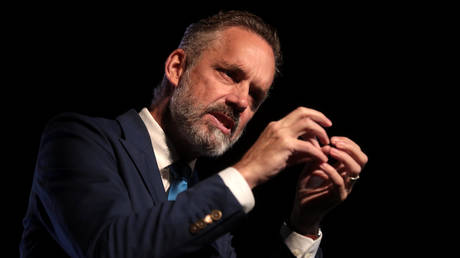
FILE PHOTO: Jordan Peterson speaking with attendees at the 2018 Student Action Summit hosted by Turning Point USA in West Palm Beach, Florida, December 20, 2018 © Flickr / Gage Skidmore
Jordan Peterson hammers ‘totalitarian’ Covid rules

He also criticized the recent COP26 climate change conference for failing to explore ideas on how best to improve national economies in the developing world, noting that he saw “very little of that sort of idea” coming out of the UN summit.

In the final hours of the two-week conference, China and India had intervened to soften the wording around the use of coal in the Glasgow Pact. The two countries demanded a change in the final text of the agreement that called for coal to be phased out, revising this to “phasing down unabated coal.”

The move prompted COP26 president and UK minister Alok Sharma to declare that China and India would have to “justify” their actions to countries that were more vulnerable to global warming effects. However, officials in both Beijing and New Delhi have countered that the criticism was unfair.

If you like this story, share it with a friend!

find more fun & mates at SoShow now !

A gunman injured two civilians, one of them fatally, and two police officers before being shot dead by security forces near Jerusalem’s Western Wall on Sunday morning, Israeli police said.

The civilian victims were taken to Shaare Zedek Medical Center. One, who was in his 30s, succumbed to his injuries at the hospital. The other, a 46-year-old, is said to have suffered moderate injuries. Two police officers were hurt by shrapnel.

In a video clip shared on social media and purportedly filmed at the scene, multiple gunshots could be heard amid agitated shouting. Security officers could then be seen standing around what appears to be a dead body. Witnesses speculated it was that of a “terrorist.”

The gunman, whose identity was not immediately disclosed, was killed during the incident. Police said he had used a homemade submachine gun.

DETAILS TO FOLLOW

find more fun & mates at SoShow now !

Sporadic clashes broke out at massive Saturday demonstrations in major European cities, as thousands of people took to the streets of Vienna, Paris and Rome to express their discontent with Covid-19 restrictions.

The Austrian capital Vienna on Saturday saw the largest protest turnout since the start of the Covid-19 pandemic. A total of 38,000 people took to the city streets to join a dozen demonstrations protesting government measures.

The protests came a day after the Austrian authorities ordered nationwide compulsory vaccination from February 1 and imposed a full lockdown, starting Monday. The massive procession that spanned over several kilometers marched along Vienna’s central ring road. The city center was paralyzed for several hours as traffic was restricted.

Austria’s right-wing Freedom Party, whose members joined the rallies, put the number of protesters at 100,000. Some demonstrations were also attended by members of various far-right groups. The protests were generally peaceful but footage published by Ruptly video news agency showed several scuffles between the police and the demonstrators breaking out.

Law enforcement spoke of a total of five arrests. One incident saw a protester attempting to grab an officer’s gun and take it from its holster. In another incident, the officers were pelted with bottles and fireworks and had to use pepper spray in response.

Hundreds of kilometers away from Vienna, in the French capital Paris, events took a more dramatic turn. There, a demonstration against the government Covid-19 measures coincided with the third anniversary of the Yellow Vests movement. Hundreds of protesters took part in the protest, which quickly turned into clashes between the demonstrators and law enforcement.

The protesters were building barricades and setting them on fire as well as pelting police with bottles and various other projectiles. Law enforcement responded with profuse amounts of tear gas, sometimes filling entire streets with thick smoke to disperse the crowds.

Rome saw a massive demonstration against Italy’s Covid-19 health pass, also known as the Green Pass. Some 4,000 people gathered in the center of the Italian capital, according to the police. The demonstrators were waving national flags and chanting “Freedom” and “No Green Pass,” referring to the vaccination certificate needed to enter various public venues such as clubs or bars.

The crowd staged a sit-in in the Circus Maximus – an ancient Roman chariot-racing stadium converted into a modern-day park. They remained there after sunset, lighting the area with thousands of phones and colored smoke bombs. The rally was peaceful, though, as the police did not report any incidents.

Unlike Rome, Italy’s northern city of Milano saw clashes between protesters and the police as law enforcement officers sought to break up an unauthorized rally at the city center. Large police forces were deployed to the city center and several squares were cordoned off.

Think your friends would be interested? Share this story!

find more fun & mates at SoShow now !

A pack of wild boars were rounded up and euthanized after one of the animals attacked a police officer in the streets of Hong Kong – the opening shot in a pitched battle between the feral hogs and the city’s law enforcement.

A group of veterinarians took seven wild boars into custody, euthanizing the beasts after knocking them out with dart guns in an area near the financial center of the city, according to a statement from Hong Kong’s Agriculture, Fisheries, and Conservation Department on Thursday.

The pigs were captured after one attacked a police officer last week, an act which reflects the city’s new policy toward the animals: stop them before they attack again.

The aggressive boar knocked down a police officer by biting his leg last week as the two faced off in a residential car park, the pig only losing the battle after falling off the building to its death. The wild boars are apparently “accustomed” to wandering back and forth along the roadway, begging for food from pedestrians and vehicles alike. Previously, the city had handled the population by capturing and sedating the animals, then relocating them to “remote areas,” according to the the department.

Hong Kong CEO Carrie Lam vowed to increase penalties for those citizens found feeding the boars, which have reportedly been responsible for some 30 attacks in recent years. While residents are warned not to feed the boars so as not to encourage population growth or disease outbreaks, the animals are a favorite among some visitors. Still, Lam insisted “we can’t simply sit on our hands while things deteriorate.”

Animal rights groups have responded with a protest letter against a policy of euthanasia, pointing out that most visitors do not feed the boars and arguing resources should be directed toward stopping the human activity rather than blaming all the boars. Allowing the boars to be captured and killed “ignores their right to live and considers their existence in urban areas as a capital offense,” the letter read.

Like this story? Share it with a friend!

find more fun & mates at SoShow now !

EXPERT PERSPECTIVE — A meeting – albeit virtual – between President Joe Biden and Chinese President Xi Jinping finally happened.  It was a cordial and reportedly candid exchange that hopefully cooled some of the tension between the U.S. and China.

President Biden captured the essence of the meeting with his concern that this tension “does not veer into conflict, whether intended or unintended.”  President Xi said, “China and the U.S. need to increase communications and cooperation” and “respect each other and coexist in peace.”

It’s hard to believe that in 1979, when formal U.S. – China diplomatic relations were established, Chinese President Deng Xiaoping looked to the U.S. as the country that would provide the investment, technology, and unlimited access to our best universities.  And the U.S. didn’t disappoint.  Investment and sophisticated technology flowed to China, with hundreds of thousands of Chinese students enrolling in our universities.  Strategic bilateral cooperation initially contributed to the defeat of the Soviet Union in Afghanistan, with joint efforts to address international terrorism and nuclear proliferation.

So, during the span of forty-two years, relations have gone from close economic and strategic cooperation to a concern about conflict, intended or unintended.  Understandably, scholars will spend considerable time analyzing what went wrong. 

What is important now is that U.S. – China relations move in a more positive direction.  That tension over China’s aggression against Taiwan, the militarization of islands and reefs in the South China Sea, internment camps for Uyghurs in Xinjiang, the national security law in Hong Kong that suppresses democratic protests and the theft of intellectual property all must be candidly discussed by our diplomats and leaders to avoid misunderstanding and accidental conflict.

President Biden said Washington continues to have a “one China” policy and “opposes unilateral efforts to change the status quo.”  President Xi reportedly said, “Beijing will take decisive measures if the pro-Taiwan independence movement crosses a red line.”

The three communiques and the Taiwan Relations Act of 1979 specifically states that, inter alia, “the United States decision to establish diplomatic relations with the People’s Republic of China rests upon the expectation that the future of Taiwan will be determined by peaceful means; to consider any effort to determine the future of Taiwan by other than peaceful means, including by boycotts or embargoes, is a threat to the peace and security of the Western Pacific area and of grave concern to the United States.”

The challenge for the U.S. and China is to address Taiwan and a myriad of other irritants in the bilateral relationship to ensure that no one issue, or series of issues leads to conflict.  Toning down the rhetoric and pursuing a policy of substantive and sustained communications, especially by our diplomats, would be a necessary first step.


The Cipher Brief hosts private briefings with the world’s most experienced national and global security experts.  Become a member today.


The annual Economic and Strategic Dialogue with China, led by the heads of State Department and Treasury and their counterparts in Beijing was established to oversee progress in addressing these and other challenging issues.  A forum of this type, with announcements to ensure that the public is kept apprised of the issues and the work being done to resolve these issues, is of value, only if this dialogue is substantive and not just ceremonial.

This virtual presidential summit can be transformative if, in addition to addressing these and other irritants, it also addresses the opportunity to cooperate on a multitude of geopolitical issues that affect the security of the U.S. and China – and the world.

I’ll start with the nuclear issue and the fact that there’s minimal dialogue with China on its nuclear program.  And given recent reporting on the three sites in China with the construction of hundreds of missile silos and the recent DIA report that China, by 2030, will have a nuclear arsenal of 1000 nuclear warheads is of concern.  Ideally, China should be part of New Start arms control negotiations with the U.S. and Russia.  But they previously refused to join in this or any other arms control dialogue.  At a minimum, China should be responsive to a dialogue with the U.S. on nuclear-related issues, to include their recent test of two hypersonic missiles.

A separate but equally important dialogue with China is on cyber, to ensure that the cyber domain is not weaponized and used against our private sector for economic advantage.  Also, to ensure that outer space is used exclusively for peaceful purposes.

There are a multitude of global issues requiring bilateral cooperation.  We recently saw some U.S. – China cooperation on climate change at the Glasgow COPS 26 UN Climate Change Conference.  Obviously, more must be done, but this is a positive first step.

Other issues, like North Korea can and should be addressed now.  China has unique leverage with a North Korea that relies on China for its economic survival.  China can use that leverage to get North Korea to return to negotiations and to convince the North that complete and verifiable denuclearization, in return for significant deliverables, is in North Korea’s interest.

With over five million global casualties and over 760,000 deaths in the U.S. due to COVID-19, it should be obvious that greater bilateral cooperation on this and future pandemics is necessary.


Go beyond the headlines with expert perspectives on today’s news with The Cipher Brief’s Daily Open-Source Podcast.  Listen here or wherever you listen to podcasts.


Bilateral cooperation on nuclear proliferation, countering international terrorism, the trafficking of narcotics and confronting international organized crime are just some of the global issues that affect the security of the U.S. and China and the global community.  Failure to cooperate on these and other international issues is not only a security imperative, but a moral responsibility of all great powers.

Finally, with the Taliban back in control in Afghanistan, the U.S. and China have a shared goal: ensuring that the Taliban does not permit Al Qaeda and other terrorist organizations to once again use Afghanistan as a base for its international terrorist operations. China has engaged this Taliban government and should use its significant financial leverage to ensure that all terrorist groups are permanently removed from Afghanistan.

Xi Jinping was just anointed by the Chinese Communist Party as one of its revered leaders, with Mao Zedong and Deng Xiaoping.  The Party congress next year will likely give Xi a third five-year term as the Party’s Secretary General.  There are a multitude of domestic issues requiring Xi’s and the Party’s attention, to include a campaign of “common prosperity” – addressing the disparity of wealth in a China governed by a capitalist system with Chinese characteristics.

Hopefully, President Xi Jinping will work with President Joe Biden to ensure that the two great powers, consumed with domestic issues, will also address the myriad of international issues requiring immediate and long-term attention and avoid a cold war that could veer into conflict.

Read more expert-driven national security insights, perspective and analysis in The Cipher Brief

The post How to Avoid Cold War with China appeared first on The Cipher Brief.

find more fun & mates at SoShow now !

The Philippine government has accused the Chinese Coast Guard of unleashing water cannon on two supply ships in a disputed stretch of the South China Sea, claiming its boats were blocked and forced to turn around.

Manila’s Department of Foreign Affairs detailed the encounter in a statement on Wednesday, alleging that a pair of supply boats en route to the Ayungin Shoal – also known as the Second Thomas Shoal – were stopped by three Chinese vessels and “water cannoned” before they could reach their destination.

“Fortunately, no one was hurt; but our boats had to abort their resupply mission,” Foreign Affairs Secretary Teodoro Locsin said, adding that the department had conveyed its “outrage, condemnation and protest of the incident” to Beijing’s envoy to the Philippines, Huang Xilian.

The acts of the Chinese Coast Guard vessels are illegal. China has no law enforcement rights in and around these areas. They must take heed and back off.

Though both China and the Philippines claim territorial rights to the Ayungin Shoal, The Hague’s Permanent Court of Arbitration ruled in the latter country’s favor in 2016. And despite Chinese objections, the Philippines has occupied the area for much longer, after its military purposely grounded a naval vessel on the shoal in 1999.  

READ MORE: Manila backs controversial AUKUS security pact as move to fix ‘imbalance’ of power in Southeast Asia

Manila was also quick to note that the supply ships are “covered by the Philippines-United States Mutual Defense Treaty,” a pact inked with Washington in 1951 that calls for a US military response to any attack on the country, including “island territories under its jurisdiction in the Pacific Ocean, its armed forces, public vessels or aircraft.” 

Beijing so far has not commented on the alleged run-in.

Think your friends would be interested? Share this story!

find more fun & mates at SoShow now !
The Chinese foreign ministry has lashed out at Lithuania after the small Baltic Sea nation approved the opening of the Taiwan Representative Office in Vilnius. Beijing says it undermines its One China policy.

Beijing was disappointed that Lithuania had proceeded to grant Taiwan permission to open its ‘representative office’ in Vilnius despite “China’s strong opposition and repeated persuasion,” Chinese foreign ministry spokesman Zhao Lijian said at a press briefing on Friday. Taiwan had opened its mission in Vilnius the previous day. 

Read more

Chinese star Peng Shuai is reportedly missing. © Visual China Group via Getty Images
Peng Shuai: What do we know about Chinese tennis star at center of international storm?

Zhao called the move a violation of the One China principle, which he said is undermining China’s sovereignty and territorial integrity, while grossly interfering in its internal affairs. The spokesman reminded Lithuania that Taiwan is an inalienable part of China’s territory and the Beijing government has sole legal authority. 

As to what necessary measures China will take, you may wait and see. The Lithuanian side shall reap what it sows.

In a “stern warning” to the Taiwanese authorities, Zhao then added that “seeking ‘Taiwan independence’ by soliciting foreign support is a totally misguided attempt that is doomed to fail.”

In August, Lithuania announced that the diplomatic outpost would be named the “Taiwan Representative Office,” angering China. Taiwan’s diplomatic branches – in countries that have de facto relations with the island’s authorities – are normally called “Taipei Economic and Cultural Offices.”

China demanded that Lithuania recall its ambassador from China, which it did. Beijing then withdrew its envoy to the Baltic state.

Chinese officials have repeatedly called on Western nations, notably the UK and US, to stop interfering in Beijing’s internal affairs, stressing that they consider Taiwan to be part of China.

If you like this story, share it with a friend!

find more fun & mates at SoShow now !
Two climate activists in Australia have brought the world’s busiest coal port to a halt, strapping themselves to a massive piece of machinery and refusing to come down. The stunt follows more than a week of similar actions.

Blockade Australia, a climate group focused on “strategic direct action,” declared that two of its members had clambered atop equipment at the Port of Newcastle and stopped work there late Tuesday night, sharing footage captured by the activists as they suspended themselves from a large loading machine.

“Zianna and Hannah have shut down Newcastle coal port, abseiling from coal handling machinery. The port cannot resume operations until the pair are removed by police,” the group said, identifying the activists by their first names only, adding “This is the tenth consecutive day of disruption to Newcastle coal port and its supply rail network.”

The protest stunt follows at least 16 similar actions over the last week or so, the group said, some targeting the rail line near the port, the world’s largest for coal exports.

Another demonstration carried out on Tuesday saw a second pair of activists breach the port and “hit emergency stop buttons” on machines before strapping themselves to a different piece of equipment. They were brought down and arrested after “several hours” and are expected to appear in court in the coming days.

The disruptions have drawn the ire of state officials, with New South Wales Environment Minister Matt Kean calling them “completely out of line” and urging police to “throw the book” at the protesters, at least 19 of whom have already been arrested so far this month, according to ABC.

“Pull your heads in, get out of the way and stop hurting other people going about their lives, running their businesses,” the minister said during a radio interview on Wednesday. “There are hundreds of ways to make your views known and advocate for change, but risking the lives of rail workers is definitely not one of them.”

The activists could face charges that carry maximum sentences of 25 years in prison, NSW police commissioner Mick Fuller said, noting that local law enforcement has created a “strike force” to deal with future disturbances at the port.

READ MORE: The trillion dollar push to decarbonize global shipping

Like this story? Share it with a friend!

find more fun & mates at SoShow now !