Some voters in Germany’s capital, Berlin, may have to re-cast their ballots after the country’s federal election czar filed an official complaint over irregularities in a parliamentary vote held two months ago.

The election – which saw Berliners decide the makeup of the German parliament, the Bundestag, as well as select city representatives – was marred by irregularities at numerous polling stations, according to the official, Georg Thiel. 

Among the most common problems were ballot shortages and long lines, with waiting times of up to two hours. In some cases, voters were also seen casting their ballots past a 6pm cutoff – the time when all polling stations were supposed to have closed. Thiel, who was tasked with overseeing elections at federal level, saw all of the above as reason enough to raise an objection in the German capital, local media reported on Friday.

Read more

Workers remove a campaign poster showing Armin Laschet, the Christian Democratic Union’s candidate for chancellor, in Bad Segeberg, Germany, September 27, 2021. © Fabian Bimmer / Reuters
Conservative wing of Merkel’s bloc says party leadership must resign after ‘debacle’ in Germany’s general election

Thiel identified six Berlin constituencies where irregularities were allegedly rampant, potentially setting the stage for a re-do election in the city.  

It is now up to a special Bundestag committee to examine Thiel’s complaint and see if the reported violations ran afoul of German law or electoral procedures. For the vote to be repeated, however, at least one of those violations would have to be deemed serious enough to have affected the distribution of seats in the Bundestag.

The September 26 election saw outgoing Chancellor Angela Merkel’s conservatives take a historic beating, with the Social Democrats coming out on top. The Social Democratic Party (SPD) has been engaged in coalition talks with the Greens and the Free Democratic Party ever since, with the trio expected to announce a preliminary deal as early as next week.

Think your friends would be interested? Share this story!

find more fun & mates at SoShow now !

EXPERT PERSPECTIVE — A meeting – albeit virtual – between President Joe Biden and Chinese President Xi Jinping finally happened.  It was a cordial and reportedly candid exchange that hopefully cooled some of the tension between the U.S. and China.

President Biden captured the essence of the meeting with his concern that this tension “does not veer into conflict, whether intended or unintended.”  President Xi said, “China and the U.S. need to increase communications and cooperation” and “respect each other and coexist in peace.”

It’s hard to believe that in 1979, when formal U.S. – China diplomatic relations were established, Chinese President Deng Xiaoping looked to the U.S. as the country that would provide the investment, technology, and unlimited access to our best universities.  And the U.S. didn’t disappoint.  Investment and sophisticated technology flowed to China, with hundreds of thousands of Chinese students enrolling in our universities.  Strategic bilateral cooperation initially contributed to the defeat of the Soviet Union in Afghanistan, with joint efforts to address international terrorism and nuclear proliferation.

So, during the span of forty-two years, relations have gone from close economic and strategic cooperation to a concern about conflict, intended or unintended.  Understandably, scholars will spend considerable time analyzing what went wrong. 

What is important now is that U.S. – China relations move in a more positive direction.  That tension over China’s aggression against Taiwan, the militarization of islands and reefs in the South China Sea, internment camps for Uyghurs in Xinjiang, the national security law in Hong Kong that suppresses democratic protests and the theft of intellectual property all must be candidly discussed by our diplomats and leaders to avoid misunderstanding and accidental conflict.

President Biden said Washington continues to have a “one China” policy and “opposes unilateral efforts to change the status quo.”  President Xi reportedly said, “Beijing will take decisive measures if the pro-Taiwan independence movement crosses a red line.”

The three communiques and the Taiwan Relations Act of 1979 specifically states that, inter alia, “the United States decision to establish diplomatic relations with the People’s Republic of China rests upon the expectation that the future of Taiwan will be determined by peaceful means; to consider any effort to determine the future of Taiwan by other than peaceful means, including by boycotts or embargoes, is a threat to the peace and security of the Western Pacific area and of grave concern to the United States.”

The challenge for the U.S. and China is to address Taiwan and a myriad of other irritants in the bilateral relationship to ensure that no one issue, or series of issues leads to conflict.  Toning down the rhetoric and pursuing a policy of substantive and sustained communications, especially by our diplomats, would be a necessary first step.


The Cipher Brief hosts private briefings with the world’s most experienced national and global security experts.  Become a member today.


The annual Economic and Strategic Dialogue with China, led by the heads of State Department and Treasury and their counterparts in Beijing was established to oversee progress in addressing these and other challenging issues.  A forum of this type, with announcements to ensure that the public is kept apprised of the issues and the work being done to resolve these issues, is of value, only if this dialogue is substantive and not just ceremonial.

This virtual presidential summit can be transformative if, in addition to addressing these and other irritants, it also addresses the opportunity to cooperate on a multitude of geopolitical issues that affect the security of the U.S. and China – and the world.

I’ll start with the nuclear issue and the fact that there’s minimal dialogue with China on its nuclear program.  And given recent reporting on the three sites in China with the construction of hundreds of missile silos and the recent DIA report that China, by 2030, will have a nuclear arsenal of 1000 nuclear warheads is of concern.  Ideally, China should be part of New Start arms control negotiations with the U.S. and Russia.  But they previously refused to join in this or any other arms control dialogue.  At a minimum, China should be responsive to a dialogue with the U.S. on nuclear-related issues, to include their recent test of two hypersonic missiles.

A separate but equally important dialogue with China is on cyber, to ensure that the cyber domain is not weaponized and used against our private sector for economic advantage.  Also, to ensure that outer space is used exclusively for peaceful purposes.

There are a multitude of global issues requiring bilateral cooperation.  We recently saw some U.S. – China cooperation on climate change at the Glasgow COPS 26 UN Climate Change Conference.  Obviously, more must be done, but this is a positive first step.

Other issues, like North Korea can and should be addressed now.  China has unique leverage with a North Korea that relies on China for its economic survival.  China can use that leverage to get North Korea to return to negotiations and to convince the North that complete and verifiable denuclearization, in return for significant deliverables, is in North Korea’s interest.

With over five million global casualties and over 760,000 deaths in the U.S. due to COVID-19, it should be obvious that greater bilateral cooperation on this and future pandemics is necessary.


Go beyond the headlines with expert perspectives on today’s news with The Cipher Brief’s Daily Open-Source Podcast.  Listen here or wherever you listen to podcasts.


Bilateral cooperation on nuclear proliferation, countering international terrorism, the trafficking of narcotics and confronting international organized crime are just some of the global issues that affect the security of the U.S. and China and the global community.  Failure to cooperate on these and other international issues is not only a security imperative, but a moral responsibility of all great powers.

Finally, with the Taliban back in control in Afghanistan, the U.S. and China have a shared goal: ensuring that the Taliban does not permit Al Qaeda and other terrorist organizations to once again use Afghanistan as a base for its international terrorist operations. China has engaged this Taliban government and should use its significant financial leverage to ensure that all terrorist groups are permanently removed from Afghanistan.

Xi Jinping was just anointed by the Chinese Communist Party as one of its revered leaders, with Mao Zedong and Deng Xiaoping.  The Party congress next year will likely give Xi a third five-year term as the Party’s Secretary General.  There are a multitude of domestic issues requiring Xi’s and the Party’s attention, to include a campaign of “common prosperity” – addressing the disparity of wealth in a China governed by a capitalist system with Chinese characteristics.

Hopefully, President Xi Jinping will work with President Joe Biden to ensure that the two great powers, consumed with domestic issues, will also address the myriad of international issues requiring immediate and long-term attention and avoid a cold war that could veer into conflict.

Read more expert-driven national security insights, perspective and analysis in The Cipher Brief

The post How to Avoid Cold War with China appeared first on The Cipher Brief.

find more fun & mates at SoShow now !

French luxury giant Dior has taken down a controversial photograph that had been criticized in China for “smearing Asian women” by pandering to Western stereotypes while “distorting Chinese culture.”

The photo, which was part of the brand’s ‘Lady Dior’ exhibition in Shanghai, depicts an Asian model wearing a traditional dress and clutching a Dior handbag. It came under fire this week from Chinese media outlets for featuring “spooky eyes, [a] gloomy face and Qing Dynasty-styled nail armor.”

Read more

A screenshot from D&G's apology video © YouTube / Dolce & Gabbana
Dolce & Gabbana beg for forgiveness after ‘racist’ ad triggers backlash in China

Although Dior has not released a statement regarding the controversy, it confirmed to fashion trade publication Business of Fashion that the photo had been removed from the exhibition. The brand has also reportedly taken the photo off Chinese social media platform Weibo.

The image, which was shot by Chinese photographer Chen Man, had drawn both media ire and public outrage. However, there were apparently no calls for a boycott of the brand.

In an editorial on Monday titled “Is This the Asian Woman in Dior’s Eyes?”, the Beijing Daily paper had noted that the image makes Chinese consumers uncomfortable. The publication criticized Man for “playing up to the brands, or the aesthetic tastes of the Western world.”

For years, Asian women have always appeared with small eyes and freckles from the Western perspective, but the Chinese way to appreciate art and beauty can’t be distorted by that.

Warning that both the brand and the photographer had “gone too far,” the China Women’s News paper ran an editorial on Wednesday that claimed it “indicated their intention of uglifying Chinese women and distorting Chinese culture.”

Read more

RT
‘Deeply sorry’: Versace in hot water as China accuses fashion brand of questioning its sovereignty

“Again, from… Dior’s ghost-style picture, which makes the public feel uncomfortable, it’s easy to see some Western brands’ ‘pride and prejudice’ in their aesthetics and culture,” said the newspaper, which is run by the All-China Women’s Federation.

Meanwhile, the Global Times noted that the “lingering controversy could pose a delicate situation” for Dior and other global brands – for whom China’s “massive” luxury market was one of the biggest sources of revenue. The paper said that the Chinese public had become “increasingly sensitive” toward the depiction and treatment of Chinese people and culture by foreign companies.

While pointing out that Chinese social media users had demanded the company and photographer explain their intention, a number of media outlets also highlighted how some netizens had praised the photo as a departure from typical standards of beauty in the country, often characterized by “fair skin and large eyes.”

If you like this story, share it with a friend!

find more fun & mates at SoShow now !

An Argentinian woman has become the second-ever HIV-infected person whose immune system helped defeat the virus without requiring additional medical treatment. She was first diagnosed with the AIDS-causing infection in 2013.

Scientists have dubbed the 30-year-old mother the “Esperanza patient,” after her hometown. The word ‘esperanza’ translates to ‘hope’ in English. Publishing their findings in the Annals of Internal Medicine journal on Monday, the researchers said the discovery boosts hope for a “sterilizing cure” for the estimated 38 million people with the life-long infection.

“I enjoy being healthy,” the Esperanza patient told NBC News over email. “I have a healthy family. I don’t have to medicate, and I live as though nothing has happened. This already is a privilege.”

The study found no intact remnants of the virus in the 1.5 billion blood and tissue cells the researchers analyzed – confirming the discovery first announced in March at an international meeting of HIV experts.

Read more

© Belova59 from Pixabay
‘Elite controllers’ can cure themselves of HIV without any medical treatment, bombshell research claims

No additional information about the woman has been made public, but she was described at the time as “athletic and beautiful” and revealed to have an HIV-negative boyfriend and newborn baby.

Only one other person, identified in August 2020 as 67-year-old Loreen Willenberg from San Francisco, has been confirmed to have overcome the virus without medical intervention. The two women have been labeled ‘elite controllers’, referring to a rare subset of HIV patients who show no signs of the infection despite not undergoing antiretroviral treatments.

Typically, an HIV-infected person requires constant drug therapy to prevent the virus from attaching to their immune cells’ DNA and replicating. But, in the eight years since she was diagnosed, the Esperanza patient only received medication for six months during pregnancy to ensure her baby would be healthy.

In all, there have been four patients cured of HIV, two of whom – the ‘Berlin patient’ Timothy Ray Brown and the ‘London patient’ Adam Castillejo – were also cancer patients who received risky bone marrow transplants from donors with HIV-resistant genes. However, the success of their procedures is yet to be replicated.

“This is really the miracle of the human immune system that did it,” Dr. Xu Yu, an immunologist at the Ragon Institute in Boston, who co-authored the study, told NBC.

If you like this story, share it with a friend!

find more fun & mates at SoShow now !

The International Criminal Court has halted an investigation into alleged rights abuses carried out by Philippines authorities as part of a harsh crackdown on the drug trade, saying it is reviewing a deferral request from Manila.

The ICC’s chief prosecutor Karim Khan said the probe was suspended after the Philippines government filed a request to defer the case earlier this month, according to court documents cited by Reuters on Friday. 

“The prosecution has temporarily suspended its investigative activities while it assesses the scope and effect of the deferral request,” he wrote, adding that the court is seeking more information from the government in Manila.

Based in The Hague, the ICC allows states to ask for postponements if they conduct their own investigations into the charges in question. President Rodrigo Duterte’s administration filed its deferral request on November 10, while the country’s Justice Ministry announced its own investigation into the alleged abuses late last month.

Read more

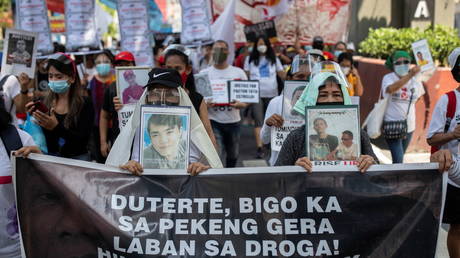
Relatives of drug war victims hold photographs of their slain loved ones with placards calling for justice (FILE PHOTO) © REUTERS/Eloisa Lopez
Philippines announces probe into thousands of killings during Duterte’s war on drugs as initial review suggests abuses took place

The court initially opened the probe in September over allegations that Philippines police had carried out thousands of extrajudicial executions and used other brutal tactics against suspected drug dealers, and that Duterte gave implicit backing to those actions. Activists have accused authorities of killing innocent people, including children, though the police insist they only use violence in self-defense.

While Duterte has declined to cooperate with the ICC probe, saying it has no authority on the island nation, and even pulled the Philippines out of the international body in 2019, the court has jurisdiction to investigate alleged violations committed by the country while it was still a member.

The president’s chief legal counsel, Salvador Panelo, confirmed the deferral request in brief comments to Reuters, saying “There is no inconsistency with the request for suspension of action,” though he did not elaborate.

Since its founding some 20 years ago, the ICC has successfully convicted just five people of war crimes or crimes against humanity – all leaders of armed movements in Africa, including in Mali, Uganda and the Democratic Republic of the Congo.

Think your friends would be interested? Share this story!

find more fun & mates at SoShow now !

The planned introduction of chemical castration for serial rapists in Pakistan has been dropped due to objections from experts in Islamic law, who said such punishment would be counter to Sharia.

The controversial clause in a bill amending criminal law in Pakistan was dropped before the National Assembly voted on it on Wednesday, a parliament official said on Friday. If it were passed, it would have been unconstitutional, Parliamentary Secretary for Law and Justice Maleeka Bokhari explained. The basic law of the country requires all its laws to be in line with the Sharia and the Koran.

Bokhari said the decision to drop the clause was taken due to objections from the Council of Islamic Ideology, a constitutional body that advises the government of Pakistan on the intricacies of Islamic law.

Read more

© publicdomainpictures.net
Outrage as teen’s rapist spared jail time

The bill amends Pakistan’s Penal Code and Criminal Procedure Code to streamline investigations and prosecutions of sexual crimes as part of wider anti-rape reform. Some conservative lawmakers vocally argued against the castration clause as the piece of legislation was moving towards approval. Senator Mushtaq Ahmed from the Islamist Jamaat-i-Islami party argued that rapists should be hanged publicly, while castration was never mentioned in Sharia.

A separate bill also approved by the parliament on Wednesday introduces a system of special regional investigators for rape allegations to be appointed by the prime minister, as well as new protections for victims, and punishments for officials who fail to investigate their complaints properly. Among other things, it makes evidence that a victim is “generally of immoral character” inadmissible in court.

The reform is necessary because currently deterrence of sexual crimes in Pakistan is undermined by “poor investigation, archaic procedures and rules of evidence and delay in the trial,” the bill said.

If you like this story, share it with a friend!

find more fun & mates at SoShow now !
The European Union’s top court has ruled that Hungary’s 2018 law aimed at criminalizing aiding illegal immigrants who are claiming asylum violates the “rights safeguarded” by the bloc’s legislature.

The Hungarian legislation, passed in 2018, sought to punish anyone “facilitating illegal immigration” with a year in prison, under a bill dubbed the “Stop Soros” law. Hungary’s government justified it at the time by arguing that migrants illegally entering the country threatened its national security. 

In the ruling, handed down on Tuesday, the European Court of Justice declared that “criminalizing such activities impinges on the exercise of the rights safeguarded by the EU legislature in respect of the assistance of applicants for international protection.”

The EU’s advocate general, Athanasios Rantos, had urged the court to make such a judgement back in February, claiming the introduction of the legislation meant that “Hungary has failed to fulfil its obligations under the [bloc’s] Procedures Directive.”

It became known as the Stop Soros law after billionaire philanthropist George Soros became a vocal opponent of the Hungarian government’s opposition to migration. The administration, in turn, accused Soros of orchestrating migration to Europe, with the Open Society Foundation, run by the philanthropist, closing its operation in the country in response. 

Read more

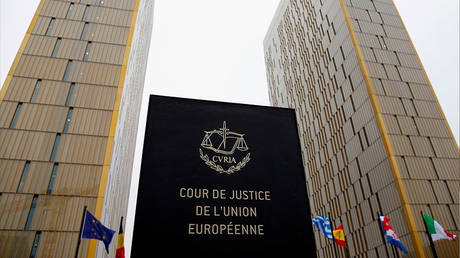
The towers of the European Court of Justice are seen in Luxembourg. © Reuters / Francois Lenoir
Top EU court says Poland broke rules with judge appointment system

Hungary, under the leadership of right-wing Prime Minister Viktor Orban, has repeatedly clashed with the EU in recent years over its strong stance on immigration and concerns from the bloc about threats to the rule of law in the country.

At the end of 2020, a dispute between Hungary and Poland and the EU risked derailing the bloc’s budget, as both member states were threatening to veto it over their view that the EU was attempting to interfere in their domestic affairs. Ultimately, the EU backed down, agreeing to a compromise with Budapest and Warsaw to ensure the budget secured the support of all 27 member states. 

Despite acknowledging the EU court’s ruling, Hungary’s government defended its right to challenge any foreign-funded non-government organizations that are attempting to “promote migration.”

“Hungary’s position on migration remains unchanged: Help should be taken where the problem is, instead of bringing the problem here,” Hungarian government spokesperson Zoltan Kovacs said, adding that the country will challenge outside entities “seeking to gain political influence and interference.”

Think your friends would be interested? Share this story!

find more fun & mates at SoShow now !

Instagram is looking to channel the anger of its users by introducing a new feature that allows them to report various problems with the app by shaking their phones.

“Have you ever used Instagram and it wasn’t working like it was supposed to? It was just really getting you… really just pissing you off?” Instagram’s head Adam Mosseri asked his followers in a clip uploaded to Twitter on Wednesday.

Well, precisely for infuriating situations like that, the platform has developed a feature it’s calling “rage shake,” he announced.

Shaking your phone will, from now on, cause a special form to pop up on screen, allowing you to instantly report issues such as photos not uploading or audio not playing.

Read more

© Pexels / Cottonbro
The culture in the grip of Instagram influencers can ruin lives and Facebook knows it. It’s time someone took responsibility

The form is also the perfect place to let out “all the emotions and feels you’ve got going on,” Mosseri insisted, assuring Instagrammers that these reports would be promptly dealt with.

Thanks to their feedback, Instagram will be able to optimize its bug-fixing process, he said. The option, which he described as a “hidden gem,” is so far available only in the US, on both iOS and Android.  

The Instagram boss gently shook his own cellphone in the clip to demonstrate the feature in action. However, it’s likely upset users may well end up rage-shaking with a good deal more passion, which could increase the risk of a gadget being damaged, or their owner or even a passerby being struck should the phone fly out of their hand.

Mosseri also didn’t advise the public what to do with their rage over media revelations about alleged shady practices by Instagram and the platform’s owner, Facebook.

Among the trove of papers recently leaked by former Facebook employee Frances Haugen was an internal study from 2020 reporting that Instagram was causing many of its young users, particularly teen girls, to suffer mental health issues and suicidal thoughts. However, the platform kept operating in the same manner despite this finding, with changes being promised only after the study made headlines this September.

Like this story? Share it with a friend!

find more fun & mates at SoShow now !
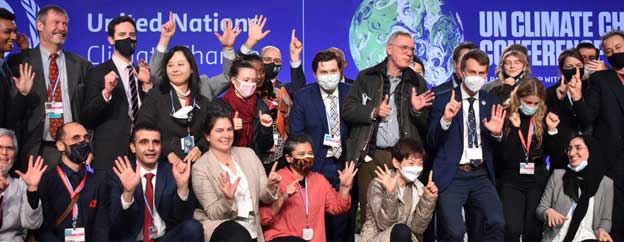
NEW YORK, Nov 19 (IPS) – A week has gone by since COP 26 with 197 Parties ended in the Scottish city of Glasgow on extended time last Saturday. Climate change which covers wide array of issues affecting all living beings engaged the people around the world for COP 26 in a way never experienced since COP1 was held in Berlin in 1995.

Read the full story, “Glossing Over in Glasgow – Some Thoughts on COP26”, on globalissues.org

find more fun & mates at SoShow now !

The Chinese envoy to the European Union has reiterated Beijing’s goal of peacefully reuniting Taiwan with the mainland but stated the country’s preparedness to use “decisive measures.”

Speaking on Tuesday, China’s ambassador to the EU, Zhang Ming, said Beijing would never change its position on Taiwan. “If anything changes, it is that the Chinese people’s resolve to realize complete reunification of our country grows even stronger,” Ming told an online think tank event in Brussels.

Read more

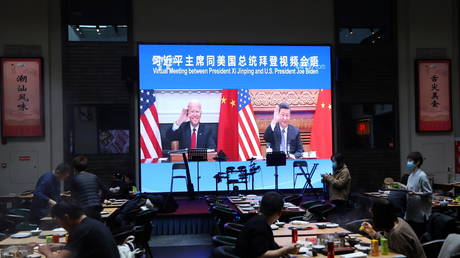
A screen at a restaurant in Beijing showing Chinese President Xi Jinping's virtual meeting with US President Joe Biden. © Reuters / Tingshu Wang
Biden & Xi agree to avoid conflict

“Some people in Europe seem to underestimate the Chinese people’s aspiration for a reunification of our country,” he added, noting also that the bloc must lift its sanctions if a new Sino-EU investment deal is to be ratified. 

In May, Brussels halted an investment pact agreed with China last December, after Beijing imposed sanctions on several members of the European Parliament. The EU responded, introducing its own sanctions related to the treatment of the Uyghur people and alleged genocide in Xinjiang. 

In recent years, China has become increasingly assertive about reuniting its wealthy island neighbor with the mainland. Beijing claims Taiwan is an inalienable part of the country and has called on Western parties to refrain from interfering in Chinese internal affairs. Western nations, notably the US and UK, have shown willingness to defend the democratic island. 

Taiwan considers itself to be independent of China since 1949 when the communist forces overthrew the government of the Republic of China on the mainland, forcing the Kuomintang-ruled state to relocate there.

If you like this story, share it with a friend!

find more fun & mates at SoShow now !