EU nations have agreed on an emergency plan to slash gas consumption
EU nations have agreed on a controversial scheme to slash gas consumption in preparation for a possible complete stoppage of supplies from Russia, diplomats have told German news agency DPA.
Some members – led by Hungary and Greece – have expressed strong objections to the proposal.
With the level of reliance on Russia gas varying between member states, the proposal by the European Commission had been met with criticism from many governments within the EU.
The emergency plan will see member states voluntarily reduce their consumption of natural gas by 15% between August 2022 and the end of March 2023, the sources said.
The hope is that the measure will help “to soften the impact of a potential total stoppage in Russian gas supplies,” according to DPA.
The plan will likely be approved during a summit of EU energy ministers in Brussels later on Tuesday, the diplomats said.
As she arrived for the meeting in the Belgian capital, European Union energy policy chief Kadri Simson said she expected the ministers to reach a deal on gas rationing.
She argued that Russian gas giant Gazprom’s announcement that gas supply to the EU would be cut further this week due to the need to fix a turbine on the Nord Stream 1 pipeline was “politically motivated.”
“We know that there is no technical reason to do so… And exactly for that reason, the pre-emptive reduction of our gas demand is a wise strategy,” Simson insisted.
The so-called “Save Gas for a Safe Winter” proposal had been proposed by the European Commission a week ago. It urged all EU member states to lower their gas consumption by 15% by switching to renewable energy or even coal, oil and nuclear power, as well as by instructing their citizens to ration their use of energy.
The idea caused a lot of protests within the bloc, especially in southern Europe. The Spanish minister for ecological transition insisted the plan was “not necessarily the most effective nor the most efficient nor the most just,” while the Portuguese secretary of state for environment and energy slammed it as “unsustainable” and “disproportionate.”
France, Greece, Italy, Hungary, Denmark, Ireland, Malta, the Netherlands and Poland were also among the countries that spoke out against the cuts.
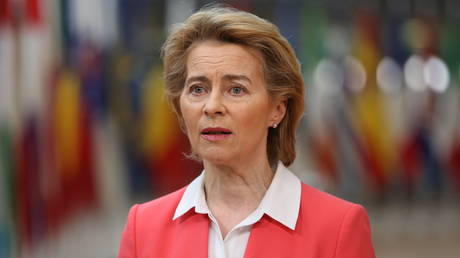
European Commission President Ursula von der Leyen defended the plan again on Monday, insisting the bloc “must be prepared for the worst-case scenario: a complete halt to gas supplies, sooner or later.”
In an interview with DPA, she described Moscow as “not a reliable partner for Europe’s energy supply,” claiming that “Gazprom has deliberately kept its storage levels low.” The company had reduced or cut off supply to 12 EU member states, von der Leyen added.
Von Der Leyen expressed confidence that the EU energy ministers would support the plan, as they “understand their responsibility” to see Europe safely through the winter.
Last week, Russian President Vladimir Putin rejected claims that gas supplies could be cut off to the EU completely. Despite tensions in relations between Moscow and Brussels over Russia’s military operation in Ukraine, Gazprom was “ready to pump as much as necessary,” but it was the EU that “closed everything themselves,” he argued.
Research concludes that hair loss and sexual dysfunction are among the potential long-term effects of Covid-19
Hair loss, reduced libido and sexual dysfunction are among a wide range of symptoms that can follow a Covid-19 infection, a new study released on Monday suggests.
According to a peer-reviewed study in the Nature Medicine journal, the most common long Covid symptoms include loss of smell, fatigue and shortness of breath. However, hair growth and libido can also be impaired, among other previously unrecognized symptoms.
“We explored the effect of Covid-19 on 115 symptoms of which we found 62 symptoms to be statistically significantly associated with Covid-19 at 12 weeks [or more] after infection,” Anuradhaa Subramanian at the University of Birmingham in the UK, the lead author of the paper, told New Scientist.
“Some of these new symptoms, like reduced libido, sexual dysfunction and hair loss, are really new. They had not been attributed to Covid-19 in the longer term before,” she added.
The study analyzed the health records of 2.4 million people across the UK, comparing almost 500,000 patients who had contracted the virus with around 1.9 million who had not tested positive. The researchers also used the data of patients who had not been admitted to hospital.
For now, it is unclear how exactly the illness may lead to hair loss, although it’s known that the condition can be triggered by other infections or stress. The problems with sexual function can apparently include ejaculation difficulties.
“People with other chronic illnesses frequently experience sexual dysfunction and we find the same with Covid-19, suggesting Covid-19 is a chronic illness,” Dr Shamil Haroon, the study’s co-author and associate clinical professor in public health at the University of Birmingham, told New Scientist.
The identified symptoms spanned multiple organ systems and could generally be split into three categories: respiratory, including coughing and shortness of breath; mental health and cognitive problems such as anxiety, depression and brain fog; and a wider range of symptoms including pain, fatigue and rashes.
In addition to identifying new health problems linked to long Covid, researchers also outlined the groups that are most likely to suffer from the disease in the long term. They include women and people of African ascent, as well as some other ethnic groups. People from poorer backgrounds, smokers, and overweight sufferers also run a higher risk of long Covid.
“This research validates what patients have been telling clinicians and policymakers throughout the pandemic – that the symptoms of long Covid are extremely broad and cannot be fully accounted for by other factors such as lifestyle risk factors or chronic health conditions,” Haroon concluded.
SYDNEY and KUALA LUMPUR, Jul 26 (IPS) – Like so many others, Africans have long been misled. Alleged progress under imperialism has long been used to legitimize exploitation. Meanwhile, Western colonial powers have been replaced by neo-colonial governments and international institutions serving their interests.
KINSHASA, Jul 26 (IPS) – The writer is the International Project Leader for the Congo Basin Forest, Greenpeace AfricaFrom the fall-out of the pandemic to the interlocking cost of living and energy security crises currently gripping the world, it has been fascinating to see the world’s richest governments bending over backwards to help fossil fuel companies.
The overall situation in Libya remains “highly volatile”, Martha Pobee, UN Assistant Secretary-General for political affairs and peace operations, told the Security Council on Monday.
The Roman Catholic Church leader sought forgiveness from the indigenous community
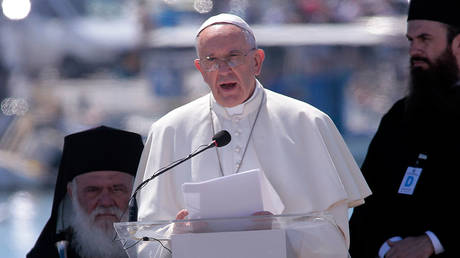
Pope Francis on Monday begged forgiveness from Canada’s indigenous community, apologizing for the Roman Catholic Church’s participation in the project of residential schools which a Canadian government body has described as genocidal. The pontiff is on a six-day apology tour of Canada, demanded since last year by Prime Minister Justin Trudeau.
“Dear Indigenous Peoples of Canada, I have come to your native lands to tell you in person of my sorrow, to implore God’s forgiveness, healing and reconciliation, to express my closeness and to pray with you and for you,” the pope tweeted on Monday.
“I ask forgiveness for the ways in which many members of the Church cooperated in those projects of cultural destruction and assimilation stipulated by the government, which culminated in the system of residential schools,” he added.
The tweet came after the pope visited the former site of the Ermineskin Indian Residential School in Maskwacis, Alberta. Visiting the local cemetery, Francis sought absolution from the four Cree nations that live in the area.
“I humbly beg forgiveness for the evil committed by so many Christians against the Indigenous peoples,” the pope said.
The 85-year-old pontiff arrived in Edmonton on Sunday, for a “penitential pilgrimage” to Canada that will take him from Alberta to Quebec as well as the far-north region of Nunavut. The purpose of the trip is to mend relations with First Nations over the residential schools program, which Canada’s Truth and Reconciliation Commission (2008-2015) said amounted to “cultural genocide.”
Seeking to “civilize” the children of native nations, the Canadian government separated them from their families and sent them to a network of boarding schools, which continued operating until 1969. Catholics operated 66 out of the 139 institutions, with the Church of England responsible for another 36. An estimated 150,000 indigenous children went through the system.
In addition to the “cultural genocide,” however, indigenous activists have accused the Catholic Church of a physical one as well, alleging widespread sexual abuse and even deaths at residential schools. Last year, several activist groups claimed to have found “mass graves” at four sites, from Kamloops, British Columbia to Saskatchewan.
In the weeks that followed, several Catholic churches across western Canada went up in flames in suspected arson attacks. Trudeau’s response was to denounce the residential schools as a “dark and shameful chapter of our country’s history” and to demand Pope Francis come to Canada and seek forgiveness.
Canada has already paid billions of dollars in reparations to First Nations in a settlement with some 90,000 surviving residential school students. Catholic dioceses in Canada have contributed about $50 million, and intend to add $30 million more over the next five years. Indigenous activists have also sought reparations from the British crown – as the head of both the Canadian state and the Church of England.
Some critics have pointed out that while the radar imagery cited by indigenous activists showed “disturbances” in the ground, no actual bodies have been found – only to be denounced as “genocide deniers” by much of the Canadian public.
The pope’s trip to Canada comes just weeks after the Vatican canceled his six-day trip to South Sudan and the Democratic Republic of Congo, citing ongoing problems with his knee. Francis has been using a wheelchair and a cane to move around during the Canadian visit.
Dealing with the Russian president is a matter of attitude, the Turkish leader said
Turkish President Recep Tayyip Erdogan on Monday criticized his Western colleagues for having the wrong attitude towards Russian President Vladimir Putin, contrasting that with his own ability to work with Moscow on issues ranging from the Syrian peace process to last week’s deal to export Ukrainian grain via the Black Sea ports.
“You know the attitude of Western politicians towards Putin,” he told the state broadcaster TRT during a lengthy interview on Monday evening, calling it “unbecoming of politics.”
“The attitude you show him is the attitude you will get in return,” Erdogan explained.
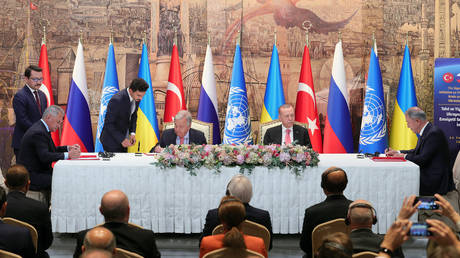
He credited this insight for Ankara’s ability to successfully negotiate the grain deal with both Moscow and Kiev on Friday. Turkey had also hosted the initial talks between Ukraine and Russia in the early days of the conflict, before the process broke down – reportedly at the urging of some Western leaders.
“We are determined to put this agreement into practice,” Erdogan said of the grain deal, saying it would go a long way to ease the threat of a global food crisis. He urged both Russia and Ukraine to abide by what they signed in Istanbul.
In the conflict between Russia and Ukraine, Ankara does not regard either side as an enemy, Erdogan said. Turkey has not imposed sanctions against Russia, but it has spoken in opposition to Moscow’s military operation in Ukraine and sold Kiev combat drones such as the Bayraktar TB-2.
As for relations with Russia, Erdogan said that Turkey was focusing on issues of “mutual benefit,” such as the peace process for neighboring Syria. As part of the ‘Astana Three’ initiative, the Turkish leader met with Putin and Iranian President Ebrahim Raisi in Tehran earlier this month.


 news
news