The French government has kicked off a €14 million national campaign to tackle underage prostitution and pimping. It comes months after a report found as many as 10,000 youngsters, mostly teen girls, are involved in the sex trade.
The campaign, launched by the Ministry for Solidarity and Health on Monday, is expected to be fully rolled out in 2022. The ministry described the problem as a “growing phenomenon that society can no longer ignore” and about which “too little is known.”
The government programme is expected to “increase awareness” while helping to “inform and provide a better understanding of the phenomenon.” It also aims to help “identify the young people involved” and “prosecute clients and pimps more effectively.”
According to RFI, the prevalence of underage prostitution has increased by as much as 70% over the past five years, with social media believed to be compounding the problem. The public broadcaster noted that the situation had worsened during the Covid-19 pandemic when young people spent more time online.
In July, a working group produced a damning report that found between 7,000 and 10,000 young people were involved in prostitution across the country. The majority are young girls aged between 15 and 17, but a ministry statement noted that the “entry point” into prostitution was increasingly becoming younger at around 14-15 years.
“There’s really a normalisation of prostitution of young people because girls say that selling sex is a way of making lots of money easily and that it can help them reach their dream life,” deputy public prosecutor Raphaelle Wach told the news outlet France 24.
In its statement, the ministry noted that many minors did not consider themselves victims and valued the “financial autonomy” and feelings of “belonging to a group” and “regaining control” over their lives.
“These minors are however in danger, both physically and psychologically,” the ministry warned.
“Covid played a considerable role because social networking provided new ways of being able to hook in underage girls very easily,” Geneviève Collas, who runs an NGO fighting human trafficking, told RFI. She added that recruiting minors has been made “easier” with short-term apartment rental apps like Airbnb helping mask the scale of the problem on the streets.
A cleaner for Israel’s defense minister has been accused of espionage after allegedly offering to place malware on his boss’ household computer for an Iran-linked hacking group.
In a statement on Thursday, the Shin Bet security service said that Omri Goren, a housekeeper for Defense Minister Benny Gantz, and a former bank robber according to Israeli media, corresponded with an unnamed person over social media shortly before his arrest.
Goren reached out earlier this month to “a figure affiliated with Iran and offered to help him in different ways, in light of his access to the minister’s home,” the statement read, according to the Times of Israel.
It is understood that Goren offered to spy and place malware on Gantz’s computer on behalf of a hacking group, reportedly called ‘Black Shadow’ and associated with Iran, Tel Aviv’s perennial enemy. It is also said that he provided photos of Gantz’s residence to prove he had access.
A Central District prosecutor filed espionage charges against Goren on Thursday. If convicted, the accused could face a sentence of between 10 and 15 years, according to the Times of Israel.
The 37-year-old Lod resident has previously served four prison sentences, the most recent of which was for four years. Goren was found guilty of five crimes between 2002 to 2013, two of the convictions were for bank robbery.
The Shin Bet said they would review their processes for staff background checks “with the goal of limiting the possibility of cases like this repeating themselves in the future.”
Speaking on Kan public radio, Gal Wolf, the attorney representing Goren, suggested his client had intended to extract money from the Iranians without carrying out any spying.
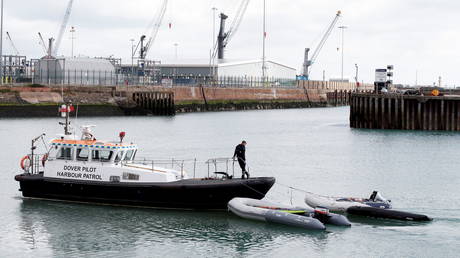
Sports goods retailer Decathlon has said it won’t be selling canoes in its stores in northern France anymore because the light vessels are increasingly being used by migrants trying to cross into England.
“Given the current context… the purchase of canoes will no longer be possible” in Decathlon stores in Calais and Grande-Synthe, outside Dunkirk, the French retailer announced.
The two cities overlook the Strait of Dover, which is the narrowest point in the English Channel. Thousands of migrants have been using this spot in recent years to try to make the dangerous 34-kilometer-long sea journey from France to the UK.A lot of canoes aren’t being purchased for their original sporting purpose, Decathlon complained.
They “could be used to cross the Channel” and as a result of this, “people’s lives would be endangered,” it pointed out.
“We are committed to never putting our customers at risk in the use of our products, whatever the circumstances,” the company said.
The initiative to remove canoes from the shelves came from the stores themselves and was backed by the head office, according to the retailer. However, Decathlon will keep selling the vessels online and in its other shops across France.
Last Thursday, two canoes were found adrift in the Channel near Calais, while two migrants were rescued from the water. The next day, three more people were reported missing after attempting to get to England using canoes.
Tensions between London and Paris are high after a record number of migrants – 1,185 – were able to cross the Channel a week ago.
Britain said it was “unacceptable” that France had let so many people slip through, but the French government insisted they were “neither their collaborators nor their assistants” and blamed the soaring crossings on the smugglers and the UK’s labor market, which makes the country attractive to people eager to “work at low cost.”
Two supply boats are sent to provide food to Filipino marines guarding a disputed shoal in the South China Sea after the Chinese coast guard used water cannons to turn the boats away last week.
Australia’s Jewish community has condemned the repeated displays of Nazi references at anti-vaccine and anti-lockdown rallies in Victoria, some of which saw the state premier depicted as Adolf Hitler.
Daniel Aghion, the president of the Jewish Community Council of Victoria, claims that references to the genocidal regime of the Nazis amid the current unrest over pandemic rules is a false equivalence.
“The Nazis had the intention of wiping from the face of the Earth a race or religion simply because of what they were,” Aghion told Guardian Australia. “Nothing in the current proposals is remotely like that, and the comparison to Nazi Germany is therefore shocking, inappropriate and wrong,” he added.
Aghion’s comments come after demonstrators, protesting against pandemic laws, referenced Nazi Germany in an effort to make their point. Some carried placards depicting state premier, Daniel Andrews, as Hitler.
I don’t agree with Daniel Andrews Pandemic Bill. It’s overreach & has rightly been condemned. But placards depicting the Premier in Nazi uniform is offensive & wrong.
It shows a lack of understanding of history. It fuels hatred. It’s dangerous & has no place in public debate. pic.twitter.com/9QN5rj5hym
Wendy Lovell, a Liberal MP, had also claimed laws proposed to govern future pandemics were similar to Germany’s 1933 Enabling Act – which allowed the Reich government to issue laws without the consent of parliament and preceded atrocities, most notably the Holocaust.
MP Bernie Finn had gone as far as to share a social media post depicting the state premier as Hitler. It was later deleted.Laws proposed by Andrews seek to grant powers to the state leaders in the event of another pandemic. Under the move, the minister “may make any order… that the minister believes is reasonably necessary to protect public health.”
Opponents claim the legislation, which would see power concentrated with the head of state and health minister, is too broad and far reaching.
The annual migration of red crabs has brought traffic to a standstill on an Australian island. Apart from the epic journey, the species is also notorious for eating its own young.
Tens of millions of crustaceans are swarming Canberra-governed Christmas Island, which is almost a thousand miles northwest of the Australian mainland. Parks Australia, a government body in charge of wildlife conservation on the island, has deployed its staff to manage traffic, rake crabs off roads and provide advisories to local residents regarding road closures. Authorities are well-prepared to deal with the epic crab march as it repeats every year, usually in October and November. There are even special bridges and tunnels in place, built over and under busy roads so as to minimize the number of crabs crushed by cars. The sight of millions of these creatures making their perilous trek has become one of Christmas Island’s main tourist attractions.
The exact timing of the red crabs’ journey from forest to ocean is defined by rainfall and lunar phases. The march is led by male crabs, which are later joined by females. On reaching the ocean, they mate and spawn, with each female capable of producing as many as 100,000 eggs. However, most of the young crabs never make it back to the forest as they end up being eaten by fish and whale sharks for whom this is a veritable feast. To make matters worse, the crab larvae that do make it to the beach are often devoured by returning adult crabs of the very same species, hence one of their names – the cannibal crab.
President Joe Biden commented on reports that US officials are planning to boycott the upcoming Olympics in Beijing over alleged human rights violations – but his answer left journalists perplexed.
When asked on Tuesday if an official US delegation will be traveling to the Winter Games in the Chinese capital in February, Biden responded: “I am the delegation.”
The president, however, did not elaborate, leaving the White House correspondents in a state of confusion, as his response could mean that Biden will attend the Winter Olympics alone or, as some reporters suggested, that he simply did not understand the question.
A recent report by a Washington Post columnist claimed the US won’t be sending an official delegation to Beijing in 2022 over allegations of human rights violations by the Chinese government. According to the sources cited in the article, a formal recommendation for a diplomatic boycott of the Olympics has been already presented to Biden, with the move expected to be approved by the president by the end of November.
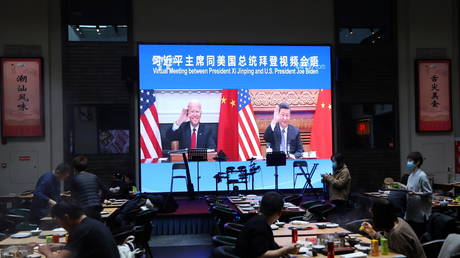
The piece was published on the day that Biden held a lengthy virtual meeting with Chinese leader Xi Jinping, in which they discussed a range of issues regarding the strained relations between the two nations – but not the Olympics.
The White House said that during the talks, President Biden challenged his Chinese counterpart over what Washington sees as persecution against the Uyghur population in the Xinjiang region, as well as human rights violations in Tibet and Hong Kong. China has strongly denied the claims, accusing the US of interfering in its internal affairs.
Calls for the Biden administration to boycott the Olympics and refrain from sending a political delegation to Beijing have recently been made by top Democratic and Republican lawmakers.
If implemented, it won’t affect the American athletes, who will still be taking part in the Winter Olympics.
France’s best-known book of words, Le Petit Robert dictionary, has caused a stir by including the non-binary personal pronoun as an alternative to the existing masculine and feminine terms.
While the annual update of the Petit Robert dictionary is often a topic of considerable debate in French media, the latest edition has caused quite the backlash, with some, including a cabinet member, accusing it of pandering to wokeism.
The word “iel,” a neologism combining the French words for he and she (“il” and “elle“), is described as the personal pronoun for a person of any gender. “Personal pronoun subject to the third person singular and plural, used to evoke a person of any gender. The use of the pronominal in inclusive communication,” the dictionary’s entry reads.
Striking out at the latest inclusion, François Jolivet, an MP in President Emmanuel Macron’s LREM party took his protest to the Académie Française, the official guardians of the French language.
Describing the move as “wokeism,” Jolivet said in a letter to the Académie that the word “iel” had no place in the French language and claimed it would be a precursor to the rise of ‘woke’ ideology, which undermines the values of the Gallic nation.
Outspoken Education Minister Jean-Michel Blanquer also chimed in. “Inclusive writing is not the future of the French language,” he tweeted, sharing Jolivet’s letter. “Just as our schoolchildren are consolidating their basic skills, they don’t need to have this as a reference,” he added.
The head of Gaullist party Debout La France, Nicolas Dupont-Aignan, further criticized Petit Robert’s “woke” addition. “Let’s defend our language against these ridiculous fanatics of deconstruction and let’s boycott the collaborators who give into them,” he tweeted.
Le Petit Robert has responded to the “lively debate” by claiming that the pronoun has been used increasingly in society in recent months and they chose to reflect this by adding it to their latest update. The publication also said that some have welcomed the addition.
France’s offensive against wokeism, which has been described by some as an Anglo-Saxon import, recently saw Blanquer vow to increase the teaching of ancient Greek and Latin languages. The education minister claims that the classical vernaculars respond to a demand for logos (language as a tool for reason), in a world where “a lack of reason is spreading like wildfire.”
Covid-battered global supply chains are being threatened by organized criminals, including drug cartels and con artists posing as legit suppliers, a new study has found, warning that the situation is set to get worse.
The international supply chain woes amid the Covid-19 pandemic are highlighted in a new annual report, released this week by the British Standards Institution (BSI).
The document, titled the ‘Supply Chain Risk Insights Report’, highlights Covid’s impact on supply chains, with the experts also warning that organized crime has increasingly preyed on this crucial area during the pandemic. On multiple instances, criminals were posing as legitimate logistics providers, stealing goods during shipment.
“I’m seeing a significant number of false suppliers acting as genuine potential suppliers in supply chain logistics provision – warehousing distribution, distribution centres, transportation companies – and actually, they are criminal groups trying to infiltrate the logistics supply chain,” said David Fairnie, BSI’s principal consultant in supply chain security. He urged producers to “continuously monitor” the supply chain and to not immediately trust new logistics providers – especially those contacted only remotely.
So, arguably today more than ever, you do need to know your suppliers. So far in 2021, BSI has noted this issue of fake carriers in an increasing number of countries in both the Americas and Europe.
Criminals have apparently been trying to steal goods in various ways, with phony truck drivers loading up items and taking off with them, while conmen “posing as legitimate employees” have reportedly been observed lurking around delivery destinations to steal cargo.
At the same time, the report found that trade in illicit goods has also been on the rise lately, with the illegal drug industry in particular appearing to flourish. While the supply chain for drug cartels, which require large amounts of assorted chemicals to produce narcotics, was disrupted due to the pandemic lockdowns and border closures impacted trafficking routes, organized crime quickly overcame these problems, the BSI noted.
“Drug cartels around the world did not miss a beat,” Chris Tomas, BSI lead intelligence analyst, said.
While many cartels shifted their production towards synthetic drugs, namely amphetamine, amid the pandemic, the apparent “lack of eradication of coca crops in Latin American countries” also remains an issue, the BSI said. The flow of cocaine has grown over the past year and is expected to increase even further, the organization warned.
“The numbers and quantities of cocaine seizures in Europe increased steadily in 2020 and 2021 and are expected to continue to rise in 2022,” the report reads.
Think your friends would be interested? Share this story!