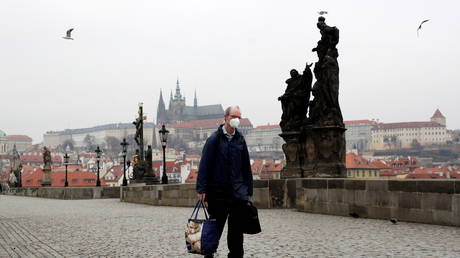
Sports goods retailer Decathlon has said it won’t be selling canoes in its stores in northern France anymore because the light vessels are increasingly being used by migrants trying to cross into England.
“Given the current context… the purchase of canoes will no longer be possible” in Decathlon stores in Calais and Grande-Synthe, outside Dunkirk, the French retailer announced.
The two cities overlook the Strait of Dover, which is the narrowest point in the English Channel. Thousands of migrants have been using this spot in recent years to try to make the dangerous 34-kilometer-long sea journey from France to the UK.A lot of canoes aren’t being purchased for their original sporting purpose, Decathlon complained.
They “could be used to cross the Channel” and as a result of this, “people’s lives would be endangered,” it pointed out.
“We are committed to never putting our customers at risk in the use of our products, whatever the circumstances,” the company said.
The initiative to remove canoes from the shelves came from the stores themselves and was backed by the head office, according to the retailer. However, Decathlon will keep selling the vessels online and in its other shops across France.
Last Thursday, two canoes were found adrift in the Channel near Calais, while two migrants were rescued from the water. The next day, three more people were reported missing after attempting to get to England using canoes.
Tensions between London and Paris are high after a record number of migrants – 1,185 – were able to cross the Channel a week ago.
Britain said it was “unacceptable” that France had let so many people slip through, but the French government insisted they were “neither their collaborators nor their assistants” and blamed the soaring crossings on the smugglers and the UK’s labor market, which makes the country attractive to people eager to “work at low cost.”
Hundreds of major websites returned ‘404: not found’ errors after an apparent problem with Google Cloud. Alphabet said the problem was “partially resolved” after about ten minutes, but it will take time for everything to update.
The site Downdetector began showing a spike in reports of outages starting at 12:40pm Eastern time on Tuesday, affecting Google, Facebook, Instagram, Snapchat, Discord, Spotify, and TikTok, as well as e-commerce sites Target, Etsy, Shopify, and Home Depot, among others.
Amazon, Amazon Web Services (AWS), and Cloudflare were also affected.
Google’s Status Dashboard reported an unspecified “issue” with the Cloud service starting at 10:10 Pacific, which was causing users to encounter errors when accessing websites.
“We believe the issue with Cloud Networking is partially resolved,” the company said by 10:17 PST, but it added that “Customers will be unable to apply changes to their load balancers until the issue is fully resolved,” and they did not have an estimate as to when that might be.
Think your friends would be interested? Share this story!
France’s education minister has announced plans to boost the teaching of ancient Greek and Latin in an effort to fight the proliferation of wokeism and “develop the culture” of the country’s younger generations.
Speaking on Monday, Education Minister Jean-Michel Blanquer, a leading figure in France’s war on woke, said that ancient Greek and Latin would become available to sixth formers pursuing vocational courses next year, as well as middle school students.
Blanquer wants sixth formers to have the opportunity to “develop their culture” by reading ancient philosophers while gaining the technical qualifications that the economy demands.
Speaking at a charter signing, alongside counterparts from Italy, Greece, and Cyprus, the minister claimed their joint commitment to the promotion of the classics came at a time when ancient languages were being threatened by American wokeism.
The targeting of the dead languages has been most prominent in the US with Princeton University announcing this summer that it would no longer require classics students to study ancient Greek and Latin; the two vernaculars are often considered the core pillars of the discipline.
Dan-el Padilla Peralta, an associate professor of classics at Princeton, claimed the ancient languages had been used as a justification of slavery, colonialism, and fascism for 2,000 years.
In a similar move, a Massachusetts high school boasted that it had removed Homer’s Odyssey from the school curriculum as it conflicted with the anti-racist agenda it wanted to teach. “Very proud to say we got the Odyssey removed from the curriculum this year,” a teacher wrote on social media.
Blanquer told Le Point that such interpretations of the classics were “completely mind boggling.” “To stick categories and a contemporary world view on writings dating back two millennia is an abyssal absurdity,” he added, noting that these civilizations brought us “openness and a search for the universal.”
The minister believes that ancient languages are a common bond for contemporary European nations, noting that the “common linguistic fund” would help spread “common values.”
Blanquer also claimed the classics respond to a demand for logos (language as a tool for reason), in a world where “a lack of reason is spreading like wildfire.”
Last month, the education minister set up a think tank dedicated to President Emmanuel Macron’s war on wokeism.
The liberal or woke agenda, which some in France claim is an Anglo-Saxon import, is likely to be a major feature in the 2022 presidential election, where Macron’s main competitor is likely to hail from the far right of the political spectrum.
Slovakia has become the latest European country to implement lockdown restrictions on people who haven’t had the Covid vaccine, as it seeks to prevent a resurgence in infections and hospital admissions over the winter.
Slovakian Prime Minister Eduard Heger announced the new measures in a press conference on Thursday, declaring a “lockdown for the unvaccinated” after the country reported a record number of new cases.
The new restrictions in Slovakia, which come into effect on Monday, will require people to have been vaccinated or have recovered from Covid in the past six months to enter restaurants, non-essential shops, or public events.
In the past few days, the European nation has seen record numbers of new infections, including over 8,000 on Tuesday, with hospitals running out of space to treat Covid patients.
Slovakia has one of the lowest rates of vaccination in the European Union, with over 50% of individuals still not jabbed. The country of around 5.5 million has so far only inoculated 2.5 million people against the virus.
Earlier this week, Austria became the first nation to impose restrictions on unvaccinated individuals, as it sought to limit pressure on hospitals and emergency care units. The move came into effect at midnight on Monday for anyone aged 12 and older who has not received their Covid vaccine or recently recovered from the virus.
The German state of Bavaria and the Czech Republic followed Austria in restricting access for unvaccinated individuals. Only people who can show proof of vaccination or that they have recently recovered from Covid will be allowed to enter public spaces, such as restaurants and shops.
France’s education minister has announced plans to boost the teaching of ancient Greek and Latin in an effort to fight the proliferation of wokeism and “develop the culture” of the country’s younger generations.
Speaking on Monday, Education Minister Jean-Michel Blanquer, a leading figure in France’s war on woke, said that ancient Greek and Latin would become available to sixth formers pursuing vocational courses next year, as well as middle school students.
Blanquer wants sixth formers to have the opportunity to “develop their culture” by reading ancient philosophers while gaining the technical qualifications that the economy demands.
Speaking at a charter signing, alongside counterparts from Italy, Greece, and Cyprus, the minister claimed their joint commitment to the promotion of the classics came at a time when ancient languages were being threatened by American wokeism.
The targeting of the dead languages has been most prominent in the US with Princeton University announcing this summer that it would no longer require classics students to study ancient Greek and Latin; the two vernaculars are often considered the core pillars of the discipline.
Dan-el Padilla Peralta, an associate professor of classics at Princeton, claimed the ancient languages had been used as a justification of slavery, colonialism, and fascism for 2,000 years.
In a similar move, a Massachusetts high school boasted that it had removed Homer’s Odyssey from the school curriculum as it conflicted with the anti-racist agenda it wanted to teach. “Very proud to say we got the Odyssey removed from the curriculum this year,” a teacher wrote on social media.
Blanquer told Le Point that such interpretations of the classics were “completely mind boggling.” “To stick categories and a contemporary world view on writings dating back two millennia is an abyssal absurdity,” he added, noting that these civilizations brought us “openness and a search for the universal.”
The minister believes that ancient languages are a common bond for contemporary European nations, noting that the “common linguistic fund” would help spread “common values.”
Blanquer also claimed the classics respond to a demand for logos (language as a tool for reason), in a world where “a lack of reason is spreading like wildfire.”
Last month, the education minister set up a think tank dedicated to President Emmanuel Macron’s war on wokeism.
The liberal or woke agenda, which some in France claim is an Anglo-Saxon import, is likely to be a major feature in the 2022 presidential election, where Macron’s main competitor is likely to hail from the far right of the political spectrum.
WASHINGTON DC/SAN DIEGO, Nov 22 (IPS) – The COVID-19 pandemic has had devastating effects across the globe, but the data and evidence show that women have borne the brunt of the crisis. While inequalities in health, economic power, and other areas existed long before the pandemic began, the pandemic has widened these gaps.
French luxury giant Dior has taken down a controversial photograph that had been criticized in China for “smearing Asian women” by pandering to Western stereotypes while “distorting Chinese culture.”
The photo, which was part of the brand’s ‘Lady Dior’ exhibition in Shanghai, depicts an Asian model wearing a traditional dress and clutching a Dior handbag. It came under fire this week from Chinese media outlets for featuring “spooky eyes, [a] gloomy face and Qing Dynasty-styled nail armor.”
Although Dior has not released a statement regarding the controversy, it confirmed to fashion trade publication Business of Fashion that the photo had been removed from the exhibition. The brand has also reportedly taken the photo off Chinese social media platform Weibo.
The image, which was shot by Chinese photographer Chen Man, had drawn both media ire and public outrage. However, there were apparently no calls for a boycott of the brand.
In an editorial on Monday titled “Is This the Asian Woman in Dior’s Eyes?”, the Beijing Daily paper had noted that the image makes Chinese consumers uncomfortable. The publication criticized Man for “playing up to the brands, or the aesthetic tastes of the Western world.”
For years, Asian women have always appeared with small eyes and freckles from the Western perspective, but the Chinese way to appreciate art and beauty can’t be distorted by that.
Warning that both the brand and the photographer had “gone too far,” the China Women’s News paper ran an editorial on Wednesday that claimed it “indicated their intention of uglifying Chinese women and distorting Chinese culture.”
“Again, from… Dior’s ghost-style picture, which makes the public feel uncomfortable, it’s easy to see some Western brands’ ‘pride and prejudice’ in their aesthetics and culture,” said the newspaper, which is run by the All-China Women’s Federation.
Meanwhile, the Global Times noted that the “lingering controversy could pose a delicate situation” for Dior and other global brands – for whom China’s “massive” luxury market was one of the biggest sources of revenue. The paper said that the Chinese public had become “increasingly sensitive” toward the depiction and treatment of Chinese people and culture by foreign companies.
While pointing out that Chinese social media users had demanded the company and photographer explain their intention, a number of media outlets also highlighted how some netizens had praised the photo as a departure from typical standards of beauty in the country, often characterized by “fair skin and large eyes.”
Marx, Lenin, and Ho Chi Minh – the revolutionaries’ namesakes – have gathered for a wedding in India’s state of Kerala. Friedrich Engels was the one walking down the aisle.
And this has nothing to do with time travel. In India’s southwestern state of Kerala parents have often named their children after prominent figures in the hammer and sickle movement. The local communist party has been at the helm there for much of the past 60 years, and is still quite popular with voters.
In the town of Athirappilly on Sunday the groom, Friedrich Engels, a namesake of the 19th century German philosopher who helped conceive Marxism, tied the knot with the bride, Bismitha. In attendance were also Engels’s brother Lenin, named after the man behind the 1917 Russian Revolution, as well as the groom’s friends, Marx and Ho Chi Minh, who bear the names of Marxism’s founding father and the Vietnamese revolutionary leader respectively.
All four men are members of India’s Communist Party. Incidentally, Marx is currently working and residing in ultra-capitalist Dubai, but flew back to see his friend exchange wedding vows with his betrothed, as reported by local media.
Another wedding ceremony that took place in June in the state of Tamil Nadu, saw Socialism getting married in front of his brothers, Communism and Leninism, as well as nephew, Marxism.
Think your friends would be interested? Share this story!
The EU Commission has released draft legislation aimed at tackling the destruction of woodland by introducing import restrictions on products not certified as ‘deforestation-free’.
The draft proposal, which the commission hopes will become binding rules for all member states, seeks to limit the import of beef, cocoa, coffee, palm, soy, and wood if it is not proven “deforestation-free.”
Outlining the legislation, the EU commissioner for climate action policy, Virginijus Sinkevicius, called it a “ground-breaking” proposal that will help fight “illegal deforestation” and “deforestation driven by agricultural expansion.”
Our proposal to fight deforestation will help us protect 1/3 of 🌎 lands.
We don’t only target illegal deforestation but 𝙖𝙡𝙡 deforestation driven by agricultural expansion.
We start with 6 products that must be deforestation-free 👉🏼 beef, wood, palm oil, soya, coffee, cocoa. pic.twitter.com/Cs9POoydNX
The bill comes after nations at the COP26 summit agreed to work to end deforestation by 2030. It would impose two criteria on imports, requiring items to have been produced in accordance with the origin country’s laws, and not on land that has been deforested or degraded since the start of 2021.
It is not clear when the rules would come into effect; legislative proposals by the commission have to be debated and considered by both the EU Parliament and the Council of the EU before they are passed. The implementation of measures could potentially impact the EU’s trade relations with countries like Brazil, where clearing of the Amazon rainforest hit a new record in October.
During the recent COP26 climate summit, 110 world leaders – whose countries contain around 85% of the world’s woodland – committed to ending and reversing deforestation by 2030, pledging around £14 billion ($18.84 billion) of public and private funds towards the goal.
Australia’s Jewish community has condemned the repeated displays of Nazi references at anti-vaccine and anti-lockdown rallies in Victoria, some of which saw the state premier depicted as Adolf Hitler.
Daniel Aghion, the president of the Jewish Community Council of Victoria, claims that references to the genocidal regime of the Nazis amid the current unrest over pandemic rules is a false equivalence.
“The Nazis had the intention of wiping from the face of the Earth a race or religion simply because of what they were,” Aghion told Guardian Australia. “Nothing in the current proposals is remotely like that, and the comparison to Nazi Germany is therefore shocking, inappropriate and wrong,” he added.
Aghion’s comments come after demonstrators, protesting against pandemic laws, referenced Nazi Germany in an effort to make their point. Some carried placards depicting state premier, Daniel Andrews, as Hitler.
I don’t agree with Daniel Andrews Pandemic Bill. It’s overreach & has rightly been condemned. But placards depicting the Premier in Nazi uniform is offensive & wrong.
It shows a lack of understanding of history. It fuels hatred. It’s dangerous & has no place in public debate. pic.twitter.com/9QN5rj5hym
Wendy Lovell, a Liberal MP, had also claimed laws proposed to govern future pandemics were similar to Germany’s 1933 Enabling Act – which allowed the Reich government to issue laws without the consent of parliament and preceded atrocities, most notably the Holocaust.
MP Bernie Finn had gone as far as to share a social media post depicting the state premier as Hitler. It was later deleted.Laws proposed by Andrews seek to grant powers to the state leaders in the event of another pandemic. Under the move, the minister “may make any order… that the minister believes is reasonably necessary to protect public health.”
Opponents claim the legislation, which would see power concentrated with the head of state and health minister, is too broad and far reaching.