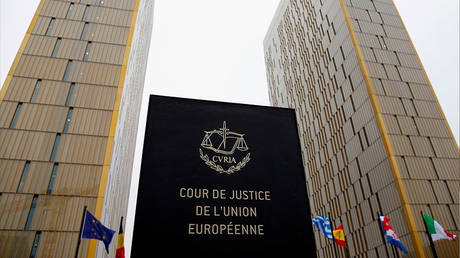
The European Union’s top court has ruled that Hungary’s 2018 law aimed at criminalizing aiding illegal immigrants who are claiming asylum violates the “rights safeguarded” by the bloc’s legislature.
The Hungarian legislation, passed in 2018, sought to punish anyone “facilitating illegal immigration” with a year in prison, under a bill dubbed the “Stop Soros” law. Hungary’s government justified it at the time by arguing that migrants illegally entering the country threatened its national security.
In the ruling, handed down on Tuesday, the European Court of Justice declared that “criminalizing such activities impinges on the exercise of the rights safeguarded by the EU legislature in respect of the assistance of applicants for international protection.”
The EU’s advocate general, Athanasios Rantos, had urged the court to make such a judgement back in February, claiming the introduction of the legislation meant that “Hungary has failed to fulfil its obligations under the [bloc’s] Procedures Directive.”
It became known as the Stop Soros law after billionaire philanthropist George Soros became a vocal opponent of the Hungarian government’s opposition to migration. The administration, in turn, accused Soros of orchestrating migration to Europe, with the Open Society Foundation, run by the philanthropist, closing its operation in the country in response.
Hungary, under the leadership of right-wing Prime Minister Viktor Orban, has repeatedly clashed with the EU in recent years over its strong stance on immigration and concerns from the bloc about threats to the rule of law in the country.
At the end of 2020, a dispute between Hungary and Poland and the EU risked derailing the bloc’s budget, as both member states were threatening to veto it over their view that the EU was attempting to interfere in their domestic affairs. Ultimately, the EU backed down, agreeing to a compromise with Budapest and Warsaw to ensure the budget secured the support of all 27 member states.
Despite acknowledging the EU court’s ruling, Hungary’s government defended its right to challenge any foreign-funded non-government organizations that are attempting to “promote migration.”
“Hungary’s position on migration remains unchanged: Help should be taken where the problem is, instead of bringing the problem here,” Hungarian government spokesperson Zoltan Kovacs said, adding that the country will challenge outside entities “seeking to gain political influence and interference.”
Think your friends would be interested? Share this story!
French President Emmanuel Macron has dismissed the possibility of locking down unvaccinated people in France, claiming the move would not be necessary because of the success of the Covid-19 ‘health pass’.
Speaking to La Voix du Nord newspaper in an interview published on Thursday, Macron said there was no need for France to follow Austria’s lead by locking down its unvaccinated citizens.
“Those countries locking down the non-vaccinated are those which have not put in place the [health] pass. Therefore, this step is not necessary in France,” Macron claimed.
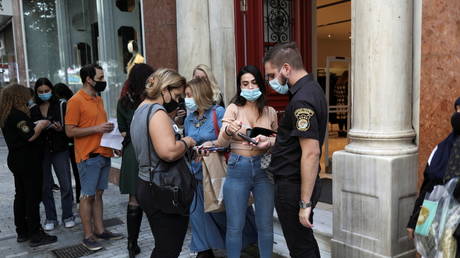
The president’s health pass, which was the target of much criticism when it was introduced, requires people to provide proof of vaccination or a recent negative test before undertaking certain normal activities.
The ‘Pass Sanitaire’ is required if citizens wish to go to restaurants, cafes, cultural venues, or cinemas. It’s also required to take long-distance trains, among other activities.
Austria has led the way by starting a partial lockdown of the unvaccinated amid a surge in Covid-19 cases. The Czech Republic will follow suit next week, while Germany decided on Thursday to introduce similar measures in areas where Covid incident rates exceed the threshold.
Earlier in November, Macron made the continued use of the Covid health pass for over 65s dependent on getting a booster jab.
Some 20,366 new infections were registered in the last 24-hour recording period. Case numbers have risen steeply in recent weeks.
The annual migration of red crabs has brought traffic to a standstill on an Australian island. Apart from the epic journey, the species is also notorious for eating its own young.
Tens of millions of crustaceans are swarming Canberra-governed Christmas Island, which is almost a thousand miles northwest of the Australian mainland. Parks Australia, a government body in charge of wildlife conservation on the island, has deployed its staff to manage traffic, rake crabs off roads and provide advisories to local residents regarding road closures. Authorities are well-prepared to deal with the epic crab march as it repeats every year, usually in October and November. There are even special bridges and tunnels in place, built over and under busy roads so as to minimize the number of crabs crushed by cars. The sight of millions of these creatures making their perilous trek has become one of Christmas Island’s main tourist attractions.
The exact timing of the red crabs’ journey from forest to ocean is defined by rainfall and lunar phases. The march is led by male crabs, which are later joined by females. On reaching the ocean, they mate and spawn, with each female capable of producing as many as 100,000 eggs. However, most of the young crabs never make it back to the forest as they end up being eaten by fish and whale sharks for whom this is a veritable feast. To make matters worse, the crab larvae that do make it to the beach are often devoured by returning adult crabs of the very same species, hence one of their names – the cannibal crab.
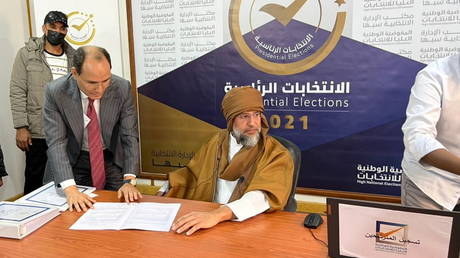
Libyan military commander Khalifa Haftar is set to challenge Gaddafi’s son for the top job, announcing his presidential bid. The election will take place on December 24.
“I declare my candidacy for the presidential election, not because I am chasing power but because I want to lead our people towards glory, progress and prosperity,” the de facto leader of Eastern Libya said in a televised speech.
Haftar added that the election is the only way out of the severe crisis the country has been plunged into.
The announcement was expected; in September, Haftar announced that he was temporarily stepping down as head of the force known as the Libyan National Army, fulfilling the requirement for presidential hopefuls to suspend public work three months before an election.
Haftar will run against the son of former leader Muammar Gaddafi, Saif al-Islam Gaddafi, who represents the Popular Front for the Liberation of Libya.
Haftar’s presidential bid is likely to anger many who consider him a war criminal responsible for the indiscriminate killing of civilians during his military campaign. A number of civil lawsuits have been filed against him in a US federal court for alleged war crimes. Haftar has both US and Libyan citizenship, and owns property in Virginia.
Following years of civil war and political chaos after the NATO-backed intervention that saw Muammar Gaddafi deposed and brutally murdered, the upcoming election is widely viewed as an opportunity for political settlement and the long-awaited unification of the country, divided now between Haftar’s forces and the Tripoli-based Government of National Accord. However, there is still no consensus on the legal grounds for the election, which could become an obstacle for the peace process.
A pack of wild boars were rounded up and euthanized after one of the animals attacked a police officer in the streets of Hong Kong – the opening shot in a pitched battle between the feral hogs and the city’s law enforcement.
A group of veterinarians took seven wild boars into custody, euthanizing the beasts after knocking them out with dart guns in an area near the financial center of the city, according to a statement from Hong Kong’s Agriculture, Fisheries, and Conservation Department on Thursday.
The pigs were captured after one attacked a police officer last week, an act which reflects the city’s new policy toward the animals: stop them before they attack again.
The aggressive boar knocked down a police officer by biting his leg last week as the two faced off in a residential car park, the pig only losing the battle after falling off the building to its death. The wild boars are apparently “accustomed” to wandering back and forth along the roadway, begging for food from pedestrians and vehicles alike. Previously, the city had handled the population by capturing and sedating the animals, then relocating them to “remote areas,” according to the the department.
Hong Kong CEO Carrie Lam vowed to increase penalties for those citizens found feeding the boars, which have reportedly been responsible for some 30 attacks in recent years. While residents are warned not to feed the boars so as not to encourage population growth or disease outbreaks, the animals are a favorite among some visitors. Still, Lam insisted “we can’t simply sit on our hands while things deteriorate.”
Animal rights groups have responded with a protest letter against a policy of euthanasia, pointing out that most visitors do not feed the boars and arguing resources should be directed toward stopping the human activity rather than blaming all the boars. Allowing the boars to be captured and killed “ignores their right to live and considers their existence in urban areas as a capital offense,” the letter read.
At least ten people have been killed and several wounded by security forces during mass demonstrations in Sudan against the recent military coup, a medics organization has said.
“The coup forces used live bullets heavily in different areas of the capital and there are tens of gunshot injuries, some of them in serious condition,” the Central Committee of Sudanese Doctors (CCSD) said in a statement.
The group of medics, which supports the protest movement, said several of the injured were in critical condition. It reported ten deaths across Bahri, Omdurman and the capital Khartoum.
According to AFP, citing witnesses, security forces also fired tear gas at protesters in the capital.
Although internet services have been disrupted and telephone lines cut since the military coup on October 25, thousands of people made it to the streets of major cities.
The Sudanese Professionals Association, which also supports the demonstrators, said people were witnessing “excessive repression” and that there was a “deliberate interruption of voice and internet communications services.”
Videos posted on social media show protesters wrapping up in national flags, chanting anti-military mottos and demanding the release of activists detained by the military since the takeover. Resistance committees across Sudan adopted the Liverpool Football Club’s chant ‘You Will Never Walk Alone’ as their slogan, which has already become a popular hashtag on Twitter.
“The street is calling Thwra (revolution), The revolution says Madaniya (civilian gov)”
On October 25, following a long period of tensions between Sudan’s military and civilian-led government, General Abdel Fattah al-Burhan announced the dissolution of both the Sovereign Council and the transitional government, declaring a state of emergency. The apparent military coup immediately prompted mass protests across the country.
Think your friends would be interested? Share this story!
Apple has finally caved to users demanding the ‘right to repair’, allowing owners of iPhones, MacBooks, and other devices to tinker with their electronics at home instead of bringing them to notoriously expensive service centers.
Called Self Service Repair, the feature is set to launch “early next year” in the US before expanding to other countries. Some 200 parts are expected to be available, along with instructions on how to replace them.
Initially, the company will offer repairs for the iPhone 12 and 13, to be followed by Macs with M1 chips. Users will be able to replace the phones’ display, battery, and camera – some of the earliest parts to cease functioning – using original equipment from the company. While Apple encourages only “individual technicians with the knowledge and experience to repair electronic devices,” urging users to take their devices to a professional before cracking them open themselves, the move nevertheless represents a major step for a company that has long been resistant to allowing users to even swap out a battery.
After rolling out repair instructions and parts for the iPhone 12 and 13, the company will gradually expand users’ abilities to fix their phones themselves without having to wait in line at the Apple Store. Users who attempt to make these repairs on their own will not void their warranty, according to TechCrunch, representing another major change for the tech giant.
Even this week, Apple was sealing off users’ ability to fix their own phones, barring users who replaced their own screens from being able to use Face ID recognition going forward. However, the various departments seem to be coordinating among themselves – users will receive a recycling credit for returning their used or broken part after completing the repair, and the company plans to sell “more than 200 individual parts and tools,” as well as repair manuals customers can peruse before attempting to repair their devices.
The decision to open up Apple’s “right to repair” might not have been entirely that of the company – the Federal Trade Commission wrote to the corporation earlier this year vowing to “address unlawful repair restrictions,” adding it would also “stand ready to work with legislators, either at the state or federal level, in order to ensure that consumers have choices when they need to repair products that they purchase and own.”
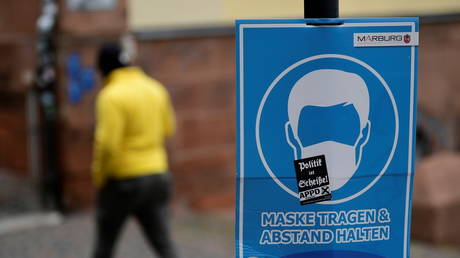
For the first time since the start of the pandemic, the number of new daily Covid cases in Germany has exceeded 60,000, according to the country’s disease control and prevention agency, the Robert Koch Institute.
Authorities fear that in reality the figure is even higher, as not all cases are immediately reported or detected. Just a week ago, the number of daily infections across Germany surpassed the 50,000 mark.
Among the country’s Covid hotspots are Thuringia, Saxony and Bavaria. In the latter region, hospitals are so overwhelmed with Covid patients that they have had to put off any non-emergency surgery.
Against this grim backdrop, lawmakers in the Bundestag on Thursday backed a new set of measures aimed at containing the spread of the disease. The package was proposed by Germany’s Social Democrats, the Green and Free Democratic parties, which are expected to form a new coalition government as early as next week.
If passed by the upper house, the rules would include mandatory daily Covid testing for employees of, and visitors to, care homes, regardless of vaccination status. Germans would also be required to show proof of full vaccination, recovery or a fresh negative Covid test in order to enter their workplace or use public transport.
On top of that, those caught selling and forging fake certificates and tests could face up to five years behind bars. Just like the Covid regulations currently in place, the new plan gives some leeway to regional authorities in terms of restrictions so that, for instance, the banning of recreational, cultural, and sporting events will be at their discretion. However, things like travel bans, curfews and massive closures of businesses would now be off-limits to local government.
The stars of the Harry Potter films will reunite for a 20-year anniversary special on HBO, minus author JK Rowling. Fans and commenters wondered if Rowling’s absence had anything to do with her views on transgender issues.
‘Harry Potter and the Sorcerer’s Stone’ premiered 20 years ago this week, catapulting actors Daniel Radcliffe, Rupert Grint, and Emma Watson to superstardom. Warner Bros announced on Tuesday that the three stars – as well as a whole range of supporting actors from the franchise – will travel back to Hogwarts for an “enchanting making-of story” airing on New Year’s Day, entitled ‘Harry Potter 20th Anniversary: Return to Hogwarts’.
Conspicuously absent from the production is author JK Rowling. A Warner Bros’ press release made no mention of Rowling, and a lengthy Instagram post by actress Emma Watson thanked fans and fellow cast members, but also made no mention of Rowling, whom other Harry Potter actors said they “owe everything” to.
Rowling’s PR team did not comment on the author’s absence, and the Hollywood Reporter claimed that the author will only appear in the show in archival footage.
Commentators online reckoned that Rowling had been canceled from the retrospective special due to her high-profile clashes with transgender activists. A self-described feminist, Rowling has spoken out against gender-neutral language, arguing that it “erases” the concept of sex and therefore the concept of womanhood. She has also stated that sex is a binary concept, and argued against gender-neutral bathrooms, claiming that by allowing men into women’s bathrooms, women are made less safe.
If I owed my entire career to 1 person, if I’d known her since I was 8, if I was worth $90m because of her, then not only would I defend her when maligned but I would refuse to take part in any reunion that excluded her. But that’s just me. #JKRowlinghttps://t.co/0ay5mhQ1FE
I can’t believe they’re actually shunning JK Rowling
“No you can’t participate in something celebrating the world you made because we are the new Amish but with more Puritan soul and no redeeming features”.
Rowling’s comments on gender issues generated intense backlash from LGBT organizations, and death and rape threats from the most zealous transgender ideologues online. Actors Daniel Radcliffe and Emma Watson also both spoke out against Rowling’s defense of biological sex last year, with Radcliffe declaring that “transgender women are women,” and apologizing to upset fans “for the pain [Rowling’s] comments have caused you.”
“Trans people are who they say they are and deserve to live their lives without being constantly questioned or told they aren’t who they say they are,” Watson chimed in.
Rowling has repeatedly stated that she is against anti-trans discrimination, but would not change her position on sex. “I refuse to bow down to a movement that I believe is doing demonstrable harm in seeking to erode ‘woman’ as a political and biological class and offering cover to predators like few before it,” she wrote last year.
Think your friends would be interested? Share this story!
The European Union’s top court has ruled that Hungary’s 2018 law aimed at criminalizing aiding illegal immigrants who are claiming asylum violates the “rights safeguarded” by the bloc’s legislature.
The Hungarian legislation, passed in 2018, sought to punish anyone “facilitating illegal immigration” with a year in prison, under a bill dubbed the “Stop Soros” law. Hungary’s government justified it at the time by arguing that migrants illegally entering the country threatened its national security.
In the ruling, handed down on Tuesday, the European Court of Justice declared that “criminalizing such activities impinges on the exercise of the rights safeguarded by the EU legislature in respect of the assistance of applicants for international protection.”
The EU’s advocate general, Athanasios Rantos, had urged the court to make such a judgement back in February, claiming the introduction of the legislation meant that “Hungary has failed to fulfil its obligations under the [bloc’s] Procedures Directive.”
It became known as the Stop Soros law after billionaire philanthropist George Soros became a vocal opponent of the Hungarian government’s opposition to migration. The administration, in turn, accused Soros of orchestrating migration to Europe, with the Open Society Foundation, run by the philanthropist, closing its operation in the country in response.
Hungary, under the leadership of right-wing Prime Minister Viktor Orban, has repeatedly clashed with the EU in recent years over its strong stance on immigration and concerns from the bloc about threats to the rule of law in the country.
At the end of 2020, a dispute between Hungary and Poland and the EU risked derailing the bloc’s budget, as both member states were threatening to veto it over their view that the EU was attempting to interfere in their domestic affairs. Ultimately, the EU backed down, agreeing to a compromise with Budapest and Warsaw to ensure the budget secured the support of all 27 member states.
Despite acknowledging the EU court’s ruling, Hungary’s government defended its right to challenge any foreign-funded non-government organizations that are attempting to “promote migration.”
“Hungary’s position on migration remains unchanged: Help should be taken where the problem is, instead of bringing the problem here,” Hungarian government spokesperson Zoltan Kovacs said, adding that the country will challenge outside entities “seeking to gain political influence and interference.”
Think your friends would be interested? Share this story!