Brazil’s former President Luiz Inacio Lula da Silva has said he is willing to stand as a candidate in elections against incumbent leader Jair Bolsonaro, labelling his potential opponent “a poor copy of Trump.”
Speaking in Brussels at a media conference in the European Parliament on Monday, Lula announced that the Workers Party needs to put forward a presidential candidate to take over from right-wing Bolsonaro in 2022 and said he was willing to run in the elections again.
“I’m willing, I’m motivated, I’m in good health,” Lula stated, adding that said he would only make his decision early next year, some months before the election scheduled for October 2022. The popular leftist said his candidacy would depend on whether the party wanted him.
“We need to have someone who stands, we need to win the elections. And at the same time, we have to rebuild Brazil,” he said, speaking on behalf of his Workers Party.
Lula, 76, also took aim at the incumbent president. “He’s a poor copy of Trump. But Bolsonaro doesn’t think, he doesn’t have any ideas,” the former president said, claiming the incumbent leader was hellbent on ensuring the beneficial legacies of Lula’s administration were “torn down.”
A recent poll put him 27 points ahead of Bolsonaro, despite his candidacy not officially being announced.
In 2010, Lula made way for his protégé, Dilma Rousseff. Rousseff was ousted from power in what was described by her supporters as a parliamentary coup. Lula served nearly two years in prison after being convicted on money laundering and corruption, despite a nine-and-a-half-year sentence. He was also barred from running in the 2018 election.
A number of judges have subsequently ruled that the case against Lula was unlawful and the Supreme Court annulled his earlier convictions, meaning he can face off against Bolsonaro in 2022.
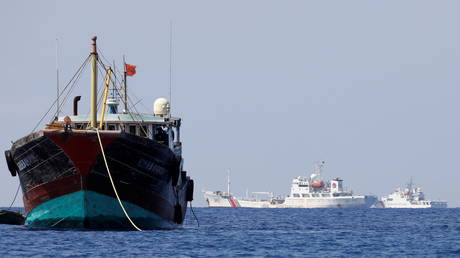
The Philippine government has accused the Chinese Coast Guard of unleashing water cannon on two supply ships in a disputed stretch of the South China Sea, claiming its boats were blocked and forced to turn around.
Manila’s Department of Foreign Affairs detailed the encounter in a statement on Wednesday, alleging that a pair of supply boats en route to the Ayungin Shoal – also known as the Second Thomas Shoal – were stopped by three Chinese vessels and “water cannoned” before they could reach their destination.
“Fortunately, no one was hurt; but our boats had to abort their resupply mission,” Foreign Affairs Secretary Teodoro Locsin said, adding that the department had conveyed its “outrage, condemnation and protest of the incident” to Beijing’s envoy to the Philippines, Huang Xilian.
The acts of the Chinese Coast Guard vessels are illegal. China has no law enforcement rights in and around these areas. They must take heed and back off.
Though both China and the Philippines claim territorial rights to the Ayungin Shoal, The Hague’s Permanent Court of Arbitration ruled in the latter country’s favor in 2016. And despite Chinese objections, the Philippines has occupied the area for much longer, after its military purposely grounded a naval vessel on the shoal in 1999.
[3] I reminded China that a public vessel is covered by the Philippines-United States Mutual Defense Treaty.
Manila was also quick to note that the supply ships are “covered by the Philippines-United States Mutual Defense Treaty,” a pact inked with Washington in 1951 that calls for a US military response to any attack on the country, including “island territories under its jurisdiction in the Pacific Ocean, its armed forces, public vessels or aircraft.”
Beijing so far has not commented on the alleged run-in.
Think your friends would be interested? Share this story!
The Philippine government has accused the Chinese Coast Guard of unleashing water cannon on two supply ships in a disputed stretch of the South China Sea, claiming its boats were blocked and forced to turn around.
Manila’s Department of Foreign Affairs detailed the encounter in a statement on Wednesday, alleging that a pair of supply boats en route to the Ayungin Shoal – also known as the Second Thomas Shoal – were stopped by three Chinese vessels and “water cannoned” before they could reach their destination.
“Fortunately, no one was hurt; but our boats had to abort their resupply mission,” Foreign Affairs Secretary Teodoro Locsin said, adding that the department had conveyed its “outrage, condemnation and protest of the incident” to Beijing’s envoy to the Philippines, Huang Xilian.
The acts of the Chinese Coast Guard vessels are illegal. China has no law enforcement rights in and around these areas. They must take heed and back off.
Though both China and the Philippines claim territorial rights to the Ayungin Shoal, The Hague’s Permanent Court of Arbitration ruled in the latter country’s favor in 2016. And despite Chinese objections, the Philippines has occupied the area for much longer, after its military purposely grounded a naval vessel on the shoal in 1999.
[3] I reminded China that a public vessel is covered by the Philippines-United States Mutual Defense Treaty.
Manila was also quick to note that the supply ships are “covered by the Philippines-United States Mutual Defense Treaty,” a pact inked with Washington in 1951 that calls for a US military response to any attack on the country, including “island territories under its jurisdiction in the Pacific Ocean, its armed forces, public vessels or aircraft.”
Beijing so far has not commented on the alleged run-in.
Think your friends would be interested? Share this story!
China has accused the Philippines of breaching its territory, saying two supply ships were blocked by Beijing’s coast guard as they approached a disputed shoal. Manila protested over the run-in, citing its own claim to the area.
The two Philippines vessels “trespassed” into waters near the Nansha island chain – also known as the Spratly Islands – on November 16, Foreign Ministry spokesman Zhao Lijan told reporters on Friday, noting that they entered the area “without China’s consent.”
“Chinese coast guard vessels performed official duties in accordance with law and upheld China’s territorial sovereignty and maritime order,” Zhao said, adding that the area is now “generally tranquil” and that the two countries are in communication about the encounter.
The comments from Beijing come just one day after Manila first publicized the incident, with the Philippines Foreign Affairs Secretary Teodoro Locsin claiming Chinese vessels fired water cannon on the two supply boats and forced them to abandon their mission near a disputed shoal in the Spratlys. He called on China to “back off” and “take heed” of Philippines claims to the region.
While both countries regard the Ayungin shoal – alternatively referred to as the Second Thomas or Renai Jiao shoal – as their own territory, The Hague’s Permanent Court of Arbitration settled the dispute in the Philippines’ favor in 2016. However, despite that ruling, as well as the fact that Manila has maintained a presence on the shoal since 1999, Beijing has not abandoned its claims to the area.
An exoplanet some 70% the mass of Jupiter and about 1.4 times its size has been discovered by astronomers at India’s Physical Research Laboratory (PRL). The behemoth is 752 light years away from Earth, and has an incredible orbit.
The new discovery was revealed by the Indian Space Research Organization on Tuesday in a statement saying the country’s PRL Advanced Radial-velocity Abu-sky Search (PARAS) had measured the movements of the newly-discovered exoplanet between December 2020 and March 2021.
The planet, named either HD 82139 or TOI 1789 depending on which cataloguing method is used, is ultra-hot – with a surface temperature up to 2,000 degrees Kelvin.
India’s PRL Advanced Radial-velocity Abu-sky Search (PARAS), an optical fiber-fed spectrograph, observed t he exoplanet and its movements from the Mt. Abu Observatory, according to the space agency. Not only is the planet ultra-hot, but it is also one of the closest to an orbiting star yet discovered.
The measurements obtained via PARAS were confirmed by Germany’s TCES spectrograph in April, and further verified by independent photometric observations from the PRL’s 43cm telescope, also located at Mt. Abu.
The exoplanet has an unusually quick orbit – a mere 3.2 days. The pace indicates that its distance from its host star is one-tenth the distance between Mercury and the Sun. This makes the exoplanet one of fewer than 10 such solar systems discovered thus far. Given the closeness to its host star – an aging orb 1.5 times the mass of the Sun – the new planet is also one of the lowest density planets yet discovered.
Planets so close to their host stars, with a distance less than 0.1 AU and masses between 0.25 to several times the mass of Jupiter, are known as “hot-Jupiters.”
The Indian space agency hailed the detection of the new planet as an opportunity to “enhance our understanding of various mechanisms responsible for inflation in hot-Jupiters and the formation and evolution of planetary systems around evolving and aging stars.” It is the second planet to be discovered by PARAS, with a previous discovery taking place in 2018.
Taiwan’s president unveiled the country’s combat wing of advanced US-made F-16 fighters in a ceremony on Thursday, showing its new Air Force capabilities against mainland China.
The event, held at an air base in the southern Taiwanese city of Chiayi, saw the island commission the first combat wing of F-16 fighters, developed with US support.
The F-16 upgrades, costing T$110 billion (USD$3.95 billion), have been jointly completed by American manufacturer Lockheed Martin Corp and Taiwan’s Aerospace Industrial Development Corp.
Taiwan’s leader, Tsai Ing-wen, touted the new F-16s as ensuring that the island’s defenses would be “even stronger” in the face of increased tensions with China.
In October, Beijing sent a record 150 warplanes into Taiwan’s air defense identification zone (ADIZ) in four straight days of incursions. Over the past year, China’s Air Force has increased military activity in and around Taiwan’s ADIZ, according to Taipei.
Despite Taipei claiming it does not want to provoke a confrontation with China, the island’s president pledged that it will “do whatever it takes to defend itself.”
China has rejected claims that it is provoking conflict in Taiwan, which it sees as an integral part of its country, accusing America of “inflating” the island separatist movement, firmly stating that “Taiwan independence” is a dead end and Beijing will “take all steps” to ensure the island remains under its control. In recent years, China has become increasingly assertive about reuniting its wealthy island neighbor with the mainland.
The successful F-16 development process has been seen by Taiwan as the latest visible sign of the military partnership between Washington, DC and Taipei. Back in 2019, America approved an $8 billion sale of F-16s to Taiwan, which would bring the total number of jets in the island’s fleet to 200.
During the event, the Taiwanese president praised America for remaining steadfast in its cooperation with the island despite opposition from China. “As long as we adhere to the values of democracy and freedom, there will be more like-minded countries standing on the same front with us,” Tsai said alongside US diplomat Sandra Oudkirk.
In 2019, after the US and Taiwan agreed to upgrade the F-16 fighter jets, then-Foreign Ministry spokesperson Geng Shuang threatened to sanction American firms unless the deal was halted. Beijing opposed the military partnership between Taipei and Washington, DC, arguing that the sale violated international law, harmed relations between the countries, and breached the One China policy, which America recognizes.
Think your friends would be interested? Share this story!
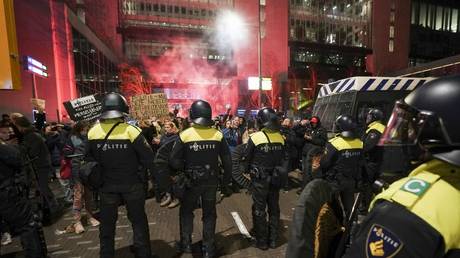
Truckers and other motorists have been trapped in a four-mile-long traffic jam on the outskirts of the Dutch city of Rotterdam amid a protest against the government’s Covid measures.
According to local media, as many as 200 activists blocked the gates of a major port in the city’s harbor on Thursday. For several hours, they prevented any vehicles from driving in and out of the cargo hub, which, in turn, led to massive traffic congestion on the highway leading to the port. Police engaged in negotiations with the protesters, who eventually relented and left the site later in the evening.
The group behind the protest action is reportedly Dockers United, who are staunchly opposed to government Covid policies. The organization’s biggest concern is that authorities could soon make it mandatory for employees to have a vaccination or recovery certificate to enter the workplace, which, as the group argues, would be tantamount to excluding people from society on an “unconstitutional basis.” They are also generally unhappy with the curbs introduced by the Dutch government, with ‘Don’t normalize what’s not normal’ being a translation of one of their slogans.
In fact, the Dutch government did announce earlier this month that it was working on introducing a ‘corona pass’ for the workplace, though it isn’t clear yet when this measure will be rolled out and how strict it will be.
Meanwhile, on Friday the EU country logged its highest-ever number of new Covid cases within 24 hours, with that figure reaching 23,591. Medics say they are working at capacity.
Amid the spike, the Dutch prime minister imposed a partial lockdown last Saturday, which requires bars, restaurants, cafes and supermarkets to close at 8pm, while shops selling non-essential goods are to shut by 6pm. Public gatherings are banned altogether.
Libyan military commander Khalifa Haftar is set to challenge Gaddafi’s son for the top job, announcing his presidential bid. The election will take place on December 24.
“I declare my candidacy for the presidential election, not because I am chasing power but because I want to lead our people towards glory, progress and prosperity,” the de facto leader of Eastern Libya said in a televised speech.
Haftar added that the election is the only way out of the severe crisis the country has been plunged into.
The announcement was expected; in September, Haftar announced that he was temporarily stepping down as head of the force known as the Libyan National Army, fulfilling the requirement for presidential hopefuls to suspend public work three months before an election.
Haftar will run against the son of former leader Muammar Gaddafi, Saif al-Islam Gaddafi, who represents the Popular Front for the Liberation of Libya.
Haftar’s presidential bid is likely to anger many who consider him a war criminal responsible for the indiscriminate killing of civilians during his military campaign. A number of civil lawsuits have been filed against him in a US federal court for alleged war crimes. Haftar has both US and Libyan citizenship, and owns property in Virginia.
Following years of civil war and political chaos after the NATO-backed intervention that saw Muammar Gaddafi deposed and brutally murdered, the upcoming election is widely viewed as an opportunity for political settlement and the long-awaited unification of the country, divided now between Haftar’s forces and the Tripoli-based Government of National Accord. However, there is still no consensus on the legal grounds for the election, which could become an obstacle for the peace process.
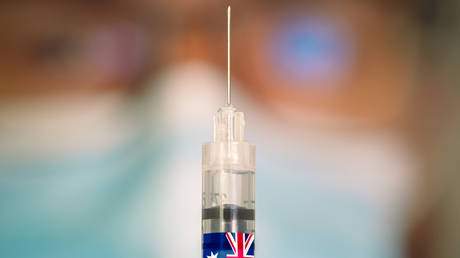
Australia’s government could be forced to spend tens of millions in payouts after receiving more than 10,000 compensation claims from people who suffered side effects and loss of income due to Covid-19 vaccines.
Under its no-fault indemnity scheme, eligible claimants can apply for compensation amounts between AU$5,000 (US$3,646) to AU$20,000 (US$14,585) to cover medical costs and lost wages as a result of being hospitalized after getting the shot. The scheme’s online portal is scheduled to be launched next month.
Official figures suggest, however, that over 10,000 people have already indicated their intention to make a claim since registration opened on the health department’s website in September. If each claim was approved, the government could face a bill of at least AU$50 million (US$36.46 million).
There were around 78,880 adverse events to Covid-related vaccination in Australia as of November 7, according to the Therapeutic Goods Administration, which regulates national health products. The majority of side effects were minor, including headaches, nausea, and arm soreness.
Only people who experienced a moderate to significant adverse reaction that resulted in a hospital stay of at least one night are eligible for coverage under the government’s scheme. Those seeking $20,000 or less have to provide proof their claims are vaccine-related – although there has been no information as yet on exactly what evidence would be acceptable.
“Adverse events, even though they happen to a tiny proportion of people, for the people it does impact it’s really quite devastating,” Clare Eves, the head of medical negligence at injury compensation firm Shine Lawyers, told the Sydney Morning Herald.
Among the adverse reactions covered are the blood clotting disorder “thrombosis with thrombocytopenia syndrome (TTS)” linked to the AstraZeneca vaccine and the “myocarditis and pericarditis” heart conditions associated with the Pfizer vaccine. Other reportedly accepted side effects are Guillain-Barré syndrome, a rare neurological condition, and immune thrombocytopenia (excessive bleeding due to low platelet levels).
Claims for over $20,000, including those for vaccine-related deaths, will be assessed by an independent legal panel of legal experts and compensation paid on its recommendations. Nine people have reportedly died after an adverse reaction to one of the three vaccines in the country.
Eves told the Morning Herald that her firm was representing a number of litigants over the vaccine side effects, including several who are not eligible for the scheme.
The Philippine government has accused the Chinese Coast Guard of unleashing water cannon on two supply ships in a disputed stretch of the South China Sea, claiming its boats were blocked and forced to turn around.
Manila’s Department of Foreign Affairs detailed the encounter in a statement on Wednesday, alleging that a pair of supply boats en route to the Ayungin Shoal – also known as the Second Thomas Shoal – were stopped by three Chinese vessels and “water cannoned” before they could reach their destination.
“Fortunately, no one was hurt; but our boats had to abort their resupply mission,” Foreign Affairs Secretary Teodoro Locsin said, adding that the department had conveyed its “outrage, condemnation and protest of the incident” to Beijing’s envoy to the Philippines, Huang Xilian.
The acts of the Chinese Coast Guard vessels are illegal. China has no law enforcement rights in and around these areas. They must take heed and back off.
Though both China and the Philippines claim territorial rights to the Ayungin Shoal, The Hague’s Permanent Court of Arbitration ruled in the latter country’s favor in 2016. And despite Chinese objections, the Philippines has occupied the area for much longer, after its military purposely grounded a naval vessel on the shoal in 1999.
[3] I reminded China that a public vessel is covered by the Philippines-United States Mutual Defense Treaty.
Manila was also quick to note that the supply ships are “covered by the Philippines-United States Mutual Defense Treaty,” a pact inked with Washington in 1951 that calls for a US military response to any attack on the country, including “island territories under its jurisdiction in the Pacific Ocean, its armed forces, public vessels or aircraft.”
Beijing so far has not commented on the alleged run-in.
Think your friends would be interested? Share this story!