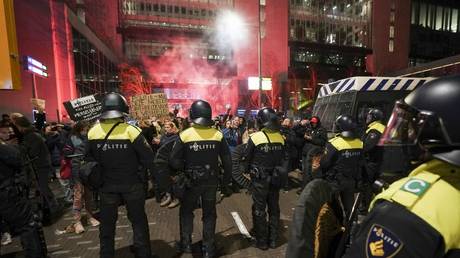
Truckers and other motorists have been trapped in a four-mile-long traffic jam on the outskirts of the Dutch city of Rotterdam amid a protest against the government’s Covid measures.
According to local media, as many as 200 activists blocked the gates of a major port in the city’s harbor on Thursday. For several hours, they prevented any vehicles from driving in and out of the cargo hub, which, in turn, led to massive traffic congestion on the highway leading to the port. Police engaged in negotiations with the protesters, who eventually relented and left the site later in the evening.
The group behind the protest action is reportedly Dockers United, who are staunchly opposed to government Covid policies. The organization’s biggest concern is that authorities could soon make it mandatory for employees to have a vaccination or recovery certificate to enter the workplace, which, as the group argues, would be tantamount to excluding people from society on an “unconstitutional basis.” They are also generally unhappy with the curbs introduced by the Dutch government, with ‘Don’t normalize what’s not normal’ being a translation of one of their slogans.
In fact, the Dutch government did announce earlier this month that it was working on introducing a ‘corona pass’ for the workplace, though it isn’t clear yet when this measure will be rolled out and how strict it will be.
Meanwhile, on Friday the EU country logged its highest-ever number of new Covid cases within 24 hours, with that figure reaching 23,591. Medics say they are working at capacity.
Amid the spike, the Dutch prime minister imposed a partial lockdown last Saturday, which requires bars, restaurants, cafes and supermarkets to close at 8pm, while shops selling non-essential goods are to shut by 6pm. Public gatherings are banned altogether.
The annual migration of red crabs has brought traffic to a standstill on an Australian island. Apart from the epic journey, the species is also notorious for eating its own young.
Tens of millions of crustaceans are swarming Canberra-governed Christmas Island, which is almost a thousand miles northwest of the Australian mainland. Parks Australia, a government body in charge of wildlife conservation on the island, has deployed its staff to manage traffic, rake crabs off roads and provide advisories to local residents regarding road closures. Authorities are well-prepared to deal with the epic crab march as it repeats every year, usually in October and November. There are even special bridges and tunnels in place, built over and under busy roads so as to minimize the number of crabs crushed by cars. The sight of millions of these creatures making their perilous trek has become one of Christmas Island’s main tourist attractions.
The exact timing of the red crabs’ journey from forest to ocean is defined by rainfall and lunar phases. The march is led by male crabs, which are later joined by females. On reaching the ocean, they mate and spawn, with each female capable of producing as many as 100,000 eggs. However, most of the young crabs never make it back to the forest as they end up being eaten by fish and whale sharks for whom this is a veritable feast. To make matters worse, the crab larvae that do make it to the beach are often devoured by returning adult crabs of the very same species, hence one of their names – the cannibal crab.
France has imposed a curfew on its overseas territory of Guadeloupe and is sending extra police to the island, citing days of “violence,” unrest and vandalism in response to harsh pandemic restrictions.
“Given the ongoing social unrest and acts of vandalism, the prefect of Guadeloupe has decided to establish a curfew starting today from 6pm to 5am,” Alexandre Rochatte, who represents the archipelago as prefect, said on Friday.
Earlier on Friday, the French Interior Ministry noted that 200 French police officers and gendarmes would be shipped into Guadeloupe in the coming days to crack down on the “violence” and “restore republican order.”
The move comes after nearly a week of heated protests over local Covid-19 policies – which include mandatory vaccinations for healthcare staff and other ‘essential’ workers, among other things. Demonstrators have torched cars and erected burning barricades in the streets, while doctors, firefighters and other professionals have walked off their jobs in protest, according to Reuters.
Barrages incendiées et affront*ments cette nuit en #Guadeloupe où la grève générale illimitée, enclenchée contre le pass sanitaire et l’obligation vaccinale exprime désormais une colère plus large contre les problématiques sociales, économiques et environnementales de l’île. pic.twitter.com/gXToww1gXZ
In footage circulating online earlier this week, men purported to be protesting firefighters were seen soaking police with a water hose hooked up to a nearby fire hydrant. Officers quickly shut off the spigot.
A firefighter sprinkles the gendarmes during the evacuation of a dam in #Guadeloupe where an unlimited general strike began today against the health pass and compulsory vaccination under penalty of suspension but also to denounce other problems of the territory . pic.twitter.com/lDtDkMx4YZ
As in mainland France, residents are also required to present proof of vaccination, a negative PCR test or show they recently recovered from the virus in order to enter a number of public establishments, including restaurants and museums.
Those policies have proven unpopular for many locals, with trade unions launching indefinite strikes in protest over the past week, joined by other residents in street demonstrations.
A cleaner for Israel’s defense minister has been accused of espionage after allegedly offering to place malware on his boss’ household computer for an Iran-linked hacking group.
In a statement on Thursday, the Shin Bet security service said that Omri Goren, a housekeeper for Defense Minister Benny Gantz, and a former bank robber according to Israeli media, corresponded with an unnamed person over social media shortly before his arrest.
Goren reached out earlier this month to “a figure affiliated with Iran and offered to help him in different ways, in light of his access to the minister’s home,” the statement read, according to the Times of Israel.
It is understood that Goren offered to spy and place malware on Gantz’s computer on behalf of a hacking group, reportedly called ‘Black Shadow’ and associated with Iran, Tel Aviv’s perennial enemy. It is also said that he provided photos of Gantz’s residence to prove he had access.
A Central District prosecutor filed espionage charges against Goren on Thursday. If convicted, the accused could face a sentence of between 10 and 15 years, according to the Times of Israel.
The 37-year-old Lod resident has previously served four prison sentences, the most recent of which was for four years. Goren was found guilty of five crimes between 2002 to 2013, two of the convictions were for bank robbery.
The Shin Bet said they would review their processes for staff background checks “with the goal of limiting the possibility of cases like this repeating themselves in the future.”
Speaking on Kan public radio, Gal Wolf, the attorney representing Goren, suggested his client had intended to extract money from the Iranians without carrying out any spying.
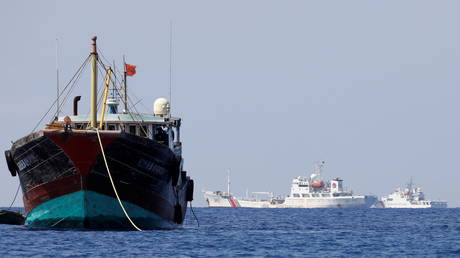
China has accused the Philippines of breaching its territory, saying two supply ships were blocked by Beijing’s coast guard as they approached a disputed shoal. Manila protested over the run-in, citing its own claim to the area.
The two Philippines vessels “trespassed” into waters near the Nansha island chain – also known as the Spratly Islands – on November 16, Foreign Ministry spokesman Zhao Lijan told reporters on Friday, noting that they entered the area “without China’s consent.”
“Chinese coast guard vessels performed official duties in accordance with law and upheld China’s territorial sovereignty and maritime order,” Zhao said, adding that the area is now “generally tranquil” and that the two countries are in communication about the encounter.
The comments from Beijing come just one day after Manila first publicized the incident, with the Philippines Foreign Affairs Secretary Teodoro Locsin claiming Chinese vessels fired water cannon on the two supply boats and forced them to abandon their mission near a disputed shoal in the Spratlys. He called on China to “back off” and “take heed” of Philippines claims to the region.
While both countries regard the Ayungin shoal – alternatively referred to as the Second Thomas or Renai Jiao shoal – as their own territory, The Hague’s Permanent Court of Arbitration settled the dispute in the Philippines’ favor in 2016. However, despite that ruling, as well as the fact that Manila has maintained a presence on the shoal since 1999, Beijing has not abandoned its claims to the area.
The Chinese envoy to the European Union has reiterated Beijing’s goal of peacefully reuniting Taiwan with the mainland but stated the country’s preparedness to use “decisive measures.”
Speaking on Tuesday, China’s ambassador to the EU, Zhang Ming, said Beijing would never change its position on Taiwan. “If anything changes, it is that the Chinese people’s resolve to realize complete reunification of our country grows even stronger,” Ming told an online think tank event in Brussels.
“Some people in Europe seem to underestimate the Chinese people’s aspiration for a reunification of our country,” he added, noting also that the bloc must lift its sanctions if a new Sino-EU investment deal is to be ratified.
In May, Brussels halted an investment pact agreed with China last December, after Beijing imposed sanctions on several members of the European Parliament. The EU responded, introducing its own sanctions related to the treatment of the Uyghur people and alleged genocide in Xinjiang.
In recent years, China has become increasingly assertive about reuniting its wealthy island neighbor with the mainland. Beijing claims Taiwan is an inalienable part of the country and has called on Western parties to refrain from interfering in Chinese internal affairs. Western nations, notably the US and UK, have shown willingness to defend the democratic island.
Taiwan considers itself to be independent of China since 1949 when the communist forces overthrew the government of the Republic of China on the mainland, forcing the Kuomintang-ruled state to relocate there.
Czechia will prohibit people who have not been vaccinated from entering public spaces such as restaurants and shops from Monday. Negative Covid-19 tests will no longer be allowed.
Speaking on Wednesday, outgoing Prime Minister Andrej Babis said the country would adopt the so-called Bavarian model from Monday next week, prohibiting those who have not received a Covid-19 vaccine from entering public places. Those who have recently recovered from the virus will be allowed entry.
The country will enter a partial lockdown of the unvaccinated from Monday morning, assuming the restrictions are approved by the cabinet on Thursday.
“We will introduce the Bavarian model from Sunday to Monday. This means that entry to restaurants, service establishments, or mass events will only be allowed for vaccinated or survivors. Those vaccinated with a single dose must have a PCR test,” Babis said on local TV.
The prime minister said that self-testing would be completely cancelled, as he lamented unvaccinated people for clogging up hospitals and preventing treatment reaching those with other illnesses.
“The death toll is rising; the situation is serious. Vaccination is the only solution, there is no other,” he added.
The country is seeing a spike in infections, with a record 22,479 new cases reported on Tuesday.
The Bavarian model refers to strict anti-Covid measures introduced in the southern German state. Markus Soder, the state’s premier, claimed there was no choice but to implement “a kind of lockdown for the unvaccinated,” citing increasing pressure on hospitals and medical staff.
Meanwhile, some two million people in Austria who are yet to receive their Covid shots have been subject to the world’s first lockdown for the unvaccinated, in an effort to bring case numbers down.
While 68% of people are vaccinated in Germany, and 65% in Austria, just over 60% are vaccinated in the Czech Republic.
French President Emmanuel Macron has dismissed the possibility of locking down unvaccinated people in France, claiming the move would not be necessary because of the success of the Covid-19 ‘health pass’.
Speaking to La Voix du Nord newspaper in an interview published on Thursday, Macron said there was no need for France to follow Austria’s lead by locking down its unvaccinated citizens.
“Those countries locking down the non-vaccinated are those which have not put in place the [health] pass. Therefore, this step is not necessary in France,” Macron claimed.
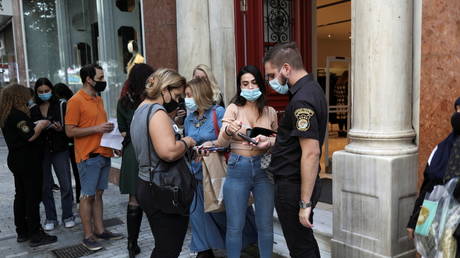
The president’s health pass, which was the target of much criticism when it was introduced, requires people to provide proof of vaccination or a recent negative test before undertaking certain normal activities.
The ‘Pass Sanitaire’ is required if citizens wish to go to restaurants, cafes, cultural venues, or cinemas. It’s also required to take long-distance trains, among other activities.
Austria has led the way by starting a partial lockdown of the unvaccinated amid a surge in Covid-19 cases. The Czech Republic will follow suit next week, while Germany decided on Thursday to introduce similar measures in areas where Covid incident rates exceed the threshold.
Earlier in November, Macron made the continued use of the Covid health pass for over 65s dependent on getting a booster jab.
Some 20,366 new infections were registered in the last 24-hour recording period. Case numbers have risen steeply in recent weeks.
An Argentinian woman has become the second-ever HIV-infected person whose immune system helped defeat the virus without requiring additional medical treatment. She was first diagnosed with the AIDS-causing infection in 2013.
Scientists have dubbed the 30-year-old mother the “Esperanza patient,” after her hometown. The word ‘esperanza’ translates to ‘hope’ in English. Publishing their findings in the Annals of Internal Medicine journal on Monday, the researchers said the discovery boosts hope for a “sterilizing cure” for the estimated 38 million people with the life-long infection.
“I enjoy being healthy,” the Esperanza patient told NBC News over email. “I have a healthy family. I don’t have to medicate, and I live as though nothing has happened. This already is a privilege.”
The study found no intact remnants of the virus in the 1.5 billion blood and tissue cells the researchers analyzed – confirming the discovery first announced in March at an international meeting of HIV experts.
No additional information about the woman has been made public, but she was described at the time as “athletic and beautiful” and revealed to have an HIV-negative boyfriend and newborn baby.
Only one other person, identified in August 2020 as 67-year-old Loreen Willenberg from San Francisco, has been confirmed to have overcome the virus without medical intervention. The two women have been labeled ‘elite controllers’, referring to a rare subset of HIV patients who show no signs of the infection despite not undergoing antiretroviral treatments.
Typically, an HIV-infected person requires constant drug therapy to prevent the virus from attaching to their immune cells’ DNA and replicating. But, in the eight years since she was diagnosed, the Esperanza patient only received medication for six months during pregnancy to ensure her baby would be healthy.
In all, there have been four patients cured of HIV, two of whom – the ‘Berlin patient’ Timothy Ray Brown and the ‘London patient’ Adam Castillejo – were also cancer patients who received risky bone marrow transplants from donors with HIV-resistant genes. However, the success of their procedures is yet to be replicated.
“This is really the miracle of the human immune system that did it,” Dr. Xu Yu, an immunologist at the Ragon Institute in Boston, who co-authored the study, told NBC.
The EU Commission has released draft legislation aimed at tackling the destruction of woodland by introducing import restrictions on products not certified as ‘deforestation-free’.
The draft proposal, which the commission hopes will become binding rules for all member states, seeks to limit the import of beef, cocoa, coffee, palm, soy, and wood if it is not proven “deforestation-free.”
Outlining the legislation, the EU commissioner for climate action policy, Virginijus Sinkevicius, called it a “ground-breaking” proposal that will help fight “illegal deforestation” and “deforestation driven by agricultural expansion.”
Our proposal to fight deforestation will help us protect 1/3 of 🌎 lands.
We don’t only target illegal deforestation but 𝙖𝙡𝙡 deforestation driven by agricultural expansion.
We start with 6 products that must be deforestation-free 👉🏼 beef, wood, palm oil, soya, coffee, cocoa. pic.twitter.com/Cs9POoydNX
The bill comes after nations at the COP26 summit agreed to work to end deforestation by 2030. It would impose two criteria on imports, requiring items to have been produced in accordance with the origin country’s laws, and not on land that has been deforested or degraded since the start of 2021.
It is not clear when the rules would come into effect; legislative proposals by the commission have to be debated and considered by both the EU Parliament and the Council of the EU before they are passed. The implementation of measures could potentially impact the EU’s trade relations with countries like Brazil, where clearing of the Amazon rainforest hit a new record in October.
During the recent COP26 climate summit, 110 world leaders – whose countries contain around 85% of the world’s woodland – committed to ending and reversing deforestation by 2030, pledging around £14 billion ($18.84 billion) of public and private funds towards the goal.