A stream literally flowing with booze emitting a strong beery odor has been discovered in one of the tropical islands of Hawaii. Its waters have been apparently contaminated with alcohol after a leak at a beverage warehouse.
A small river with a distinctive alcoholic smell was recently found on the island of Oahu, some 15 miles (24 kilometers) away from Honolulu, Hawaiian capital. Its waters have been flowing through the Waipio valley and even turned into a 100-foot (30 meters) waterfall on their way.
The stream caught the attention of local environmental activists, who noticed the smell in the area.
“The other day we came here you would think it was a beer pub that hadn’t opened its doors for three or four days,” activist Carroll Cox told local Hawaii News Now. She also contacted the Department of Health about the issue.
Local media took samples from the unusual stream and had them checked at a private laboratory. It tested positive for alcohol, containing 1.2% percent of the substance in its waters – nearly a quarter the content in regular beer and strong enough to cause a buzz.
Local health authorities got involved, and an investigation into the source of contamination was launched. It was learned that the stream was coming from a drain pipe that was traced back to a warehouse of Hawaii’s largest liquor distributor, Paradise Beverages. Its representatives told local media they were working with officials to eliminate a possible spill, with the booze river apparently closing its free drinks service.
The longest lunar eclipse in over 500 years will occur in the early hours of November 19, lasting several hours.
The peak of the partial eclipse will take place in the predawn hours on Friday when 97% of the moon will be eclipsed by the Earth’s shadow. The previous longest partial eclipse took place in 2018 and lasted less than two hours, while this will last for several hours.
LONGEST PARTIAL ECLIPSE of the CENTURY to occur in the Pre-dawn hours of November 19th. Maximum eclipse is at 4:03 AM EST when 97% of the Moon will be eclipsed. At that time it will be high in our western sky. This will also be the longest partial lunar eclipse in 580 years! pic.twitter.com/Xa9ciXLp3V
The eclipse will be visible from all 50 US states, Canada, and Mexico, as well as parts of South America, Polynesia, Australia, and China, according to NASA.
The moon will be at its farthest point from Earth during the eclipse, slowing its orbit and extending the time it takes to move out of the darkest part of the planet’s shadow, known as the umbra, as the moon, Earth, and sun will all be aligned. The Holcomb Observatory has released a video detailing what the eclipse will look like.
Movie of the “NEAR TOTAL ECLIPSE.” LONGEST PARTIAL LUNAR ECLIPSE in 580 years occurs on morning of November 19th. 1st parts of the eclipse begin at 1:02AM EST. Max eclipse occurs at 4:02 AM when 97% of MOON in darkest part of Earth’s shadow. pic.twitter.com/2HwPpqPbbd
The event will begin shortly after midnight and unlike a solar eclipse, no one will need special eyewear to view the phenomenon.
When the eclipse occurs, the moon will take on a reddish hue, with only a sliver of the actual moon visible. The event will last for several hours, making it the longest of its kind in 580 years, with the next lunar eclipse not occurring until May of 2022.
Syrian-born musician Omar Souleyman, who worked with the likes of Bjork and Damon Albarn, has been detained in Turkey over alleged links to the Kurdistan Workers’ Party, which is deemed a terrorist group by Ankara.
Souleyman was brought in for questioning on Wednesday, with officers also searching through his home in Turkey’s southeastern province of Sanliurfa, the singer’s manager said.
The arrest was likely provoked by recent reports that the musician had traveled to an area in Syria controlled by the Kurdish militias known as the YPG, he added.
The YPG have been US allies in the fight against Islamic State (IS, formerly ISIS), but Turkey considers them to be an extension of the Kurdistan Workers’ Party (PKK) and a threat to its national security.
For decades, the Workers’ Party has been fighting Turkish troops in the southeast of the country, striving for greater autonomy for the Kurdish population.
Souleyman’s son denied his father’s alleged terrorist links, saying he didn’t have any political affiliation and had become the victim of a “malicious report.” Some media outlets claimed the musician could be released from custody later on Thursday.
Coming from Syria’s majority-Kurdish province of Hasekeh, Souleyman had been known as a prolific wedding performer in his home country. But his international career skyrocketed after he moved to Turkey a decade ago, fleeing the Syrian conflict. The 55-year-old’s clips, including his top hit ‘Warni Warni’, have garnered millions of views on YouTube. He performed at the Nobel Peace Prize ceremony in 2013, as well as at many large festivals around the globe.
His unique style, which is based on mixing traditional Middle Eastern folk music with electronic sound, has attracted the attention of such stars as Bjork, Four Tet, Damon Albarn, and Diplo, who have all collaborated with Souleyman.
Extinction Rebellion has targeted Colombian diplomatic missions across several EU countries, including France and Italy, demanding that the nation address deforestation, coal mining, and indigenous peoples’ rights.
The hard-line climate activist group staged simultaneous protests outside several of Colombia’s diplomatic missions on Tuesday, calling on Bogota to protect biodiversity and stop deforestation. It also urged the country’s government to take action against the El Descanso open-pit coal mine, which is said to be threatening the Yukpa indigenous people.
The French branch of the activist group targeted the Colombian Embassy in Paris, vandalizing its entrance. Footage from the scene shows activists dousing the mission’s entrance in black paint, while plastering placards over its walls.
Action de @xrFrance a l’ambassade de Colombie à #Paris pour dénoncer l’inaction du gouvernement Colombien pour la protection de la biodiversité et des peuples indigènes. pic.twitter.com/1hpf3vVxK4
Another protest held outside Colombia’s consulate in Milan, Italy, saw that mission vandalized too. The building’s entrance was covered in fake blood, with a pile of a black substance, which looked like charcoal or coal, left by its doors.
#ATENCIÓN| Así se vive la Minga Internacional en el Consulado de Colombia en la ciudad de Milán, Italia, donde defensores del medio ambiente alzan su voz por el respeto a la vida y del territorio ancestral del Pueblo Yukpa.
— Organización Nacional Indígena de Colombia – ONIC (@ONIC_Colombia) November 16, 2021
Demonstrations also took place outside Colombia’s missions in Germany’s capital, Berlin, as well as in Madrid, Spain. Those protests appeared to be more civil, with activists rallying outside of the missions without vandalizing them.
As infections are rising again, scientists all around the world are rushing to fight the danger, offering a choice of new treatments and unusual variants of vaccines.
Levels of contagion are setting new records, hospitals are overwhelmed, governments are starting to introduce lockdowns, and not only for unvaccinated people – the picture of the fight against Covid-19 looks quite disappointing. However, there’s still a place for good news: Research teams report positive results while trialling new medicines and vaccine types.
Nasal vaccines
Vaccination will remain one of the most effective tools against Covid-19. As Professor David Dockrell, from the Center for Inflammation Research of the University of Edinburgh, told RT, “vaccines will continue to be a central part of how we control the virus.”
“If we can dampen down the number of infections, and the severity of infections, and also the extent to which the virus can replicate in people when they become infected, then we are slowing down the ability of the virus to change and to mutate,” he explains.
So I think the vaccines still will be a very important part of the preventive strategy. It’s vital that they are available to all the world’s population, irrespective of where people live, and the wealth of the country in which they live.
However, vaccination doesn’t always mean you have to get an injection. For instance, several intranasal Covid-19 vaccines are currently being developed. As the virus gets into the body through the nose, a nasal spray or drops are aimed to produce mucosal immune response and prevent it from getting into the lungs.
In India, a vaccine of this type is already completing Phase 2 of clinical trials. In Russia, a nasal vaccine is undergoing a clinical trial on volunteers. In Thailand, a home-developed product is expected to be trialed on humans next spring. In the US, Universities of Houston and Stanford recently reported good results of their experiments carried out on mice.
Intranasal vaccines can have several potential benefits compared to inoculation.
“They would be easier to use, because they can be self-administered. They wouldn’t need a nurse or clinical settings,” Swedish professor emeritus of epidemiology Marcello Ferrada de Noli explained to RT. As a result, he says, there’s hope that fewer people will be reluctant to be immunized. Not so many of us find it pleasant to get a jab – and after all, there are those who are just afraid of needles. Also, it would be much easier to vaccinate children with nasal substances.
However, what concerns Prof. de Noli the most is the duration of the effect of a vaccine of this type. Still, scientists can’t say for sure whether a nasal substance may completely replace a shot. According to Alexander Gintsburg, the head of Moscow’s Gamaleya Center biomedical research institute, which created the Sputnik V vaccine, the nasal version they are working on would serve for an additional protection against the virus, but would not replace the injections.
Chew the virus away?
A nasal vaccine is not the only one being developed. In summer, it was revealed that Russian Defense Ministry scientists were creating a ‘chewing gum’ vaccine, also targeting the mucosal immune response. Meanwhile, a UK firm announced this month that it would conduct a human trial of a skin patch that uses T-cells to confront the virus. Developers hope it would offer longer-lasting immunity than the existing vaccines. Work on a similar project is being done in the University of Queensland, Australia.
While it all looks so promising, Prof. de Noli warns that it would still take a lot of time until these products become available to the public. “I think that discoveries in this field are a very good thing. But if we say ‘We discovered a new type of vaccine’, people will say ‘Aha, so I’m going to wait’. But we need to vaccinate people now,” he points out.
Improving Covid treatment
Vaccines are not a silver bullet, unfortunately, given the not-so-high level of global immunization and the constantly emerging new strains of the virus. “People might get infected despite having had a vaccine, but I still think the vaccine strategy is going to be central to how we manage this kind of virus going forward,” Prof. Dockrell says. “But we will have other strategies that will be very important. We will have other elements. When we put them all together, it gives us the best opportunity that people can live with coronaviruses, and hopefully, the mortality can be limited to much lower extense than what we’ve sadly seen in the last eighteen months.”
Monoclonal antibodies will be central to the ongoing vaccine strategy, Prof. Dockrell explains. These are the antibodies similar to those the body uses to fight the virus. They are produced in labs and given via infusion or injection to boost the patient’s response against certain diseases. Monoclonal antibody treatment is used for people under a high risk of developing severe infection (including older patients 65+ years old or those with chronic medical conditions). It’s already being used in the US, following last year’s FDA approval. Earlier in November, the European Medicines agency recommended authorizing two monoclonal antibody medicines.
In October, UK’s AstraZeneca reported positive results of a Phase 3 study of its antibody combination, which, according to developers, is highly effective in both prevention and treatment of coronavirus.
Researchers are also working on a possibility to save Covid-infected patients from the so-called ‘cytokine storm’ – a situation when the immune system reacts so intensely that kills not only the virus, but the whole organism itself. A drug to ‘calm the storm’ was registered in Russia this year, and it’s already being used on patients.
Another way to fight Covid-19 is to use antiviral drugs. When the pandemic started, medics had to use something already existing (like anti-influenza Favipiravir) or something being authorized for emergency use (like remdesivir). Now, more than a year on, the work to create a special drug to specifically cure Covid-19 is giving its results. This month, Russia registered its first injectable anti-Covid medicine. A bit earlier, the UK became the first country to approve an antiviral pill produced by the US-based companies Merck and Ridgeback Biotherapeutics. Another American firm, Pfizer, got positive results from trials of its drug of the same kind. Both firms hope that with a drug in the form of a pill it would be easier to treat people at home.
Appreciating all the efforts on the field of developing anti-Covid treatment, Prof. de Noli points out that still, the key issue now is to reduce the spreading of the virus. “The new medicines are developed for people who already got the disease,” he says.
But we need to prevent people from getting the infection, not let them get infected because we have some new medicine that can cure them.
The same idea is echoed by scientists all over the world quoted in plenty of articles dedicated to the medical gains: it’s great to have the treatment, but none of the drugs may substitute vaccination, as first and foremost, humanity has to adopt preventive measures and stop the pandemic.
Vaccination of all Hungarian citizens against Covid-19 is inevitable, PM Viktor Orban has said, stating that even the most hardline anti-vaxxers will ultimately face a choice between dying with the virus and getting a jab.
Speaking to Kossuth radio on Friday, the Hungarian leader lashed out at those reluctant to get vaccinated against coronavirus, branding them a threat “not only to themselves but to all others.”
In the end, everyone will have to be vaccinated; even the anti-vaxxers will realize that they will either get vaccinated or die. So, I urge everyone to take this opportunity.
The EU member state is currently experiencing its fourth wave of coronavirus, Orban stated, blaming the situation on those who had not got vaccinated. “If everybody were inoculated, there would be no fourth wave or it would be just a small one,” the PM claimed.
Apart from urging the unvaccinated to go and finally get their jabs, Orban also promoted booster shots, revealing that he had already taken three doses of a coronavirus vaccine.
“The only thing that protects us from the virus is vaccination. And we are now also seeing, at least the experts are unanimous in saying, that four to six months after the second vaccination, the protective power of the vaccine weakens. Therefore, a third vaccination is justified,” he said.
Hungary has already announced new anti-Covid measures, though somewhat short of the strict measures proposed by the nation’s Medical Chamber on Wednesday. The medical body called for a blanket ban on mass events, and suggested making entry to restaurants, theaters and other indoor venues conditional on bearing a Covid-19 inoculation certificate. Instead, Budapest rolled out compulsory mask wearing for most indoor environments, as well as making booster shots mandatory for all medical workers, starting from Saturday.
A nation of 10 million, Hungary’s total tally of logged Covid cases is hovering just below the one million mark. On Friday, it registered a new daily record, with nearly 11,300 new Covid infections. More than 32,700 people in Hungary have succumbed to the disease over the course of the pandemic.
Think your friends would be interested? Share this story!
Hard-line cleric Ebrahim Raisi won Iran’s presidential election on Saturday in a move that is expected to bolster the conservative legacy of the country’s supreme leader, Ayatollah Ali Khamenei.
The decision is not expected to derail ongoing negotiations aimed at restoring the Joint Comprehensive Plan of Action (JCPOA) nuclear deal, even though Mr. Raisi himself is under US sanctions over accusations of human rights abuses. Many voters stayed away from the polls as the outcome had been predicted for months with many progressive candidates barred from running.
“The Islamic Republic has entered a post-revolutionary dynamic in which a fading revolutionary generation seeks to ensure that the rising political leadership sustains their revolutionary ideals,” says Norman T. Roule, former National Intelligence Manager for Iran at ODNI and Cipher Brief Expert. “The regime’s decision to bar so many candidates and the low turnout make this election a historic embarrassment for the regime and its supporters.”
The Cipher Brief talked with Roule about what the election means and what it doesn’t mean when it comes to relations with the west, the progressive movement within Iran and the election’s impact on the oil markets.
“The Cipher Brief has become the most popular outlet for former intelligence officers; no media outlet is even a close second to The Cipher Brief in terms of the number of articles published by formers.” – Sept. 2018, Studies in Intelligence, Vol. 62 No.
Access all of The Cipher Brief’s national-security focused expert insight by becoming a Cipher Brief Level I Member .
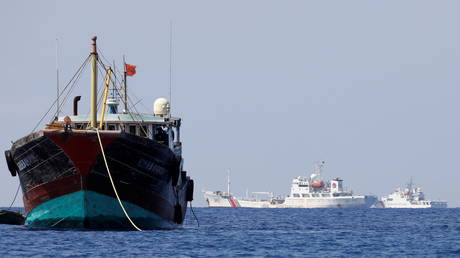
China has accused the Philippines of breaching its territory, saying two supply ships were blocked by Beijing’s coast guard as they approached a disputed shoal. Manila protested over the run-in, citing its own claim to the area.
The two Philippines vessels “trespassed” into waters near the Nansha island chain – also known as the Spratly Islands – on November 16, Foreign Ministry spokesman Zhao Lijan told reporters on Friday, noting that they entered the area “without China’s consent.”
“Chinese coast guard vessels performed official duties in accordance with law and upheld China’s territorial sovereignty and maritime order,” Zhao said, adding that the area is now “generally tranquil” and that the two countries are in communication about the encounter.
The comments from Beijing come just one day after Manila first publicized the incident, with the Philippines Foreign Affairs Secretary Teodoro Locsin claiming Chinese vessels fired water cannon on the two supply boats and forced them to abandon their mission near a disputed shoal in the Spratlys. He called on China to “back off” and “take heed” of Philippines claims to the region.
While both countries regard the Ayungin shoal – alternatively referred to as the Second Thomas or Renai Jiao shoal – as their own territory, The Hague’s Permanent Court of Arbitration settled the dispute in the Philippines’ favor in 2016. However, despite that ruling, as well as the fact that Manila has maintained a presence on the shoal since 1999, Beijing has not abandoned its claims to the area.
Scientists have used an AI tool to identify which animals are most likely to contract and spread mutated versions of Covid-19. The model highlighted both pets and wild animals as likely reservoirs for the virus.
Using information about their habitats and various biological traits, researchers at the Cary Institute of Ecosystem Studies in New York developed the machine learning tool to figure out which animals had the particular ACE2 protein that the coronavirus was most likely to latch onto.
Out of 5,400 tested, the scientists narrowed it down to 540 mammalian species.
Some of its predictions have been previously documented as transmission risks, for instance, dogs, cats and bats, while farm animals like pigs and exotic zoo animals were surprise additions.
Other expected additions are minks, Sunda pangolins, and 35 species of bats – which are together ranked among the top 10% of animals most likely to spread the virus, in line with lab results.
The study, published in the Proceedings of the Royal Society journal, also ranked water buffalo, a number of primates, including gorillas and 76 rodent species as being more susceptible to infection.
The researchers taught the AI to identify patterns between rates of transmission and some 60 ecological and biological traits collected by earlier studies, including the overlap between the animal and human habitats as well as their respective lifespans, diets, and sizes.
Previously, the specific amino acid sequences had only been mapped out in around 300 species, including about 143 mammals — and figuring out which ones are more prone to infection is key to predicting the spread of the virus, researchers said.
Arinjay Banerjee at the University of Saskatchewan in Canada told the New Scientist that the results will help researchers “track viral infections and the possible emergence of animal-adapted coronavirus variants” around the world. Barbara Han, who led the study, said predictions needed to be followed up with systematic surveillance and lab studies.
Think your friends would be interested? Share this story!