The EU’s drug regulator has backed the emergency use of Merck’s pill for the treatment for clinically vulnerable Covid-19 patients as cases surge across the continent.
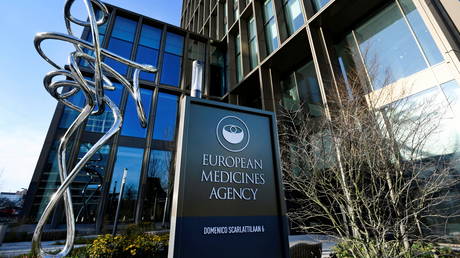
On Friday, the European Medicines Agency (EMA) “issued advice” backing the emergency use of the drug developed by Merck in collaboration with Ridgeback Biotherapeutics, although it has not yet been authorized by national authorities.
In a statement, the drug regulator said the medicine called Lagevrio – also known as molnupiravir or MK 4482 – “can be used to treat adults with Covid-19 who do not require supplemental oxygen and who are at increased risk of developing severe Covid-19.”
It said the treatment should be administered as soon as possible after Covid-19 is diagnosed and within five days of the start of symptoms. The medicine should be taken twice a day for a period of five days.
The EMA listed the potential side effects of the capsules, including mild or moderate diarrhea, nausea, dizziness and headache. The treatment is not recommended for pregnant women.
The watchdog announced earlier on Friday that it had begun reviewing Pfizer’s medicine Paxlovid for Covid-19 with the same goal “to support national authorities” who may decide on its early use prior to marketing authorization in light of rising cases and deaths in Europe.
On Friday, Austria announced it would enter a new nationwide lockdown from Monday and make vaccination mandatory, while Germany’s health authorities claimed the country had turned into “one big outbreak.”
Both Pfizer and Merck have requested approval for their coronavirus medicines from the US Food and Drug Administration, but it is unclear when it might be granted.
Think your friends would be interested? Share this story!
The Robert Koch Institute, Germany’s disease control agency, has warned that the country will face a “really terrible Christmas” unless steps are taken to mitigate a huge rise in Covid-19 cases.
Speaking on Thursday, the director of the Robert Koch Institute, Lothar Wieler, reiterated the case for new, strict countermeasures to prevent the spread of Covid-19.
“We are currently heading toward a serious emergency,” Wieler stated, adding “we are going to have a really terrible Christmas if we don’t take countermeasures now.” He added that hospitals were already struggling to find enough beds.
Wieler has called for a campaign for a further increase in vaccine uptake, from the current 67% to well over 75%.
The diseases institute director also believes bars, nightclubs, and other large-scale venues should be temporarily forced to close, and that other areas of public life should be off-limits to the unvaccinated.
His comments come as German leaders ponder new restrictions to replace the nationwide epidemic rules, which could include a lockdown of the unvaccinated, following measures already taken in neighboring Austria.
On Thursday, in an attempt to counter waning immunity levels, the country’s vaccine advisory board recommended that booster shots be made available to everyone aged 18 or above.
EXPERT PERSPECTIVE — On 16 June, US President Joe Biden and Russian President Vladimir Putin met for just under four hours in Geneva. This was Mr. Biden’s first meeting with Mr. Putin during his presidency and Biden is the fifth US President with whom Putin has held a summit.
Expectations for the summit were characterized as low by both sides in advance and assessed a bit more positively after the conclusion of the meeting. The meeting presented an opportunity for both leaders to present grievances and warnings to the other (and show toughness to their domestic constituencies). Other than presenting the opportunity to blow off steam, the results of the meeting appear modest: the agreement to return ambassadors to their posts, to resume bilateral arms control discussions, to conduct discussions on “strategic stability” and to hold unspecified consultations on cyber. In typical fashion, Mr. Putin rejected all of Mr. Biden’s assertions about Russian actions and made counter accusations referencing hostile US actions.
Of the deliverables from the summit, cyber will no doubt turn out to be the most problematic area for follow up. Mr. Biden apparently delivered to Mr. Putin a list of 16 US critical infrastructure sectors that should be considered “off limits” for cyberattacks, e.g., “red lines” not to be crossed without the risk of significant retaliation. For his part, Mr. Putin asserted that it is Russia that is the victim of cyberattacks originating from the territory of the US and it’s NATO partners and also is the victim of attempts to interfere with Russian elections. The challenge in cyber discussions going forward will center around three areas: differing interpretations of the relevance of deterrence theory in today’s cyber environment, attribution, and control.
Mr. Biden’s firm comments to Mr. Putin on recent cyberattacks against the US such as the ransomware attack on Colonial Pipelines (Mr. Biden is said to have asked Mr. Putin how he would react if Russia’s pipelines were hit?) and his provision of a list of “off limits” US infrastructure entities suggests a deep belief in this administration that Russia can be deterred from engaging in future conduct of cyber operations against US targets or “sanctioning” attacks originating from the territory of the Russian Federation by criminal groups.
Unfortunately, it is highly likely that either Mr. Putin nor those who control the levers of Russian cyber operations agree that deterrence theory applies. Deterrence only works when both sides know the other is capable of – and willing to – cause significant harm to the other.
The Russian side likely believes (and may have amply demonstrated) that the US is disproportionately vulnerable to cyber risk at every level of its economic, societal, and political infrastructure whereas Russia is not. There is a reason the use of cyber tools has become a central feature of Russian strategic doctrine. They work and seem a legitimate tool that falls short of conventional war. Hybrid warfare using cyber tools, the Russian side would argue, is no different than the economic warfare Russia is experiencing from sanctions imposed by the US its allies.
For full access to the article, sign up to become a Cipher Brief member for just $10/mo.
“The Cipher Brief has become the most popular outlet for former intelligence officers; no media outlet is even a close second to The Cipher Brief in terms of the number of articles published by formers.” – Sept. 2018, Studies in Intelligence, Vol. 62 No.
Access all of The Cipher Brief’s national-security focused expert insight by becoming a Cipher Brief Level I Member .
People around the world will need to get a jab against Covid-19 once a year, at least when it comes to the Pfizer vaccine, BioNTech’s CEO Ugur Sahin said in an interview on Sunday, as he praised the quality of its booster shot.
In an interview with Germany’s Bild newspaper on Sunday, Sahin said he considers the vaccine, co-developed by his company, to be “very effective.”
When asked whether people should be worried about the “breakthrough infections” – in which those vaccinated with the Pfizer-BioNTech vaccine still developed Covid-19 symptoms – he dismissed such concerns, saying that the jab offers a “90 percent protection” against cases that require intensive care in those aged over 60.
A “very high” level of protection against severe illness lasts for up to nine months, the BioNTech CEO maintained. He said this level starts decreasing “from the fourth month,” however. To maintain the protection, Sahin strongly pushed for booster shots, arguing that they would not just restore levels of antibodies but would potentially help “to break … chains of infection.”
He also encouraged doctors to be “as pragmatic as possible” when it comes to greenlighting vaccination and “not to send people home unvaccinated even though they could be vaccinated without any problems.”
In the future, people might need to get booster shots once a year, the BioNTech CEO believes. He said that he expects protection from a booster shot to “last longer” than the initial immunity one acquires after getting two doses of the vaccine.
“Subsequent … vaccinations may only be needed every year – just like [with] influenza,” he said. Currently, the German Federal Center for Health Education – an agency subordinated to the Health Ministry – recommends a booster shot six months after one gets the second dose of a vaccine. It also says that “booster vaccination makes sense after a minimum interval of about four months.”
Sahin’s interview comes days after it was revealed that Pfizer, BioNTech and Moderna are making a combined profit of $65,000 every minute – all thanks to their Covid-19 jabs. That is according to estimates made by the People’s Vaccine Alliance (PVA) – a coalition demanding wider access to vaccines.
The PVA estimated that the three companies are to earn a total of $34 billion in combined pre-tax profits this year alone, which roughly translates into more than $1,000 a second and $93.5 million a day.
PVA has slammed the three companies over their refusal to allow vaccine technology transfer despite receiving a combined $8 billion in public funding. Such a move could increase global supply and save millions of lives as well as drive down prices, the coalition said.
“Pfizer, BioNTech and Moderna have used their monopolies to prioritize the most profitable contracts with the richest governments, leaving low-income countries out in the cold,” said Maaza Seyoum of the African Alliance and People’s Vaccine Alliance Africa.
Think your friends would be interested? Share this story!
Israel has allegedly launched two missiles targeting an area south of the Syrian capital, Damascus, Syria’s state media reported, noting that one of the projectiles was intercepted. There are no reports of damage.
The reported attack took place shortly after midnight on Wednesday local time, according to Syria’s SANA news agency. The projectiles came from the direction of the Israeli-occupied Golan Heights, the outlet noted. The strike targeted an “empty building” south of the capital and resulted in no losses, according to the report.
Israel routinely makes incursions into Syria under the pretext of taking out alleged Iranian outposts there. The Israel Defense Forces (IDF) typically refrain from commenting on the raids, in line with its long-standing policy on military operations conducted outside its borders. Just over a week ago, two Syrian soldiers were injured in reported Israeli missile strikes on the cities of Tartus and Homs, near Russia’s naval base. The bombing also reportedly inflicted material losses.
Damascus has repeatedly condemned Israeli attacks against its territory as violations of its sovereignty. Russia, Iran, and Turkey have also denounced the Israeli airstrikes in Syria as a breach of international law.
Think your friends would be interested? Share this story!
A gunman injured two civilians, one of them fatally, and two police officers before being shot dead by security forces near Jerusalem’s Western Wall on Sunday morning, Israeli police said.
The civilian victims were taken to Shaare Zedek Medical Center. One, who was in his 30s, succumbed to his injuries at the hospital. The other, a 46-year-old, is said to have suffered moderate injuries. Two police officers were hurt by shrapnel.
Two civilians were critically and seriously wounded this morning, Sunday, and two policemen were lightly wounded in a shooting attack in the area of the Chain Gate near the Western Wall and the entrance to the Temple Mount. pic.twitter.com/MRN6MLckj3
In a video clip shared on social media and purportedly filmed at the scene, multiple gunshots could be heard amid agitated shouting. Security officers could then be seen standing around what appears to be a dead body. Witnesses speculated it was that of a “terrorist.”
Scenes and sounds of shooting in the Old City of Jerusalem captured on Live Cam. Initial reports are attack is near the Temple Mount area 2 Israelis wounded one apparently seriously the terrorist has been neutralised pic.twitter.com/UKWSOqCu8D
— ElBluemountain MossadDolphin 🇮🇱🐬🇮🇱🐬🇮🇱 (@EBluemountain1) November 21, 2021
The gunman, whose identity was not immediately disclosed, was killed during the incident. Police said he had used a homemade submachine gun.
Palestinian Islamist group Hamas has called on Canadian singer Justin Bieber to cancel his upcoming concert in what it calls the “Zionist occupation state” of Israel.
Bieber announced his 2022 world tour dates this week, with a concert in Tel Aviv planned for next October. On Thursday, Hamas’ Artistic Production Department issued a statement, cited by the Palestinian Sawa news outlet, “condemning and denouncing” the performer. It called on the star to cancel the show and “boycott the Zionist occupation state in protest at its repeated crimes against the Palestinian people.”
Bieber has performed in Israel multiple times, his last performance there having been in 2017 at Park HaYarkon – the same venue slated for next year. Since the announcement of the ‘Justice’ tour dates, calls for him to cancel the Tel Aviv show have gained momentum across social media, with many posters condemning the singer for supporting what one called an “apartheid state.”
Some noted that Bieber was set to arrive in Israel after performing in South Africa. “Justin Bieber is really going straight from SA to Israel. From a country that fought apartheid to a country that’s practicing apartheid,” one Twitter user complained.
A petition asking the singer to boycott Israel and exclude it from his tour has been launched online, and had garnered some 3,700 signatures by Friday.
In 2018, the New Zealand singer Lorde canceled a concert in Israel, subsequently thanking fans for “educating” her on the issue, and, the same year, US artist Lana Del Rey at first defended her decision to perform in the country, saying her appearance would not be a “political statement,” before backtracking and canceling the gig.
Hamas has been designated a terrorist group by the US, the EU, and, as of Friday, the UK. In April 2021, international non-governmental organization Human Rights Watch concluded in a report that Israel had committed “crimes against humanity of apartheid and persecution.”
French luxury giant Dior has taken down a controversial photograph that had been criticized in China for “smearing Asian women” by pandering to Western stereotypes while “distorting Chinese culture.”
The photo, which was part of the brand’s ‘Lady Dior’ exhibition in Shanghai, depicts an Asian model wearing a traditional dress and clutching a Dior handbag. It came under fire this week from Chinese media outlets for featuring “spooky eyes, [a] gloomy face and Qing Dynasty-styled nail armor.”
Although Dior has not released a statement regarding the controversy, it confirmed to fashion trade publication Business of Fashion that the photo had been removed from the exhibition. The brand has also reportedly taken the photo off Chinese social media platform Weibo.
The image, which was shot by Chinese photographer Chen Man, had drawn both media ire and public outrage. However, there were apparently no calls for a boycott of the brand.
In an editorial on Monday titled “Is This the Asian Woman in Dior’s Eyes?”, the Beijing Daily paper had noted that the image makes Chinese consumers uncomfortable. The publication criticized Man for “playing up to the brands, or the aesthetic tastes of the Western world.”
For years, Asian women have always appeared with small eyes and freckles from the Western perspective, but the Chinese way to appreciate art and beauty can’t be distorted by that.
Warning that both the brand and the photographer had “gone too far,” the China Women’s News paper ran an editorial on Wednesday that claimed it “indicated their intention of uglifying Chinese women and distorting Chinese culture.”
“Again, from… Dior’s ghost-style picture, which makes the public feel uncomfortable, it’s easy to see some Western brands’ ‘pride and prejudice’ in their aesthetics and culture,” said the newspaper, which is run by the All-China Women’s Federation.
Meanwhile, the Global Times noted that the “lingering controversy could pose a delicate situation” for Dior and other global brands – for whom China’s “massive” luxury market was one of the biggest sources of revenue. The paper said that the Chinese public had become “increasingly sensitive” toward the depiction and treatment of Chinese people and culture by foreign companies.
While pointing out that Chinese social media users had demanded the company and photographer explain their intention, a number of media outlets also highlighted how some netizens had praised the photo as a departure from typical standards of beauty in the country, often characterized by “fair skin and large eyes.”
An adviser to the EU’s top court has claimed that citizens’ information in Germany is being illegally harvested, after telecom companies challenged bulk data collection.
The German data retention law was criticized on Thursday by an adviser to the Court of Justice of the European Union (CJEU), who stated that general and indiscriminate retention of traffic and location data is only allowed in exceptional cases, such as a threat to national security.
According to the adviser, bulk collection of data generates a ‘serious risk’ of leaks or improper access. It also entails a ‘serious interference’ with citizens’ fundamental rights to privacy and the protection of personal data.
This comes after two companies, SpaceNet and Telekom Deutschland, challenged the obligation to store their customers’ telecommunications traffic data in 2016. The Administrative Court of Cologne ruled that the two companies were not obliged to retain data because such an obligation violated Union law. Germany then appealed to the Federal Administrative Court, who asked the CJEU about the compatibility of the data retention obligation.
The CJEU has often stated that indiscriminate mass surveillance does not fit within the general principles of EU law. Over a year ago it saw a similar case involving legal challenges around national bulk data collection under UK and French law. The court then ruled that only limited data collection and temporary retention were allowed. France seeks to bypass the CJEU on data retention and has asked the country’s highest administrative court (the Council of State) not to follow the EU ruling. France is waiting for the conclusion of the procedure launched by the Council of State before “assessing to what extent” national law should be changed.
Despite recent EU court attempts to curb surveillance powers, leaked papers from June 2021 show that the national governments of the Netherlands, France, Spain, Luxembourg, Slovakia, and Estonia are pushing for a new pan-EU data retention law. They claim that data retention is essential for safeguarding public security and ensuring effective criminal investigations.
Think your friends would be interested? Share this story!
Protesters thronged the streets of Australian cities on Saturday, demanding an end to what they called the “tyranny” and “oppression” of lockdowns, vaccine mandates, and the proposed expansion of the government’s pandemic powers.
In Melbourne, Sky News reporter Sophie Elsworth described “tens of thousands of people streaming through the streets.” The march came after a week of smaller protests aimed at Victoria Premier Dan Andrews’ controversial pandemic bill, which if approved by the state’s legislature would allow Andrews and Health Minister Martin Foley to declare an indefinite state of emergency and issue public health orders by decree – including “any order… that the minister believes is reasonably necessary to protect public health.”
Tens of thousands of people keep streaming through the streets. Many I’ve spoken to are concerned about the state govt, Premier, vaccine mandates, the pandemic bill & what future holds for their kids. #melbourneprotestpic.twitter.com/smexulQ4ts
Should the bill pass, it would allow Andrews to target certain classes of people with these orders, categorizing them by age, occupation, or vaccination status. Fines for noncompliance would range from up to AU$21,800 for people and AU$109,000 for businesses.
Alternative media sources claimed that more than 100,000 people showed up to protest. However, the demonstration remained free of the violent clashes seen at protests in Melbourne in recent months.
“Australia has been willing to send troops to all parts of the world to help people become free,” one military veteran told a crowd of listeners during the protest. “To now be fighting oppression here in our own country, it’s saddening.”
Melbourne Australia 🇦🇺
An Aussie veteran is calling former servicemen and cops who have sworn an oath to Australia to stand up against the tyranny 👊 pic.twitter.com/4RsoRMjoJE
Huge numbers of protesters also turned out in Sydney, and although more than 600 police officers were deployed to watch over the gathering, no arrests were made, 9News reported.
Holding signs decrying state “tyranny,” the demonstrators chanted “freedom” and called for the firing of state politicians who have implemented a two-tier system where the unvaccinated are denied many of the privileges extended to the fully jabbed.
Similarly massive gatherings took place in Adelaide, Brisbane, and Perth, with no notable incidents of violence or police action. Further afield, protests are taking place in more than 120 cities around the world this weekend, in a loosely coordinated event dubbed the ‘Worldwide Rally For Freedom’ by activists.
Thousands of people have descended across Rundle Park today as part of an Adelaide freedom rally. Some of those in the crowd say they have lost their job as a result of mandated vaccinations in their sector. @9NewsAdelpic.twitter.com/YdzvxYJhqF