We’re starting a new segment on The Cipher Brief’s Open-Source Collection Podcast and adding to the line-up of curated headlines we bring you from around the world with expert insights on today’s news. 

The Cipher Brief’s Brad Christian talked with former CIA Officer Marc Polymeropoulos this week about what’s next for the US Government when it comes to investigating ‘Havana Syndrome’, making sure Afghan interpreters aren’t left behind and why a White House visit by Jordan’s King Abdullah was a bigger deal than some may realize.  

Cipher Brief Expert Marc Polymeropoulos served 26 years in the CIA before retiring from the Senior Intelligence Service in June 2019.  His positions included field and headquarters operational assignments covering the Middle East, Europe, Eurasia and Counterterrorism. 

Christian: What’s top of mind for you this week in the world of national security?

Polymeropoulos:  Havana Syndrome, CIA’s response to the Afghan withdrawal, and the visit of Jordan’s King Abdullah to D.C. Let’s start with Havana Syndrome.

You saw in the press the last couple of days, the notion that the CIA’s inspector general is conducting a review of CIA’s handling of healthcare, of how officers were coming to them starting in 2016 after these attacks started in Cuba. I think that’s a good thing. It’s a necessary evil. I think a lot of your listeners and readers know that I was affected by this in December of 2017. It caused my retirement in July of 2019. I’ve been very vocal on the need for healthcare for our officers.  We have to think about Havana Syndrome in three bins.

The first, is accountability and that’s good. It’s a necessary evil, but we have to look at how the agency responded to officers because that’s critical. The agency workforce is watching. I think the IG review by the CIA is good as well as a look at what’s happening in the House and Senate oversight committees as well.

The second, is continued healthcare for officers, the officers getting to Walter Reed’s National Intrepid Center of Excellence. CIA Director Bill Burns is doing that, so that’s positive.

And then the last piece is culpability. I think you also saw recently in the press, that a senior intelligence service officer who was integral in the hunt for Osama bin Laden, has been named to the task force. So, a lot of stuff is happening on Havana Syndrome, I think all of it is moving in a positive direction. I applaud Director Burns. This is something that I think is going to be at the top of the news cycle for days, weeks, and months to come.

Christian: Do you feel like now there’s a unified awareness at the entire government level outside of CIA?  Is Congress focused on this? Is the White House focused on this in the ways that you think they need to be?

Polymeropoulos: What a great question. The White House for sure. Congress has been absolutely integral both in the Senate and the House. They’re about to pass the Havana Act, which is going to provide financial relief for officers affected, but in all US government agencies. I will say that the Department of State has been woefully behind and that’s a big concern of mine. I feel for my State colleagues. There are 41 State Department officers who have been affected by this. Secretary of State Blinken has not even met with them while Director Burns has met with nearly all of the CIA victims, so State’s got a long way to go. I think we’ll look to the White House and to Congress to keep the pressure on.

Christian: These are events that are still occurring, even as they’re being investigated. Tell us a little bit about the latest that’s happened on the attack front.

Polymeropoulos: I think you see what the press reports of what can only be considered a kind of slow-rolling mass casualty event in Vienna, Austria. There were numerous State Department and intelligence officers affected at our Embassy there. Again, this is coming out in the press, so it’s important to note that. But these things are still happening and I think that we have to look back to the old counter-terrorism model that CIA employed so effectively of detect, disrupt, and deter attacks by our terrorist adversaries. We have to apply that same type of mindset to this problem set.


Go beyond the headlines with expert perspectives on today’s news with The Cipher Brief’s Daily Open-Source Podcast.  Listen here or wherever you listen to podcasts.


Christian: The Afghanistan withdrawal, there’s a lot going on there. We’ve seen reports of US airstrikes supporting Afghan forces in Kandahar. This week, it was reported that just under 50 Afghan troops requested refuge in Pakistan when their border posts near Chitral, which is a Pakistani city, was overrun. The Pakistani government let them in. And we’re seeing now an Afghan strategy focusing on protecting the capital regions and maybe ceding some of those provincial capitals.

Polymeropoulos: I look at this from a narrow optic. As a former CIA officer who was the base chief in Afghanistan between 2011 and 2012, I ran one of our paramilitary bases in eastern Afghanistan along the border with Pakistan. What is unique about life as a CIA officer out in the field, particularly in the bases, was that there were only a few of us. We had a very small number of Americans, yet we had hundreds, if not over 1,000 Afghanistan indigenous personnel, whether they were troops who were fighting with us or whether they were support personnel.  We lived with them. I think this is a little bit different than perhaps big US military’s experience with the Afghan national army.

I trusted my life to these guys. They were armed in front of us all the time. We ate together at the mess hall. We sat around the fire pit together, certainly went on patrols together. So, it’s really personal for me. I remember our Afghan interpreters. I remember our indigenous personnel and I really worry about them. The future, I think is one that certainly is bleak. I don’t support the administration’s decision for a full withdrawal. I don’t understand why we couldn’t have left a residual force, but that policy decision has been made.  I think that the things I’m looking to in the near future are even after the end of August, will the US military still conduct airstrikes in support of Afghan forces?  There is something about betraying those who really made that pact with us. That’s just something as a CIA officer that’s ingrained in us that we don’t want to do that. So, this is something I really worry about. I remember the faces of our interpreters and indigenous personnel every day. These were great heroes. I think a lot of us at CIA wouldn’t be alive today without their heroism.


 The Cipher Brief hosts private briefings with the world’s most experienced national and global security experts.  Become a member today.


Christian: The third issue you raised was interesting, the visit to D.C. by Jordan’s King Abdullah. It didn’t get a lot of press.  But you say it’s a significant story.  Tell us why.

Polymeropoulos: President Biden has had a long-standing relationship with King Abdullah. It’s a sign that Jordan is back. We call Jordan the lily pad for the United States for a lot of reasons. I mean, when you think back to 2006 and Jordan’s integral role in the Anbar Awakening, that’s when we were rallying the tribes in Iraq to fight terrorism. When you think about how the US has access to strategic bases in Jordan and when you think about the Jordanian General Intelligence Directorate as one of the US Government’s most critical counter-terrorism partners. But the fact of the matter is that under the last administration, Jordan was not treated well, so it’s really significant that Abdullah was here. I think this is a really good thing. Don’t forget that CIA Director Bill Burns was ambassador in Amman quite some time ago. I think this is a really positive development, not only for the United States going back to an old strategic partner, but also for Jordan as well, which has been a steadfast ally not only during King Abdullah’s reign, but also of course, under King Hussein before him.

Read more expert-driven national security insights, perspective and analysis in The Cipher Brief

The post An Open-Source Brief: former CIA Officer Marc Polymeropoulos appeared first on The Cipher Brief.
find more fun & mates at SoShow now !

General Joseph L. Votel (Ret.) joined BENS as CEO & President in January 2020 following a 39-year military career where he commanded special operations and conventional forces at every level; last serving as the Commander of U.S. Central Command (CENTCOM) where he was responsible for U.S. and coalition military operations in the Middle East, Levant, and Central and South Asia. General Votel’s career included combat in Panama, Afghanistan, and Iraq and he led the 79-member coalition that successfully liberated Iraq and Syria from the Islamic State Caliphate. General Votel preceded his assignment at CENTCOM with service as the Commander of U.S. Special Operations Command and the Joint Special Operations Command.

The Cipher Brief:  Did you ever envision that the U.S. would pull out so quickly or completely leaving the Afghan military on its own without U.S. air support?  

General Votel: I did not anticipate this during my time – but once the President sets a hard departure date – then a fast withdrawal is inevitable.  No Commander wants to accept unnecessary risk with troops on the ground when you are up against a clearly articulated departure date.

The Cipher Brief: Intelligence assessments wildly missed the mark on how fast Kabul would fall, what factors contributed most directly to this? 

General Votel: Certainly, the departure of our own capabilities is a big part of this; the lack of direct contact with Afghan leaders is another important factor; and, of course, once it was clear that we were departing (and took our Commander out) — we lost priority and access with our normal and reliable Afghan intelligence sources.

The Cipher Brief: U.S. personnel are facing a deteriorating security situation at the Kabul airport while U.S. forces are still deploying for the contingency operation, another sign that the administration underestimated how fast the Taliban would reach Kabul. The U.S. could have chosen to slow the Taliban advance using airpower, why didn’t it happen, do you think? 


The Cipher Brief hosts private briefings with the world’s most experienced national and global security experts.  Become a member today.


General Votel: I think it is very clear that this was no longer a priority for our Government.  The mission right now, at least articulated over the weekend, is about supporting evacuation of the diplomats and helping with the departure of those Afghans who assisted the US and meet the criteria for evacuation.  While I don’t know this for certain — I believe what we were trying to do with over the horizon air support in a rapidly developing situation, was not optimal or overly effective.  It doesn’t seem to have done much – if anything.

The Cipher Brief: The U.S. has allowed U.S. supplied military hardware, weapons and technology to fall into the hands of the Taliban, a group responsible for the deaths of U.S. personnel and thousands of innocent Afghans.  The U.S. government holds private citizens and corporations accountable for far lesser violations of export violations involving dual-use technology or military equipment, etc.  How should Americans think about this situation now, where the Taliban will use equipment, paid for the by the U.S. taxpayer, to potentially perpetrate acts of violence against U.S. interests, and erode democratic values that the U.S. tried to introduce to Afghanistan?  

General Votel: Not sure on this.  Unfortunately, it is not the first time we have seen this — remember ISIS in 2014, in Mosul?  I suspect these will be more trophy pieces than they will be hard military capability – with the exception of small arms, mortars, and artillery.  Most of this will be difficult for the Taliban to sustain – and they probably prefer their own gear, anyway.

The Cipher Brief:  There is a lot of anger among the national security community right now.  What would you say to individuals who have suffered because of the U.S. role in Afghanistan, who may be feeling anger and rage?  

General Votel: I can’t really comment on anger in the national security community — I am sure that exists, but the sentiment that seems more strong to me, is disappointment.  No one wants what we are seeing now.  I think most security professionals can accept a decision to depart by the Commander in Chief — that is well within his authority, and everyone understands this; what is harder to accept is the manner in which this happened, and how it has played out.  It was hard for me to watch Taliban sitting at a conference table that I once sat at with the Afghan President.  In a number of public engagements, I have participated in lately – people have asked me if this whole effort was a waste.  My response has been consistent.  American military personnel, members of the IC and the diplomatic corps conducted themselves honorably throughout this war.  They responded when the Nation called and did their best for our Country, each other, and the Afghan people.  There will be plenty of time to place the blame – but the vast, vast majority of Americans who participated in some aspect of the Afghan War did so nobly and to the best of their ability.  We should not lose sight of this.  That this did not turn out the way we all hoped — is not their fault … and I would not want anyone (especially families of our wounded and killed) to think these efforts were in vain.  That is not how I thought about them at the time, and it is not how I think about them now.  They answered when the Nation called.

Have a perspective to share?  Email Editor@thecipherbrief.com

Read more expert-driven national security insight, perspective and analysis in The Cipher Brief


The post The Painful Lessons of Afghanistan appeared first on The Cipher Brief.

find more fun & mates at SoShow now !

The International Criminal Court has halted an investigation into alleged rights abuses carried out by Philippines authorities as part of a harsh crackdown on the drug trade, saying it is reviewing a deferral request from Manila.

The ICC’s chief prosecutor Karim Khan said the probe was suspended after the Philippines government filed a request to defer the case earlier this month, according to court documents cited by Reuters on Friday. 

“The prosecution has temporarily suspended its investigative activities while it assesses the scope and effect of the deferral request,” he wrote, adding that the court is seeking more information from the government in Manila.

Based in The Hague, the ICC allows states to ask for postponements if they conduct their own investigations into the charges in question. President Rodrigo Duterte’s administration filed its deferral request on November 10, while the country’s Justice Ministry announced its own investigation into the alleged abuses late last month.

Read more

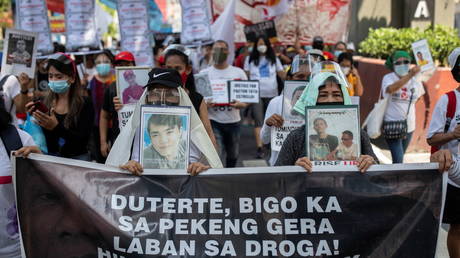
Relatives of drug war victims hold photographs of their slain loved ones with placards calling for justice (FILE PHOTO) © REUTERS/Eloisa Lopez
Philippines announces probe into thousands of killings during Duterte’s war on drugs as initial review suggests abuses took place

The court initially opened the probe in September over allegations that Philippines police had carried out thousands of extrajudicial executions and used other brutal tactics against suspected drug dealers, and that Duterte gave implicit backing to those actions. Activists have accused authorities of killing innocent people, including children, though the police insist they only use violence in self-defense.

While Duterte has declined to cooperate with the ICC probe, saying it has no authority on the island nation, and even pulled the Philippines out of the international body in 2019, the court has jurisdiction to investigate alleged violations committed by the country while it was still a member.

The president’s chief legal counsel, Salvador Panelo, confirmed the deferral request in brief comments to Reuters, saying “There is no inconsistency with the request for suspension of action,” though he did not elaborate.

Since its founding some 20 years ago, the ICC has successfully convicted just five people of war crimes or crimes against humanity – all leaders of armed movements in Africa, including in Mali, Uganda and the Democratic Republic of the Congo.

Think your friends would be interested? Share this story!

find more fun & mates at SoShow now !

President Joe Biden commented on reports that US officials are planning to boycott the upcoming Olympics in Beijing over alleged human rights violations – but his answer left journalists perplexed.

When asked on Tuesday if an official US delegation will be traveling to the Winter Games in the Chinese capital in February, Biden responded: “I am the delegation.”

The president, however, did not elaborate, leaving the White House correspondents in a state of confusion, as his response could mean that Biden will attend the Winter Olympics alone or, as some reporters suggested, that he simply did not understand the question.

Read more

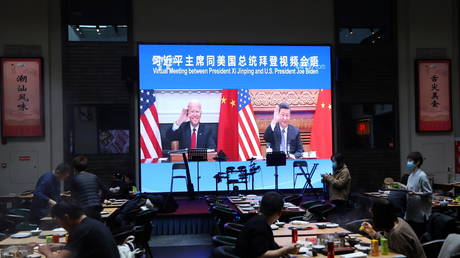
A screen at a restaurant in Beijing showing Chinese President Xi Jinping's virtual meeting with US President Joe Biden. © Reuters / Tingshu Wang
Biden & Xi agree to avoid conflict

A recent report by a Washington Post columnist claimed the US won’t be sending an official delegation to Beijing in 2022 over allegations of human rights violations by the Chinese government. According to the sources cited in the article, a formal recommendation for a diplomatic boycott of the Olympics has been already presented to Biden, with the move expected to be approved by the president by the end of November.

The piece was published on the day that Biden held a lengthy virtual meeting with Chinese leader Xi Jinping, in which they discussed a range of issues regarding the strained relations between the two nations – but not the Olympics.

The White House said that during the talks, President Biden challenged his Chinese counterpart over what Washington sees as persecution against the Uyghur population in the Xinjiang region, as well as human rights violations in Tibet and Hong Kong. China has strongly denied the claims, accusing the US of interfering in its internal affairs.

Calls for the Biden administration to boycott the Olympics and refrain from sending a political delegation to Beijing have recently been made by top Democratic and Republican lawmakers. 

If implemented, it won’t affect the American athletes, who will still be taking part in the Winter Olympics.

Like this story? Share it with a friend!

find more fun & mates at SoShow now !

Protesters thronged the streets of Australian cities on Saturday, demanding an end to what they called the “tyranny” and “oppression” of lockdowns, vaccine mandates, and the proposed expansion of the government’s pandemic powers.

In Melbourne, Sky News reporter Sophie Elsworth described “tens of thousands of people streaming through the streets.” The march came after a week of smaller protests aimed at Victoria Premier Dan Andrews’ controversial pandemic bill, which if approved by the state’s legislature would allow Andrews and Health Minister Martin Foley to declare an indefinite state of emergency and issue public health orders by decree – including “any order… that the minister believes is reasonably necessary to protect public health.”

Should the bill pass, it would allow Andrews to target certain classes of people with these orders, categorizing them by age, occupation, or vaccination status. Fines for noncompliance would range from up to AU$21,800 for people and AU$109,000 for businesses.

Alternative media sources claimed that more than 100,000 people showed up to protest. However, the demonstration remained free of the violent clashes seen at protests in Melbourne in recent months.

“Australia has been willing to send troops to all parts of the world to help people become free,” one military veteran told a crowd of listeners during the protest. “To now be fighting oppression here in our own country, it’s saddening.”

Huge numbers of protesters also turned out in Sydney, and although more than 600 police officers were deployed to watch over the gathering, no arrests were made, 9News reported.

Holding signs decrying state “tyranny,” the demonstrators chanted “freedom” and called for the firing of state politicians who have implemented a two-tier system where the unvaccinated are denied many of the privileges extended to the fully jabbed.

Similarly massive gatherings took place in Adelaide, Brisbane, and Perth, with no notable incidents of violence or police action. Further afield, protests are taking place in more than 120 cities around the world this weekend, in a loosely coordinated event dubbed the ‘Worldwide Rally For Freedom’ by activists.

Like this story? Share it with a friend!

find more fun & mates at SoShow now !

AstraZeneca has announced that its preventative antibody cocktail offers 83% protection against symptomatic Covid-19 for at least six months, making it more effective than its own vaccine.

In a statement on Thursday, AstraZeneca cemented its lead in the race to develop and market a preventative Covid-19 drug, which is delivered as a shot in the arm. 

The drug, named AZD7442, reduces the risk of symptomatic Covid-19 by 83% over the course of six months, according to data from a trial in which participants were given one 300mg dose. There were no deaths or severe infections recorded within the trial group, it said. 

Read more

Paxlovid, a Pfizer's coronavirus disease (Covid-19) pill, is seen manufactured in Ascoli, Italy (FILE PHOTO) © Pfizer/Handout via REUTERS
Pfizer gets new $5.3bn boost over Covid

A separate trial showed the drug reduced the risk of severe Covid-19 or death by 88% when administered within three days of the onset of symptoms. 

“These new data add to the growing body of evidence supporting AZD7442’s potential … We are progressing regulatory filings around the world and look forward to providing an important new option against SARS-CoV-2 [Covid-19] as quickly as possible,” AstraZeneca Executive Vice President Mene Pangalos said in the statement. 

The Anglo-Swedish firm has agreed to supply the US government with 700,000 doses of AZD7442 if the Food and Drug Administration grants it emergency use, which AstraZeneca requested on October 5. The firm has similar agreements with other nations. 

The drug is created using a combination of two antibodies originating from immune B-cells donated by a recovering Covid-19 patient. 

The treatment could be used in people who are known not to respond well to vaccines, such as cancer patients. Around 2% of people are considered to be at risk of not creating enough antibodies following the administration of a Covid-19 vaccine. 

Based on the numbers, the drug appears to be more effective than the firm’s first-generation Covid-19 vaccine. Britain’s Zoe Covid study showed the effectiveness of the vaccine dropped to around 67% after four to five months. 

If you like this story, share it with a friend!

find more fun & mates at SoShow now !

Libyan military commander Khalifa Haftar is set to challenge Gaddafi’s son for the top job, announcing his presidential bid. The election will take place on December 24.

Read more

Saif al-Islam al-Gaddafi at the registration centre in Sebha. ©Khaled Al-Zaidy / Handout via REUTERS
Gaddafi heir runs for Libyan presidency despite arrest warrant

I declare my candidacy for the presidential election, not because I am chasing power but because I want to lead our people towards glory, progress and prosperity,” the de facto leader of Eastern Libya said in a televised speech.

Haftar added that the election is the only way out of the severe crisis the country has been plunged into.

The announcement was expected; in September, Haftar announced that he was temporarily stepping down as head of the force known as the Libyan National Army, fulfilling the requirement for presidential hopefuls to suspend public work three months before an election.

Haftar will run against the son of former leader Muammar Gaddafi, Saif al-Islam Gaddafi, who represents the Popular Front for the Liberation of Libya.

Haftar’s presidential bid is likely to anger many who consider him a war criminal responsible for the indiscriminate killing of civilians during his military campaign. A number of civil lawsuits have been filed against him in a US federal court for alleged war crimes. Haftar has both US and Libyan citizenship, and owns property in Virginia.

Following years of civil war and political chaos after the NATO-backed intervention that saw Muammar Gaddafi deposed and brutally murdered, the upcoming election is widely viewed as an opportunity for political settlement and the long-awaited unification of the country, divided now between Haftar’s forces and the Tripoli-based Government of National Accord. However, there is still no consensus on the legal grounds for the election, which could become an obstacle for the peace process.

Like this story? Share it with a friend!

find more fun & mates at SoShow now !

Greece will soon prohibit unvaccinated residents from entering a litany of public spaces, the country’s prime minister has announced, claiming its current Covid outbreak is largely fueled by those who haven’t received the jab.

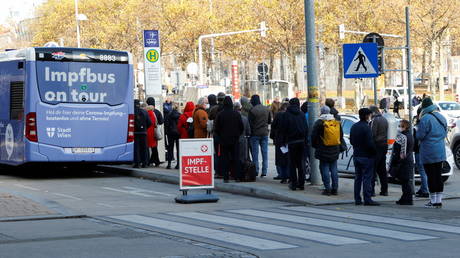
Starting next week, the unvaccinated will be barred from entry to restaurants, cafes, theaters, bars, gyms and museums, among other indoor public places, PM Kyriakos Mitsotakis said on Thursday, noting that a negative Covid-19 test will no longer be accepted as an alternative to proof of vaccination.

“This is indeed a pandemic of the unvaccinated,” he said as he announced the move in a televised address, adding “Greece is mourning unnecessary losses because it simply does not have the vaccination rates of other European countries.”

The new rules are set to take effect on Monday, and will require Greeks to present vaccine certificates to businesses and other indoor establishments to be allowed inside. Those attending religious services mark a rare exception, however, as they will only be asked to present a negative test in order to enter a church or other place of worship.

Read more

People wait in front of a vaccination after Austria's government has imposed a lockdown on people who are not fully vaccinated, in Vienna, Austria, November 18, 2021. © Reuters /Leonhard Foeger
Austria may lock down the vaccinated too

In a bid to encourage booster vaccinations among the elderly – a population much more vulnerable to Covid-19 – citizens over the age of 60 will be made to renew their certificate after a period of seven months.

While officials had hoped to hit a full vaccination figure of 70% for Greece’s population of 11 million by autumn, the number currently stands at about 62%, according to Reuters. As its weekly case counts continue to soar to record highs, the country reported 7,317 new Covid-19 infections and 63 deaths on Thursday, bringing the totals to more than 860,000 cases and some 17,000 fatalities since the pandemic kicked off in late 2019.

The new restrictions in Greece mirror similar policies implemented elsewhere in Europe, with Austria, Germany, Italy, France, the Czech Republic and Slovakia each imposing limits on public life for the unvaccinated. Though the Austrian government recently imposed a full lockdown for millions of residents who have not received the shot, some officials in that country are pushing for even harsher policies, including a national stay-at-home order on the jabbed and non-jabbed alike.

Think your friends would be interested? Share this story!

find more fun & mates at SoShow now !

The EU Commission has released draft legislation aimed at tackling the destruction of woodland by introducing import restrictions on products not certified as ‘deforestation-free’.

The draft proposal, which the commission hopes will become binding rules for all member states, seeks to limit the import of beef, cocoa, coffee, palm, soy, and wood if it is not proven “deforestation-free.”

Outlining the legislation, the EU commissioner for climate action policy, Virginijus Sinkevicius, called it a “ground-breaking” proposal that will help fight “illegal deforestation” and “deforestation driven by agricultural expansion.”

The bill comes after nations at the COP26 summit agreed to work to end deforestation by 2030. It would impose two criteria on imports, requiring items to have been produced in accordance with the origin country’s laws, and not on land that has been deforested or degraded since the start of 2021.

It is not clear when the rules would come into effect; legislative proposals by the commission have to be debated and considered by both the EU Parliament and the Council of the EU before they are passed. The implementation of measures could potentially impact the EU’s trade relations with countries like Brazil, where clearing of the Amazon rainforest hit a new record in October.

During the recent COP26 climate summit, 110 world leaders – whose countries contain around 85% of the world’s woodland – committed to ending and reversing deforestation by 2030, pledging around £14 billion ($18.84 billion) of public and private funds towards the goal.

Like this story? Share it with a friend!

find more fun & mates at SoShow now !

Scientists have used artificial intelligence to “predict” formulas for new designer drugs, with the stated goal of helping to improve their regulation. The AI generated formulas for nearly nine million potential new drugs.

Researchers with the University of British Columbia (UBC) used a deep neural net for the job, teaching it to make up chemical structures of potential new drugs. According to their study, released this week, the computer intelligence fared better at the task than the scientists had expected.

The research team used a database of known designer drugs – synthetic psychoactive substances – to train the AI on their structures. The market for designer drugs is ever-changing, since their manufacturers are constantly tweaking their formulas to circumvent restrictions and produce new “legal” substances, while cracking their structure takes months for law enforcement agencies, the researchers said.

Read more

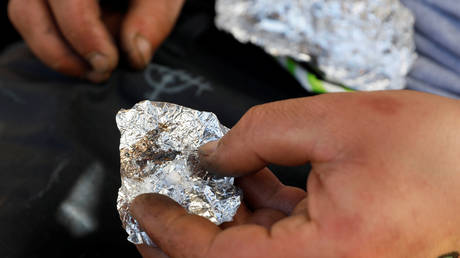
FILE PHOTO: A man living on the streets displays what he says is the synthetic drug fentanyl, in the Tenderloin section of San Francisco, California, February 27, 2020 © Reuters / Shannon Stapleton
Drug overdose deaths in US hit all-time record

“The vast majority of these designer drugs have never been tested in humans and are completely unregulated. They are a major public-health concern to emergency departments across the world,” one of the researchers, UBC medical student Dr. Michael Skinnider has said.

After its training, the AI was able to generate some 8.9 million potential designer drugs. Afterwards, researchers ran a data sheet of some 196 new drugs, which had emerged in real life after the model was trained, and found that more than 90% of these have been already predicted by the computer.

“The fact that we can predict what designer drugs are likely to emerge on the market before they actually appear is a bit like the 2002 sci-fi movie, Minority Report, where foreknowledge about criminal activities about to take place helped significantly reduce crime in a future world,” senior author Dr. David Wishart, a professor of computing science at the University of Alberta, has said.

Identifying completely unknown substances remains an issue for the AI, the research team has noted, but they hope it might potentially help with that task, since the computer was also able to predict which formulas of designer drugs were more likely to be created and hit the market. The model “ranked the correct chemical structure of an unidentified designer drug among the top 10 candidates 72 percent of the time,” while throwing in spectrometry analysis, which is an easily obtained measurement, bumped the accuracy to some 86%.

“It was shocking to us that the model performed this well, because elucidating entire chemical structures from just an accurate mass measurement is generally thought to be an unsolvable problem,” Skinnider stated.

Think your friends would be interested? Share this story!

find more fun & mates at SoShow now !