Taiwan’s president unveiled the country’s combat wing of advanced US-made F-16 fighters in a ceremony on Thursday, showing its new Air Force capabilities against mainland China.

The event, held at an air base in the southern Taiwanese city of Chiayi, saw the island commission the first combat wing of F-16 fighters, developed with US support.

The F-16 upgrades, costing T$110 billion (USD$3.95 billion), have been jointly completed by American manufacturer Lockheed Martin Corp and Taiwan’s Aerospace Industrial Development Corp.

Taiwan’s leader, Tsai Ing-wen, touted the new F-16s as ensuring that the island’s defenses would be “even stronger” in the face of increased tensions with China.

In October, Beijing sent a record 150 warplanes into Taiwan’s air defense identification zone (ADIZ) in four straight days of incursions. Over the past year, China’s Air Force has increased military activity in and around Taiwan’s ADIZ, according to Taipei. 

Despite Taipei claiming it does not want to provoke a confrontation with China, the island’s president pledged that it will “do whatever it takes to defend itself.”

China has rejected claims that it is provoking conflict in Taiwan, which it sees as an integral part of its country, accusing America of “inflating” the island separatist movement, firmly stating that “Taiwan independence” is a dead end and Beijing will “take all steps” to ensure the island remains under its control. In recent years, China has become increasingly assertive about reuniting its wealthy island neighbor with the mainland.

The successful F-16 development process has been seen by Taiwan as the latest visible sign of the military partnership between Washington, DC and Taipei. Back in 2019, America approved an $8 billion sale of F-16s to Taiwan, which would bring the total number of jets in the island’s fleet to 200.

Read more

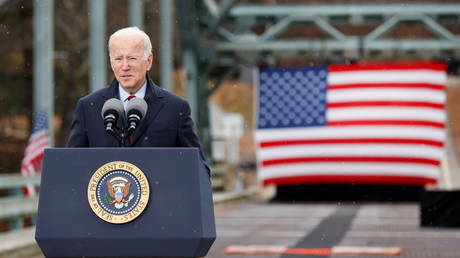
US President Joe Biden speaks in Woodstock, New Hampshire, November 16, 2021.
Biden reveals US Taiwan policy after call with Xi

During the event, the Taiwanese president praised America for remaining steadfast in its cooperation with the island despite opposition from China. “As long as we adhere to the values of democracy and freedom, there will be more like-minded countries standing on the same front with us,” Tsai said alongside US diplomat Sandra Oudkirk.

In 2019, after the US and Taiwan agreed to upgrade the F-16 fighter jets, then-Foreign Ministry spokesperson Geng Shuang threatened to sanction American firms unless the deal was halted. Beijing opposed the military partnership between Taipei and Washington, DC, arguing that the sale violated international law, harmed relations between the countries, and breached the One China policy, which America recognizes.

Think your friends would be interested? Share this story!

find more fun & mates at SoShow now !

Japan’s fifth wave of Covid-19 has virtually disappeared so dramatically that some scientists are puzzled as to why it happened. One team suggests the highly infectious Delta strain mutated into extinction on the island nation.

In mid-August, Japan experienced a peak in Covid-19 infections, recording over 23,000 new cases per day. Now the metric is just around 170, with deaths attributed to the disease mostly remaining in single digits this month.

The decline has been attributed by many to high vaccination rates, public acceptance of masks, and other factors, but some researchers say the drop was uniquely significant, compared to other nations with similar conditions.

Ituro Inoue, a geneticist at the National Institute of Genetics, believes that Japan had the good fortune of witnessing the Delta strain mostly rooting out other variants of the SARS-CoV-2 virus before then eradicating itself. He explained his team’s theory to the Japan Times newspaper this week.

For some time now, Inoue and his fellow scientists were researching mutations of SARS-CoV-2 and how they are affected by the protein nsp14, which is crucial for the reproduction of the virus.

RNA viruses, like the one causing Covid-19, tend to have a very high mutation rate, which helps them quickly adapt to changes in the environment. However, this opens the door for a so-called “error catastrophe,” when bad mutations pile up and finally cause the full extinction of a strain. The protein nsp14 appears to offer a form of error proofreading that helps the virus genome to stay below the threshold of the “error catastrophe.”

Read more

© Getty Images / Morsa Images
Fighting for our lives: Humanity’s weapons against Covid-19

In the case of Japan’s fifth wave of Covid-19, the Delta variant’s nsp14 failed at this job, Inoue believes, based on the genetic study of specimens collected from June to October. Contrary to his team’s expectations, there was a lack of genetic diversity, while many samples had many genetic changes in the site called A394V, which is linked to the error-fixing protein.

“We were literally shocked to see the findings,” the researcher told the Japan Times. “The Delta variant in Japan was highly transmissible and [was] keeping other variants out. But as the mutations piled up, we believe it eventually became a faulty virus and it was unable to make copies of itself.”

The theory could be relevant to the previous SARS strain, which was identified in 2003, explaining why it didn’t cause a pandemic. But that would be hard to confirm, since the outbreak ended relatively quickly and didn’t result in the massive collection of genetic data necessary to test the hypothesis.

It’s not clear why Japan had this lucky turn of events, but nothing comparable happened in other East Asian countries like South Korea, where populations are genetically close to that of Japan. Virus mutations similar to those flagged by the scientists have been discovered in at least 24 countries, Inoue said. He and his team plan to publish a paper detailing their findings by the end of November.

Even if the natural extinction theory is confirmed, it is at best a temporary reprieve for the Japanese people. New, more successful strains are likely to eventually find their way into the country, though quarantine measures and immigration control could delay the emergence of new variants in Japan, Inoue believes.

Meanwhile, Tokyo is bracing for a new wave of Covid-19 this winter and is preparing to live with the virus. The government reportedly plans to ease travel restrictions by increasing the number of people it allows to enter the country per day from 3,500 to 5,000.

Like this story? Share it with a friend!

find more fun & mates at SoShow now !

EXPERT PERSPECTIVE — A meeting – albeit virtual – between President Joe Biden and Chinese President Xi Jinping finally happened.  It was a cordial and reportedly candid exchange that hopefully cooled some of the tension between the U.S. and China.

President Biden captured the essence of the meeting with his concern that this tension “does not veer into conflict, whether intended or unintended.”  President Xi said, “China and the U.S. need to increase communications and cooperation” and “respect each other and coexist in peace.”

It’s hard to believe that in 1979, when formal U.S. – China diplomatic relations were established, Chinese President Deng Xiaoping looked to the U.S. as the country that would provide the investment, technology, and unlimited access to our best universities.  And the U.S. didn’t disappoint.  Investment and sophisticated technology flowed to China, with hundreds of thousands of Chinese students enrolling in our universities.  Strategic bilateral cooperation initially contributed to the defeat of the Soviet Union in Afghanistan, with joint efforts to address international terrorism and nuclear proliferation.

So, during the span of forty-two years, relations have gone from close economic and strategic cooperation to a concern about conflict, intended or unintended.  Understandably, scholars will spend considerable time analyzing what went wrong. 

What is important now is that U.S. – China relations move in a more positive direction.  That tension over China’s aggression against Taiwan, the militarization of islands and reefs in the South China Sea, internment camps for Uyghurs in Xinjiang, the national security law in Hong Kong that suppresses democratic protests and the theft of intellectual property all must be candidly discussed by our diplomats and leaders to avoid misunderstanding and accidental conflict.

President Biden said Washington continues to have a “one China” policy and “opposes unilateral efforts to change the status quo.”  President Xi reportedly said, “Beijing will take decisive measures if the pro-Taiwan independence movement crosses a red line.”

The three communiques and the Taiwan Relations Act of 1979 specifically states that, inter alia, “the United States decision to establish diplomatic relations with the People’s Republic of China rests upon the expectation that the future of Taiwan will be determined by peaceful means; to consider any effort to determine the future of Taiwan by other than peaceful means, including by boycotts or embargoes, is a threat to the peace and security of the Western Pacific area and of grave concern to the United States.”

The challenge for the U.S. and China is to address Taiwan and a myriad of other irritants in the bilateral relationship to ensure that no one issue, or series of issues leads to conflict.  Toning down the rhetoric and pursuing a policy of substantive and sustained communications, especially by our diplomats, would be a necessary first step.


The Cipher Brief hosts private briefings with the world’s most experienced national and global security experts.  Become a member today.


The annual Economic and Strategic Dialogue with China, led by the heads of State Department and Treasury and their counterparts in Beijing was established to oversee progress in addressing these and other challenging issues.  A forum of this type, with announcements to ensure that the public is kept apprised of the issues and the work being done to resolve these issues, is of value, only if this dialogue is substantive and not just ceremonial.

This virtual presidential summit can be transformative if, in addition to addressing these and other irritants, it also addresses the opportunity to cooperate on a multitude of geopolitical issues that affect the security of the U.S. and China – and the world.

I’ll start with the nuclear issue and the fact that there’s minimal dialogue with China on its nuclear program.  And given recent reporting on the three sites in China with the construction of hundreds of missile silos and the recent DIA report that China, by 2030, will have a nuclear arsenal of 1000 nuclear warheads is of concern.  Ideally, China should be part of New Start arms control negotiations with the U.S. and Russia.  But they previously refused to join in this or any other arms control dialogue.  At a minimum, China should be responsive to a dialogue with the U.S. on nuclear-related issues, to include their recent test of two hypersonic missiles.

A separate but equally important dialogue with China is on cyber, to ensure that the cyber domain is not weaponized and used against our private sector for economic advantage.  Also, to ensure that outer space is used exclusively for peaceful purposes.

There are a multitude of global issues requiring bilateral cooperation.  We recently saw some U.S. – China cooperation on climate change at the Glasgow COPS 26 UN Climate Change Conference.  Obviously, more must be done, but this is a positive first step.

Other issues, like North Korea can and should be addressed now.  China has unique leverage with a North Korea that relies on China for its economic survival.  China can use that leverage to get North Korea to return to negotiations and to convince the North that complete and verifiable denuclearization, in return for significant deliverables, is in North Korea’s interest.

With over five million global casualties and over 760,000 deaths in the U.S. due to COVID-19, it should be obvious that greater bilateral cooperation on this and future pandemics is necessary.


Go beyond the headlines with expert perspectives on today’s news with The Cipher Brief’s Daily Open-Source Podcast.  Listen here or wherever you listen to podcasts.


Bilateral cooperation on nuclear proliferation, countering international terrorism, the trafficking of narcotics and confronting international organized crime are just some of the global issues that affect the security of the U.S. and China and the global community.  Failure to cooperate on these and other international issues is not only a security imperative, but a moral responsibility of all great powers.

Finally, with the Taliban back in control in Afghanistan, the U.S. and China have a shared goal: ensuring that the Taliban does not permit Al Qaeda and other terrorist organizations to once again use Afghanistan as a base for its international terrorist operations. China has engaged this Taliban government and should use its significant financial leverage to ensure that all terrorist groups are permanently removed from Afghanistan.

Xi Jinping was just anointed by the Chinese Communist Party as one of its revered leaders, with Mao Zedong and Deng Xiaoping.  The Party congress next year will likely give Xi a third five-year term as the Party’s Secretary General.  There are a multitude of domestic issues requiring Xi’s and the Party’s attention, to include a campaign of “common prosperity” – addressing the disparity of wealth in a China governed by a capitalist system with Chinese characteristics.

Hopefully, President Xi Jinping will work with President Joe Biden to ensure that the two great powers, consumed with domestic issues, will also address the myriad of international issues requiring immediate and long-term attention and avoid a cold war that could veer into conflict.

Read more expert-driven national security insights, perspective and analysis in The Cipher Brief

The post How to Avoid Cold War with China appeared first on The Cipher Brief.

find more fun & mates at SoShow now !

Apple has finally caved to users demanding the ‘right to repair’, allowing owners of iPhones, MacBooks, and other devices to tinker with their electronics at home instead of bringing them to notoriously expensive service centers.

Called Self Service Repair, the feature is set to launch “early next year” in the US before expanding to other countries. Some 200 parts are expected to be available, along with instructions on how to replace them.

Initially, the company will offer repairs for the iPhone 12 and 13, to be followed by Macs with M1 chips. Users will be able to replace the phones’ display, battery, and camera – some of the earliest parts to cease functioning – using original equipment from the company. While Apple encourages only “individual technicians with the knowledge and experience to repair electronic devices,” urging users to take their devices to a professional before cracking them open themselves, the move nevertheless represents a major step for a company that has long been resistant to allowing users to even swap out a battery.

Read more

Apple Chief Executive Officer Tim Cook at the Apple Store on University Avenue,  Palo Alto, California, September 20, 2013.
Apple’s labor breach results in huge payments for employees

After rolling out repair instructions and parts for the iPhone 12 and 13, the company will gradually expand users’ abilities to fix their phones themselves without having to wait in line at the Apple Store. Users who attempt to make these repairs on their own will not void their warranty, according to TechCrunch, representing another major change for the tech giant.

Even this week, Apple was sealing off users’ ability to fix their own phones, barring users who replaced their own screens from being able to use Face ID recognition going forward. However, the various departments seem to be coordinating among themselves – users will receive a recycling credit for returning their used or broken part after completing the repair, and the company plans to sell “more than 200 individual parts and tools,” as well as repair manuals customers can peruse before attempting to repair their devices.

The decision to open up Apple’s “right to repair” might not have been entirely that of the company – the Federal Trade Commission wrote to the corporation earlier this year vowing to “address unlawful repair restrictions,” adding it would also “stand ready to work with legislators, either at the state or federal level, in order to ensure that consumers have choices when they need to repair products that they purchase and own.”

If you like this story, share it with a friend!

find more fun & mates at SoShow now !

An object lurking in the outer region of our solar system may well be the elusive Planet 9, a leading British astronomer has suggested after digging through the telescope archives of 250,000 point sources.

Possible evidence of a mysterious planet up to 10 times bigger than Earth, with a distant orbit around the Sun, has been unveiled by professor of astrophysics at Imperial College of London, Michael Rowan-Robinson. Aiming to prove – or rule out – the existence of another big planet beyond Neptune, the UK scientist decided to conduct a new analysis of data collected by the Infrared Astronomical Satellite (IRAS) in 1983.

Read more

Courtesy NASA TV
NASA’s Lucy mission blasted into outer solar system to study Trojan asteroids & planetary evolution (VIDEO)

The astronomer has looked through some 250,000 point sources detected by the telescope, which took a far-infrared survey of 96% of the sky. Having analyzed the data, keeping in mind the hypothetical planet’s size and distance, “at the very limit of the survey,” he singled out a moving object that the satellite picked out on three occasions.

The candidate for Planet 9 would be up to five times the mass of Earth, according to the IRAS data. Its orbital distance would be some 225 times farther than that of our planet, equaling about 33.7 billion kilometers (20.9 billion miles) from the Sun. 

READ MORE: Astronomers find exoplanet with unusual orbit

If the enigmatic object is indeed rotating around the Sun at such a distance, it would be extremely cold and not much sunlight would be reflected by it, making it even more elusive and harder to find. While the latest study is not a clear detection, it could be valuable as guidance for where exactly to search for the new planet, the astronomer concluded. 

Given the great interest of the Planet 9 hypothesis, it would be worthwhile to check whether an object with the proposed parameters and in the region of sky proposed, is inconsistent with the planetary ephemerides,” he wrote in the preprint paper, accepted for publication in the Monthly Notices of the Royal Astronomical Society. 

A debate on the possible existence of an undiscovered planet in our solar system has been ongoing for decades. With no concrete evidence found, there has been speculation about its presence, mainly based on the gravitational clustering of objects in the system’s outer reaches. Several years ago, a suggestion was put forward that a group of icy objects that lie beyond the orbit of Neptune in the Kuiper Belt are possibly under the gravitational influence of a larger mysterious body, possibly Planet 9. The claim was based not on observation, but on modeling. 

Currently, the eighth and farthest known planet from the Sun is Neptune. In the last century, Pluto, discovered in 1930, was regarded as the ninth planet, but a controversial vote at the International Astronomical Union (IAU) in 2006 formally excluded it from the solar system’s ‘planets’, and reclassified it as a dwarf planet.

Like this story? Share it with a friend!

find more fun & mates at SoShow now !

Chris Inglis’ new White House office has a startup feel to it. There are desks, a few chairs, a coffee maker and a poster hanging on the wall.  But as the head of the newly established Office of the National Cyber Director, Inglis has to make due with what he has while still advising President Joe Biden on the smartest ways for the US to prevent and respond to cyberattacks.

Inglis has already had numerous conversations with the president, who has made clear that the government has a role to play in the defense of the private sector and in assisting the private sector in defending critical infrastructure.  And the president knows, says Inglis, that means the government needs to get its own cyber house in order. 

But like any real startup, Inglis’ resources are scarce.  More than three months after being confirmed by the Senate, he still doesn’t have the full staff he needs to take on his timely and critical mission.  That’s because the funding for his office – some $21 million, part of the $1 trillion infrastructure bill making its way through Congress – is still stuck in the political spin cycle.  Why does it matter?

“The threat is greater than I can ever remember,” Inglis told me during last month’s AFCEA and INSA Intelligence & National Security Summit in National Harbor, Maryland. “The audacity, the brazenness, the thresholds that have been crossed at every turn; we’re in a difficult place.”

While he’s waiting for Congress to act, he says he’s spending about fifty percent of his time defining his role, being careful not to duplicate the work already being done by other agencies and departments, while spending another fifty percent building relationships that will be important later.  Eventually, he’s expected to have a staff of some 75 people who will be expected to work hand in glove with CISA, the National Security Council’s cyber staff, the OMB and others.  The remaining fifty percent of his time, Inglis jokes, is spent figuring out how to attract the country’s best talent.   

“People are starting to flow into the organization. I’m confident that we’re coming up to a breakout moment, not for the National Cyber Director, but the contribution that we can and should make. I’m sobered by the nature of the challenge, I’m optimistic we can make a difference.”

Optimistic he is.  And he’s not even complaining about being given a critical task for US national security and then having to wait for politics to play out before being able to act on it.

“It has been a semi-silver lining in that we would not have had time to think about how we want to apply the resources coming our way.”

While Inglis has been waiting, he and his small team have had time to think about the four things they’d like to focus on right away. 

First, is streamlining the roles and responsibilities in government of who handles what when it comes to protecting the public and private sectors from cyberattacks.  He also spoke during his confirmation hearing about the importance of allocation of resources and while the Office of the National Cyber Director doesn’t have the authority to move money, it does have what Inglis calls the responsibility to account for cyber money.

“One of the most critical gaps in cyber is that the physical digital infrastructure is not built to a common standard. The executive order related to this requires that within a certain amount of time we have to install basic procedures like multifactor authentication and encryption of stored material. That is a challenge and a potential vulnerability for us. We need to make sure that we make these investments necessary to buy down the lack of investment for years.

The second gap is in talent related to number of people required to occupy these jobs. It’s not simply the folks with IT or cyber in their name, but general cyber awareness. There is some expenditure of resources of time, attention, and money to get awareness right on the part of the truly accountable parties like agency and department heads. We have to make sure they don’t see cyber as a cost center, but an enabler on the part of all the users as they understand what their roles are and what the accountability is.

He admits there is still a level of education needed within government to get there.

That is usually the case in both the government and the private sector,” he said.  “We need to think this way about cyber and invest in cyber so that we can enable the mission, not hold it back. I think that education is the most important and effective way to handle this. Then, it is to make sure that the accountability is aligned and harmonized. We tend to take risk in one place and expect someone in another place to be the mitigator of a risk they don’t understand was taken in the first place. We need to operate in a collaborative fashion and get away from divisions of effort which are an agreement not to collaborate and allow adversaries to pick us off one at a time.”

Inglis says that unity of effort must start at home.  “The executive order issued in May has begun to lay out common expectations about the hardware, software, and practices that we need to begin in those spaces,” he said.  “Externally, if we have sector risk management agencies who engage the private sector for the purposes of supporting and engaging the critical components of that infrastructure, we need to make sure you don’t need a Ph.D. in government to know who to deal with and what you’re going to get from them.”

He is arguing for the government to also put ‘valuable material’ on the table.  “That could be our convening power,” said Inglis. “We could perhaps address and reduce liability or give companies a clue as to what might be around the corner because the government has access to exquisite intelligence. If that setup is possible, we also need a venue where collaboration takes place. Information doesn’t collaborate, people do.”

Inglis likes to point to the example of CISA and the Joint Cyber Collaborative.  “They put people from the private sector and the public sector side by side to co-discover threats that hold us at common risk. That project sets up the possibility of implicit collaboration in what we then do with that common operational picture. The government could take ideas that private sector companies turn into proprietary systems and enrich and classify them to deal with it in their system.”

Using what he calls “all the tools in the toolkit,” Inglis also notes the importance of international relationships, which fits nicely into the White House’s International Summit on Ransomware last week in Washington, which zeroed in on tighter cryptocurrency standards, among other things. “Beyond the Five Eyes, what do other like-minded nations think about what is expected behavior in this? What are governmental actions that are appropriate,” he asked.  

Inglis has been an active participant in the president’s recent actions in cyber.  He took part in a White House meeting with tech leaders in August that was hosted by President Biden, who Inglis says, spent the first hour sharing his vision about how the country should focus on collaborative integration.  “The companies represented weren’t only companies like Microsoft and Apple, but people who operate in the critical infrastructure space,” said Inglis.  “The people component, educators, were represented reflecting the president’s view that cyberspace is not just technology, it is also the people component. They are a major link in the chain, and we need to get the roles and responsibilities right.”

While he’s waiting for the funding he needs to get his office fully staffed, Inglis said he’s also putting thought into reconciling resources with aspirations.  Managing expectations is going to be important.  Frustration has been growing for years over what some see as a lack of government response to some of the largest hacks in history.  The phrase ‘time and place of our choosing’ as a definition of response has grown old and some Americans are weary of a government that isn’t responding in a more public way to the beating it sees the US taking in cyberspace.

So, I asked Inglis whether there should be red lines in cyber.

“Red lines are both good and bad,” he answered.  “They are clear and crisp, and everybody knows what they are. The downside is that because of that, an adversary knows exactly how far they can go. It means that you set up a somewhat permissive environment. Red lines also don’t have context; sometimes there is a reason that a defender would make the ransomware payment. As a matter of policy, the U.S. government does not pay ransomware, but I imagine there will be a situation at some point where a hospital is against the Russian state and actual life and safety is at risk. If there is no other way to get the material back, in order to get back in the business of saving lives, they would want to rethink if a red line is a red line in that particular situation. I think the right thing to do here is not to establish hard thresholds of things with scripted responses, but outline what we are prepared to defend and what principles we will exercise in defense of those things. We commit to defending the private sector when it is held at risk by a nation state in cyberspace as much as in the kinetic space and make that clear to adversaries. I think that would be more helpful in changing decision calculus and creating a useful ambiguity about when and where we will come in.”

Inglis said he’s also thinking a lot about present and future resilience.  It’s a worthwhile focus, given that the White House estimates that nearly half a million public and private sector cybersecurity jobs are currently unfilled. 

“That is a massive problem,” said Inglis. “However, the more insidious problem is that the 320 million people in the United States who use the internet who have no idea how to properly take their place on the front lines of this issue. There is an awareness issue that requires us not to make Python programmers out of them but to make sure they understand the nature of this space.”

Everyone has heard the old saying that time is money, but in Inglis’ case, time is security so I asked him point blank whether he thought government was moving has quickly as it should on the cyber problem.

“Government is moving at speed; the question is if it is at the necessary speed. I don’t think anyone is moving at the necessary speed. Some are moving at light speed, but at the end of the day, we need an integrated, collaborative approach. While we won’t have unity of command, I think there needs to be a universally felt sense of urgency so that we will all get our heads in the game.”

Congress, are you listening?  Oh, and by the way, that poster in Inglis’ office? It reads, ‘Hours Since the Last Surprise.”

As a startup with maybe too few resources at the start and who often didn’t understand how all the wickets are run, we have our occasional surprise,” said Inglis.  “When we encounter those surprises and go to someone with the deep and sharp expertise to help us navigate that, we get what we need. However, we are not a full functioning, full featured, fully capable organization yet. We’re trying to build somebody else’s airplane while we’re free falling from our own. We have a parachute, and we can land safely, but it is a bit of a challenge at times.”

Find out more about why experts like former NSA Director General Keith Alexander (Ret.), Mandiant CEO Kevin Mandia and others have joined The Cyber Initiatives Group, powered by The Cipher Brief

Read more expert national security insights, perspective and analysis in The Cipher Brief

The post Chris Inglis and the Gathering Cyber Storm appeared first on The Cipher Brief.

find more fun & mates at SoShow now !
Any apology for Nazism is unacceptable, Colombia’s president Ivan Duque has insisted, after photos of police academy cadets dressed up in Third Reich uniforms were uploaded online, causing outrage.

“Any apology for Nazism is unacceptable,” Duque stated in a tweet on Friday. The president said he condemned any references to those who were “responsible for the Jewish Holocaust that claimed the lives of more than 6 million people,” adding that “anti-Semitism has no place in the world.”

Duque had earlier made demands for “heads to roll” at an academy that “promotes such criminal practices,” with its director, Lieutenant Colonel Jorge Ferney Bayona Sanchez, already having been sacked.

Colombia’s defense ministry, which oversees the country’s police, also insisted in a statement that that its training programs “don’t envisage in any way an activity such as the one which took place” at the academy.

Read more

Nazi uniforms found inside the house of a man suspected of raping a 12-year-old boy at the Vargem Grande neighbourhood of Rio de Janeiro. © AFP / Rio de Janeiro Civil Police
Brazilian police discover $3.5mn trove of Nazi memorabilia at home of ‘insane psychopath’ suspected of child rape

The images of police cadets in Nazi uniforms caused anger and bewilderment among internet users.

The German and Israeli embassies in the country reacted by issuing a joint statement, in which they expressed “total rejection of any form of apology or demonstration of Nazism.” The US embassy in Bogota also said that it was “shocked and deeply disappointed” by the development.

The controversial images, in which aspiring officers were caught sporting black SS outfits with red swastika armbands and grey Wehrmacht uniforms from the World War II era, weren’t revealed in some bombshell media report, but were actually published on the official Twitter account of the Colombian police this Thursday.

The photos were taken as part of a “cultural exchange” event at the police academy in the city of Tulua, aimed at commemorating Germany and “strengthening the knowledge of our police students.” The cosplay was apparently intended to illustrate the history of German law enforcement, with more cadets pictured wearing more modern versions of the country’s police uniforms in the pictures.

Like this story? Share it with a friend!

find more fun & mates at SoShow now !

Some voters in Germany’s capital, Berlin, may have to re-cast their ballots after the country’s federal election czar filed an official complaint over irregularities in a parliamentary vote held two months ago.

The election – which saw Berliners decide the makeup of the German parliament, the Bundestag, as well as select city representatives – was marred by irregularities at numerous polling stations, according to the official, Georg Thiel. 

Among the most common problems were ballot shortages and long lines, with waiting times of up to two hours. In some cases, voters were also seen casting their ballots past a 6pm cutoff – the time when all polling stations were supposed to have closed. Thiel, who was tasked with overseeing elections at federal level, saw all of the above as reason enough to raise an objection in the German capital, local media reported on Friday.

Read more

Workers remove a campaign poster showing Armin Laschet, the Christian Democratic Union’s candidate for chancellor, in Bad Segeberg, Germany, September 27, 2021. © Fabian Bimmer / Reuters
Conservative wing of Merkel’s bloc says party leadership must resign after ‘debacle’ in Germany’s general election

Thiel identified six Berlin constituencies where irregularities were allegedly rampant, potentially setting the stage for a re-do election in the city.  

It is now up to a special Bundestag committee to examine Thiel’s complaint and see if the reported violations ran afoul of German law or electoral procedures. For the vote to be repeated, however, at least one of those violations would have to be deemed serious enough to have affected the distribution of seats in the Bundestag.

The September 26 election saw outgoing Chancellor Angela Merkel’s conservatives take a historic beating, with the Social Democrats coming out on top. The Social Democratic Party (SPD) has been engaged in coalition talks with the Greens and the Free Democratic Party ever since, with the trio expected to announce a preliminary deal as early as next week.

Think your friends would be interested? Share this story!

find more fun & mates at SoShow now !

EXPERT PERSPECTIVE — On 16 June, US President Joe Biden and Russian President Vladimir Putin met for just under four hours in Geneva. This was Mr. Biden’s first meeting with Mr. Putin during his presidency and Biden is the fifth US President with whom Putin has held a summit.

Expectations for the summit were characterized as low by both sides in advance and assessed a bit more positively after the conclusion of the meeting. The meeting presented an opportunity for both leaders to present grievances and warnings to the other (and show toughness to their domestic constituencies).  Other than presenting the opportunity to blow off steam, the results of the meeting appear modest:  the agreement to return ambassadors to their posts, to resume bilateral arms control discussions, to conduct discussions on “strategic stability” and to hold unspecified consultations on cyber. In typical fashion, Mr. Putin rejected all of Mr. Biden’s assertions about Russian actions and made counter accusations referencing hostile US actions.

Of the deliverables from the summit, cyber will no doubt turn out to be the most problematic area for follow up. Mr. Biden apparently delivered to Mr. Putin a list of 16 US critical infrastructure sectors that should be considered “off limits” for cyberattacks, e.g., “red lines” not to be crossed without the risk of significant retaliation. For his part, Mr. Putin asserted that it is Russia that is the victim of cyberattacks originating from the territory of the US and it’s NATO partners and also is the victim of  attempts to interfere with Russian elections.  The challenge in cyber discussions going forward will center around three areas:  differing interpretations of the relevance of deterrence theory in today’s cyber environment, attribution, and control.

Mr. Biden’s firm comments to Mr. Putin on recent cyberattacks against the US such as the ransomware attack on Colonial Pipelines (Mr. Biden is said to have asked Mr. Putin how he would react if Russia’s pipelines were hit?) and his provision of a list of “off limits” US infrastructure entities suggests a deep belief in this administration that Russia can be deterred from engaging in future conduct of cyber operations against US targets or “sanctioning” attacks originating from the territory of the Russian Federation by criminal groups.

Unfortunately, it is highly likely that either Mr. Putin nor those who control the levers of Russian cyber operations agree that deterrence theory applies.  Deterrence only works when both sides know the other is capable of – and willing to – cause significant harm to the other.

The Russian side likely believes (and may have amply demonstrated) that the US is disproportionately vulnerable to cyber risk at every level of its economic, societal, and political infrastructure whereas Russia is not.  There is a reason the use of cyber tools has become a central feature of Russian strategic doctrine. They work and seem a legitimate tool that falls short of conventional war. Hybrid warfare using cyber tools, the Russian side would argue, is no different than the economic warfare Russia is experiencing from sanctions imposed by the US its allies.

For full access to the article, sign up to become a Cipher Brief member for just $10/mo.


“The Cipher Brief has become the most popular outlet for former intelligence officers; no media outlet is even a close second to The Cipher Brief in terms of the number of articles published by formers.” – Sept. 2018, Studies in Intelligence, Vol. 62 No.

Access all of The Cipher Brief’s national-security focused expert insight by becoming a  Cipher Brief Level I Member .  


The post After Geneva: US – Russia Strategy Moving Forward appeared first on The Cipher Brief.

find more fun & mates at SoShow now !

Protests against renewed Covid-19 restrictions turned violent in The Hague. The unrest comes a day after several demonstrators in another Dutch city, Rotterdam, were injured amid police gunfire.

Seven people were arrested after fierce clashes broke out between law enforcement and anti-lockdown demonstrators in The Hague, the seat of the International Court of Justice (ICJ), on Saturday.

A video shared on social media shows protesters lighting firecrackers that sparked multiple fires, causing the skies in the city to glow an eerie red.

In another clip, a group of protesters could be seen knocking down a traffic pole fitted with a surveillance camera.

Dutch police reported that five of its officers were injured in the showdown with rioters. One officer was taken to hospital with a knee injury and concussion. Two others “suffered hearing damage,” while another two suffered injuries to their hands.

Read more

A burned electric scooter is seen after an anti-lockdown protest in Rotterdam, Netherlands, November 19, 2021 © AFP / Jeffrey Groeneweg
Lockdown protest described as ‘orgy of violence’

The chaotic scenes in the Netherlands’ third-largest city unfolded a day after a protest against reimposed Covid-19 restrictions in Rotterdam was marred by violence. Over 50 people were arrested in the city and three were injured after police opened fire in a bid to quell the unrest. Police later claimed that officers were “compelled to shoot at targets” to protect themselves. The three injured protesters remain in hospital, and their condition is unknown.

Protests have swept through a number of Dutch cities after the Netherlands became the first country in Western Europe since summer to go into a partial lockdown last week. Tensions soared further after the government banned New Year’s Eve fireworks displays and the Dutch parliament backed the introduction of the so-called 2G system, which would bar the unvaccinated and those who have not recently recovered from the virus from a long list of public places if introduced.

Think your friends would be interested? Share this story!

find more fun & mates at SoShow now !