This piece was first published by RUSI in London.  The views do not represent those of RUSI.

EXPERT PERSPECTIVE –The international community is coming under increasing pressure to recognise the Taliban and to unfreeze Afghan funds held by the IMF or to risk a humanitarian crisis over the winter and a resurgence of international terrorism.

As Afghanistan heads deeper into winter the desperate need is to avoid a humanitarian crisis. The World Food Programme has launched an appeal to feed up to 23 million people and Médecins sans Frontières have followed suit in the healthcare field. Fortunately, the distribution mechanisms are in place inside Afghanistan; what is needed is for the international community to ensure that UN humanitarian programmes are fully funded. This will require Western capitals to get over the shock of their recent defeat. It goes without saying that hunger and health should not be used as instruments of political leverage.

Meanwhile, it is becoming ever more apparent that the Taliban do not have the skills to administer a country which is far more complex than the Afghanistan of 1996 – when they began their previous and disastrous spell in office. They will need international assistance to stabilise the economy, get people back to work and, in time, continue the gradual infrastructure improvements which have been underway since 2002. China will doubtless be willing to assist in some areas but Beijing has already made clear that it is adopting a cautious, gradualist approach. However, there are emerging indications that the Taliban’s intransigent views are beginning to relax; such as their approval of the polio vaccination scheme and their willingness to work with UN humanitarian agencies.

The Taliban will also need outside help in defeating the threat from the Islamic State’s Khorasan Province (ISK). Already the Taliban are finding it difficult to counter similar asymmetric tactics which they used so successfully against Western forces. This is likely one of the subjects which CIA Director William Burns discussed with the Taliban during his visit on 24 August and where there is a mutual interest.

What can the international community (not just the West) realistically expect from the Taliban, following the militant group’s stunning victory? Maximalist demands will inevitably get short shrift.


The Cipher Brief hosts private briefings with the world’s most experienced national and global security experts.  Become a member today.


First, the Taliban should form a more inclusive government. According to multiple sources, the Taliban were intending to form such an administration had Ashraf Ghani not fled the country on 15 August. I am sceptical that this was ever their intention but former president Hamid Karzai and former reconciliation chief Abdullah Abdullah may have remained in Kabul on this understanding and Fatima Gailani, a former negotiator, insists this was the Taliban’s intention.

An inclusive government would need to include women and non-Taliban representatives from the Hazara, Uzbek and Tajik communities. It need not comprise the failed politicians and bloodstained warlords of the past, least of all Gulbuddin Hekmatyar and Abdul Rashid Dostum. It is surely time for a new generation of more technocratic Afghans to become involved in government. Some may be persuaded to return from abroad but they will need assurances for their safety.

Second, the international community should insist on female education at all levels be restored and for women to play a fuller role in society. The Taliban will baulk at this but they only need to look at Pakistan where women play an important role in an avowedly Islamic, if not Islamist, society.

Third, all neighbouring countries, as well as the wider world, want Afghanistan to commit to removing all terrorist bases and terrorists from its soil; not just ISK and Al-Qa’ida but also the Eastern Turkistan Islamic Movement, the Pakistani Taliban (TTP), anti-Iranian and anti-Indian groups, and Central Asian militant movements including the Islamic Movement of Uzbekistan.

Fourth, the Taliban should commit to allow people to join their families in exile if they wish and also cease the continuing search for and punishment of those Afghans who served the Afghan government and Western allies since 2001.


Go beyond the headlines with expert perspectives on today’s news with The Cipher Brief’s Daily Open-Source Podcast.  Listen here or wherever you listen to podcasts.


In an ideal world there would also be a fifth request: to remove Haqqani network members from the Taliban administration. However, that pass was sold when the US negotiator Zalmay Khalilzad engaged with the Haqqanis in Doha – another result of that calamitous dialogue. Furthermore, the current reality is that the Haqqanis control both Kabul and its airport and Sirajuddin Haqqani holds the key position of interior minister.

Instead, the Haqqanis need to be persuaded to prevent Al-Qa’ida regrouping in Afghanistan. Sirajuddin’s father was close to Osama bin Laden and the group retains its Al-Qa’ida connections. Pakistan is already using the Haqqanis to bring the TTP to the negotiating table. It remains to be seen how successful this will be. It is doubtful that the Haqqanis would be willing to take military action against a group from a similar area in the tribal borderlands. However, the Haqqanis could be useful as intermediaries, if not as enforcers.

Meanwhile, the wider Taliban, usually referred to as the ‘Kandaharis’, are increasingly exasperated by the entryist Haqqanis. Although they have worked together, there was never much love lost between the two. The Kandaharis have always distrusted the Haqqanis’ proximity to the Pakistani military. Since the Taliban takeover of Afghanistan, Mullah Abdul-Ghani Baradar, whose willingness to negotiate with the Kabul government in 2008 and 2010 earned him eight years in a Pakistani prison, has been sidelined. There will doubtless be a reckoning

A lasting regret of the US’s careless withdrawal is that Washington did not conclude a broader settlement for Afghanistan involving China, Iran, Russia, India and the Central Asian Republics. From now on it is essential to include all the neighbours in the discussion of recognition and the conditions required. But first the Afghans must be helped to survive the winter.

Read more expert-driven national security insights, perspective and analysis in The Cipher Brief

The post What Stands Between the Taliban and Recognition appeared first on The Cipher Brief.
find more fun & mates at SoShow now !

A stream literally flowing with booze emitting a strong beery odor has been discovered in one of the tropical islands of Hawaii. Its waters have been apparently contaminated with alcohol after a leak at a beverage warehouse.

A small river with a distinctive alcoholic smell was recently found on the island of Oahu, some 15 miles (24 kilometers) away from Honolulu, Hawaiian capital. Its waters have been flowing through the Waipio valley and even turned into a 100-foot (30 meters) waterfall on their way.  

Read more

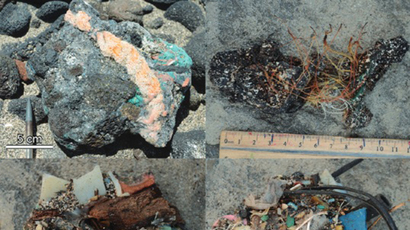
Image from geosociety.org
​‘Plastic stones’ found at remote Hawaii beach

The stream caught the attention of local environmental activists, who noticed the smell in the area.

The other day we came here you would think it was a beer pub that hadn’t opened its doors for three or four days,” activist Carroll Cox told local Hawaii News Now. She also contacted the Department of Health about the issue.

Local media took samples from the unusual stream and had them checked at a private laboratory. It tested positive for alcohol, containing 1.2% percent of the substance in its waters – nearly a quarter the content in regular beer and strong enough to cause a buzz.

Local health authorities got involved, and an investigation into the source of contamination was launched. It was learned that the stream was coming from a drain pipe that was traced back to a warehouse of Hawaii’s largest liquor distributor, Paradise Beverages. Its representatives told local media they were working with officials to eliminate a possible spill, with the booze river apparently closing its free drinks service.

Like this story? Share it with a friend!

find more fun & mates at SoShow now !

General Joseph L. Votel (Ret.) joined BENS as CEO & President in January 2020 following a 39-year military career where he commanded special operations and conventional forces at every level; last serving as the Commander of U.S. Central Command (CENTCOM) where he was responsible for U.S. and coalition military operations in the Middle East, Levant, and Central and South Asia. General Votel’s career included combat in Panama, Afghanistan, and Iraq and he led the 79-member coalition that successfully liberated Iraq and Syria from the Islamic State Caliphate. General Votel preceded his assignment at CENTCOM with service as the Commander of U.S. Special Operations Command and the Joint Special Operations Command.

The Cipher Brief:  Did you ever envision that the U.S. would pull out so quickly or completely leaving the Afghan military on its own without U.S. air support?  

General Votel: I did not anticipate this during my time – but once the President sets a hard departure date – then a fast withdrawal is inevitable.  No Commander wants to accept unnecessary risk with troops on the ground when you are up against a clearly articulated departure date.

The Cipher Brief: Intelligence assessments wildly missed the mark on how fast Kabul would fall, what factors contributed most directly to this? 

General Votel: Certainly, the departure of our own capabilities is a big part of this; the lack of direct contact with Afghan leaders is another important factor; and, of course, once it was clear that we were departing (and took our Commander out) — we lost priority and access with our normal and reliable Afghan intelligence sources.

The Cipher Brief: U.S. personnel are facing a deteriorating security situation at the Kabul airport while U.S. forces are still deploying for the contingency operation, another sign that the administration underestimated how fast the Taliban would reach Kabul. The U.S. could have chosen to slow the Taliban advance using airpower, why didn’t it happen, do you think? 


The Cipher Brief hosts private briefings with the world’s most experienced national and global security experts.  Become a member today.


General Votel: I think it is very clear that this was no longer a priority for our Government.  The mission right now, at least articulated over the weekend, is about supporting evacuation of the diplomats and helping with the departure of those Afghans who assisted the US and meet the criteria for evacuation.  While I don’t know this for certain — I believe what we were trying to do with over the horizon air support in a rapidly developing situation, was not optimal or overly effective.  It doesn’t seem to have done much – if anything.

The Cipher Brief: The U.S. has allowed U.S. supplied military hardware, weapons and technology to fall into the hands of the Taliban, a group responsible for the deaths of U.S. personnel and thousands of innocent Afghans.  The U.S. government holds private citizens and corporations accountable for far lesser violations of export violations involving dual-use technology or military equipment, etc.  How should Americans think about this situation now, where the Taliban will use equipment, paid for the by the U.S. taxpayer, to potentially perpetrate acts of violence against U.S. interests, and erode democratic values that the U.S. tried to introduce to Afghanistan?  

General Votel: Not sure on this.  Unfortunately, it is not the first time we have seen this — remember ISIS in 2014, in Mosul?  I suspect these will be more trophy pieces than they will be hard military capability – with the exception of small arms, mortars, and artillery.  Most of this will be difficult for the Taliban to sustain – and they probably prefer their own gear, anyway.

The Cipher Brief:  There is a lot of anger among the national security community right now.  What would you say to individuals who have suffered because of the U.S. role in Afghanistan, who may be feeling anger and rage?  

General Votel: I can’t really comment on anger in the national security community — I am sure that exists, but the sentiment that seems more strong to me, is disappointment.  No one wants what we are seeing now.  I think most security professionals can accept a decision to depart by the Commander in Chief — that is well within his authority, and everyone understands this; what is harder to accept is the manner in which this happened, and how it has played out.  It was hard for me to watch Taliban sitting at a conference table that I once sat at with the Afghan President.  In a number of public engagements, I have participated in lately – people have asked me if this whole effort was a waste.  My response has been consistent.  American military personnel, members of the IC and the diplomatic corps conducted themselves honorably throughout this war.  They responded when the Nation called and did their best for our Country, each other, and the Afghan people.  There will be plenty of time to place the blame – but the vast, vast majority of Americans who participated in some aspect of the Afghan War did so nobly and to the best of their ability.  We should not lose sight of this.  That this did not turn out the way we all hoped — is not their fault … and I would not want anyone (especially families of our wounded and killed) to think these efforts were in vain.  That is not how I thought about them at the time, and it is not how I think about them now.  They answered when the Nation called.

Have a perspective to share?  Email Editor@thecipherbrief.com

Read more expert-driven national security insight, perspective and analysis in The Cipher Brief


The post The Painful Lessons of Afghanistan appeared first on The Cipher Brief.

find more fun & mates at SoShow now !

Sports goods retailer Decathlon has said it won’t be selling canoes in its stores in northern France anymore because the light vessels are increasingly being used by migrants trying to cross into England.

“Given the current context… the purchase of canoes will no longer be possible” in Decathlon stores in Calais and Grande-Synthe, outside Dunkirk, the French retailer announced.

The two cities overlook the Strait of Dover, which is the narrowest point in the English Channel. Thousands of migrants have been using this spot in recent years to try to make the dangerous 34-kilometer-long sea journey from France to the UK.A lot of canoes aren’t being purchased for their original sporting purpose, Decathlon complained.

Read more

FILE PHOTO. ©REUTERS/Peter Cziborra
London & Paris trade barbs over Channel crossings

They “could be used to cross the Channel” and as a result of this, “people’s lives would be endangered,” it pointed out.

“We are committed to never putting our customers at risk in the use of our products, whatever the circumstances,” the company said. 

The initiative to remove canoes from the shelves came from the stores themselves and was backed by the head office, according to the retailer. However, Decathlon will keep selling the vessels online and in its other shops across France.

Last Thursday, two canoes were found adrift in the Channel near Calais, while two migrants were rescued from the water. The next day, three more people were reported missing after attempting to get to England using canoes.

Tensions between London and Paris are high after a record number of migrants – 1,185 – were able to cross the Channel a week ago. 

Britain said it was unacceptable” that France had let so many people slip through, but the French government insisted they were “neither their collaborators nor their assistants” and blamed the soaring crossings on the smugglers and the UK’s labor market, which makes the country attractive to people eager to work at low cost.”

Like this story? Share it with a friend!

find more fun & mates at SoShow now !

As India is mulling new rules for digital money, Prime Minister Narendra Modi has called for regulations to ensure cryptocurrencies like bitcoin do not “end up in the wrong hands,” warning that this could “spoil” young people.

While he did not expand on those concerns, Modi spoke on Thursday about the need for “democratic nations” to band together and deal with challenges posed by emerging technologies. He was delivering a virtual address at the Sydney Dialogue, an annual cyber-tech summit.

Noting that technology and data could either become “new weapons” for conflict or “instruments of cooperation,” Modi brought up digital currencies as an example of how it was important that like-minded nations “work together on this” to “ensure it does not end up in the wrong hands, which can spoil our youth.”

We are at a historic moment of choice. Whether all the wonderful powers of technology of our age will be instruments of cooperation or conflict, coercion or choice, domination or development, oppression or opportunity.

He also urged the development of technical and governance standards and norms, singling out the use of data, and called for renewed efforts to prevent manipulation of public opinion. In recent weeks, Indian authorities have raised concerns over claims of huge returns from cryptocurrency investment as well as its potential connections to money laundering, organized crime and terror financing.

Read more

© AP Photo / Charles Krupa
Bitcoin crashes after China rules all crypto-related transactions illegal

On Saturday, Modi chaired a meeting to formulate the country’s approach to digital currencies and examine their impact on the economy. According to The Economic Times, Indian officials are drafting regulations to propose a ban on all transactions and payments in cryptocurrencies, while allowing investors to hold them as assets, similar to gold, bonds and stock shares.

Citing unnamed sources familiar with the government’s discussions, the newspaper said there was a belief in policy circles that crypto markets needed to be regulated in order to tackle the problem of opaque advertising that exaggerates investment returns in order to attract young investors.

The sources informed the newspaper that draft legislation on the matter was expected to be forwarded to Modi’s cabinet for consideration in the next two to three weeks.

In September, China had banned all cryptocurrency transactions and crypto-mining.

If you like this story, share it with a friend!

find more fun & mates at SoShow now !

Palestinian Islamist group Hamas has called on Canadian singer Justin Bieber to cancel his upcoming concert in what it calls the “Zionist occupation state” of Israel.

Bieber announced his 2022 world tour dates this week, with a concert in Tel Aviv planned for next October. On Thursday, Hamas’ Artistic Production Department issued a statement, cited by the Palestinian Sawa news outlet, “condemning and denouncing” the performer. It called on the star to cancel the show and “boycott the Zionist occupation state in protest at its repeated crimes against the Palestinian people.” 

Read more

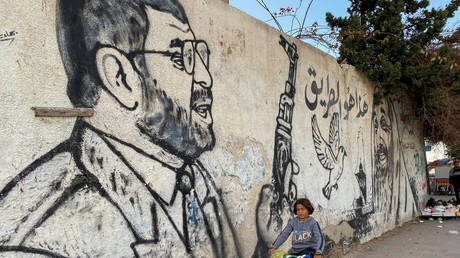
A Palestinian boy rides a bicycle past a mural depicting late Hamas leader Abdel-Aziz Al-Rantissi in Gaza City (FILE PHOTO) © REUTERS/Mohammed Salem
UK outlaws Hamas as terrorist organization

Bieber has performed in Israel multiple times, his last performance there having been in 2017 at Park HaYarkon – the same venue slated for next year. Since the announcement of the ‘Justice’ tour dates, calls for him to cancel the Tel Aviv show have gained momentum across social media, with many posters condemning the singer for supporting what one called an “apartheid state.”

Some noted that Bieber was set to arrive in Israel after performing in South Africa. “Justin Bieber is really going straight from SA to Israel. From a country that fought apartheid to a country that’s practicing apartheid,” one Twitter user complained.

A petition asking the singer to boycott Israel and exclude it from his tour has been launched online, and had garnered some 3,700 signatures by Friday. 

In 2018, the New Zealand singer Lorde canceled a concert in Israel, subsequently thanking fans for “educating” her on the issue, and, the same year, US artist Lana Del Rey at first defended her decision to perform in the country, saying her appearance would not be a “political statement,” before backtracking and canceling the gig.

Hamas has been designated a terrorist group by the US, the EU, and, as of Friday, the UK. In April 2021, international non-governmental organization Human Rights Watch concluded in a report that Israel had committed “crimes against humanity of apartheid and persecution.”

If you like this story, share it with a friend!

find more fun & mates at SoShow now !

Hundreds of major websites returned ‘404: not found’ errors after an apparent problem with Google Cloud. Alphabet said the problem was “partially resolved” after about ten minutes, but it will take time for everything to update.

The site Downdetector began showing a spike in reports of outages starting at 12:40pm Eastern time on Tuesday, affecting Google, Facebook, Instagram, Snapchat, Discord, Spotify, and TikTok, as well as e-commerce sites Target, Etsy, Shopify, and Home Depot, among others.

Amazon, Amazon Web Services (AWS), and Cloudflare were also affected.

Google’s Status Dashboard reported an unspecified “issue” with the Cloud service starting at 10:10 Pacific, which was causing users to encounter errors when accessing websites. 

“We believe the issue with Cloud Networking is partially resolved,” the company said by 10:17 PST, but it added that “Customers will be unable to apply changes to their load balancers until the issue is fully resolved,” and they did not have an estimate as to when that might be.

Think your friends would be interested? Share this story!

find more fun & mates at SoShow now !

French luxury giant Dior has taken down a controversial photograph that had been criticized in China for “smearing Asian women” by pandering to Western stereotypes while “distorting Chinese culture.”

The photo, which was part of the brand’s ‘Lady Dior’ exhibition in Shanghai, depicts an Asian model wearing a traditional dress and clutching a Dior handbag. It came under fire this week from Chinese media outlets for featuring “spooky eyes, [a] gloomy face and Qing Dynasty-styled nail armor.”

Read more

A screenshot from D&G's apology video © YouTube / Dolce & Gabbana
Dolce & Gabbana beg for forgiveness after ‘racist’ ad triggers backlash in China

Although Dior has not released a statement regarding the controversy, it confirmed to fashion trade publication Business of Fashion that the photo had been removed from the exhibition. The brand has also reportedly taken the photo off Chinese social media platform Weibo.

The image, which was shot by Chinese photographer Chen Man, had drawn both media ire and public outrage. However, there were apparently no calls for a boycott of the brand.

In an editorial on Monday titled “Is This the Asian Woman in Dior’s Eyes?”, the Beijing Daily paper had noted that the image makes Chinese consumers uncomfortable. The publication criticized Man for “playing up to the brands, or the aesthetic tastes of the Western world.”

For years, Asian women have always appeared with small eyes and freckles from the Western perspective, but the Chinese way to appreciate art and beauty can’t be distorted by that.

Warning that both the brand and the photographer had “gone too far,” the China Women’s News paper ran an editorial on Wednesday that claimed it “indicated their intention of uglifying Chinese women and distorting Chinese culture.”

Read more

RT
‘Deeply sorry’: Versace in hot water as China accuses fashion brand of questioning its sovereignty

“Again, from… Dior’s ghost-style picture, which makes the public feel uncomfortable, it’s easy to see some Western brands’ ‘pride and prejudice’ in their aesthetics and culture,” said the newspaper, which is run by the All-China Women’s Federation.

Meanwhile, the Global Times noted that the “lingering controversy could pose a delicate situation” for Dior and other global brands – for whom China’s “massive” luxury market was one of the biggest sources of revenue. The paper said that the Chinese public had become “increasingly sensitive” toward the depiction and treatment of Chinese people and culture by foreign companies.

While pointing out that Chinese social media users had demanded the company and photographer explain their intention, a number of media outlets also highlighted how some netizens had praised the photo as a departure from typical standards of beauty in the country, often characterized by “fair skin and large eyes.”

If you like this story, share it with a friend!

find more fun & mates at SoShow now !

An adviser to the EU’s top court has claimed that citizens’ information in Germany is being illegally harvested, after telecom companies challenged bulk data collection.

The German data retention law was criticized on Thursday by an adviser to the Court of Justice of the European Union (CJEU), who stated that general and indiscriminate retention of traffic and location data is only allowed in exceptional cases, such as a threat to national security.

According to the adviser, bulk collection of data generates a ‘serious risk’ of leaks or improper access. It also entails a ‘serious interference’ with citizens’ fundamental rights to privacy and the protection of personal data.

Read more

(FILE PHOTO) © REUTERS/Russell Cheyne
Google won’t pay for spying on UK iPhone users

This comes after two companies, SpaceNet and Telekom Deutschland, challenged the obligation to store their customers’ telecommunications traffic data in 2016. The Administrative Court of Cologne ruled that the two companies were not obliged to retain data because such an obligation violated Union law. Germany then appealed to the Federal Administrative Court, who asked the CJEU about the compatibility of the data retention obligation.

The CJEU has often stated that indiscriminate mass surveillance does not fit within the general principles of EU law. Over a year ago it saw a similar case involving legal challenges around national bulk data collection under UK and French law. The court then ruled that only limited data collection and temporary retention were allowed. France seeks to bypass the CJEU on data retention and has asked the country’s highest administrative court (the Council of State) not to follow the EU ruling. France is waiting for the conclusion of the procedure launched by the Council of State before “assessing to what extent” national law should be changed. 

Despite recent EU court attempts to curb surveillance powers, leaked papers from June 2021 show that the national governments of the Netherlands, France, Spain, Luxembourg, Slovakia, and Estonia are pushing for a new pan-EU data retention law. They claim that data retention is essential for safeguarding public security and ensuring effective criminal investigations.

Think your friends would be interested? Share this story!

find more fun & mates at SoShow now !