The International Criminal Court has halted an investigation into alleged rights abuses carried out by Philippines authorities as part of a harsh crackdown on the drug trade, saying it is reviewing a deferral request from Manila.

The ICC’s chief prosecutor Karim Khan said the probe was suspended after the Philippines government filed a request to defer the case earlier this month, according to court documents cited by Reuters on Friday. 

“The prosecution has temporarily suspended its investigative activities while it assesses the scope and effect of the deferral request,” he wrote, adding that the court is seeking more information from the government in Manila.

Based in The Hague, the ICC allows states to ask for postponements if they conduct their own investigations into the charges in question. President Rodrigo Duterte’s administration filed its deferral request on November 10, while the country’s Justice Ministry announced its own investigation into the alleged abuses late last month.

Read more

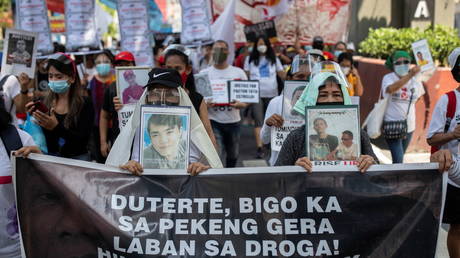
Relatives of drug war victims hold photographs of their slain loved ones with placards calling for justice (FILE PHOTO) © REUTERS/Eloisa Lopez
Philippines announces probe into thousands of killings during Duterte’s war on drugs as initial review suggests abuses took place

The court initially opened the probe in September over allegations that Philippines police had carried out thousands of extrajudicial executions and used other brutal tactics against suspected drug dealers, and that Duterte gave implicit backing to those actions. Activists have accused authorities of killing innocent people, including children, though the police insist they only use violence in self-defense.

While Duterte has declined to cooperate with the ICC probe, saying it has no authority on the island nation, and even pulled the Philippines out of the international body in 2019, the court has jurisdiction to investigate alleged violations committed by the country while it was still a member.

The president’s chief legal counsel, Salvador Panelo, confirmed the deferral request in brief comments to Reuters, saying “There is no inconsistency with the request for suspension of action,” though he did not elaborate.

Since its founding some 20 years ago, the ICC has successfully convicted just five people of war crimes or crimes against humanity – all leaders of armed movements in Africa, including in Mali, Uganda and the Democratic Republic of the Congo.

Think your friends would be interested? Share this story!

find more fun & mates at SoShow now !

The EU’s drug regulator has backed the emergency use of Merck’s pill for the treatment for clinically vulnerable Covid-19 patients as cases surge across the continent.

On Friday, the European Medicines Agency (EMA) “issued advice” backing the emergency use of the drug developed by Merck in collaboration with Ridgeback Biotherapeutics, although it has not yet been authorized by national authorities.

Read more

© Reuters / Piroschka van de Wouw
EMA green lights new Covid treatments

In a statement, the drug regulator said the medicine called Lagevrio – also known as molnupiravir or MK 4482 – “can be used to treat adults with Covid-19 who do not require supplemental oxygen and who are at increased risk of developing severe Covid-19.

It said the treatment should be administered as soon as possible after Covid-19 is diagnosed and within five days of the start of symptoms. The medicine should be taken twice a day for a period of five days.

The EMA listed the potential side effects of the capsules, including mild or moderate diarrhea, nausea, dizziness and headache. The treatment is not recommended for pregnant women.

The watchdog announced earlier on Friday that it had begun reviewing Pfizer’s medicine Paxlovid for Covid-19 with the same goal “to support national authorities” who may decide on its early use prior to marketing authorization in light of rising cases and deaths in Europe.

On Friday, Austria announced it would enter a new nationwide lockdown from Monday and make vaccination mandatory, while Germany’s health authorities claimed the country had turned into “one big outbreak.”

Both Pfizer and Merck have requested approval for their coronavirus medicines from the US Food and Drug Administration, but it is unclear when it might be granted.

Think your friends would be interested? Share this story!

find more fun & mates at SoShow now !

A pack of wild boars were rounded up and euthanized after one of the animals attacked a police officer in the streets of Hong Kong – the opening shot in a pitched battle between the feral hogs and the city’s law enforcement.

A group of veterinarians took seven wild boars into custody, euthanizing the beasts after knocking them out with dart guns in an area near the financial center of the city, according to a statement from Hong Kong’s Agriculture, Fisheries, and Conservation Department on Thursday.

The pigs were captured after one attacked a police officer last week, an act which reflects the city’s new policy toward the animals: stop them before they attack again.

The aggressive boar knocked down a police officer by biting his leg last week as the two faced off in a residential car park, the pig only losing the battle after falling off the building to its death. The wild boars are apparently “accustomed” to wandering back and forth along the roadway, begging for food from pedestrians and vehicles alike. Previously, the city had handled the population by capturing and sedating the animals, then relocating them to “remote areas,” according to the the department.

Hong Kong CEO Carrie Lam vowed to increase penalties for those citizens found feeding the boars, which have reportedly been responsible for some 30 attacks in recent years. While residents are warned not to feed the boars so as not to encourage population growth or disease outbreaks, the animals are a favorite among some visitors. Still, Lam insisted “we can’t simply sit on our hands while things deteriorate.”

Animal rights groups have responded with a protest letter against a policy of euthanasia, pointing out that most visitors do not feed the boars and arguing resources should be directed toward stopping the human activity rather than blaming all the boars. Allowing the boars to be captured and killed “ignores their right to live and considers their existence in urban areas as a capital offense,” the letter read.

Like this story? Share it with a friend!

find more fun & mates at SoShow now !

General Joseph L. Votel (Ret.) joined BENS as CEO & President in January 2020 following a 39-year military career where he commanded special operations and conventional forces at every level; last serving as the Commander of U.S. Central Command (CENTCOM) where he was responsible for U.S. and coalition military operations in the Middle East, Levant, and Central and South Asia. General Votel’s career included combat in Panama, Afghanistan, and Iraq and he led the 79-member coalition that successfully liberated Iraq and Syria from the Islamic State Caliphate. General Votel preceded his assignment at CENTCOM with service as the Commander of U.S. Special Operations Command and the Joint Special Operations Command.

The Cipher Brief:  Did you ever envision that the U.S. would pull out so quickly or completely leaving the Afghan military on its own without U.S. air support?  

General Votel: I did not anticipate this during my time – but once the President sets a hard departure date – then a fast withdrawal is inevitable.  No Commander wants to accept unnecessary risk with troops on the ground when you are up against a clearly articulated departure date.

The Cipher Brief: Intelligence assessments wildly missed the mark on how fast Kabul would fall, what factors contributed most directly to this? 

General Votel: Certainly, the departure of our own capabilities is a big part of this; the lack of direct contact with Afghan leaders is another important factor; and, of course, once it was clear that we were departing (and took our Commander out) — we lost priority and access with our normal and reliable Afghan intelligence sources.

The Cipher Brief: U.S. personnel are facing a deteriorating security situation at the Kabul airport while U.S. forces are still deploying for the contingency operation, another sign that the administration underestimated how fast the Taliban would reach Kabul. The U.S. could have chosen to slow the Taliban advance using airpower, why didn’t it happen, do you think? 


The Cipher Brief hosts private briefings with the world’s most experienced national and global security experts.  Become a member today.


General Votel: I think it is very clear that this was no longer a priority for our Government.  The mission right now, at least articulated over the weekend, is about supporting evacuation of the diplomats and helping with the departure of those Afghans who assisted the US and meet the criteria for evacuation.  While I don’t know this for certain — I believe what we were trying to do with over the horizon air support in a rapidly developing situation, was not optimal or overly effective.  It doesn’t seem to have done much – if anything.

The Cipher Brief: The U.S. has allowed U.S. supplied military hardware, weapons and technology to fall into the hands of the Taliban, a group responsible for the deaths of U.S. personnel and thousands of innocent Afghans.  The U.S. government holds private citizens and corporations accountable for far lesser violations of export violations involving dual-use technology or military equipment, etc.  How should Americans think about this situation now, where the Taliban will use equipment, paid for the by the U.S. taxpayer, to potentially perpetrate acts of violence against U.S. interests, and erode democratic values that the U.S. tried to introduce to Afghanistan?  

General Votel: Not sure on this.  Unfortunately, it is not the first time we have seen this — remember ISIS in 2014, in Mosul?  I suspect these will be more trophy pieces than they will be hard military capability – with the exception of small arms, mortars, and artillery.  Most of this will be difficult for the Taliban to sustain – and they probably prefer their own gear, anyway.

The Cipher Brief:  There is a lot of anger among the national security community right now.  What would you say to individuals who have suffered because of the U.S. role in Afghanistan, who may be feeling anger and rage?  

General Votel: I can’t really comment on anger in the national security community — I am sure that exists, but the sentiment that seems more strong to me, is disappointment.  No one wants what we are seeing now.  I think most security professionals can accept a decision to depart by the Commander in Chief — that is well within his authority, and everyone understands this; what is harder to accept is the manner in which this happened, and how it has played out.  It was hard for me to watch Taliban sitting at a conference table that I once sat at with the Afghan President.  In a number of public engagements, I have participated in lately – people have asked me if this whole effort was a waste.  My response has been consistent.  American military personnel, members of the IC and the diplomatic corps conducted themselves honorably throughout this war.  They responded when the Nation called and did their best for our Country, each other, and the Afghan people.  There will be plenty of time to place the blame – but the vast, vast majority of Americans who participated in some aspect of the Afghan War did so nobly and to the best of their ability.  We should not lose sight of this.  That this did not turn out the way we all hoped — is not their fault … and I would not want anyone (especially families of our wounded and killed) to think these efforts were in vain.  That is not how I thought about them at the time, and it is not how I think about them now.  They answered when the Nation called.

Have a perspective to share?  Email Editor@thecipherbrief.com

Read more expert-driven national security insight, perspective and analysis in The Cipher Brief


The post The Painful Lessons of Afghanistan appeared first on The Cipher Brief.

find more fun & mates at SoShow now !

Carving the turkey for Thanksgiving is a true honor for any man, and should be taken extremely seriously. Assuming you have no backup turkey, you have one opportunity to slice and carve it just perfectly, or your reputation with your family with be tainted forever. What better way to ensure you carve your Thanksgiving turkey properly and in the most manly way possible than with a chainsaw carving tool?

Turkey carving chainsaw.

The electric chainsaw turkey carving tool looks and acts like a real chainsaw, except it won’t actually cut wood, and it’s a much smaller version of its larger counterpart. Though a chain doesn’t wrap around the blade and spin like a real chainsaw, a small electric knife is on the bottom of the blade to make it look like it’s working like a real chainsaw.

Turkey carving chainsaw.

Made with stainless steel cutting blades along with an ABS plastic body, the chainsaw inspired turkey carving tool is not only great for cutting turkeys and other birds, but is also useful for cutting melons, pineapples, potatoes, breads, and more.

Chainsaw knife.

Turkey carving chainsaw.

Turkey carving chainsaw.

Turkey carving chainsaw.

Turkey carving chainsaw.

If you feel like this is something you would want to spend money on, you can get this weird kitchen tool on Amazon.

The post This Miniature Chainsaw For Carving Turkeys Will Take Thanksgiving To The Next Level first appeared on .

find more fun & mates at SoShow now !

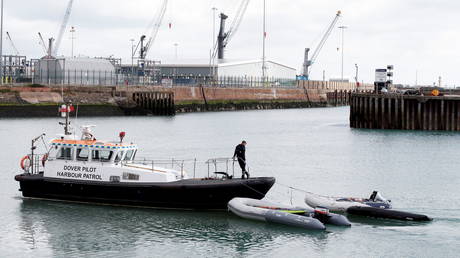
Sports goods retailer Decathlon has said it won’t be selling canoes in its stores in northern France anymore because the light vessels are increasingly being used by migrants trying to cross into England.

“Given the current context… the purchase of canoes will no longer be possible” in Decathlon stores in Calais and Grande-Synthe, outside Dunkirk, the French retailer announced.

The two cities overlook the Strait of Dover, which is the narrowest point in the English Channel. Thousands of migrants have been using this spot in recent years to try to make the dangerous 34-kilometer-long sea journey from France to the UK.A lot of canoes aren’t being purchased for their original sporting purpose, Decathlon complained.

Read more

FILE PHOTO. ©REUTERS/Peter Cziborra
London & Paris trade barbs over Channel crossings

They “could be used to cross the Channel” and as a result of this, “people’s lives would be endangered,” it pointed out.

“We are committed to never putting our customers at risk in the use of our products, whatever the circumstances,” the company said. 

The initiative to remove canoes from the shelves came from the stores themselves and was backed by the head office, according to the retailer. However, Decathlon will keep selling the vessels online and in its other shops across France.

Last Thursday, two canoes were found adrift in the Channel near Calais, while two migrants were rescued from the water. The next day, three more people were reported missing after attempting to get to England using canoes.

Tensions between London and Paris are high after a record number of migrants – 1,185 – were able to cross the Channel a week ago. 

Britain said it was unacceptable” that France had let so many people slip through, but the French government insisted they were “neither their collaborators nor their assistants” and blamed the soaring crossings on the smugglers and the UK’s labor market, which makes the country attractive to people eager to work at low cost.”

Like this story? Share it with a friend!

find more fun & mates at SoShow now !

A gunman injured two civilians, one of them fatally, and two police officers before being shot dead by security forces near Jerusalem’s Western Wall on Sunday morning, Israeli police said.

The civilian victims were taken to Shaare Zedek Medical Center. One, who was in his 30s, succumbed to his injuries at the hospital. The other, a 46-year-old, is said to have suffered moderate injuries. Two police officers were hurt by shrapnel.

In a video clip shared on social media and purportedly filmed at the scene, multiple gunshots could be heard amid agitated shouting. Security officers could then be seen standing around what appears to be a dead body. Witnesses speculated it was that of a “terrorist.”

The gunman, whose identity was not immediately disclosed, was killed during the incident. Police said he had used a homemade submachine gun.

DETAILS TO FOLLOW

find more fun & mates at SoShow now !

When The Washington Post reported this week that CIA Director William Burns slipped into Afghanistan on Monday to meet with Taliban leader Abdul Ghani Baradar, it was described as the highest-level face-to-face encounter between the Taliban and the Biden Administration.  WaPo cited anonymous sources for the information and the CIA offered no immediate comment on the reporting.  If the reporting is accurate, it doesn’t answer any immediate questions about why the President would dispatch the CIA director for such a meeting.

What we do know, is that the unexpected advances of the Taliban that have dominated the headlines over the past week and a half were initially blamed on an intelligence failure by many.  Early on, Cipher Brief Expert and former Acting Director of CIA John McLaughlin tweeted that “The ‘intelligence failure’ drumbeat is starting. People should be careful about the charge if they have not actually seen/read the intelligence…”

So, what intelligence did the US have that would have led to a different outcome in Kabul and throughout the country?

  • The New York Times reported last week that “classified assessments by American spy agencies over the summer painted an increasingly grim picture of the prospect of a Taliban takeover of Afghanistan and warned of the rapid collapse of the Afghan military, even as President Biden and his advisers said publicly that was unlikely to happen as quickly.” The paper cited current and former US government officials, saying, “By July, many intelligence reports grew pessimistic, questioning whether Afghan security forces would muster serious resistance and whether the government could hold on in Kabul, the capital.”
  • On August 15, The Wall Street Journal reported that administration officials said they knew that a “total capitulation of the Taliban was a possibility, and they planned their withdrawal efforts accordingly.” But they also cited an administration official, saying “it wasn’t so much a failure in intelligence in which the administration based its decision, but rather, a change in circumstances brought about by the swift U.S. withdrawal.”

But private sector analysts were watching as well. Here’s an inside look at what The Cipher Brief has been publishing since January with key outtakes from Cipher Brief Expert Tim Willasey-Wilsey:

Brief: January 25, 2021

“The Afghans themselves are also monitoring the Washington newsfeeds in forensic detail and will be encouraged by Sullivan’s statement. Recently, all too many conversations in Kabul have been about when to leave and which route to take. Some wealthier Afghans already have their money in Dubai and children in foreign universities. Some even have passports and property in the United States, UK or Germany. For those who are less fortunate, the discussions are about which route to take out. The Uzbekistan border is favoured because a visa costs just $30 and there is a variety of onward routes via Turkey or Russia to the West whereas the routes via Iran or Pakistan are more restrictive or liable to interference.”

Brief: March 11, 2021

“Saleh will advise Ghani not to take Taliban or Pakistani promises on trust. Instead, Ghani may decide to call Washington’s bluff. He may doubt that Washington is really willing to abandon Afghanistan on 1st May with the risk of a rapid Taliban victory jeopardising all the hard-won advances in areas such as women’s rights and counterterrorism over the past 20 years. The spectre of Al Qaida re-establishing camps in Afghanistan would surely be too much for Biden and Blinken.”

“Even if there were no helicopters from the US Embassy roof, the TV pictures of the Taliban entering Kabul, and of Afghan refugees fleeing their advance could evoke memories of Saigon in 1975. The reimposition of Taliban curbs on women would provoke international opprobrium. And subsequent reports of AQ training camps being re-established in Afghanistan would bring back recent and painful memories. After all the blood and treasure expended in Afghanistan that would be a disastrous outcome.”

Brief: April 19, 2021

“The Afghan government may be able to hold on to power for a few years as the Najibullah administration survived after the Soviet departure. However, there is a danger that there will be a sudden dam-burst in confidence with senior officials and politicians leaving en masse and hundreds of thousands of refugees fleeing westwards through Iran, Pakistan and the Central Asian Republics. As the Taliban re-enter Kabul, we could see disturbing scenes of retribution and, in time, the return of Al Qa’ida figures from their hiding-places in the tribal borderlands in Pakistan. Only then will people re-examine this decision and recognise that the Afghan deployments since 2014 have not been that onerous.”


The Cipher Brief hosts private briefings with the world’s most experienced national and global security experts.  Become a member today.


Brief: June 1, 2021

“According to my sources, the Taliban are convinced they can take Kabul “within days” of the NATO withdrawal and they believe the Afghan army is “in a shambles and demoralised”. Although the Taliban will not disrupt departing US troops (unless attacked) they are not willing to wait until September to continue their campaign against Kabul government forces.”

“But we should not take much comfort from the Najibullah example. The comparisons with today’s Afghanistan are misleading. Najibullah’s government was able to reach and supply all the major towns by military convoy. The Afghan army was deployed to protect towns and road communications. By contrast, in 2021, only the route between Kabul and Jalalabad is reasonably safe. Convoys cannot get through from Kabul to Kandahar, Kandahar to Herat, or Kabul to Mazar-e-Sharif. The Afghan army is spread across the country in piecemeal district centres (often surrounded by Taliban-controlled countryside) and have to be resupplied by air. This is not a sustainable model.”

“Furthermore, a number of today’s Afghan leaders, officials and military officers have received offers to relocate to the United States, Germany and elsewhere. As the security situation continues to deteriorate, the gradual trickle of departures is likely to gather pace. In such circumstances, the government could implode quite suddenly.”

“To some, this may evoke images of the 1975 fall of Saigon with the big losers being the Afghans who remain, particularly the women, who face a future of uncertainty and anxiety. There could also be a migration crisis reminiscent of Syria in the last decade.”

Brief: June 28, 2021

“One key indicator is that Afghan security forces have begun to surrender to the Taliban. The procedure is quick and simple. Tribal elders are used to deliver a stark message to Afghan troops often holding positions in district centres. The message is often; “The non-believers are leaving Afghanistan. They are defeated. Your leaders are corrupt. You can surrender now, and we will protect you; or you can fight, and we will kill you.” Recently, the Taliban appear to have honoured their promise not to punish Afghan soldiers who surrender. News of this new-found leniency is likely to encourage other units to follow suit and lay down their arms. In several provinces, including in the north, the Taliban are tightening their grip on those cities which are still held by the government. The Taliban will soon be in a position to cut off food supplies and demand their surrender, possibly offering a similarly lenient dispensation to the population. Now that the Taliban possesses captured armoured vehicles and artillery, their ability to exert pressure on the cities is enhanced. In Kabul, a sense of panic has begun to grip the capital. There are desperate attempts to sell family homes but there are no buyers even when houses are on the market at one tenth of their previous value. Some families have departed to Tajikistan, conscious that several of the land border crossing-points with the Central Asian Republics have been captured by Taliban forces in recent weeks.”

Read also Putin’s Calculated Afghanistan Play from Cipher Brief Expert Robert Dannenberg


The Cipher Brief hosts private briefings with the world’s most experienced national and global security experts.  Become a member today. 


Read more expert-driven national security insight, perspective and analysis in The Cipher Brief


The post What Intelligence was there on Afghanistan? appeared first on The Cipher Brief.

find more fun & mates at SoShow now !

Colder weather is settling in around much of the globe and after a year and a half of managing a global pandemic, energy markets are more complicated than ever.  The U.S. petroleum inventory is at its lowest level since 2015, the UK is experiencing a severe energy crisis, Russia continues to push Germany on the Nordstream II pipeline and winter has already come to China, which has experienced weeks of rolling blackouts. What does all of this mean as both state and non-state cyber actors continue to take aim at energy infrastructure?

The Cipher Brief spoke with energy expert Norm Roule, a top adviser on energy issues, to get a sense of where we’re headed.

Norman T. Roule served for 34-years in the Central Intelligence Agency, managing numerous programs relating to Iran and the Middle East.  He served as the National Intelligence Manager for Iran (NIM-I) at the Office of the Director of National Intelligence from November 2008 until September 2017.  As NIM-I, he was the principal Intelligence Community (IC) official responsible for overseeing all aspects of national intelligence policy and activities related to Iran, to include IC engagement on Iran issues with senior policy makers in the National Security Council and the Department of State.

The Cipher Brief: Give us a brief snapshot of the global energy market today and what you think we will see in the coming months.

Roule: The energy market is working through what will hopefully be the final phase of a perfect storm of market distortions ignited by the pandemic and influenced by shifts in capital markets and climate change initiatives. I say the final phase because most countries are returning to growth and pre-pandemic energy consumption. Most of the drivers of this final phase will likely push prices upward in the near term. A few involve long-known issues that are now coming into play. A few remain unpredictable. Ancillary industries that rely on oil, gas, or distillates as significant feedstocks will either raise prices or shift production to areas with less exposure to hydrocarbons. In short, in the coming weeks, consumers should expend to not only pay more at the gas pump but at the supermarket and mall.  We are likely to see relief in the Spring as the pandemic and supply chain distortions wane, seasonal demands on oil and gas pass, and energy producers ramp up operations to exploit high prices. China’s economy also shows signs of slowing, and financial packages meant to jump-start global economies will run their course.

The Cipher Brief: Energy markets seem more complicated than ever. What are the primary variables at play?

Roule: Global oil consumption is now back to 100 million barrels per day, a statistic last seen when the pandemic hit. Production is up, but the most crucial trend in recent months has been the deep draw on the glut of oil stocks during the pandemic. Producers – especially OPEC – have constrained production to reflect their cautious approach to market stability and their desire to reduce the stockpiles accumulated during the pandemic. As a result, stocks are now lower than before the pandemic. If you exclude the strategic petroleum reserve, the U.S. petroleum inventory is at a level not seen since 2014-2015. Stockpiles at Cushing are at a similar level. U.S. gasoline stocks are around five million barrels below pre-pandemic seasonal averages.

U.S. producers have consolidated, and the industry prioritizes return on equity over expansion, particularly in a political environment that is increasingly hostile to hydrocarbon production. As a result, U.S. oil production is still about 1.7 million barrels a day below pre-pandemic levels. Add to this the push to reduce carbon emissions, gas supply cuts, and some supply chain distortions, and you get a surge in gas prices and a need for oil (and coal) to replace gas in electricity production, as we see in China.

The Cipher Brief: The administration seems to be blaming OPEC plus for high oil prices. What’s happening within the cartel?  How does the cartel see the current energy market?

Roule: OPEC’s role in oil markets remains deeply significant. The cartel produces 40 percent of the world’s oil, but 60 percent of the world’s total traded exports. That inevitably gives it an important voice. It is also clear that OPEC+ leaders remain confident in their strategy to maintain market stability and benefit from prices that are not so high that they ignite demand destruction. OPEC discipline during this turbulent period has been quite good, especially given that it is far from a monolith of views and capabilities. For example, the UAE would likely support additional production. Moscow makes positive noises about its willingness to increase production, but it follows Riyadh’s lead for the revenue and political advantage it derives from the current market.  

Riyadh remains the architect of OPEC’s approach. Kuwait and Baghdad seem comfortable with this strategy. Production restraint is made easier because about half of OPEC’s members reportedly are unable to meet production quotas due to technical problems, mismanagement, or a lack of capital investment. This list includes Angola, Gabon, Equatorial Guinea, Nigeria, Libya, and Venezuela.  

OPEC decision-making likely rests on a handful of variables, some predictable, others not. The cartel has done well in its assessments of global recovery and pandemic impact. But questions remain on aviation recovery. Likewise, even their best analysts have a tough time predicting the impact of speculators, weather trends, and the future of sanctions on Iran and Venezuela. Riyadh and Abu Dhabi will do what they can to avoid the financial and political consequences of inflation and any energy-instigated recession.

The strains in US-Saudi relations appear to have undermined Riyadh’s sympathy for Washington’s challenges. The Saudis are tired of being a political target within the U.S. They also seem to believe that while the U.S. touts itself as being interested in only renewable energy sources, it has no problem criticizing the Kingdom when high gas prices become a political issue. Last, we should recall that it was only in May 2020 that a group of Republican Senators publicly called on Saudi Arabia, demanding that it stabilize the energy market. From Riyadh’s perspective, it has done precisely that.

The Cipher Brief: Are the Gulf oil producers serious about renewable energy? 

Roule: Absolutely. Regional leaders certainly understand the consequences of climate change for their people. In recent years, the region has experienced some of the highest temperatures on record, causing concern that, if unchecked, the trend could make portions of the Middle East unlivable.

But their approach is different from ours and as we all know, Gulf economies rely heavily on revenues from hydrocarbons. To varying degrees, all the Gulf states are trying to diversify their economies. But they also want to avoid a situation in which they are stuck with stranded strategic assets. In the West, our climate narrative tends to focus on ending the use of hydrocarbons. As with Norway, Gulf producers claim that they will use the resources from their oil revenues to fund the transition to a new energy economy.


Join The Cipher Brief for Members Only expert conversations on issues related to economic and global security.  Become a member for just $10 a month and then join us for a Members Only Brief with Norm Roule on Thursday, November 18 at 1:30p.  Members receive invitations via email.


Their focus tends to be a balance between a reduction of emissions and reduction of hydrocarbon use. Recent weeks have seen multiple significant events in the Gulf in which they tried to highlight their decision to expend resources and political bandwidth on green technologies, hydrogen production, and carbon capture solutions. We will also see increasing efforts to plant trees and to rely on natural gas instead of oil for power generation. They also claim they will try to end gas flaring and reduce methane emissions. I don’t think these efforts will satisfy Western environmental activists who demand an end to oil use, but the trend is undeniable.

The Cipher Brief: What is happening with U.S. oil and gas producers?  How are they responding to changing conditions?

Roule: Much has changed in the last two years. First, the sector underwent significant consolidation. The larger publicly-held companies must satisfy investors and financial institutions with a steady return on equity over the growth. Washington has cooled on its support for the industry. The decision to kill the Keystone Pipeline and limit drilling on federal property has contributed to industry reluctance on expansion. Last, some investors are pushing for companies to devote more attention to renewable energy sources.  During the pandemic, this reduced capital investment to about half of average expenditure, thus producing our current limited production capacity. U.S. rig count has significantly improved over the past year, but not on a scale that would return U.S. production to pre-pandemic levels. In the near term, smaller privately-held firms are likely to spend the resources to expand production with public firms following once they get a sense of what 2022 will bring.

The results speak for themselves. At the beginning of the pandemic, the U.S. produced around 12.8 million barrels of oil per day (BPD). By May 2020, production declined to 9.7 million BPD, and with recovery is now approximately 11.3 million BPD.  We are once again a net importer, bringing in about 1.3 million BPD in October.

We have seen a broader recovery in gas production, particularly in Texas. But a lack of production, low stockpiles, and unprecedented demand from abroad means consumers will face high bills if winter is severe or the risk of short supplies. Beyond heating, gas-fired power plants produce more than 50% of New England’s electricity, for example, so that any price spike will play out elsewhere in the economy.

The Cipher Brief: Is there a policy response to this situation?

Roule: I think policymakers globally are praying for a mild winter. But beyond this, policy options are few in the near term. A release from the strategic petroleum reserve (SPR) is conceivable. Still, we should remember the SPR was established for national emergencies and not a piggy bank to manage gas prices in an election year. Domestic producers will take a while to ramp up production, but policymakers will find this tough to seek in the current political environment. The administration could ban oil and gas exports or allow Congress to pass legislation enabling the federal government to sue OPEC for its cartel activities. Either step would invite predictable and unwelcome diplomatic consequences. 

Although the American public demands cheap energy, it isn’t enthusiastic about supporting the infrastructure needed to achieve this, even if the power is produced elsewhere.  Let me cite a couple of recent examples:

• Maine voters just rejected the construction of a billion-dollar electric line that would have delivered Canadian hydro-power electricity to New England.

• The administration is wrestling with a decision as to whether it should shut a pipeline that carries crude oil from Canada to refineries across Wisconsin, Michigan, and the Great Lakes region. 

If the administration hopes to convince OPEC members to increase production, it will improve relations with Gulf Arabs. It might be possible to convince Saudi Arabia, Kuwait, and the UAE to lift production to cover the exports of OPEC members unable to meet their production quotas. In an extreme situation, the administration might consider a temporary oil export waiver to Iran as a sign of goodwill. I think the political blowback on the latter rules it out, but the possibility is there. 

The Cipher Brief: The United Kingdom seems to be working its way through a severe energy crisis. How did this happen, and what are its policymakers doing in response?

Roule: The United Kingdom’s energy challenge is significant. As with other countries, it faces consequences of production limitation and the need to turn to more climate-friendly energy sources.

A few basics.  Gas produces about 40% of the country’s electricity and heats many of its homes. Once London could rely on the North Sea for its gas; it now imports about half of its gas requirements.  Norway is its primary gas source, but it also depends on gas producers in the U.S., Russia, Qatar, Belgium, and the Netherlands. To add to its woes, the U.K.’s storage capacity would survive only a short period of peak consumption. In 2017, London closed a massive Rough, which accounted for 70% of the country’s entire gas storage system. At the time, London believed it could rely on the global LNG market for reliable and cheap gas. Unfortunately, most LNG tankers head to Asia, a trend that can only increase as power-hungry Asian countries wean themselves from coal and oil.

The exploitation of new energy sources in the U.K. is no less contentious than in the U.S. A good illustration of this would be the tussle over the development of the Cambo oil and gas field in the waters near Scotland. Opposed by environmentalists who cite the inevitable carbon emissions the project and its oil would produce, the project offers to ease London’s energy woes and provide around a thousand jobs. The Johnson government has yet to indicate whether it will approve the project.

London’s options are few and leaving the country reliant on market conditions means risking shortages. For this reason, it has reportedly asked Qatar to agree to become the “supplier of last resort” in case global suppliers are unavailable. 


Go beyond the headlines with expert perspectives on today’s news with The Cipher Brief’s Daily Open-Source Podcast.  Listen here or wherever you listen to podcasts.


The Cipher Brief: What’s the Russian angle to the energy story?

Roule: Upfront, I think we should worry whether Russia will perceive the energy crisis as offering an opportunity for aggression. What if Moscow decides its gas hold over Europe allows it to invade Ukraine without penalty? Or as a means of pushing German regulators to accelerate their approval of the Nordstream II pipeline?

Moscow insists that it is meeting contractual obligations and that its exports have increased in the past year. At the same time, there are routine reports that Russia’s gas supplies to Europe have not only not met requirements, but that gas flow reversed in the Yamal-Europe pipeline. Russia also maintains eight gas storage sites in Europe to help manage supply during high-demand periods. Gas levels at these sites are currently low. Critics claim Gazprom diverted production to Russian domestic storage and that exports in October fell to the lowest level since 2014. When pressed, Moscow explains shortages saying that it must fill its winter supply stocks and expects to send Europe additional gas this week. 

But if the current energy dynamic seems to be in Russia’s interest, Moscow’s long-term prospects are dim. A global shift to renewable energy sources forces Moscow to reckon with the prospect of holding a massive oil infrastructure of little commercial value. If so, future historians may look at the recent Glasgow climate summit as a significant step in accelerating Russia’s decline, possibly a new era of aggression as it seeks to accumulate power ahead of this decline or a more competitive race for market share against OPEC members.

The Cipher Brief: What about China?

Roule: No major country has endured such energy problems in recent months as China. After weeks of rolling blackouts, China looks well on its way to solving its coal problems that partially contributed to this situation. That won’t delight environmentalists, but it should ease China’s electricity problems and ensure its citizens stay warm this winter. Winter arrived early, and Beijing is about to see its first snow of the season. China’s efforts will be put to the test in a winter that many expect to be colder than 2020.

Longer-term, China still must work through the causes of this crisis. If the global economy continues to surge demand for Chinese products, its energy requirements will grow. Weather problems cut wind production; floods shut mines. We shouldn’t be surprised if such problems continue. Inevitably, China can only meet its climate goals by shifting from coal to natural gas, raising prices for other consumers.

The Cipher Brief: Let’s shift to North Africa.  Algeria recently closed a long-established pipeline that transited Morocco to deliver gas to Spain.  Will this impact Europe’s already tight gas situation? What’s the story here? 

Roule: Over the past year, Algerian relations with Morocco have steadily deteriorated.  In addition to their traditional disagreement over the status of Western Sahara and the Polisario, Algiers criticized Morocco’s renewed ties with Israel and accused Rabat of supporting an opposition group that Algeria claims ignited forest fires. Algiers closed its airspace to Moroccan flights and accused Morocco of killing several Algerian citizens in the Sahara region.

Here’s how it touches the energy picture. On 31 October, Algiers closed an 800-mile pipeline that carried Algerian gas to Spain via Morocco and the Strait of Gibraltar.  The closure cost Morocco a portion of the gas it used from the pipeline. Morocco used this gas to produce about a tenth of its electricity. Rabat claims it can use other energy sources for this purpose. However, Spain has little gas and derives a significant portion of its electricity from that which it must import. Algiers claims it will make up the loss through a secondary pipeline, but the loss of gas will compound the energy problems of Spain and Europe in general.

The Cipher Brief: Any other issues on the horizon we should consider?

Roule: A growing number of aging refineries in the West will be closed in the coming years.  However, Asia is the new center for refinery construction. This expansion will draw even more crude to the region for processing with the inherent impact on local economies and global consumers.

The Cipher Brief: Last, let’s touch on wild cards. What are the grey swans that might impact markets in 2022?

Roule: With low stockpiles and supplies, the energy topography is ill-prepared to sudden shocks to its production or distribution architecture. Yet, it faces three threats that have grown in the last decade.

First, we have climate change issues.  Increasingly harsh weather events have shut down large portions of the production and refinery sectors in the United States and Mexico, sometimes taking weeks to restore normal production. Second, we have the universe of cyber threats.  State and non-state cyber actors routinely probe or attack every aspect of the energy industry. Last, we have new geopolitical pressures.  Tensions are rising with China as well as Iran and its proxies. Three of the world’s six most significant shipping channels are in the Middle East and a fourth in Asia.

Join us for a Members Only Brief with Norm Roule on Thursday, November 18 at 1:30p.  Cipher Brief Members receive invitations via email.

Read more expert-driven national security insights, perspective and analysis in The Cipher Brief

The post Winter is Coming: Global Energy Markets and the Impact on National Security appeared first on The Cipher Brief.

find more fun & mates at SoShow now !
Mark Kelton, Former Deputy Director, CIA’s Counterintelligence, National Clandestine Service

Cipher Brief Expert Mark Kelton is a retired senior Central Intelligence Agency executive with 34 years of experience in intelligence operations. Before retiring, he served as CIA’s Deputy Director for Counterintelligence.  He is a partner at the FiveEyes Group and is Board Chair of Spookstock, a charity that benefits the CIA Memorial Foundation, the Special Operations Warrior Foundation and the Defense Intelligence Memorial Foundation.

EXPERT PERSPECTIVE — Winston Churchill’s 04 June 1940 speech in which he vowed that he and his countrymen would “fight on the beaches “and would “never surrender” in the face of a seemingly inevitable Nazi invasion is rightly renowned as perhaps history’s most famous address by a wartime leader.  Less well known, however, is the cautionary tone the new Prime Minister struck in that same appearance before the House of Commons, as he sought to temper the joy and relief engendered by the seemingly miraculous extraction of the British army from the beaches of Dunkirk.  “We must,” Churchill warned, “be very careful not to assign to this deliverance the attributes of a victory.”  “Wars” he admonished, “are not won by evacuations.”

Shortly before the 2011 Abbottabad operation that killed Osama bin Laden, I was asked by my HQ, my views on mounting an assault on the target we knew as Abbottabad Compound 1, (AC1) given that we were not sure it sheltered the terrorist leader.  After expressing my 95% confidence that the Al Qaeda (AQ) leader was in fact, there, I allegorically added that we must strike as ‘you cannot leave Hitler in his bunker and end the war’.  I was fortuitously, right in my assessment that the murderer of so many innocents was present within AC1.  Sadly, however, his death did not bring our war with radical Islamic terrorism to a conclusion.  As was the case after Dunkirk, our enemy was unwilling to quit the field or to limit his unbounded war aims.

Likewise, we should have no expectation that the withdrawal of our forces from the Afghan theater of combat signals an end to the conflict with terrorists who started that war by attacking us on September 11, 2001.  We cannot unilaterally declare an end to the War on Terror by leaving Afghanistan – however much we might wish to do so – for the very simple reason that our enemies do not share that desire.  As former Defense Secretary Leon E. Panetta put it, “I understand that we’re trying to get our troops out of there, but the bottom line is, we can leave a battlefield, but we can’t leave the war on terrorism, which still is a threat to our security.”

The Taliban parading of the American-made weapons and accoutrements of their defeated foes was, in a manner akin to that of ancient Rome, intended not only to celebrate victory.  It was also meant to humiliate the vanquished.   Such triumphal demonstrations – and what will be a galling celebration of the anniversary of 9/11 as their own holiday to follow – will evoke enthusiastic responses from Islamic extremists and will draw many new adherents to the cause that lies at the core of Taliban legitimacy and belief.

As was the case when we left Iraq and later had to go back into the region to crush the ISIS Caliphate that metastasized in the wake of our departure, there is every prospect that the Taliban’s success will breathe new life into Islamic extremist groups.  And there is no reason to believe that the “new” and now much more heavily armed Taliban – an organization that refused to break with AQ over the course of a brutal twenty-year battle, will be any less receptive to working with Islamic terror groups than were their pre-9/11 forebears.


The Cipher Brief hosts private briefings with the world’s most experienced national and global security experts.  Become a member today.


“We are going to have to maintain very, very intense  levels of indicators and warnings and observstion and ISR [Intelligence, Surveillance, Reconnaissance] over that entire region to monitor potential terrorist threats”, said Chairman of the Joint Chiefs, General Mark Milley in a recent interview, adding it will not be easy.

As CIA Director William Burns said during Senate testimony in April, “Our ability to keep (the) threat…in check in Afghanistan from either al Qaeda or ISIS…has benefited greatly from the presence of U.S. and coalition militaries on the ground and in the air fueled by intelligence provided by the CIA and our other intelligence partners.” With the withdrawal of the American military, Burns said, “the U.S. government’s ability to collect and act on threats will diminish.”

Much discussed ‘over the horizon’ intelligence collection against Afghan terror targets will not fill the void left by the loss of our ability to monitor and attack terrorist targets from in-country bases.  With Afghanistan bordered by countries unlikely to be willing to host a significant US presence, intelligence collection missions will now have to be launched from bases well beyond the horizon with all that implies for the quantity, quality and timeliness of intelligence collected.  Such operations will also be commensurately more expensive and difficult to mount.  Moreover, the intimate knowledge of our adversaries that we have painstakingly built over the course of nearly 20 years on the ground, began aging the moment we departed Afghanistan.  Absent an intelligence presence on the ground, our ability to collect on terrorist groups operating in and from that country will only degrade further as time goes on.

After acknowledging that we “could see a resurgence of terrorism out of the region in the coming 12-36 months”, Milley went on that we will, “as opportunities present themselves… have to continue to conduct strike operations if there’s a threat to the United States.”  However, as our pre-9/11 experience showed, such remote strikes can delay our terrorist enemies’ plans, but will not deter them from their intent to strike the US homeland.

As such, Secretary Panetta is undoubtedly correct in his conclusion that US involvement in Afghanistan is not over.  “We’re going to have to go back in to get ISIS,” Panetta said.  “We’re probably going to have to go back in when al-Qaeda resurrects itself, as they will, with this Taliban.”  And, as was the case with our operations to destroy ISIS’s so-called Caliphate after we precipitously left Iraq, there can be no doubt that should we have to go back into Afghanistan, our task will be greatly complicated by the manner in which we left that country, abandoning our allies and bases there.


Go beyond the headlines with expert perspectives on today’s news with The Cipher Brief’s Daily Open-Source Podcast.  Listen here or wherever you listen to podcasts.


The US withdrawal from Afghanistan will have profound geo-strategic implications for America’s position in the region and in the world.  Our Chinese, Russian and Iranian adversaries will seize the opportunity to fill the void left in the wake of our departure.

The Taliban has already indicated it will engage with China, which covets Afghanistan’s mineral wealth.  Entry into a transactional relationship with the cash-strapped Taliban regime and granting access to Afghan mineral resources – and possibly use of Bagram Air Base – in exchange for financial aid and Chinese support for the Taliban in international organizations would suit Beijing, which would evince no concerns about human rights and the like.

For their part, Central Asian countries will look away from Washington and ever more towards their old masters in Moscow and a rising China to ensure their security and economic well-being.   Islamabad, while publicly celebrating the victory of their Taliban proxies and its role in guiding it, must at the same time worry that the extremism embodied by the victors will gain renewed traction beyond its frontier provinces with all that implies for the security of the Pakistani state.

Caught by surprise by Washington’s decision to leave and the conduct of the withdrawal, even our closest and oldest allies are questioning US resolve.  They will surely think twice before acceding to any future US request to join in joint operations.  Our decision to quit Afghanistan, and its messy execution, will also evoke questions about the validity of American assurances to other nations under threat from aggressors.  It will not have been lost on them that the withdrawal of American air, intelligence, planning expertise and logistical support ensured the collapse of an Afghan Army that was dependent on the US.

Our adversaries, too, will see the chaotic nature of our departure as well as the abandonment of Americans, allied citizens and Afghans to uncertain fates as signs of weakness and enfeeblement.   This possibility is particularly dangerous in that they could seize this moment of US distraction to engage in opportunistic adventurism that could include movement by China against Taiwan; a Russian attempt to resolve its impasse with Ukraine forcibly; stepped-up Iranian prosecution of its proxy war with Israel; or a further ramping up by North Korea of its nuclear program.  Any such eventuality would force the US to respond vigorously or risk further erosion of its international credibility.

Finally, the costs involved in remotely monitoring and trying to deter threats emanating from a Taliban-controlled Afghanistan mean that we will be unable to shift intelligence and military resources away from the War on Terror to confront the threat posed by peer competitors to the degree we had hoped.

Aristotle is said to have pronounced, “You will never do anything in this world without courage. It is the greatest quality of the mind next to honor.”  Likewise, the courage shown by so many – and the heroic conduct of US military and CIA personnel in particular – in seeking to extract American citizens from Afghanistan and to honor our obligations to Afghans who worked and fought alongside us for so long, cannot obviate the dishonor attendant to having left so many behind.  Bloody Taliban outrages and reprisals against the latter are a certainty.

It will not be long before Kabul’s new rulers recognize that the Americans now under their control, are potentially useful pawns in trying to extract diplomatic, financial and other concessions in exchange for their freedom.  The effectiveness of our efforts hereafter to extract our own people and our Afghan allies from the clutches of the Taliban and how we respond to any attempts to use them as leverage against us, will determine the depth of the stain on our national honor already attendant to the disastrous end of our Afghan campaign.

In that same famous speech, Churchill solemnly told his countrymen that: ‘The Battle of France is over: The Battle of Britain is about to begin.”  He went on that “we would be well advised to gird our loins for the continued warfare to come.”

As we approach the 20th anniversary of 9/11, we should honor our sacred dead from that horrible day.  But we should likewise prepare ourselves for the battles with Al Qaeda and its murderous kindred of Cain that will surely come.

Recent polls would indicate that Americans support the decision to withdraw from Afghanistan, if not the way in which it was conducted.  One wonders how those polled would have responded if the question had been ‘Do you support a withdrawal from Afghanistan even if it markedly increases the chance of terror attacks and atrocities directed at your fellow citizens at home and abroad?’  I fear we will find out soon enough.

Read more expert-driven national security insights, perspective and analysis in The Cipher Brief

The post Wars are not Won by Evacuations appeared first on The Cipher Brief.

find more fun & mates at SoShow now !