Controversial agriculture laws that saw farmers across India protesting for over a year are going to be rolled back, Prime Minister Narendra Modi has unexpectedly announced.

“I want to tell the country that we have decided to repeal the three farm laws,” Modi said in a televised address on Friday, which local media described as “stunning.”

The Indian parliament will complete the constitutional process of repealing the agricultural legislation in late November, he added.

However, the PM again defended the divisive legislation, saying that the reform of the sector, which accounts for some 15% of India’s $2.7 trillion economy, was actually aimed at supporting the country’s small farmers.

Whatever I did was for farmers. What I am doing is for the country.

“Maybe something was lacking in our efforts, which is why we couldn’t convince some farmers about the laws,” Modi acknowledged.

Read more

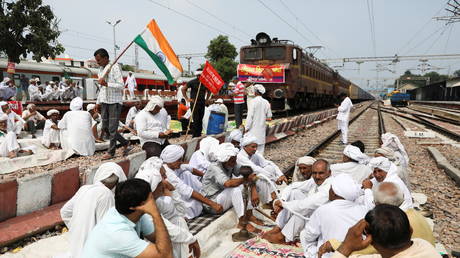
Farmers block railway tracks as part of protests against farm laws during nationwide protests, in Sonipat, northern state of Haryana, India, September 27, 2021. © Reuters / Anushree Fadnavi
Indian farmers return to hold nationwide protests against last year’s agriculture laws

The laws, which were introduced last September, allowed farmers to sell their crops outside of the government-regulated wholesale markets, in which they were guaranteed a minimum price.

The government argued that it would see them earning more, but growers feared that that move would, on the contrary, cause a drop in prices and make them hostages to large corporations.

Thousands of farmers joined the protests against what they called “black laws,” and some rallies turned violent. A year later, many demonstrators remain camped along roads outside the capital New Delhi.

And the farmers aren’t planning on going home just yet, with one of their leaders saying on Twitter: “We will wait for parliament to repeal the laws.”

Modi’s concession to the protesters may have been unexpected, but it comes several months ahead of elections in India’s most populous state of Uttar Pradesh, as well as two other northern states with large rural populations.

Think your friends would be interested? Share this story!

find more fun & mates at SoShow now !

Taiwan’s president unveiled the country’s combat wing of advanced US-made F-16 fighters in a ceremony on Thursday, showing its new Air Force capabilities against mainland China.

The event, held at an air base in the southern Taiwanese city of Chiayi, saw the island commission the first combat wing of F-16 fighters, developed with US support.

The F-16 upgrades, costing T$110 billion (USD$3.95 billion), have been jointly completed by American manufacturer Lockheed Martin Corp and Taiwan’s Aerospace Industrial Development Corp.

Taiwan’s leader, Tsai Ing-wen, touted the new F-16s as ensuring that the island’s defenses would be “even stronger” in the face of increased tensions with China.

In October, Beijing sent a record 150 warplanes into Taiwan’s air defense identification zone (ADIZ) in four straight days of incursions. Over the past year, China’s Air Force has increased military activity in and around Taiwan’s ADIZ, according to Taipei. 

Despite Taipei claiming it does not want to provoke a confrontation with China, the island’s president pledged that it will “do whatever it takes to defend itself.”

China has rejected claims that it is provoking conflict in Taiwan, which it sees as an integral part of its country, accusing America of “inflating” the island separatist movement, firmly stating that “Taiwan independence” is a dead end and Beijing will “take all steps” to ensure the island remains under its control. In recent years, China has become increasingly assertive about reuniting its wealthy island neighbor with the mainland.

The successful F-16 development process has been seen by Taiwan as the latest visible sign of the military partnership between Washington, DC and Taipei. Back in 2019, America approved an $8 billion sale of F-16s to Taiwan, which would bring the total number of jets in the island’s fleet to 200.

Read more

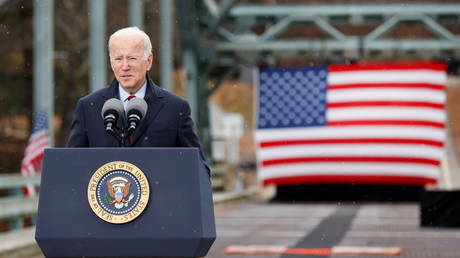
US President Joe Biden speaks in Woodstock, New Hampshire, November 16, 2021.
Biden reveals US Taiwan policy after call with Xi

During the event, the Taiwanese president praised America for remaining steadfast in its cooperation with the island despite opposition from China. “As long as we adhere to the values of democracy and freedom, there will be more like-minded countries standing on the same front with us,” Tsai said alongside US diplomat Sandra Oudkirk.

In 2019, after the US and Taiwan agreed to upgrade the F-16 fighter jets, then-Foreign Ministry spokesperson Geng Shuang threatened to sanction American firms unless the deal was halted. Beijing opposed the military partnership between Taipei and Washington, DC, arguing that the sale violated international law, harmed relations between the countries, and breached the One China policy, which America recognizes.

Think your friends would be interested? Share this story!

find more fun & mates at SoShow now !

The children of families who were affected by the massive earthquake which devastated large parts of south-west Haiti in August this year are receiving free hot meals at school as part of an initiative by the UN’s World Food Programme (WFP) to support the recovery of the country’s most vulnerable communities.

Read the full story, “Hot meals helping Haiti’s children recover from the earthquake”, on globalissues.org

find more fun & mates at SoShow now !

People are weird. They cook and eat the strangest things. This time it’s an octopus stuffed inside a turkey, sitting on top of crab legs, and (optionally) garnished with bacon strips. This monstrous culinary invention was inspired by H.P. Lovecraft’s Cthulhu mythos, and honestly… it looks like a crime against food.

Cthulhu turkey.

Cthulhu turkey.

Cthulhu turkey.

Cthulhu turkey.

Cthulhu turkey.

Cthulhu turkey.

Cthulhu turkey.

Cthulhu turkey.

Cthulhu turkey.

Cthulhu turkey.

Cthulhu turkey.

Cthulhu turkey.

Cthulhu turkey.

Cthulhu turkey.

Cthulhu turkey.

Cthulhu turkey.

Cthulhu turkey.

Cthulhu turkey.

Cthulhu turkey.

Cthulhu turkey.

Cthulhu turkey.

If this gallery wasn’t disgusting enough for you, you should also check out pre-cooked canned chicken that we’ve previously featured on this fun and useful site. We know you’ll love it!

The post Meet Cthulhu Turkey: It’s a Turkey Stuffed With Octopus That People Actually Make first appeared on .

find more fun & mates at SoShow now !

EXPERT OPINION — More than 200 U.S. officers have been hunted around the globe and targeted by an adversary using a mysterious weapon that causes permanent brain injury. It’s time to get serious about fighting back.

The Authors:

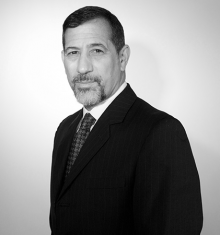
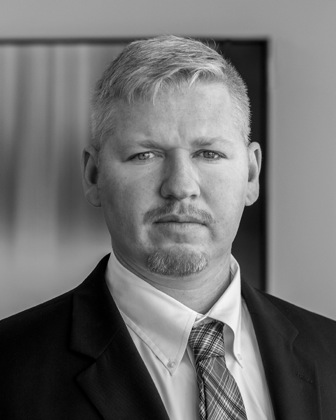
Paul Kolbe served for 25 years in the CIA’s Directorate of Operations. He is currently Director of the Intelligence Project at Harvard Kennedy School’s Belfer Center for Science and International Affairs.

Marc Polymeropoulos worked for the CIA for 26 years. He is author of “Clarity in Crisis: Leadership Lessons from the CIA.

John Sipher worked for the CIA’s clandestine service for 28 years. He is now a nonresident senior fellow at the Atlantic Council and a co-founder of Spycraft Entertainment.

Prior to 9/11, al Qaida declared war on the United States, bombed the USS Cole, and blew up U.S. embassies in Nairobi and Dar es Salam. Despite heavy casualties, America viewed successive al Qaida terrorist attacks as somehow unique, not representative of a larger threat or state of war. We went about our business and failed to take hard action against al Qaida despite clear warning. Our failure to respond forcefully led to 9/11 and the two decades of war that followed.

Fast forward to today.  Since 2016, more than 200 U.S. officials have reportedly suffered from a mysterious series of symptoms which have caused long-lasting, debilitating injuries. Suffering from searing headaches, vertigo, vision impairment, and nausea, many victims have been formally diagnosed with traumatic brain injuries (TBI) at the Walter Reed National Military Medical Center and other leading hospitals. Family members and young children have suffered as well. Some medical tests can now confirm the markers of brain injury, similar to those suffered by victims of concussive injuries in Iraq and Afghanistan.

These injuries began with a cluster of reports from Cuba in 2016 and have become commonly referred to as Havana Syndrome. Moscow, Vienna, Belgrade, and Hanoi are among more than a dozen cities where U.S. officials reportedly have been attacked and injured. In residences, on the street, in vehicles, and even at secure U.S. facilities, U.S. officers are being hunted. Stunningly, even a close aide to CIA Director Bill Burns was reportedly attacked on a trip to India just this past August.

The CIA, after a period of confusion, delay, and even denial at times, now appears to take these threats very seriously. CIA Director Burns and Deputy Director David Cohen have publicly stated that U.S. officials are being “attacked.” They have improved health care for CIA officers who are hurt. And an agency task force is hard at work trying to obtain additional intelligence on those responsible. We credit Director Burns for his solid leadership.

The cause of these injuries? The National Academy of Sciences has pointed to Directed Energy Weapons – devices which emit microwave pulses which can inflict pain and damage tissue. The United States, Russia, China, and others have all developed Directed Energy Weapons to destroy equipment, counter drones, and control crowds. This is not science fiction.

Directed energy weapons would account for the highly directional and locational nature of these incidents. When victims can “move off the x,” the signature sounds, sensations, and pain that goes with the attacks often stop, though damage has already occurred. The amount of exposure seems to affect the degree of injury. Other technologies could be at play and are being investigated, but microwaves appear to be the most likely vector. Russia has used them before, flooding the U.S. Embassy in Moscow with microwave radiation for decades.

Regardless of form, the weapons being used in these attacks are nothing less than weapons of terror, designed to cause injury to non-combatants. Who would use such a weapon to attack U.S. intelligence officers, diplomats, and military personnel, and to what conceivable end?


The Cipher Brief hosts private briefings with the world’s most experienced national and global security experts.  Become a member today.


CIA Deputy Director Cohen stated at a recent intelligence summit, that the U.S. was closer to identifying the culprit, and Politico has reported that members of the Senate Intelligence Committee are increasingly convinced that Russia or another hostile adversary is behind the attack, although reportedly, no smoking gun has been found.

As former CIA operations officers with extensive experience dealing with both counterterrorism and counterintelligence issues, we have few doubts about who will be named as the culprit. For at least a decade, Russia has conducted itself as in a state of conflict with the West in general and the United States in particular. Russia has launched cyberattacks impacting critical infrastructure and supply chains, assassinated opponents with nuclear poisons and chemical weapons, gunned down people in the streets using criminal proxies, sabotaged a Czech ammunition depot, and mounted a violent coup attempt in Montenegro. It has also bombarded the U.S. embassy in Moscow with microwave radiation and used carcinogenic “spy dust” without regard to health effects. The attacks on U.S. officials would fit this pattern of behavior.

We recognize that it is important to let the intelligence community do its job and its findings must inform policy action. Congress and the administration must work together to formulate a range of possible responses and it is not too early to begin. As Senator Collins and others have stated, these attacks are “an act of war,” and as such, preparation for a future attribution call by the national security establishment is in order. So how could the U.S. respond?

Let’s start with what doesn’t work – sanctions. Sanctions feel good and satisfy an action imperative but they are feckless. Sanctions have not stopped Russia from killing dissidents, halted the Nordstream II pipeline, compelled a pull back from occupied territories, reduced support for tyrants, or hindered oil and gas production. Sanctions have simply forced Russia to develop more creative money laundering and sanction circumvention mechanisms.

So, what would work? For starters, we must understand that the Putin regime considers itself in a state of conflict with the U.S., short of war, but nonetheless deadly real. We are dealing with a state sponsor of terror which conducts operations across the globe to weaken the U.S. abroad, divide it from its allies, and sow discord at home. Our policy must be calibrated to win this conflict, without sparking a shooting war, but at risk of one.

Russia understands reciprocity and strength. When four Russian diplomats were kidnapped by extremists in Beirut in 1985, and one of them was killed, Russia reportedly responded by kidnapping and gruesomely killing a relative of the group’s leader. The surviving diplomats were released immediately. The story may be apocryphal, but it does illustrate the Russian approach. Tempting as it may be for America to retaliate tit for tat, we need not mirror Russia’s actions. Instead, we should play to our greater economic, diplomatic, and military advantages.

We offer five elements to frame a response: enlist U.S. allies, expand forward deterrence, limit the adversary’s reach, choke off money, and bring those accountable to justice.

NATO: With proof of the attacks on U.S. officials, we should activate NATO’s Article Five collective defense clause. The only other time this was enacted was after 9/11. As justification, in addition to the Havana Syndrome attacks, (which also caused Canadian casualties), we would include GRU and FSB assassination operations across Europe, deadly sabotage in the Czech Republic, a coup attempt in Montenegro, persistent cyberattacks, and a litany of other actions that can only be described as irregular warfare directed against NATO members.


Go beyond the headlines with expert perspectives on today’s news with The Cipher Brief’s Daily Open-Source Podcast.  Listen here or wherever you listen to podcasts.


Forward Presence: A crystal clear signal that we understand the nature of Russian hybrid warfare and are responding would be to enhance our deployed military presence in Poland, the Baltic States, and in the Black Sea region. These units would pose no offensive threat to Russia but would be a clear signal that the U.S. is prepared to counter any Russian shenanigans. We should also significantly ramp up our lethal aid and training to the Ukraine, where the nature of Russian aggression is well known. Weakness in Eastern Europe is an invitation to conflict.

Travel and Presence: We should drastically limit Russian business and tourist travel which is being used as cover for FSB and GRU operations. We would reduce Russian diplomatic presence in each capital to the bare minimum – handfuls not hundreds. American and European counterintelligence experts believe there are more Russian intelligence officers operating from embassies than during the Cold War. Limiting the size of Russia’s espionage infrastructure will complicate the planning and execution of all of its intelligence operations.

Finance: A key tool in counterterrorism operations is the ability to target sources of finance which constitute material support to terrorism. In this case, we would apply that principle to the Russian government, state enterprises, and individuals who provide cover, tools, and sources of funding to Russia’s campaign to undermine the West with violence, terror, and media manipulation. Russia’s dirty money has been used to undermine the west and poison our politics. We should limit the easy access of shady money to western banks.

Criminal Cases: We need bring war crime cases to the International Court of Justice (ICJ) in the Hague. Following a decade of conflict in the Balkans, the ICJ brought to justice 161 indicted Serbian, Croatian, and Bosnian war criminals. This was an astounding success – a manhunt which included American and European law enforcement and intelligence services. Just as in Nuremberg after World War II, these actions to hold war criminals accountable drew a line in the sand.

This is a start.  Successive Democratic and Republican administrations have pursued Russia policies which represent the triumph of hope over experience. We have treated the symptoms of malign Russian actions rather than the underlying pathology. It is now time to finally acknowledge that we are in a long-term hybrid conflict and forget the fantasy of changing Putin’s behavior. Only a new regime in the Kremlin would hold the hope of bringing about a change in actions. Eventually, the Putin regime will wither or collapse, but until it does, we and our allies must do a better job of defending ourselves.

Read more expert-driven national security insights, perspective and analysis in The Cipher Brief

The post Havana and the Global Hunt for U.S. Officers appeared first on The Cipher Brief.

find more fun & mates at SoShow now !
People who live in the big cities are definitely masters of eavesdropping. Sometimes they can’t help it, accidentally overhearing conversations from complete strangers can be so funny, it’s hard not to share them with someone else. And here comes the fittingly named Instagram account Overheard San Francisco that’s dedicated to sharing the funniest eavesdropped interactions in San Francisco and the Bay area. Scroll down to see the funniest examples!

Funny conversation overheard in San Francisco.

Funny conversation overheard in San Francisco.

Funny conversation overheard in San Francisco.

Funny conversation overheard in San Francisco.

Funny conversation overheard in San Francisco.

Funny conversation overheard in San Francisco.

Funny conversation overheard in San Francisco.

Funny conversation overheard in San Francisco.

Funny conversation overheard in San Francisco.

Funny conversation overheard in San Francisco.

Funny conversation overheard in San Francisco.

Funny conversation overheard in San Francisco.

Funny conversation overheard in San Francisco.

Funny conversation overheard in San Francisco.

Funny conversation overheard in San Francisco.

Funny conversation overheard in San Francisco.

Funny conversation overheard in San Francisco.

Funny conversation overheard in San Francisco.

Funny conversation overheard in San Francisco.

Funny conversation overheard in San Francisco.

Funny conversation overheard in San Francisco.

Funny conversation overheard in San Francisco.

The post Hilarious Private Conversations People Overheard In San Francisco first appeared on .

find more fun & mates at SoShow now !
Hospitals in the Netherlands have begun delaying certain operations to free-up ICU beds during a record wave of Covid-19 infections, while an infectious diseases researcher has warned of an impending ‘Code Black’ in the sector.

The country set a daily national record for new Covid infections on Thursday, registering around 23,600 cases. It was the third day in a row of the figure topping 20,000.

To make more staff available for Covid wards, a number of operations, including those for cancer and heart patients, are being canceled from this week on, Dutch healthcare officials have said. Fewer than 200 beds remained available in Dutch ICUs as of Thursday, while Friday figures show almost half (47.8%) of occupied ICU beds were being used by Covid patients.

Read more

FILE PHOTO. A woman wearing a protective mask walks past a store in Amsterdam, Netherlands.
Netherlands re-introduces facemasks & other restrictions as Covid-19 cases surge

“These are cancer patients that should actually be operated-on within six weeks of diagnosis, and that won’t be met in all cases. It’s also heart patients,” said a spokesperson for the National Coordination Center for Patient Distribution (LCPS).

Meanwhile, new calculations by an infectious disease modeller at Wageningen University & Research suggest that a so-called ‘Code Black’ in hospitals is looming. The emergency designation means that patient safety is at risk and, if declared, would mean many people with life-threatening illnesses cannot go to the ICU, while doctors have to prioritize who to treat.

According to recent estimates from the Dutch Healthcare Authority (NZa), up to 200,000 operations were not performed as a result of urgently needed Covid care since the start of the pandemic. On Thursday, the NZa revealed that almost a quarter of operating rooms across the country are not currently in use due to a combination of Covid patient pressures and rising staff absences due to illness.

It is not yet clear what impact the delayed care will have on public health. In December 2020, the Dutch National Institute for Public Health and the Environment (RIVM) calculated that an estimated 34,000 to 50,000 ‘healthy life years’ had been lost due to the first Covid-19 wave alone.

Think your friends would be interested? Share this story!

find more fun & mates at SoShow now !

As information emerges about Islamic State of Khorasan, or ISIS-K – the terrorist group that claimed responsibility for last week’s suicide attack that killed 13 US service members and more than 160 Afghans – there is an increased effort to predict how Afghanistan, under Taliban rule, may emerge once again as a breeding ground for terrorist groups.

A United Nations report released in June estimates that thousands of fighters from the region had already poured into Afghanistan.  Many of them are believed to be affiliated with either the Taliban – still seen as a terrorist organization – or al Qaeda or ISIS-K.

The New York Times reports that ISIS-K was created six years ago by members of the Pakistani branch of the Taliban.  There is a range of thought among experts as to what their ability to successfully carry out a terrorist attack in a Taliban-ruled area means for the terrorist threat moving forward. 

The Cipher Brief spoke with respected terrorism experts Bruce Hoffman, Mitch Silber and Colin Clarke to get their thoughts on the current risk of terrorist attacks against Americans both home and abroad. 

Bruce Hoffman, Terrorism Expert and Professor, Georgetown University

Cipher Brief Expert Bruce Hoffman is a professor at Georgetown University and served as a commissioner on the Independent Commission to Review the FBI’s Post-9/11 Response to Terrorism and Radicalization.  He is also a Scholar-in-Residence for Counterterrorism at CIA.

Mitch Silber, Former Director of Analysis, NYPD

Cipher Brief Expert Mitch Silber served as Director of Intelligence Analysis at the New York City Police Department and served as principal advisor to the Deputy Commissioner of Intelligence on counterterrorism policy and analysis. He is now executive director of the Community Security Initiative.

Colin Clarke, Director of Policy and Research, The Soufan Group

Colin P. Clarke, Ph.D., is the Director of Policy and Research at The Soufan Group. Clarke’s research focuses on domestic and transnational terrorism, international security, and geopolitics. He is also a senior research fellow at The Soufan Center.  

The Cipher Brief: If the United Nations Report issued in June is accurate, and there are thousands of fighters from the region who have poured into Afghanistan – many associated with known terrorist groups – is there any way that the administration can say ‘mission accomplished’ in terms of degrading terrorism’s presence in Afghanistan? 

Hoffman: No. As those numbers from the report released by the United Nations Support and Sanctions Monitoring Team highlight, Afghanistan is again becoming a jihadi magnet and will likely continue to be so into the future. The suicide bomb attacks outside the gates of Kabul International Airport last Thursday underscore the multiplicity of terrorist groups already present in that country.

In addition to ISIS-K, there is the Haqqani Network, al Qaeda and, of course, the Taliban. Terrorism thrives in conditions of chaos and instability which the terrorists hope to spread to other countries and eventually across regions.

Much as Salafi-Jihadi terrorists migrated from existing battlefields in South Asia back to the Middle East, North Africa, and the Caucasus in the 1990s; spread to East and West Africa in the early 2000s; blossomed during the Arab Spring to wage civil wars in Syria, Libya, and the Sahel, in the early twenty-teens; the same phenomenon is unfolding in Afghanistan.

Silber:  Frankly, I don’t think any of the four administrations can make the claim that the policy goal of making Afghanistan inhospitable to serve as a safe haven for Al Qaeda or other similarly oriented jihadist groups has been accomplished.  Certainly, at a number of times during the last twenty years, the threat that jihadist groups, most importantly — Al Qaeda — has presented, in terms of their ability to project a threat to the United States has been diminished, the degradation of the threat was only temporary.

The Cipher Brief: How confident are you that Al Qaeda and ISIS are unable to plan and execute attacks against the U.S. domestically? 

Hoffman:  The credulous Doha negotiations with the Taliban that led to the withdrawal of U.S. military forces from Afghanistan and subsequently to the Taliban’s blitzkrieg across Afghanistan and then to the shambolic evacuation of our diplomats and citizens, has painted a huge target on America’s back. Like sharks in the water, terrorists will smell blood. As my Council on Foreign Relations colleague, Jacob Ware, and I wrote in War on the Rocks, in May, every time terrorism has forced the U.S. to withdraw from a conflict zone where it had committed ground forces, whether in Lebanon in 1984; Somalia in 1993; and Iraq in 2011, it has led to more terrorism worldwide, not less, and thus made the U.S. less safe.

At a time when our country continues to grapple with the COVID pandemic; when climate change is pulverizing the Gulf States with Hurricane Ida and California with worsening wildfires; when the January 6th insurrection at the U.S. Capitol building continues to smolder with incidents such as the bomb threat that paralyzed the area near the Library of Congress and Cannon House Office Building earlier this month; coupled with ongoing cyberattacks and peer competition from China and Russia and concerns over Iran’s nuclear aspirations; our terrorist adversaries may well conclude that the U.S. is sufficiently preoccupied or distracted by any or all of the preceding and therefore conclude that the time to strike the homeland is opportune. It would very unlikely entail a repeat of the catastrophic September 11th 2001 attacks. But a terrorist strike along the lines of the 2019 shootings at Naval Air Station Pensacola; the 2017 suicide bombing of a concert venue in Manchester, England; the coordinated suicide attacks on London transport in 2005; the 2004 Madrid commuter train bombings; or any kind of significant lone wolf incident perpetrated in the name of some existing terrorist movement would likely re-create the widespread fear and anxiety that are terrorism’s stock-in-trade. Twice in the past three years, it should also be noted, members of al-Shabaab – perhaps al Qaeda’s least technologically proficient franchise – have been arrested both in the Philippines and in an undisclosed African country engaging in the same flight training that four of the 9/11 hijackers undertook before their fateful, history-changing coordinated attack.

Silber:  At this very moment, it is unlikely that Al Qaeda or ISIS-K have the infrastructure, resources, recruits and external planning ability to strike the United States based on statements by the IC and senior DoD officials to Congress.  However, without any, or only limited external pressure by the U.S. military as a result of the retreat from Afghanistan, these networks and capabilities can be reconstituted in the coming months and certainly groups like Al Qaeda have never given up their desire to strike the American homeland.

Clarke:  I think it is unlikely that AQ or ISIS will be able to attack the U.S. homeland.  We’ve spent the better part of the past two decades shoring up homeland defense. We’ve got CT tools now that we didn’t have twenty years ago. That said, the picture could look quite different 6, 12, 18 months from now. Both of those organizations are capable of regenerating an external operations planning capability. There is also the worry of inspired attacks.


The Cipher Brief hosts private briefings with the world’s most experienced national and global security experts.  Become a member today.


The Cipher Brief:  Some analysts have said that morale among terrorist or Islamic extremist groups is extremely high due to the circumstances surrounding the US pullout in Afghanistan, do you agree and if so what does that mean? 

Hoffman:  Yes. Of course. Both Sunni and Shi’a terrorist movements around the globe have applauded the Taliban’s re-conquest of Afghanistan and routing of the U.S. military. For Sunni Salafi-Jihadi terrorists, the events there this past month validate the strategy articulated by Usama bin Laden just before the 2004 U.S. presidential election, when he described the ease with which al-Qaeda had been able to “bled Russia for 10 years, until it went bankrupt and was forced to withdraw in defeat” from Afghanistan in 1989, and predicted that the same fate would eventually befall the U.S. And, Sayed Hassan Nasrallah, the Secretary-General of Hezbollah, a Shi’a terrorist organization, for instance, last week delivered a sermon where he described America’s “historic and humiliating defeat in Afghanistan as representing, “the moral downfall of America.”

Silber:  Jihadi chat rooms and online extremist networks are feeling like they have the wind behind them.  It took twenty years, but before the 20th anniversary of the attacks of 9/11 an Islamic emirate has been re-established in Afghanistan.  Suddenly, what seemed impossible has become possible and Islamist insurgencies all throughout the Middle East and South Asia can take inspiration by the determination of the Taliban in their efforts to overthrow a secular democratic government and replace it with an Islamist one.

Clarke:  I do expect morale to be high among terrorist and especially Islamic extremists given the turn of events we’ve seen in Afghanistan. We’re a week and a half out from the 20-year anniversary of 9/11, and Al Qaeda leaders are returning to Afghanistan (this is being displayed in AQ propaganda). We’ve seen al-Qaeda affiliates all over the globe congratulating the Taliban for their victory. I don’t want to overstate the case here, but I do believe that what has occurred in Afghanistan will be a serious boost for the global jihadist movement right at the same time the U.S. and its allies are shifting from counterterrorism to great power competition. There will be fewer resources and energy to deal with terrorists, right at the time we have major threats metastasizing in Afghanistan, potentially with both a reinvigorated al-Qaeda and a stubbornly resilient ISKP.

Read also Mike Leiter’s Why We’re Much Safer from Terrorism Now, Than We Were After 9/11 in The Cipher Brief 

Read also Why We Need a New National Defense Strategy (for terrorism) exclusively in The Cipher Brief 


Go beyond the headlines with expert perspectives on today’s news with The Cipher Brief’s Daily Open-Source Podcast.  Listen here or wherever you listen to podcasts.


The post The Risk of Terrorism at Home and Abroad appeared first on The Cipher Brief.

find more fun & mates at SoShow now !

EXPERT PERSPECTIVE — On 16 June, US President Joe Biden and Russian President Vladimir Putin met for just under four hours in Geneva. This was Mr. Biden’s first meeting with Mr. Putin during his presidency and Biden is the fifth US President with whom Putin has held a summit.

Expectations for the summit were characterized as low by both sides in advance and assessed a bit more positively after the conclusion of the meeting. The meeting presented an opportunity for both leaders to present grievances and warnings to the other (and show toughness to their domestic constituencies).  Other than presenting the opportunity to blow off steam, the results of the meeting appear modest:  the agreement to return ambassadors to their posts, to resume bilateral arms control discussions, to conduct discussions on “strategic stability” and to hold unspecified consultations on cyber. In typical fashion, Mr. Putin rejected all of Mr. Biden’s assertions about Russian actions and made counter accusations referencing hostile US actions.

Of the deliverables from the summit, cyber will no doubt turn out to be the most problematic area for follow up. Mr. Biden apparently delivered to Mr. Putin a list of 16 US critical infrastructure sectors that should be considered “off limits” for cyberattacks, e.g., “red lines” not to be crossed without the risk of significant retaliation. For his part, Mr. Putin asserted that it is Russia that is the victim of cyberattacks originating from the territory of the US and it’s NATO partners and also is the victim of  attempts to interfere with Russian elections.  The challenge in cyber discussions going forward will center around three areas:  differing interpretations of the relevance of deterrence theory in today’s cyber environment, attribution, and control.

Mr. Biden’s firm comments to Mr. Putin on recent cyberattacks against the US such as the ransomware attack on Colonial Pipelines (Mr. Biden is said to have asked Mr. Putin how he would react if Russia’s pipelines were hit?) and his provision of a list of “off limits” US infrastructure entities suggests a deep belief in this administration that Russia can be deterred from engaging in future conduct of cyber operations against US targets or “sanctioning” attacks originating from the territory of the Russian Federation by criminal groups.

Unfortunately, it is highly likely that either Mr. Putin nor those who control the levers of Russian cyber operations agree that deterrence theory applies.  Deterrence only works when both sides know the other is capable of – and willing to – cause significant harm to the other.

The Russian side likely believes (and may have amply demonstrated) that the US is disproportionately vulnerable to cyber risk at every level of its economic, societal, and political infrastructure whereas Russia is not.  There is a reason the use of cyber tools has become a central feature of Russian strategic doctrine. They work and seem a legitimate tool that falls short of conventional war. Hybrid warfare using cyber tools, the Russian side would argue, is no different than the economic warfare Russia is experiencing from sanctions imposed by the US its allies.

For full access to the article, sign up to become a Cipher Brief member for just $10/mo.


“The Cipher Brief has become the most popular outlet for former intelligence officers; no media outlet is even a close second to The Cipher Brief in terms of the number of articles published by formers.” – Sept. 2018, Studies in Intelligence, Vol. 62 No.

Access all of The Cipher Brief’s national-security focused expert insight by becoming a  Cipher Brief Level I Member .  


The post After Geneva: US – Russia Strategy Moving Forward appeared first on The Cipher Brief.

find more fun & mates at SoShow now !