Nadya Zafira, an international relations student at Indonesia’s Gadjah Mada University, won a writing competition for her letter to UN chief António Guterres, in which she addressed the inequalities laid bare by the COVID-19 pandemic, and how indigenous communities and youth are marginalized in global conversations on climate crisis.
The longest lunar eclipse in over 500 years will occur in the early hours of November 19, lasting several hours.
The peak of the partial eclipse will take place in the predawn hours on Friday when 97% of the moon will be eclipsed by the Earth’s shadow. The previous longest partial eclipse took place in 2018 and lasted less than two hours, while this will last for several hours.
LONGEST PARTIAL ECLIPSE of the CENTURY to occur in the Pre-dawn hours of November 19th. Maximum eclipse is at 4:03 AM EST when 97% of the Moon will be eclipsed. At that time it will be high in our western sky. This will also be the longest partial lunar eclipse in 580 years! pic.twitter.com/Xa9ciXLp3V
The eclipse will be visible from all 50 US states, Canada, and Mexico, as well as parts of South America, Polynesia, Australia, and China, according to NASA.
The moon will be at its farthest point from Earth during the eclipse, slowing its orbit and extending the time it takes to move out of the darkest part of the planet’s shadow, known as the umbra, as the moon, Earth, and sun will all be aligned. The Holcomb Observatory has released a video detailing what the eclipse will look like.
Movie of the “NEAR TOTAL ECLIPSE.” LONGEST PARTIAL LUNAR ECLIPSE in 580 years occurs on morning of November 19th. 1st parts of the eclipse begin at 1:02AM EST. Max eclipse occurs at 4:02 AM when 97% of MOON in darkest part of Earth’s shadow. pic.twitter.com/2HwPpqPbbd
The event will begin shortly after midnight and unlike a solar eclipse, no one will need special eyewear to view the phenomenon.
When the eclipse occurs, the moon will take on a reddish hue, with only a sliver of the actual moon visible. The event will last for several hours, making it the longest of its kind in 580 years, with the next lunar eclipse not occurring until May of 2022.
All cities and towns in China, as well as “most” villages, will be covered by 5G networks by 2025, the Ministry of Industry in Beijing has announced in a new infrastructure development plan.
Under the plan, the number of 5G base stations per 10,000 people will be increased to 26, and gigabit optical fiber networks will be extended to most urban and rural areas of China, the Ministry of Industry and Information Technology (MIIT) announced on Tuesday.
Digital infrastructure has been defined as a “strategic, basic and pioneering industry to help build a new type of digital infrastructure and support economic and social development,” according to MIIT official Xie Cun.
Information technology will be “deeply integrated” with the economy and society, with the goal of spurring internet innovation and creating a business boom, the ministry added. Meanwhile, the authorities are working on “a new type of supervision system” as well as measures to protect users’ personal information and data.
Cipher Brief Expert Tim Willasey-Wilseyis a Visiting Professor at King’s College, London and a former senior British diplomat. From 1996 to 1999 he was senior advisor to the British government on overseas counterterrorism. This piece was first published by RUSI in London. The views do not represent those of RUSI.
Analysis of openly available sources indicates that a British report shared with the US in December 1998 described an early stage of the 9/11 plot.
EXPERT PERSPECTIVE — Two extracts from Presidential Daily Briefs (PDB) are given some prominence in the 9/11 Commission report into the terrorist attacks in New York and Washington on 11 September 2001. One is from a PDB delivered to President Bill Clinton on 4 December 1998, and the other is from a PDB given to President George W Bush on 6 August 2001. Both are presented inside a textbox and both contain intelligence ‘from a friendly government’ which provided the first and only significant suggestion that Al-Qa’ida (AQ) planned to hijack aircraft in the US.
Eight months after the attacks, under Congressional pressure, the Bush administration was obliged to reveal some details of the PDBs, and on 17 May 2002 the New York Timesdisclosed that ‘the report provided to the president on Aug. 6, which warned him that Mr. bin Laden’s followers might hijack airplanes, was based on 1998 intelligence data drawn from a single British source, government officials said today’. The British government was obliged to acknowledge that the intelligence came from British sources. The Guardianreported on 18 May that ‘The memo received by Bush on 6 August contained unconfirmed information passed on by British intelligence in 1998’. The Independentran much the same story with additional detail.
Both PDBs quoted from one British report from December 1998. The key question is whether this report, with its significant deviations from what actually happened on the day, actually referred to the 9/11 operation. Subsequently published evidence points compellingly to this indeed being an early version of the 9/11 plan.
‘On Friday December 4 1998 the CIA included an article in the Presidential Daily Brief (PDB) describing intelligence received from a friendly government about a hijacking in the United States.
‘SUBJECT. Bin Laden preparing to hijack US aircraft. Reporting [passage redacted] suggests bin Laden and his allies are preparing for attacks in the US including an aircraft hijacking to obtain the release of Sheikh Omar Abdal Rahman, Ramzi Yousef and Muhammad Sadiq Awda. One source quoted a senior member of the Gamaat Al-Islamiya (GI) saying that “as of late October the GI had completed planning for an operation in the US on behalf of bin Laden but that the operation was on hold. A senior bin Laden operative from Saudi Arabia was to visit GI counterparts in the US soon thereafter to discuss options – perhaps including an aircraft hijacking. GI leader Islambouli in late September was planning to hijack a US airliner during “the next couple of weeks” to free Abdal Rahman and the other prisoners according to what may be another source. The same source late last month said that bin Laden might implement plans to hijack aircraft before the beginning of Ramadan on 20 December and that two members of the operational team had evaded security checks during a recent trial run at an unidentified New York airport.’
The Cipher Brief hosts private briefings with the world’s most experienced national and global security experts. Become a member today.
In May 2002 the US National Security Advisor Condoleezza Rice issued a statement observing (correctly) that the report had mentioned ‘hijacking in the traditional sense’ with no indication that aircraft would be used as weapons of mass destruction. Her testimony to the 9/11 Commission made broadly the same point.
Indeed, even in late 1998, there was a profusion of threat reports of which the aviation strand was just one. The MI5 official history comments aptly that the Service was puzzled as to why there were so many more reports of threats than actual attacks: ‘Even the most reliably sourced intelligence received on this question usually consists of a snapshot of a proposed plan being discussed. Most of the reporting does not make clear how far advanced the plan is’ (Christopher Andrew, The Defence of the Realm, pp. 802–806). What MI5 did not realise at the time was that AQ operations could take up to three years from inception to execution.
Steve Coll writes that ‘Within the morass of intelligence lay ominous patterns. One was an interest by bin Laden’s operatives in the use of aircraft … yet at the counter terrorism security group meetings and at the CIA’s counter terrorist centre there was no special emphasis placed on bin Laden’s threat to civil aviation or on the several exposed plots where his followers had considered turning hijacked airplanes into cruise missiles’ (Steve Coll, Ghost Wars, pp. 419–420).
Although the December 1998 report appears fragmentary, there were a number of aspects of particular interest. The first was the name Ramzi Yousef. Yousef had studied electrical engineering at Swansea Institute from 1986 to 1990 before exploding a massive bomb under the World Trade Centre in February 1993 and then planning the Bojinka Plot against airliners in the Philippines in 1994. Yousef had been arrested in Islamabad in February 1995 and sent to the US, where he was tried and imprisoned for life. He was an energetic and imaginative terrorist, and his uncle Khalid Sheikh Mohammed was also known to move in terrorist circles.
The aviation link must have struck a chord, too. The British were also interested in Hussain Kherchtou, who had been in Kenya at the time of the Embassy bombings and was himself a pilot. He later provided a debrief to the FBI. His story and his courtship by the British came into the public domain because of a subsequent US court case and a talkative FBI officer.
The Egyptian angle also would have provoked little surprise. On 19 November 1995 Egyptian terrorists had blown up the Egyptian Embassy in Islamabad, killing 13 – only yards from the British High Commission compound with its exposed staff housing and kindergarten. The British had a miraculous escape that day.
The concern for the release of Sheikh Abdal Rahman, ‘the Blind Sheikh’, was consistent with the widespread devotion which the preacher inspired among Islamist radicals and particularly Egyptians. His imprisonment in New York for his part in Yousef’s attack on the World Trade Centre had caused significant distress among his many adherents, who all wanted his release.
The idea that AQ would strike the US had first surfaced in 1997 and felt like the logical next step. Only a month beforehand (in November 1998), AQ had attacked two US Embassies in Kenya and Tanzania, killing 224 people including 12 US citizens. These operations had served as a wake-up call for those who thought the AQ threat was being exaggerated, and some who even conceived of Osama bin Laden himself as a benign figure who had somehow got out of his depth.
There were also some puzzling elements in the report. The first was the rather outdated idea of hijacking an aircraft to demand the release of the Blind Sheikh. It felt more in tune with Palestinian terrorist methods of the 1970s, and it was already known that Ramzi Yousef had developed the idea of exploding full airliners in flight.
The involvement of Gama’at Islamiya (GI) seemed odd. Bin Laden was known to be close to Ayman Al-Zawahiri of Egyptian Islamic Jihad (EIJ), with whom GI were usually at daggers drawn. At the time GI were conceived of more as domestic Egyptian terrorists compared to the internationalist EIJ. Indeed, GI’s most recent operation had been the Luxor Massacre of November 1997, which killed 56 foreign tourists.
Go beyond the headlines with expert perspectives on today’s news with The Cipher Brief’s Daily Open-Source Podcast. Listen here or wherever you listen to podcasts.
The name Islambouli carried great resonance. This was Mohammed Shawqi Islambouli, who had tried to assassinate Egyptian President Hosni Mubarak in Addis Ababa in 1995. His brother Khalid had been one of the assassins of President Anwar Sadat in October 1981 and had been tried and executed in Cairo. However, although Mohammed was thought to be in Afghanistan, he was not then known to be close to bin Laden, let alone Al-Zawahiri.
The dates made little sense. On the one hand an attack seemed imminent, but on the other hand it was ‘on hold’. But such is the nature of counterterrorist reporting: small fragments of a much bigger jigsaw.
Nonetheless, the report was taken very seriously on its receipt in the US. President Bill Clinton’s counterterrorism advisor Richard Clarke summoned his Counterterrorism Security Group. ‘To address the hijacking warning, the group agreed that New York airports should go to maximum security starting that weekend. They agreed to boost security at other East coast airports. The CIA agreed to distribute versions of the report to the FBI and FAA to pass to the New York Police Department and the airlines. The FAA issued a security directive on December 8, with specific requirements for more intensive air carrier screening of passengers and more oversight of the screening process, at all three New York City area airports.’
Of course, when 9/11 happened nearly three years later, there were two very significant differences. Although aircraft were indeed hijacked, they were used as missiles rather than as bargaining chips, and the terrorists were mainly Saudi and not Egyptian. So what happened between December 1998 and September 2001 which could explain these changes?
The 9/11 Commission report (drawing on material from the interrogation of Khalid Sheikh Mohammed) provides a fascinating section on AQ’s development of aviation methodology. Even before bin Laden had left Sudan in mid-1996, he had allegedly discussed the use of aircraft with Mohammed Atef: ‘(1) they rejected hijackings aimed at gaining the release of imprisoned comrades as too complex, because al Qaeda had no friendly countries in which to land a plane and then negotiate; (2) they considered the bombing of commercial flights in midair, as carried out against Pan Am Flight 103 over Lockerbie, Scotland, a promising means to inflict massive casualties; and (3) they did not yet consider using hijacked aircraft as weapons against other targets.’
So, why was the idea of a traditional hijacking still being discussed as late as December 1998? The answer must lie in the Egyptian jihadists’ determination to win the release of the Blind Sheikh. Mustafa Hamid, a journalist who was with bin Laden in Afghanistan, provides illuminating insight into the wrangling between EIJ and GI in Afghanistan. Hamid documents the tortuous process by which GI, with some reluctance, formed a union (‘The World Islamic Front against Jews and Crusaders’) with AQ, EIJ and others, but recounts how GI insisted on secrecy about their involvement. Hamid also describes GI’s determination to obtain the Blind Sheikh’s release and the involvement of one of their operatives in the African Embassy bombings (Mustafa Hamid and Leah Farrall, The Arabs at War in Afghanistan, p. 241 and pp. 263–266). So GI was indeed part of bin Laden’s group in Afghanistan and was involved in operations at the time of the December 1998 report.
However, bin Laden became increasingly irritated by the endless squabbling among the two Egyptian groups. Lawrence Wright, drawing upon a variety of sources, chronicles the disastrous attack on Luxor, which had the effect of alienating the Egyptian population from both groups. When on 23 February 1998 bin Laden’s second fatwa announcing the ‘World Islamic Front’ was published in an Arabic newspaper in London, GI were appalled, and some members tried to have Rahman pronounced emir instead of bin Laden. No wonder that Wright concludes that ‘bin Laden had had enough of the in-fighting between the Egyptian factions. He told both groups that their operations in Egypt were ineffectual and too expensive and that it was time for them to turn their guns on the United States and Israel’ (Lawrence Wright, The Looming Tower, pp. 290–296). This may explain why the December 1998 report mentions the operation being ‘on hold’. Between December and the spring of 1999, the GI team and Islambouli must have been stood down.
According to the 9/11 Commission report, in March or April 1999, Khalid Sheikh Mohammed (KSM) – who had hitherto allegedly been on the fringes of AQ – was summoned to Kandahar, where he discussed the aircraft plan with bin Laden and Mohammed Atef. Four operatives were chosen to begin work on the US project. However, ‘travel issues … played a part in al Qaeda’s operational planning from the very start. During the spring and summer of 1999, KSM realized that Khallad and Abu Bara, both of whom were Yemenis, would not be able to obtain US visas as easily as Saudi operatives like Mihdhar and Hazmi’. And so, the 9/11 plot developed with 15 of the 19 terrorists being Saudi nationals. Only Mohammed Atta was Egyptian.
KSM’s key involvement in the 9/11 plot makes it evident that there could not have been a second GI plot running in parallel, because KSM and Islambouli were close associates. Robert Baer and the 9/11 Commission report agree that KSM and Islambouli were working together in Qatar in the mid-1990s. For KSM it must have been difficult to abandon the rescue of his nephew, but he would have known that a traditional hostage release operation had none of the ambition or scale of bin Laden’s new thinking.
On 6 August 2001, only five weeks before the attacks, the December 1998 report featured once again in the PDB given to George W Bush at Crawford, Texas, entitled ‘Bin Laden determined to strike in US’. It began: ‘Clandestine foreign government and media reports indicate bin Laden since 1997 has wanted to conduct terrorist attacks in the US’, and concluded: ‘We have not been able to corroborate some of the more sensational threat reporting such as that from a [redacted] Service in 1998 saying that bin Laden wanted to hijack a US aircraft to gain the release of “blind Sheikh” Omar Abdal Rahman and other US-held extremists … Nevertheless, FBI information since that time indicates patterns of suspicious activity in this country consistent with preparations for hijackings or other types of attacks.’
The PDB of 6 August caused some discomfort to the Bush administration and led to a National Security Archive page devoted to that one PDB (of which the December 1998 British report was just one constituent part).
The CIA Director George Tenet, who had been a tireless pursuer of the AQ threat before 9/11 and a regular correspondent with and visitor to London, regretted that more had not been done ‘to protect the United States against the threat. To cite two obvious and tragic failures, only after 9/11 were cockpit doors hardened and passengers forbidden from carrying box-cutters aboard US commercial airliners’ (George Tenet, At the Centre of the Storm, p. 205).
The British report of December 1998 was fragmentary, and while it was certainly ‘sensational’, it was not half as sensational as the actual events of that unforgettable and tragic day.
The views expressed in this Commentary are the authors, and do not represent those of RUSI or any other institution.
Read more expert-driven national security insights, perspective and analysis in The Cipher Brief
The Philippine government has accused the Chinese Coast Guard of unleashing water cannon on two supply ships in a disputed stretch of the South China Sea, claiming its boats were blocked and forced to turn around.
Manila’s Department of Foreign Affairs detailed the encounter in a statement on Wednesday, alleging that a pair of supply boats en route to the Ayungin Shoal – also known as the Second Thomas Shoal – were stopped by three Chinese vessels and “water cannoned” before they could reach their destination.
“Fortunately, no one was hurt; but our boats had to abort their resupply mission,” Foreign Affairs Secretary Teodoro Locsin said, adding that the department had conveyed its “outrage, condemnation and protest of the incident” to Beijing’s envoy to the Philippines, Huang Xilian.
The acts of the Chinese Coast Guard vessels are illegal. China has no law enforcement rights in and around these areas. They must take heed and back off.
Though both China and the Philippines claim territorial rights to the Ayungin Shoal, The Hague’s Permanent Court of Arbitration ruled in the latter country’s favor in 2016. And despite Chinese objections, the Philippines has occupied the area for much longer, after its military purposely grounded a naval vessel on the shoal in 1999.
[3] I reminded China that a public vessel is covered by the Philippines-United States Mutual Defense Treaty.
Manila was also quick to note that the supply ships are “covered by the Philippines-United States Mutual Defense Treaty,” a pact inked with Washington in 1951 that calls for a US military response to any attack on the country, including “island territories under its jurisdiction in the Pacific Ocean, its armed forces, public vessels or aircraft.”
Beijing so far has not commented on the alleged run-in.
Think your friends would be interested? Share this story!
Hospitals in the Netherlands have begun delaying certain operations to free-up ICU beds during a record wave of Covid-19 infections, while an infectious diseases researcher has warned of an impending ‘Code Black’ in the sector.
The country set a daily national record for new Covid infections on Thursday, registering around 23,600 cases. It was the third day in a row of the figure topping 20,000.
To make more staff available for Covid wards, a number of operations, including those for cancer and heart patients, are being canceled from this week on, Dutch healthcare officials have said. Fewer than 200 beds remained available in Dutch ICUs as of Thursday, while Friday figures show almost half (47.8%) of occupied ICU beds were being used by Covid patients.
“These are cancer patients that should actually be operated-on within six weeks of diagnosis, and that won’t be met in all cases. It’s also heart patients,” said a spokesperson for the National Coordination Center for Patient Distribution (LCPS).
Meanwhile, new calculations by an infectious disease modeller at Wageningen University & Research suggest that a so-called ‘Code Black’ in hospitals is looming. The emergency designation means that patient safety is at risk and, if declared, would mean many people with life-threatening illnesses cannot go to the ICU, while doctors have to prioritize who to treat.
According to recent estimates from the Dutch Healthcare Authority (NZa), up to 200,000 operations were not performed as a result of urgently needed Covid care since the start of the pandemic. On Thursday, the NZa revealed that almost a quarter of operating rooms across the country are not currently in use due to a combination of Covid patient pressures and rising staff absences due to illness.
It is not yet clear what impact the delayed care will have on public health. In December 2020, the Dutch National Institute for Public Health and the Environment (RIVM) calculated that an estimated 34,000 to 50,000 ‘healthy life years’ had been lost due to the first Covid-19 wave alone.
Think your friends would be interested? Share this story!
Reuters has apologized for its poor choice of photo to illustrate a story about a monkey brain study that was deemed offensive and racist in China.
On Thursday, Reuters published a story titled “Monkey-brain study with link to China’s military roils top European university.” The report was about a Chinese professor studying how a monkey’s brain functions at extreme altitude.
The study was done with the help of Beijing’s People’s Liberation Army (PLA) with the aim of developing new drugs to prevent brain damage, Reuters said.
The news agency promoted the story on Twitter with a photo of smiling Chinese soldiers in an oxygen chamber.
The tweet prompted outrage in China, with people calling it racist on social media. Reuters responded on Friday night by deleting the original tweet because the photo of Chinese soldiers was unrelated to the story and “could have been read as offensive.”
PHOTO CORRECTION: We have deleted an earlier tweet that included a picture of Chinese soldiers in an oxygen chamber not described in the original tweet that could have been read as offensive https://t.co/Ahtv9fj8EQ 2/2
“As soon as we became aware of our mistake, the tweet was deleted and corrected, and we apologize for the offense it caused,” Reuters said in a statement to the Global Times, China’s state-run newspaper.
It was not the first time the leading Western news agency had run into trouble in China. In July, the Chinese Embassy in Sri Lanka criticized Reuters for using a photo of Chinese weightlifter and Tokyo 2020 Olympics gold medalist Hou Zhihui that the country’s state media described as “ugly” and “disrespectful to the athlete.”
Think your friends would be interested? Share this story!
Carving the turkey for Thanksgiving is a true honor for any man, and should be taken extremely seriously. Assuming you have no backup turkey, you have one opportunity to slice and carve it just perfectly, or your reputation with your family with be tainted forever. What better way to ensure you carve your Thanksgiving turkey properly and in the most manly way possible than with a chainsaw carving tool?
The electric chainsaw turkey carving tool looks and acts like a real chainsaw, except it won’t actually cut wood, and it’s a much smaller version of its larger counterpart. Though a chain doesn’t wrap around the blade and spin like a real chainsaw, a small electric knife is on the bottom of the blade to make it look like it’s working like a real chainsaw.
Made with stainless steel cutting blades along with an ABS plastic body, the chainsaw inspired turkey carving tool is not only great for cutting turkeys and other birds, but is also useful for cutting melons, pineapples, potatoes, breads, and more.
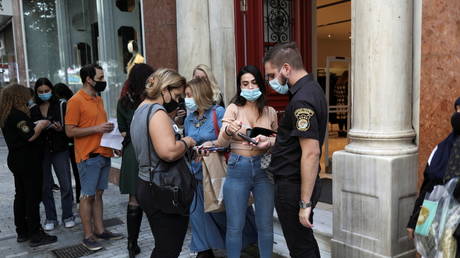
French President Emmanuel Macron has dismissed the possibility of locking down unvaccinated people in France, claiming the move would not be necessary because of the success of the Covid-19 ‘health pass’.
Speaking to La Voix du Nord newspaper in an interview published on Thursday, Macron said there was no need for France to follow Austria’s lead by locking down its unvaccinated citizens.
“Those countries locking down the non-vaccinated are those which have not put in place the [health] pass. Therefore, this step is not necessary in France,” Macron claimed.
The president’s health pass, which was the target of much criticism when it was introduced, requires people to provide proof of vaccination or a recent negative test before undertaking certain normal activities.
The ‘Pass Sanitaire’ is required if citizens wish to go to restaurants, cafes, cultural venues, or cinemas. It’s also required to take long-distance trains, among other activities.
Austria has led the way by starting a partial lockdown of the unvaccinated amid a surge in Covid-19 cases. The Czech Republic will follow suit next week, while Germany decided on Thursday to introduce similar measures in areas where Covid incident rates exceed the threshold.
Earlier in November, Macron made the continued use of the Covid health pass for over 65s dependent on getting a booster jab.
Some 20,366 new infections were registered in the last 24-hour recording period. Case numbers have risen steeply in recent weeks.
A pack of wild boars were rounded up and euthanized after one of the animals attacked a police officer in the streets of Hong Kong – the opening shot in a pitched battle between the feral hogs and the city’s law enforcement.
A group of veterinarians took seven wild boars into custody, euthanizing the beasts after knocking them out with dart guns in an area near the financial center of the city, according to a statement from Hong Kong’s Agriculture, Fisheries, and Conservation Department on Thursday.
The pigs were captured after one attacked a police officer last week, an act which reflects the city’s new policy toward the animals: stop them before they attack again.
The aggressive boar knocked down a police officer by biting his leg last week as the two faced off in a residential car park, the pig only losing the battle after falling off the building to its death. The wild boars are apparently “accustomed” to wandering back and forth along the roadway, begging for food from pedestrians and vehicles alike. Previously, the city had handled the population by capturing and sedating the animals, then relocating them to “remote areas,” according to the the department.
Hong Kong CEO Carrie Lam vowed to increase penalties for those citizens found feeding the boars, which have reportedly been responsible for some 30 attacks in recent years. While residents are warned not to feed the boars so as not to encourage population growth or disease outbreaks, the animals are a favorite among some visitors. Still, Lam insisted “we can’t simply sit on our hands while things deteriorate.”
Animal rights groups have responded with a protest letter against a policy of euthanasia, pointing out that most visitors do not feed the boars and arguing resources should be directed toward stopping the human activity rather than blaming all the boars. Allowing the boars to be captured and killed “ignores their right to live and considers their existence in urban areas as a capital offense,” the letter read.