The International Criminal Court has halted an investigation into alleged rights abuses carried out by Philippines authorities as part of a harsh crackdown on the drug trade, saying it is reviewing a deferral request from Manila.

The ICC’s chief prosecutor Karim Khan said the probe was suspended after the Philippines government filed a request to defer the case earlier this month, according to court documents cited by Reuters on Friday. 

“The prosecution has temporarily suspended its investigative activities while it assesses the scope and effect of the deferral request,” he wrote, adding that the court is seeking more information from the government in Manila.

Based in The Hague, the ICC allows states to ask for postponements if they conduct their own investigations into the charges in question. President Rodrigo Duterte’s administration filed its deferral request on November 10, while the country’s Justice Ministry announced its own investigation into the alleged abuses late last month.

Read more

Relatives of drug war victims hold photographs of their slain loved ones with placards calling for justice (FILE PHOTO) © REUTERS/Eloisa Lopez
Philippines announces probe into thousands of killings during Duterte’s war on drugs as initial review suggests abuses took place

The court initially opened the probe in September over allegations that Philippines police had carried out thousands of extrajudicial executions and used other brutal tactics against suspected drug dealers, and that Duterte gave implicit backing to those actions. Activists have accused authorities of killing innocent people, including children, though the police insist they only use violence in self-defense.

While Duterte has declined to cooperate with the ICC probe, saying it has no authority on the island nation, and even pulled the Philippines out of the international body in 2019, the court has jurisdiction to investigate alleged violations committed by the country while it was still a member.

The president’s chief legal counsel, Salvador Panelo, confirmed the deferral request in brief comments to Reuters, saying “There is no inconsistency with the request for suspension of action,” though he did not elaborate.

Since its founding some 20 years ago, the ICC has successfully convicted just five people of war crimes or crimes against humanity – all leaders of armed movements in Africa, including in Mali, Uganda and the Democratic Republic of the Congo.

Think your friends would be interested? Share this story!

find more fun & mates at SoShow now !

As part of a special series on climate in partnership with The Intelligence Project at Harvard University’s Belfer Center for Science and International Affairs, and Cipher Brief Expert and Senior Editor Kristin Wood, The Cipher Brief is focusing on the national security implications of climate change. 

This report is derived from a half-day conference in April 2021 co-sponsored by the Intelligence Project and the Environment and Natural Resources Program at Harvard Kennedy School’s Belfer Center for Science and International Affairs, along with the Center for Climate and Security and The Cipher Brief. It explores the requirements of the U.S. IC to fulfill the mission prescribed by President Biden, DNI Haines, and Secretary Kerry. The IC must rise to challenge, unshackled from the past, to re-imagine its role in combatting climate change.

The Authors

Calder Walton, Asst. Director, Belfer Center’s Applied History Project and Intelligence Project, Harvard University

Calder Walton is Assistant Director of the Belfer Center’s Applied History Project and Intelligence Project. Calder’s research is broadly concerned with intelligence history, grand strategy, and international relations. The

Sean Power, Masters in Public Policy Candidate, Harvard Kennedy School

Sean Power is a Masters in Public Policy 2021 candidate at the Harvard Kennedy School. Prior to HKS, he managed the analyst program at Kobre & Kim LLP, where he assisted on matters involving government enforcement defense and internal investigations.

The Report

The U.S. Director of National Intelligence (DNI), Avril Haines, has stated that climate change needs to be at the center of U.S. foreign policy and national security. It is a threat multiplier that impacts every function of government and society: territorial integrity, economic well-being, social stability, and military capabilities are all impacted by climate change, directly and indirectly. However, in addressing climate change, the U.S. Intelligence Community (IC) is currently unsure of its mission space and hitherto has been relying on boilerplate responses to it. In an exclusive discussion, the U.S. Special Presidential Envoy for Climate, Secretary John Kerry, who should be a principal consumer of intelligence about climate change within the U.S. government, stated that the U.S. IC must deliver significantly more.

The increasing effects of climate change are arising at a moment when the nature of intelligence itself is undergoing a revolution—from the collection of hidden secrets to collation of non-obvious (but knowable) data frequently hiding out in the open. This watershed in intelligence and national security requires bold, innovative, ideas for the U.S. IC to adapt and anticipate security threats derived by climate change. It must establish its mission space and alter its own architecture to ensure it is providing its customers with intelligence about them needed. Its mission will not be about spies disseminating secrets to policymakers; rather, it will require a new intelligence and national security paradigm that must reach across society, allowing the general public to consume climate intelligence and hold policymakers to account.

Background

The twenty-first century presents globalized threats that will require globalized solutions, the greatest of which is climate change. As the Covid-19 pandemic has demonstrated, no country is immune from actor-less threats like novel disease outbreaks and climate change. When combined with other security threats like transnational terrorism and ubiquitous cyberattacks, it becomes clear that existing national security frameworks are insufficient. New relationships and lines of communication will need to be forged, both within the U.S. government, in the private sector, and internationally with allies and adversaries. The U.S. IC needs to determine the requirements of its customers regarding climate change and how its unique collection and analytical capabilities fit into this new mission space.

The IC has incorporated climate change into its analysis and threat assessments for decades, but climate has not received the attention it requires given the magnitude of the threat it poses. On January 27, 2021, President Biden issued an executive order on tackling the climate crisis at home and abroad, establishing that “climate considerations shall be an essential element of United States foreign policy and national security.” The order also called for the Director of National Intelligence to prepare a National Intelligence Estimate on the national and economic security impacts of climate change within 120 days.

The Climate Change, Intelligence, and Global Security conference at Harvard’s Belfer Center earlier this year, brought together senior climate experts, current and former intelligence officers, and leaders in the private sector and academia to discuss the climate threat and generate innovative ideas on role the IC will play in combatting that threat. Led by Paul Kolbe, Director of the Intelligence Project, Kristin Wood, Intelligence Project Non-Resident Fellow, and Erin Sikorsky, Deputy Director of the Center for Climate and Security, the conference facilitated an urgent opportunity for productive dialogue on the climate threat.

Climate change as a threat to international security

Policymakers and the public need to understand that climate change impacts seemingly unrelated challenges and magnifies existing threats. The direct effects of climate change are readily apparent around the world—melting glaciers, rising sea levels, thawing permafrost, longer droughts, hotter heat waves, persistent wildfires, torrential rains, and catastrophic storm systems. These effects create disastrous consequences for humans like crop failures, fishery collapses, water insecurity, and the inundation of coastal regions, all of which lead to mass migration and displacement. These situations lead to fragile states and regions where increased conflict over scarce resources allows malign actors thrive. In this way, climate change is a threat multiplier that touches every aspect of international security.

Professor John P. Holdren, the Teresa and John Heinz Professor of Environmental Policy at Harvard Kennedy School, noted that the big picture on how climate change will impact the planet is clear, but the detailed effects are difficult to predict with precision and confidence, in part because we do not know exactly how human societies will react. This uncertainty exacerbates the security threat posed by climate change. We know it will increase the number of displaced persons in the world, but we do not know when they will be displaced, how many there will be, or where they will go.

Climate change also impacts the effective functioning of the U.S. military: to meet traditional security threats and protect Americans at home and abroad. U.S. bases around the world function as launching pads for everything from quick tactical operations to large-scale disaster relief missions. When severe weather damages those bases or limits their ability to operate at full capacity, America’s security is put at risk. Disasters like the flooding at Offutt Air Force Base in Nebraska, headquarters for U.S. Strategic Command, and Hurricane Michael’s destruction of Tyndall Air Force Base in Florida show that this threat knows no geographic bounds. Their effects are costly as well—the Air Force requested nearly $5 billion to rebuild those two bases alone.

The overall impacts of climate change on international security are inevitable, consequential, and predictable. Previously the U.S. government has undertaken more extensive, and expensive, actions on the basis of proportionally less intelligence about security threats. The U.S. IC must give climate change the proportional attention it deserves.

Role of U.S. intelligence in addressing climate change

Climate change poses an existential, global, non-state security threat, making it fundamentally different from past threats. Its unprecedented nature will require unprecedented thinking by the U.S. IC and requirements from it. Former Principal Deputy Director of National Intelligence Sue Gordon stated clearly that it is not enough to just say that the U.S. IC should focus more on climate— rather, the challenge lies in determining what its specific contribution will be, and then evaluating what changes need to occur to make that contribution happen. Answering these questions will require difficult, but necessary, upfront work. Without that work, the U.S. IC is likely to lead with its current capabilities, rather than identifying and developing capabilities needed to meet the nature of the new threat we face.

The U.S. IC must play to its strengths in carving out its climate mission. Intelligence is no longer just about stealing secrets; it is about providing policymakers with decision advantages to influence events, which is the same as the past, but with a key difference that doing so now requires mastery of is a vast eco-space of openly-available information. To accomplish its mission, the U.S. IC must leverage its analytic tradecraft to present objective assessments about climate change to policymakers. This means collecting intelligence, assessing it, removing bias, and delivering timely and relevant assessments to customers. The U.S. IC must also leverage its global relationships with partners and competitors in performing these tasks. These relationships lie below politics and can help elicit understanding that allows policymakers to distinguish facts on the ground from prevailing political rhetoric of the day.

The U.S. IC’s workforce and technology will need to advance and adapt to serve the climate mission. It does not need to have the foremost climate experts, but it does need to have dialogue with them, and develop its own climate expertise. Like other threats, the IC needs personnel that are devoted to understanding this new threat and understand its place in larger risk frameworks. Predictive models are critical to understanding climate science, and the IC should invest more resources into artificial intelligence and machine learning capabilities (AI/ML) that can inform them. Intelligence professionals will not need to advance science, and scientists will not need to assess national security; but collaborations between the IC and the federal science community are necessary and will benefit both by allowing them to identify and meet shared objectives.

Climate change intelligence cannot be siloed. As DNI Haines promised, it must be integrated into traditional security threat assessments, and those emerging threats from other globalized challenges, bio-hazards, cyber capabilities, and weaponized information, if we want to understand how they interact and manifest around the globe. Compared to the twentieth century, when intelligence was dominated by governments, the twenty-first century offers more democratic forms of intelligence: the private sector offers major capabilities to collect and analyze intelligence. It has disrupted and transformed the nature of intelligence. The IC’s advantage in this new environment will come from thinking deeply about these issues and using its unique analytical and collection capabilities to identify patterns and trends others might overlook.

The future of intelligence cooperation and climate change

Climate change is an indiscriminating challenge unlike anything humanity has encountered before. Understanding how it is different helps illustrate the need for intelligence cooperation among states, large and small, to combat it. Carol Dumaine, Senior Fellow at the Atlantic Council, noted that the impact of the Covid-19 pandemic has highlighted many of the ways in which the climate threat is unique. It is non-state, non-adversarial, non-linear, boundary-less, and its root causes can be found in human economic activity. Unlike pandemics, however, combatting climate change will require something we have never done: decades of consistent cooperation across states with an eye towards tackling a systemic problem that will persist for centuries.

The U.S. IC needs to determine how it will work with other countries to combat the shared threat of climate change. The big first step is determining what the security collective is trying to accomplish. One area ripe for collaboration is foresight and early warning systems. During the Cold War the famous “red telephone” connected the White House and the Kremlin, enabling direct communication to avoid nuclear brinksmanship. Similar innovate thinking will be needed on climate change cooperation. Lt. Gen. Richard Nugee, Climate Change and Sustainability Strategy Lead for the UK Ministry of Defence, emphasized that the biggest danger on climate change is not a morass of bureaucracy, but instead a lack of imagination in understanding its impact and generating solutions for it.

Relying on existing partnerships, such as the Five Eyes alliance or NATO, will not be sufficient. Those agreements will play a role, but they do not include some of largest contributors to greenhouse gases or the countries that will suffer the largest initial impacts from climate change. Intelligence communities are by nature competitive and adversarial, but when it comes to climate change they will need to be cooperative. The U.S. IC needs to identify areas of cooperation even with adversaries like China and Russia. Rolf Mowatt-Larssen, Senior Fellow and former Director of the Intelligence Project, tasked the U.S. IC to look for a peace dividend—areas where collaboration on climate will yield multilateral benefits. Even though spying will still exist, as it always had, we cannot let espionage stand in the way of climate collaboration.

Any collaboration on climate intelligence will certainly require American leadership. That means America needs to treat the climate threat with the seriousness it deserves. Climate change is siloed into a one-page length analysis in the 27-page Annual Threat Assessment issued by the Office of the Director of National Intelligence in April 2021. The six pages focusing on China and Russia make no mention of how those are contributing to climate change or working to combat it. The IC must continually reinforce that climate is a serious and central threat. We cannot wait until the impacts are painfully obvious for every individual across the globe to treat it with the seriousness it requires.

The private sector, intelligence, and climate change

The threat from climate change reinforces the fact that intelligence is no longer a domain solely for governments. Mekala Krishnan, Partner at the McKinsey Global Institute, underscored that the private sector is also seeking to take climate risk out of a sustainability silo and integrate it into all aspects of decision making affected by risk and finance. Companies are thinking about how climate interacts with physical capital, natural resources, labor supply, and food supply—the factors of production in an economy that fundamentally affect our lives and livelihoods. One of the most important factors in a country’s national security is the health of its economy. The U.S. IC needs to be working with the private sector to understand what the economic effects of climate change will be.

In many respects, the U.S. government is still one of the few parties that can afford the costs to collect data on climate change, much like space exploration and early Internet research. The private sector can innovate ways to extract insights from that public data. Harnessing that with government capabilities will require innovative public-private partnerships with a shared strategy to help combat climate change. The U.S. IC must develop a level of transparency on climate data that will allow the private sector to identify where incentives for research and development exist. It will not matter how good the climate intelligence collected by the U.S. IC is if it does not get into the hands of public and private users in the right shape and form.

At the same time, the IC cannot be everywhere at once, collecting troves of climate data at significant cost. Richard Jenkins, CEO of Saildrone, noted that the private sector has the capability to deploy significant private money to develop and test new technologies that advance climate data collection, which the government can purchase at great value and incorporate into climate intelligence analysis. New technology is democratizing intelligence; it will force the U.S. IC to change how it interacts with the private sector— for the better.

Conclusion

In a moderated discussion with Dr. Calder Walton, Secretary Kerry stated unambiguously that the U.S. IC needs to start providing policymakers with a decision advantage on climate change in order for the U.S. government to lead the world on meeting this unprecedented threat. That starts with treating climate change seriously. The U.S. IC will need to determine its requirements, play to its strengths, and adapt its workforce to best serve its mission. It will need to cultivate deeper cooperation with allies and adversaries, develop new relationships with the private sector, and approach climate change with a fresh mindset to seek and find what others overlook.

When it comes to climate change, the U.S. IC should also reframe who its customers are, not just policymakers, to whom it gives secret briefings, but also the public. By publicly disseminating assessments, the U.S. IC can effectively democratize intelligence about climate change, with the public holding policymakers to account for their actions or inactions on the basis of shared intelligence.

The Cipher Brief is proud to be continuing our coverage on Climate with a series of webcast briefings beginning in July 2021.

Read also:

The Climate and US National Security Conversation with Admiral Jim Stavridis (Ret.)

How to Integrate Climate in Future National Security Risk

Russia’s Climate Problem and Opportunity

Why the Intelligence Community Needs a Climate Change Task Force


The post Defining the IC’s Mission Space for Climate Change appeared first on The Cipher Brief.

find more fun & mates at SoShow now !

General Joseph L. Votel (Ret.) joined BENS as CEO & President in January 2020 following a 39-year military career where he commanded special operations and conventional forces at every level; last serving as the Commander of U.S. Central Command (CENTCOM) where he was responsible for U.S. and coalition military operations in the Middle East, Levant, and Central and South Asia. General Votel’s career included combat in Panama, Afghanistan, and Iraq and he led the 79-member coalition that successfully liberated Iraq and Syria from the Islamic State Caliphate. General Votel preceded his assignment at CENTCOM with service as the Commander of U.S. Special Operations Command and the Joint Special Operations Command.

The Cipher Brief:  Did you ever envision that the U.S. would pull out so quickly or completely leaving the Afghan military on its own without U.S. air support?  

General Votel: I did not anticipate this during my time – but once the President sets a hard departure date – then a fast withdrawal is inevitable.  No Commander wants to accept unnecessary risk with troops on the ground when you are up against a clearly articulated departure date.

The Cipher Brief: Intelligence assessments wildly missed the mark on how fast Kabul would fall, what factors contributed most directly to this? 

General Votel: Certainly, the departure of our own capabilities is a big part of this; the lack of direct contact with Afghan leaders is another important factor; and, of course, once it was clear that we were departing (and took our Commander out) — we lost priority and access with our normal and reliable Afghan intelligence sources.

The Cipher Brief: U.S. personnel are facing a deteriorating security situation at the Kabul airport while U.S. forces are still deploying for the contingency operation, another sign that the administration underestimated how fast the Taliban would reach Kabul. The U.S. could have chosen to slow the Taliban advance using airpower, why didn’t it happen, do you think? 


The Cipher Brief hosts private briefings with the world’s most experienced national and global security experts.  Become a member today.


General Votel: I think it is very clear that this was no longer a priority for our Government.  The mission right now, at least articulated over the weekend, is about supporting evacuation of the diplomats and helping with the departure of those Afghans who assisted the US and meet the criteria for evacuation.  While I don’t know this for certain — I believe what we were trying to do with over the horizon air support in a rapidly developing situation, was not optimal or overly effective.  It doesn’t seem to have done much – if anything.

The Cipher Brief: The U.S. has allowed U.S. supplied military hardware, weapons and technology to fall into the hands of the Taliban, a group responsible for the deaths of U.S. personnel and thousands of innocent Afghans.  The U.S. government holds private citizens and corporations accountable for far lesser violations of export violations involving dual-use technology or military equipment, etc.  How should Americans think about this situation now, where the Taliban will use equipment, paid for the by the U.S. taxpayer, to potentially perpetrate acts of violence against U.S. interests, and erode democratic values that the U.S. tried to introduce to Afghanistan?  

General Votel: Not sure on this.  Unfortunately, it is not the first time we have seen this — remember ISIS in 2014, in Mosul?  I suspect these will be more trophy pieces than they will be hard military capability – with the exception of small arms, mortars, and artillery.  Most of this will be difficult for the Taliban to sustain – and they probably prefer their own gear, anyway.

The Cipher Brief:  There is a lot of anger among the national security community right now.  What would you say to individuals who have suffered because of the U.S. role in Afghanistan, who may be feeling anger and rage?  

General Votel: I can’t really comment on anger in the national security community — I am sure that exists, but the sentiment that seems more strong to me, is disappointment.  No one wants what we are seeing now.  I think most security professionals can accept a decision to depart by the Commander in Chief — that is well within his authority, and everyone understands this; what is harder to accept is the manner in which this happened, and how it has played out.  It was hard for me to watch Taliban sitting at a conference table that I once sat at with the Afghan President.  In a number of public engagements, I have participated in lately – people have asked me if this whole effort was a waste.  My response has been consistent.  American military personnel, members of the IC and the diplomatic corps conducted themselves honorably throughout this war.  They responded when the Nation called and did their best for our Country, each other, and the Afghan people.  There will be plenty of time to place the blame – but the vast, vast majority of Americans who participated in some aspect of the Afghan War did so nobly and to the best of their ability.  We should not lose sight of this.  That this did not turn out the way we all hoped — is not their fault … and I would not want anyone (especially families of our wounded and killed) to think these efforts were in vain.  That is not how I thought about them at the time, and it is not how I think about them now.  They answered when the Nation called.

Have a perspective to share?  Email Editor@thecipherbrief.com

Read more expert-driven national security insight, perspective and analysis in The Cipher Brief


The post The Painful Lessons of Afghanistan appeared first on The Cipher Brief.

find more fun & mates at SoShow now !

When you think the internet can’t get any more niche, it finds a way to get even more specific. We’re, of course, talking about an Instagram account @BagDogs that is solely dedicated to sharing people’s photos of dogs chilling in bags as they are being transported from point A to point B. Scroll down to see some of their best photos!

Dog in a bag.

Dog in a bag.

Dog in a bag.

Dog in a bag.

Dog in a bag.

Dog in a bag.

Dog in a bag.

Dog in a bag.

Dog in a bag.

Dog in a bag.

Dog in a bag.

Dog in a bag.

Dog in a bag.

Dog in a bag.

Dog in a bag.

Dog in a bag.

Dog in a bag.

Dog in a bag.

Dog in a bag.

Dog in a bag.

Dog in a bag.

Dog in a bag.

The post This Instagram Account Shows People Carrying Dogs In Bags, And It’s Hilariously Adorable first appeared on .

find more fun & mates at SoShow now !

The city council in Austria’s second-largest city, Graz, has elected a new mayor. Communist Party member Elke Kahr has become the first Communist leader of a major city in the country.

The 60-year-old politician, who has been working in the municipal government for more than 15 years and previously served as vice mayor of Graz, was elected as the new city leader on Wednesday. A member of the Austrian Communist Party (KPÖ, Kommunistische Partei Österreichs) for almost 30 years, she won the election with 28 of 46 votes. Kahr succeeded the previous long-standing mayor Siegfried Nagl of the center-right, liberal-conservative People’s Party.

Read more

FILE PHOTO: A protester waves a EU flag outside the parliament building in Budapest, December 16, 2014
Brussels, we got a problem! 30 years after collapse of communism, Eastern Europe is losing its faith in Liberal Democracy

Who would have thought that the daughter of a locksmith, a Communist, would become mayor,” she said in her first speech following the vote.

Having acknowledged a number of issues to deal with in the city, especially during the Covid-19 pandemic, the new mayor highlighted a housing policy, pledging to put a stop to profit-driven construction in Ganz.

The Communists have also already formed a coalition with the Greens and the Social Democratic Party (SPÖ), and another precedent in European city governance was made – two women serving as mayor and deputy. Green leader Judith Schwentner was chosen as Graz’s vice mayor, with the new governing coalition saying they would support not only social, but also environmental changes, aiming to improve living standards especially for low-income groups. Providing a bicycle for every child in the city from the municipality is in their program.

However, not everyone in the local government is happy with the new Communist rule. A member of the right-wing Freedom Party of Austria (FPÖ), Alexis Pascuttini, described the choice as “unpleasant,” having accused the Graz Communists of empty catchphrases in their program and refusing to participate in what he described as “left-wing nonsense.” Kahr herself has been exposed to strong pressure to justify her party, being repeatedly asked about her position on “the crimes of communist parties around the world since 1917,” according to Austrian media.

If you like this story, share it with a friend!

find more fun & mates at SoShow now !

Nadya Zafira, an international relations student at Indonesia’s Gadjah Mada University, won a writing competition for her letter to UN chief António Guterres, in which she addressed the inequalities laid bare by the COVID-19 pandemic, and how indigenous communities and youth are marginalized in global conversations on climate crisis.

Read the full story, “First Person: ‘Bridge the gap between indigenous youth and the world’”, on globalissues.org

find more fun & mates at SoShow now !

China has accused the Philippines of breaching its territory, saying two supply ships were blocked by Beijing’s coast guard as they approached a disputed shoal. Manila protested over the run-in, citing its own claim to the area.

The two Philippines vessels “trespassed” into waters near the Nansha island chain – also known as the Spratly Islands – on November 16, Foreign Ministry spokesman Zhao Lijan told reporters on Friday, noting that they entered the area “without China’s consent.”

“Chinese coast guard vessels performed official duties in accordance with law and upheld China’s territorial sovereignty and maritime order,” Zhao said, adding that the area is now “generally tranquil” and that the two countries are in communication about the encounter.

Read more

FILE PHOTO: Chinese Coast Guard vessels patrol near a fishing boat in a disputed area of the South China Sea.
Philippines accuses China of using water cannon against its ships

The comments from Beijing come just one day after Manila first publicized the incident, with the Philippines Foreign Affairs Secretary Teodoro Locsin claiming Chinese vessels fired water cannon on the two supply boats and forced them to abandon their mission near a disputed shoal in the Spratlys. He called on China to “back off” and “take heed” of Philippines claims to the region. 

While both countries regard the Ayungin shoal – alternatively referred to as the Second Thomas or Renai Jiao shoal – as their own territory, The Hague’s Permanent Court of Arbitration settled the dispute in the Philippines’ favor in 2016. However, despite that ruling, as well as the fact that Manila has maintained a presence on the shoal since 1999, Beijing has not abandoned its claims to the area.

Like this story? Share it with a friend!

find more fun & mates at SoShow now !

Corin Stone, Washington College of Law
Corin Stone is a Scholar-in-Residence and Adjunct Professor at the Washington College of Law.  Stone is on leave from the Office of the Director of National Intelligence (ODNI) where, until August 2020, she served as the Deputy Director of National Intelligence for Strategy & Engagement, leading Intelligence Community (IC) initiatives on artificial intelligence, among other key responsibilities. From 2014-2017, Ms. Stone served as the Executive Director of the National Security Agency (NSA).

(Editor’s Note: This article was first published by our friends at Just Security and is the third in a series that is diving into the foundational barriers to the broad integration of AI in the IC – culture, budget, acquisition, risk, and oversight.)

OPINION — As I have written earlier, there is widespread bipartisan support for radically improving the nation’s ability to take advantage of artificial intelligence (AI). For the Intelligence Community (IC), that means using AI to more quickly, easily, and accurately analyze increasing volumes of data to produce critical foreign intelligence that can warn of and help defuse national security threats, among other things. To do that, the IC will have to partner closely with the private sector, where significant AI development occurs. But despite the billions of dollars that may ultimately flow toward this goal, there are basic hurdles the IC still must overcome to successfully transition and integrate AI into the community at speed and scale.

Among the top hurdles are the U.S. government’s slow, inflexible, and complex budget and acquisition processes. The IC’s rigid budget process follows the standard three-year cycle for the government, which means it takes years to incorporate a new program and requires confident forecasting of the future. Once a program overcomes the necessary hurdles to be included in a budget, it must follow a complex sequence of regulations to issue and manage a contract for the actual goods or services needed. These budget and acquisition processes are often considered separately as they are distinct, but I treat them together because they are closely related and inextricably intertwined in terms of the government’s purchasing of technology.

Importantly, these processes were not intended to obstruct progress; they were designed to ensure cautious and responsible spending, and for good reason. Congress, with its power of the purse, and the Office of Management and Budget (OMB), as the executive branch’s chief budget authority, have the solemn duty to ensure wise and careful use of taxpayer dollars. And their roles in this regard are vital to the U.S. government’s ability to function.

Unfortunately, despite the best of intentions, as noted by some in Congress itself, the budget process has become so “cumbersome, frustrating, and ineffective” that it has weakened the power of the purse and Congress’ capacity to govern. And when complicated acquisition processes are layered on top of the budget process, the result is a spider web of confusion and difficulty for anyone trying to navigate them.

The Need for Speed … and Flexibility and Simplicity

As currently constructed, government budget and acquisition processes cause numerous inefficiencies for the purchase of AI capabilities, negatively impacting three critical areas in particular: speed, flexibility, and simplicity. When it comes to speed and flexibility, the following difficulties jump out:

  • The executive branch has a methodical and deliberate three-year budget cycle that calls for defined and steady requirements at the beginning of the cycle. Changing the requirements at any point along the way is difficult and time-consuming.
  • The IC’s budgeting processes require that IC spending fit into a series of discrete sequential steps, represented by budget categories like research, development, procurement, or sustainment. Funds are not quickly or easily spent across these categories.
  • Most appropriations expire at the end of each fiscal year, which means programs must develop early on, and precisely execute, detailed spending plans or lose the unspent funds at the end of one year.
  • Government agencies expend significant time creating detailed Statements of Work (SOWs) that describe contract requirements. Standard contract vehicles do not support evolving requirements, and companies are evaluated over the life of the contract based on strict compliance with the original SOW created years earlier.

These rules make sense in the abstract and result from well-intentioned attempts to buy down the risk of loss or failure and promote accountability and transparency. They require the customer to know with clarity and certainty the solution it seeks in advance of investment and they narrowly limit the customer’s ability to change the plan or hastily implement it. These rules are not unreasonably problematic for the purchase of items like satellites or airplanes, the requirements for which probably should not and will not significantly change over the course of many years.

However, because AI technology is still maturing and the capabilities themselves are always adapting, developing, and adding new functionality, the rules above have become major obstacles to the quick integration of AI across the IC. First, AI requirements defined with specificity years in advance of acquisition – whether in the budget or in a statement of work – are obsolete by the time the technology is delivered. Second, as AI evolves there is often not a clear delineation between research, development, procurement, and sustainment of the technology – it continuously flows back and forth across these categories in very compressed timelines. Third, it is difficult to predict the timing of AI breakthroughs, related new requirements, and funding impacts, so money might not be spent as quickly as expected and could be lost at the end of the fiscal year. Taken together, these processes are inefficient and disruptive, cause confusion and delay, and discourage engagement from small businesses, which have neither the time nor the resources to wait years to complete a contract or to navigate laborious, uncertain processes.


Engage personally with experts on Artificial Intelligence and national security  at The Cipher Brief Threat Conference October 24-26.  If you are an actively working in the national security field, we invite you to apply to attend.  Seats are limited.  


Simply put, modern practices for fielding AI have outpaced the IC’s decades-old approach to budgeting and acquisition. That AI solutions are constantly evolving, learning, and improving both undermines the IC’s ability to prescribe a specific solution and, in fact, incentivizes the IC to allow the solution to evolve with the technology. The lack of flexibility and speed in how the IC manages and spends money and acquires goods and services is a core problem when it comes to fully incorporating AI into the IC’s toolkit.

Even while we introduce more speed and agility into these processes, however, the government must continue to ensure careful, intentional, and appropriate spending of taxpayer dollars. The adoption of an IC risk framework and modest changes to congressional oversight engagements, which I address in upcoming articles, will help regulate these AI activities in the spirit of the original intent of the budget and acquisition rules.

As for the lack of simplicity, the individually complex budget and acquisition rules are together a labyrinth of requirements, regulations, and processes that even long-time professionals have trouble navigating. In addition:

  • There is no quick or simple way for practitioners to keep current with frequent changes in acquisition rules.
  • The IC has a distributed approach that allows each element to use its various acquisition authorities independently rather than cohesively, increasing confusion across agency lines.
  • Despite the many federal acquisition courses aimed at demystifying the process, there is little connection among educational programs, no clear path for IC officers to participate, and no reward for doing so.

The complexity of the budget and acquisition rules compounds the problems with speed and flexibility, and as more flexibility is introduced to support AI integration, it is even more critical that acquisition professionals be knowledgeable and comfortable with the tools and levers they must use to appropriately manage and oversee contracts.

Impactful Solutions: A Target Rich Environment

Many of these problems are not new; indeed, they have been highlighted and studied often over the past few years in an effort to enable the Department of Defense (DOD) and the IC to more quickly and easily take advantage of emerging technology. But to date, DOD has made only modest gains and the IC is even further behind. While there are hundreds of reforms that could ease these difficulties, narrowing and prioritizing proposed solutions will have a more immediate impact. Moreover, significant change is more likely to be broadly embraced if the IC first proves its ability to successfully implement needed reforms on a smaller scale. The following actions by the executive and legislative branches – some tactical and some strategic – would be powerful steps to ease and speed the transition of AI capabilities into the IC.

Statements of Objectives

A small but important first step to deal with the slow and rigid acquisition process is to encourage the use of Statements of Objectives (SOO) instead of SOWs, when appropriate. As mentioned, SOWs set forth defined project activities, deliverables, requirements, and timelines, which are used to measure contractor progress and success. SOWs make sense when the government understands with precision exactly what is needed from the contractor and how it should be achieved.

SOOs, on the other hand, are more appropriate when the strategic outcome and objectives are clear, but the steps to achieve them are less so. They describe “what” without dictating “how,” thereby encouraging and empowering industry to propose innovative solutions. SOOs also create clarity about what is important to the government, leading companies to focus less on aggressively low pricing of specific requirements and more on meeting the ultimate outcomes in creative ways that align with a company’s strengths. This approach requires knowledgeable acquisition officers as part of the government team, as described below, to ensure the contract includes reasonable milestones and decision points to keep the budget within acceptable levels.


The Cipher Brief hosts private briefings with the world’s most experienced national and global security experts.  Become a member today.


New Authorities for the IC

Two new authorities would help the IC speed and scale its use of AI capabilities: Other Transaction Authority (OTA)  and Commercial Solutions Openings (CSO). Other Transaction Authority allows specific types of transactions to be completed outside of the traditional federal laws and regulations that apply to standard government procurement contracts, providing significantly more speed, flexibility, and accessibility than traditional contracts. While OTA is limited in scope and not a silver bullet for all acquisition problems, OTA has been used to good effect since 1990 by the Defense Advanced Research Projects Activity (DARPA), DOD’s over-the-horizon research and development organization, among others.

CSOs are a simplified and relatively quick solicitation method to award firm fixed price contracts up to $100 million. CSOs can be used to acquire innovative commercial items, technologies, or services that close capability gaps or provide technological advances through an open call for proposals that provide offerors the opportunity to respond with technical solutions of their own choosing to a broadly defined area of government interest. CSOs are considered competitively awarded regardless of how many offerors respond.

Both OTA and CSO authority should be immediately granted to the IC to improve the speed and flexibility with which the IC can acquire and transition AI into the IC.

Unclassified Sandbox

The predictive nature of the IC’s work and the need to forecast outcomes means the IC must be able to acquire AI at the point of need, aligned to the threat. Waiting several years to acquire AI undermines the IC’s ability to fulfill its purpose. But with speed comes added risk that new capabilities might fail. Therefore, the IC should create an isolated unclassified sandbox, not connected to operational systems, in which potential IC customers could test and evaluate new capabilities alongside developers in weeks-to-months, rather than years. Congress should provide the IC with the ability to purchase software quickly for test and evaluation purposes only to buy down the risk that a rapid acquisition would result in total failure. The sandbox process would allow the IC to test products, consider adjustments, and engage with developers early on, increasing the likelihood of success.

Single Appropriation for Software

DOD has a pilot program that funds software as a single budget item – allowing the same money to be used for research, production, operations, and sustainment – to improve and speed software’s unique development cycle. AI, being largely software, is an important beneficiary of this pilot. Despite much of the IC also being part of DOD, IC-specific activities do not fall within this pilot. Extending DOD’s pilot to the IC would not only speed the IC’s acquisition of AI, but it would also increase interoperability and compatibility of IC and DOD projects.

No-Year Funds

Congress should reconsider the annual expiration of funds as a control lever for AI. Congress already routinely provides no-year funding when it makes sense to do so. In the case of AI, no-year funds would allow the evolution of capabilities without arbitrary deadlines, drive more thoughtful spending throughout the lifecycle of the project, and eliminate the additional overhead required to manage the expiration of funds annually. Recognizing the longer-term nature of this proposal, however, the executive branch also must seek shorter-term solutions in the interim.

A less-preferable alternative is to seek two-year funding for AI. Congress has a long history of proposing biennial budgeting for all government activities. Even without a biennial budget, Congress has already provided nearly a quarter of the federal budget with two-year funding. While two-year funding is not a perfect answer in the context of AI, it would at a minimum discourage parties from rushing to outcomes or artificially burning through money at the end of the first fiscal year and would provide additional time to fulfill the contract. This is presumably why DOD recently created a new budget activity under their Research, Development, Test and Evaluation (RDT&E) category, which is typically available for two years, for “software and digital technology pilot programs.”

AI Technology Fund

Congress should establish an IC AI Technology Fund (AITF) to provide kick-starter funds for priority community AI efforts and enable more flexibility to get those projects off the ground. To be successful, the AITF must have no-year funds, appropriated as a single appropriation, without limits on usage throughout the acquisition lifecycle. The AITF’s flexibility and simplicity would incentivize increased engagement by small businesses, better allowing the IC to tap into the diversity of the marketplace, and would support and speed the delivery of priority AI capabilities to IC mission users.


Go beyond the headlines with expert perspectives on today’s news with The Cipher Brief’s Daily Open-Source Podcast.  Listen here or wherever you listen to podcasts.


ICWERX  

To quickly take advantage of private sector AI efforts at scale, the IC must better understand the market and more easily engage directly with the private sector. To do so, the IC should create an ICWERX, modeled after AFWERX, an Air Force innovation organization that drives agile public-private sector collaboration to quickly leverage and develop cutting-edge technology for the Air Force. AFWERX aggressively uses innovative, flexible, and speedy procurement mechanisms like OTA and the Small Business Innovation Research and Small Business Technology Transfer programs (SBIR/STTR) to improve the acquisition process and encourage engagement from small businesses. AFWERX is staffed by acquisition and market research experts who are comfortable using those authorities and understand the market. While the IC’s needs are not identical, an ICWERX could serve as an accessible “front door” for prospective partners and vendors, and enable the IC to more quickly leverage and scale cutting-edge AI.

De-mystify Current Authorities

While there is much complaining about a lack of flexible authorities in the IC (and a real need for legal reform), there is flexibility in existing rules that has not been fully utilized. The IC has not prioritized the development or hiring of people with the necessary government acquisition and contracts expertise, so there are insufficient officers who know how to use the existing authorities and those who do are overworked and undervalued. The IC must redouble its efforts to increase its expertise in, and support the use of, these flexibilities in several ways.

First, the IC should create formal partnerships and increase engagement with existing U.S. government experts. The General Services Administration’s Technology Transformation Services (TTS) and FEDSIM, for example, work across the federal government to build innovative acquisition solutions and help agencies more quickly adopt AI. In addition, DOD’s Joint AI Center has built significant acquisition expertise that the IC must better leverage. The IC also should increase joint duty rotations in this area to better integrate and impart acquisition expertise across the IC.

Second, the IC must prioritize training and education of acquisition professionals. And while deep acquisition expertise is not necessary for everyone, it is important for lawyers, operators, technologists, and innovators to have a reasonable understanding of the acquisition rules, and the role they each play in getting to successful outcomes throughout the process. Collaboration and understanding across these professions and up and down the chain of command will result in more cohesive, speedy, and effective outcomes.

To that end, the Office of the Director of National Intelligence (ODNI) should work with the many existing government acquisition education programs, as well as the National Intelligence University, to develop paths for IC officers to grow their understanding of and ability to navigate and successfully use acquisition rules. The ODNI also should strengthen continuing education requirements and create incentive pay for acquisition professionals.

Third, the IC should prioritize and use direct hire authority to recruit experts in government acquisition, to include a mix of senior term-limited hires and junior permanent employees with room to grow and the opportunity for a long career in the IC. Such a strategy would allow the IC to quickly tackle the current AI acquisition challenges and build a bench of in-house expertise.

Finally, practitioners should have an easily accessible reference book to more quickly discover relevant authorities, understand how to use them, and find community experts. A few years ago, the ODNI led the creation of an IC Acquisition Playbook, which describes common IC acquisition authorities, practices, and usages. The ODNI should further develop and disseminate this Playbook as a quick win for the IC.

Incentivize Behavior

To encourage creative and innovative acquisition practices, as well as interdisciplinary collaboration, the IC must align incentives with desired outcomes and create in acquisition professionals a vested interest in the success of the contract. Acquisition officers today are often brought into projects only in transactional ways, when contracts must be completed or money must be obligated, for example. They are rarely engaged early as part of a project team, so they are not part of developing the solutions and have minimal investment in the project’s success. Reinforcing this, acquisition professionals are evaluated primarily on the amount of money they obligate by the end of the fiscal year, rather than on the success of a project.

Therefore, to start, project teams should be required to engage acquisition officers early and often, both to seek their advice and to ensure they have a good understanding of the project’s goals. In addition, evaluation standards for acquisition officers should incorporate effective engagement and collaboration with stakeholders, consideration of creative alternatives and options, and delivery of mission outcomes. If an officer uses innovative practices that fail, that officer also should be evaluated on what they learned from the experience that may inform future success.

Lastly, the ODNI should reinvigorate and highlight the IC acquisition awards to publicly reward desired behavior, and acquisition professionals should be included in IC mission team awards as a recognition of their impact on the ultimate success of the mission.

Conclusion

Between the government’s rigid budget and acquisition processes and confusion about how to apply them, there is very little ability for the IC to take advantage of a fast-moving field that produces new and updated technology daily. Tackling these issues through the handful of priority actions set forth above will begin to drive the critical shift away from the IC’s traditional, linear processes to the more dynamic approaches the IC needs to speed and transform the way it purchases, integrates, and manages the use of AI.

Read more expert-driven national security insights, perspective and analysis in The Cipher Brief


The post AI and the IC: The Tangled Web of Budget and Acquisition appeared first on The Cipher Brief.

find more fun & mates at SoShow now !

President Joe Biden commented on reports that US officials are planning to boycott the upcoming Olympics in Beijing over alleged human rights violations – but his answer left journalists perplexed.

When asked on Tuesday if an official US delegation will be traveling to the Winter Games in the Chinese capital in February, Biden responded: “I am the delegation.”

The president, however, did not elaborate, leaving the White House correspondents in a state of confusion, as his response could mean that Biden will attend the Winter Olympics alone or, as some reporters suggested, that he simply did not understand the question.

Read more

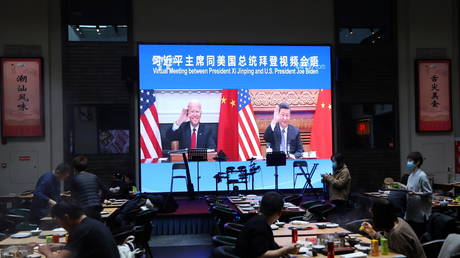
A screen at a restaurant in Beijing showing Chinese President Xi Jinping's virtual meeting with US President Joe Biden. © Reuters / Tingshu Wang
Biden & Xi agree to avoid conflict

A recent report by a Washington Post columnist claimed the US won’t be sending an official delegation to Beijing in 2022 over allegations of human rights violations by the Chinese government. According to the sources cited in the article, a formal recommendation for a diplomatic boycott of the Olympics has been already presented to Biden, with the move expected to be approved by the president by the end of November.

The piece was published on the day that Biden held a lengthy virtual meeting with Chinese leader Xi Jinping, in which they discussed a range of issues regarding the strained relations between the two nations – but not the Olympics.

The White House said that during the talks, President Biden challenged his Chinese counterpart over what Washington sees as persecution against the Uyghur population in the Xinjiang region, as well as human rights violations in Tibet and Hong Kong. China has strongly denied the claims, accusing the US of interfering in its internal affairs.

Calls for the Biden administration to boycott the Olympics and refrain from sending a political delegation to Beijing have recently been made by top Democratic and Republican lawmakers. 

If implemented, it won’t affect the American athletes, who will still be taking part in the Winter Olympics.

Like this story? Share it with a friend!

find more fun & mates at SoShow now !