EXPERT OPINION — More than 200 U.S. officers have been hunted around the globe and targeted by an adversary using a mysterious weapon that causes permanent brain injury. It’s time to get serious about fighting back.

The Authors:

Paul Kolbe served for 25 years in the CIA’s Directorate of Operations. He is currently Director of the Intelligence Project at Harvard Kennedy School’s Belfer Center for Science and International Affairs.

Marc Polymeropoulos worked for the CIA for 26 years. He is author of “Clarity in Crisis: Leadership Lessons from the CIA.

John Sipher worked for the CIA’s clandestine service for 28 years. He is now a nonresident senior fellow at the Atlantic Council and a co-founder of Spycraft Entertainment.

Prior to 9/11, al Qaida declared war on the United States, bombed the USS Cole, and blew up U.S. embassies in Nairobi and Dar es Salam. Despite heavy casualties, America viewed successive al Qaida terrorist attacks as somehow unique, not representative of a larger threat or state of war. We went about our business and failed to take hard action against al Qaida despite clear warning. Our failure to respond forcefully led to 9/11 and the two decades of war that followed.

Fast forward to today.  Since 2016, more than 200 U.S. officials have reportedly suffered from a mysterious series of symptoms which have caused long-lasting, debilitating injuries. Suffering from searing headaches, vertigo, vision impairment, and nausea, many victims have been formally diagnosed with traumatic brain injuries (TBI) at the Walter Reed National Military Medical Center and other leading hospitals. Family members and young children have suffered as well. Some medical tests can now confirm the markers of brain injury, similar to those suffered by victims of concussive injuries in Iraq and Afghanistan.

These injuries began with a cluster of reports from Cuba in 2016 and have become commonly referred to as Havana Syndrome. Moscow, Vienna, Belgrade, and Hanoi are among more than a dozen cities where U.S. officials reportedly have been attacked and injured. In residences, on the street, in vehicles, and even at secure U.S. facilities, U.S. officers are being hunted. Stunningly, even a close aide to CIA Director Bill Burns was reportedly attacked on a trip to India just this past August.

The CIA, after a period of confusion, delay, and even denial at times, now appears to take these threats very seriously. CIA Director Burns and Deputy Director David Cohen have publicly stated that U.S. officials are being “attacked.” They have improved health care for CIA officers who are hurt. And an agency task force is hard at work trying to obtain additional intelligence on those responsible. We credit Director Burns for his solid leadership.

The cause of these injuries? The National Academy of Sciences has pointed to Directed Energy Weapons – devices which emit microwave pulses which can inflict pain and damage tissue. The United States, Russia, China, and others have all developed Directed Energy Weapons to destroy equipment, counter drones, and control crowds. This is not science fiction.

Directed energy weapons would account for the highly directional and locational nature of these incidents. When victims can “move off the x,” the signature sounds, sensations, and pain that goes with the attacks often stop, though damage has already occurred. The amount of exposure seems to affect the degree of injury. Other technologies could be at play and are being investigated, but microwaves appear to be the most likely vector. Russia has used them before, flooding the U.S. Embassy in Moscow with microwave radiation for decades.

Regardless of form, the weapons being used in these attacks are nothing less than weapons of terror, designed to cause injury to non-combatants. Who would use such a weapon to attack U.S. intelligence officers, diplomats, and military personnel, and to what conceivable end?


The Cipher Brief hosts private briefings with the world’s most experienced national and global security experts.  Become a member today.


CIA Deputy Director Cohen stated at a recent intelligence summit, that the U.S. was closer to identifying the culprit, and Politico has reported that members of the Senate Intelligence Committee are increasingly convinced that Russia or another hostile adversary is behind the attack, although reportedly, no smoking gun has been found.

As former CIA operations officers with extensive experience dealing with both counterterrorism and counterintelligence issues, we have few doubts about who will be named as the culprit. For at least a decade, Russia has conducted itself as in a state of conflict with the West in general and the United States in particular. Russia has launched cyberattacks impacting critical infrastructure and supply chains, assassinated opponents with nuclear poisons and chemical weapons, gunned down people in the streets using criminal proxies, sabotaged a Czech ammunition depot, and mounted a violent coup attempt in Montenegro. It has also bombarded the U.S. embassy in Moscow with microwave radiation and used carcinogenic “spy dust” without regard to health effects. The attacks on U.S. officials would fit this pattern of behavior.

We recognize that it is important to let the intelligence community do its job and its findings must inform policy action. Congress and the administration must work together to formulate a range of possible responses and it is not too early to begin. As Senator Collins and others have stated, these attacks are “an act of war,” and as such, preparation for a future attribution call by the national security establishment is in order. So how could the U.S. respond?

Let’s start with what doesn’t work – sanctions. Sanctions feel good and satisfy an action imperative but they are feckless. Sanctions have not stopped Russia from killing dissidents, halted the Nordstream II pipeline, compelled a pull back from occupied territories, reduced support for tyrants, or hindered oil and gas production. Sanctions have simply forced Russia to develop more creative money laundering and sanction circumvention mechanisms.

So, what would work? For starters, we must understand that the Putin regime considers itself in a state of conflict with the U.S., short of war, but nonetheless deadly real. We are dealing with a state sponsor of terror which conducts operations across the globe to weaken the U.S. abroad, divide it from its allies, and sow discord at home. Our policy must be calibrated to win this conflict, without sparking a shooting war, but at risk of one.

Russia understands reciprocity and strength. When four Russian diplomats were kidnapped by extremists in Beirut in 1985, and one of them was killed, Russia reportedly responded by kidnapping and gruesomely killing a relative of the group’s leader. The surviving diplomats were released immediately. The story may be apocryphal, but it does illustrate the Russian approach. Tempting as it may be for America to retaliate tit for tat, we need not mirror Russia’s actions. Instead, we should play to our greater economic, diplomatic, and military advantages.

We offer five elements to frame a response: enlist U.S. allies, expand forward deterrence, limit the adversary’s reach, choke off money, and bring those accountable to justice.

NATO: With proof of the attacks on U.S. officials, we should activate NATO’s Article Five collective defense clause. The only other time this was enacted was after 9/11. As justification, in addition to the Havana Syndrome attacks, (which also caused Canadian casualties), we would include GRU and FSB assassination operations across Europe, deadly sabotage in the Czech Republic, a coup attempt in Montenegro, persistent cyberattacks, and a litany of other actions that can only be described as irregular warfare directed against NATO members.


Go beyond the headlines with expert perspectives on today’s news with The Cipher Brief’s Daily Open-Source Podcast.  Listen here or wherever you listen to podcasts.


Forward Presence: A crystal clear signal that we understand the nature of Russian hybrid warfare and are responding would be to enhance our deployed military presence in Poland, the Baltic States, and in the Black Sea region. These units would pose no offensive threat to Russia but would be a clear signal that the U.S. is prepared to counter any Russian shenanigans. We should also significantly ramp up our lethal aid and training to the Ukraine, where the nature of Russian aggression is well known. Weakness in Eastern Europe is an invitation to conflict.

Travel and Presence: We should drastically limit Russian business and tourist travel which is being used as cover for FSB and GRU operations. We would reduce Russian diplomatic presence in each capital to the bare minimum – handfuls not hundreds. American and European counterintelligence experts believe there are more Russian intelligence officers operating from embassies than during the Cold War. Limiting the size of Russia’s espionage infrastructure will complicate the planning and execution of all of its intelligence operations.

Finance: A key tool in counterterrorism operations is the ability to target sources of finance which constitute material support to terrorism. In this case, we would apply that principle to the Russian government, state enterprises, and individuals who provide cover, tools, and sources of funding to Russia’s campaign to undermine the West with violence, terror, and media manipulation. Russia’s dirty money has been used to undermine the west and poison our politics. We should limit the easy access of shady money to western banks.

Criminal Cases: We need bring war crime cases to the International Court of Justice (ICJ) in the Hague. Following a decade of conflict in the Balkans, the ICJ brought to justice 161 indicted Serbian, Croatian, and Bosnian war criminals. This was an astounding success – a manhunt which included American and European law enforcement and intelligence services. Just as in Nuremberg after World War II, these actions to hold war criminals accountable drew a line in the sand.

This is a start.  Successive Democratic and Republican administrations have pursued Russia policies which represent the triumph of hope over experience. We have treated the symptoms of malign Russian actions rather than the underlying pathology. It is now time to finally acknowledge that we are in a long-term hybrid conflict and forget the fantasy of changing Putin’s behavior. Only a new regime in the Kremlin would hold the hope of bringing about a change in actions. Eventually, the Putin regime will wither or collapse, but until it does, we and our allies must do a better job of defending ourselves.

Read more expert-driven national security insights, perspective and analysis in The Cipher Brief

The post Havana and the Global Hunt for U.S. Officers appeared first on The Cipher Brief.
find more fun & mates at SoShow now !

Any apology for Nazism is unacceptable, Colombia’s president Ivan Duque has insisted, after photos of police academy cadets dressed up in Third Reich uniforms were uploaded online, causing outrage.

“Any apology for Nazism is unacceptable,” Duque stated in a tweet on Friday. The president said he condemned any references to those who were “responsible for the Jewish Holocaust that claimed the lives of more than 6 million people,” adding that “anti-Semitism has no place in the world.”

Duque had earlier made demands for “heads to roll” at an academy that “promotes such criminal practices,” with its director, Lieutenant Colonel Jorge Ferney Bayona Sanchez, already having been sacked.

Colombia’s defense ministry, which oversees the country’s police, also insisted in a statement that that its training programs “don’t envisage in any way an activity such as the one which took place” at the academy.

Read more

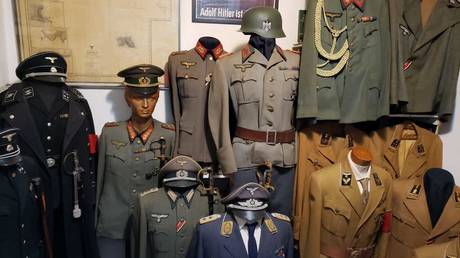
Nazi uniforms found inside the house of a man suspected of raping a 12-year-old boy at the Vargem Grande neighbourhood of Rio de Janeiro. © AFP / Rio de Janeiro Civil Police
Brazilian police discover $3.5mn trove of Nazi memorabilia at home of ‘insane psychopath’ suspected of child rape

The images of police cadets in Nazi uniforms caused anger and bewilderment among internet users.

The German and Israeli embassies in the country reacted by issuing a joint statement, in which they expressed “total rejection of any form of apology or demonstration of Nazism.” The US embassy in Bogota also said that it was “shocked and deeply disappointed” by the development.

The controversial images, in which aspiring officers were caught sporting black SS outfits with red swastika armbands and grey Wehrmacht uniforms from the World War II era, weren’t revealed in some bombshell media report, but were actually published on the official Twitter account of the Colombian police this Thursday.

The photos were taken as part of a “cultural exchange” event at the police academy in the city of Tulua, aimed at commemorating Germany and “strengthening the knowledge of our police students.” The cosplay was apparently intended to illustrate the history of German law enforcement, with more cadets pictured wearing more modern versions of the country’s police uniforms in the pictures.

Like this story? Share it with a friend!

find more fun & mates at SoShow now !

Mark Kelton, Former Deputy Director, CIA’s Counterintelligence, National Clandestine Service

Cipher Brief Expert Mark Kelton is a retired senior Central Intelligence Agency executive with 34 years of experience in intelligence operations. Before retiring, he served as CIA’s Deputy Director for Counterintelligence.  He is a partner at the FiveEyes Group and is Board Chair of Spookstock, a charity that benefits the CIA Memorial Foundation, the Special Operations Warrior Foundation and the Defense Intelligence Memorial Foundation.

EXPERT PERSPECTIVE — Winston Churchill’s 04 June 1940 speech in which he vowed that he and his countrymen would “fight on the beaches “and would “never surrender” in the face of a seemingly inevitable Nazi invasion is rightly renowned as perhaps history’s most famous address by a wartime leader.  Less well known, however, is the cautionary tone the new Prime Minister struck in that same appearance before the House of Commons, as he sought to temper the joy and relief engendered by the seemingly miraculous extraction of the British army from the beaches of Dunkirk.  “We must,” Churchill warned, “be very careful not to assign to this deliverance the attributes of a victory.”  “Wars” he admonished, “are not won by evacuations.”

Shortly before the 2011 Abbottabad operation that killed Osama bin Laden, I was asked by my HQ, my views on mounting an assault on the target we knew as Abbottabad Compound 1, (AC1) given that we were not sure it sheltered the terrorist leader.  After expressing my 95% confidence that the Al Qaeda (AQ) leader was in fact, there, I allegorically added that we must strike as ‘you cannot leave Hitler in his bunker and end the war’.  I was fortuitously, right in my assessment that the murderer of so many innocents was present within AC1.  Sadly, however, his death did not bring our war with radical Islamic terrorism to a conclusion.  As was the case after Dunkirk, our enemy was unwilling to quit the field or to limit his unbounded war aims.

Likewise, we should have no expectation that the withdrawal of our forces from the Afghan theater of combat signals an end to the conflict with terrorists who started that war by attacking us on September 11, 2001.  We cannot unilaterally declare an end to the War on Terror by leaving Afghanistan – however much we might wish to do so – for the very simple reason that our enemies do not share that desire.  As former Defense Secretary Leon E. Panetta put it, “I understand that we’re trying to get our troops out of there, but the bottom line is, we can leave a battlefield, but we can’t leave the war on terrorism, which still is a threat to our security.”

The Taliban parading of the American-made weapons and accoutrements of their defeated foes was, in a manner akin to that of ancient Rome, intended not only to celebrate victory.  It was also meant to humiliate the vanquished.   Such triumphal demonstrations – and what will be a galling celebration of the anniversary of 9/11 as their own holiday to follow – will evoke enthusiastic responses from Islamic extremists and will draw many new adherents to the cause that lies at the core of Taliban legitimacy and belief.

As was the case when we left Iraq and later had to go back into the region to crush the ISIS Caliphate that metastasized in the wake of our departure, there is every prospect that the Taliban’s success will breathe new life into Islamic extremist groups.  And there is no reason to believe that the “new” and now much more heavily armed Taliban – an organization that refused to break with AQ over the course of a brutal twenty-year battle, will be any less receptive to working with Islamic terror groups than were their pre-9/11 forebears.


The Cipher Brief hosts private briefings with the world’s most experienced national and global security experts.  Become a member today.


“We are going to have to maintain very, very intense  levels of indicators and warnings and observstion and ISR [Intelligence, Surveillance, Reconnaissance] over that entire region to monitor potential terrorist threats”, said Chairman of the Joint Chiefs, General Mark Milley in a recent interview, adding it will not be easy.

As CIA Director William Burns said during Senate testimony in April, “Our ability to keep (the) threat…in check in Afghanistan from either al Qaeda or ISIS…has benefited greatly from the presence of U.S. and coalition militaries on the ground and in the air fueled by intelligence provided by the CIA and our other intelligence partners.” With the withdrawal of the American military, Burns said, “the U.S. government’s ability to collect and act on threats will diminish.”

Much discussed ‘over the horizon’ intelligence collection against Afghan terror targets will not fill the void left by the loss of our ability to monitor and attack terrorist targets from in-country bases.  With Afghanistan bordered by countries unlikely to be willing to host a significant US presence, intelligence collection missions will now have to be launched from bases well beyond the horizon with all that implies for the quantity, quality and timeliness of intelligence collected.  Such operations will also be commensurately more expensive and difficult to mount.  Moreover, the intimate knowledge of our adversaries that we have painstakingly built over the course of nearly 20 years on the ground, began aging the moment we departed Afghanistan.  Absent an intelligence presence on the ground, our ability to collect on terrorist groups operating in and from that country will only degrade further as time goes on.

After acknowledging that we “could see a resurgence of terrorism out of the region in the coming 12-36 months”, Milley went on that we will, “as opportunities present themselves… have to continue to conduct strike operations if there’s a threat to the United States.”  However, as our pre-9/11 experience showed, such remote strikes can delay our terrorist enemies’ plans, but will not deter them from their intent to strike the US homeland.

As such, Secretary Panetta is undoubtedly correct in his conclusion that US involvement in Afghanistan is not over.  “We’re going to have to go back in to get ISIS,” Panetta said.  “We’re probably going to have to go back in when al-Qaeda resurrects itself, as they will, with this Taliban.”  And, as was the case with our operations to destroy ISIS’s so-called Caliphate after we precipitously left Iraq, there can be no doubt that should we have to go back into Afghanistan, our task will be greatly complicated by the manner in which we left that country, abandoning our allies and bases there.


Go beyond the headlines with expert perspectives on today’s news with The Cipher Brief’s Daily Open-Source Podcast.  Listen here or wherever you listen to podcasts.


The US withdrawal from Afghanistan will have profound geo-strategic implications for America’s position in the region and in the world.  Our Chinese, Russian and Iranian adversaries will seize the opportunity to fill the void left in the wake of our departure.

The Taliban has already indicated it will engage with China, which covets Afghanistan’s mineral wealth.  Entry into a transactional relationship with the cash-strapped Taliban regime and granting access to Afghan mineral resources – and possibly use of Bagram Air Base – in exchange for financial aid and Chinese support for the Taliban in international organizations would suit Beijing, which would evince no concerns about human rights and the like.

For their part, Central Asian countries will look away from Washington and ever more towards their old masters in Moscow and a rising China to ensure their security and economic well-being.   Islamabad, while publicly celebrating the victory of their Taliban proxies and its role in guiding it, must at the same time worry that the extremism embodied by the victors will gain renewed traction beyond its frontier provinces with all that implies for the security of the Pakistani state.

Caught by surprise by Washington’s decision to leave and the conduct of the withdrawal, even our closest and oldest allies are questioning US resolve.  They will surely think twice before acceding to any future US request to join in joint operations.  Our decision to quit Afghanistan, and its messy execution, will also evoke questions about the validity of American assurances to other nations under threat from aggressors.  It will not have been lost on them that the withdrawal of American air, intelligence, planning expertise and logistical support ensured the collapse of an Afghan Army that was dependent on the US.

Our adversaries, too, will see the chaotic nature of our departure as well as the abandonment of Americans, allied citizens and Afghans to uncertain fates as signs of weakness and enfeeblement.   This possibility is particularly dangerous in that they could seize this moment of US distraction to engage in opportunistic adventurism that could include movement by China against Taiwan; a Russian attempt to resolve its impasse with Ukraine forcibly; stepped-up Iranian prosecution of its proxy war with Israel; or a further ramping up by North Korea of its nuclear program.  Any such eventuality would force the US to respond vigorously or risk further erosion of its international credibility.

Finally, the costs involved in remotely monitoring and trying to deter threats emanating from a Taliban-controlled Afghanistan mean that we will be unable to shift intelligence and military resources away from the War on Terror to confront the threat posed by peer competitors to the degree we had hoped.

Aristotle is said to have pronounced, “You will never do anything in this world without courage. It is the greatest quality of the mind next to honor.”  Likewise, the courage shown by so many – and the heroic conduct of US military and CIA personnel in particular – in seeking to extract American citizens from Afghanistan and to honor our obligations to Afghans who worked and fought alongside us for so long, cannot obviate the dishonor attendant to having left so many behind.  Bloody Taliban outrages and reprisals against the latter are a certainty.

It will not be long before Kabul’s new rulers recognize that the Americans now under their control, are potentially useful pawns in trying to extract diplomatic, financial and other concessions in exchange for their freedom.  The effectiveness of our efforts hereafter to extract our own people and our Afghan allies from the clutches of the Taliban and how we respond to any attempts to use them as leverage against us, will determine the depth of the stain on our national honor already attendant to the disastrous end of our Afghan campaign.

In that same famous speech, Churchill solemnly told his countrymen that: ‘The Battle of France is over: The Battle of Britain is about to begin.”  He went on that “we would be well advised to gird our loins for the continued warfare to come.”

As we approach the 20th anniversary of 9/11, we should honor our sacred dead from that horrible day.  But we should likewise prepare ourselves for the battles with Al Qaeda and its murderous kindred of Cain that will surely come.

Recent polls would indicate that Americans support the decision to withdraw from Afghanistan, if not the way in which it was conducted.  One wonders how those polled would have responded if the question had been ‘Do you support a withdrawal from Afghanistan even if it markedly increases the chance of terror attacks and atrocities directed at your fellow citizens at home and abroad?’  I fear we will find out soon enough.

Read more expert-driven national security insights, perspective and analysis in The Cipher Brief

The post Wars are not Won by Evacuations appeared first on The Cipher Brief.

find more fun & mates at SoShow now !

Two climate activists in Australia have brought the world’s busiest coal port to a halt, strapping themselves to a massive piece of machinery and refusing to come down. The stunt follows more than a week of similar actions.

Blockade Australia, a climate group focused on “strategic direct action,” declared that two of its members had clambered atop equipment at the Port of Newcastle and stopped work there late Tuesday night, sharing footage captured by the activists as they suspended themselves from a large loading machine.

“Zianna and Hannah have shut down Newcastle coal port, abseiling from coal handling machinery. The port cannot resume operations until the pair are removed by police,” the group said, identifying the activists by their first names only, adding “This is the tenth consecutive day of disruption to Newcastle coal port and its supply rail network.”

The protest stunt follows at least 16 similar actions over the last week or so, the group said, some targeting the rail line near the port, the world’s largest for coal exports.

Another demonstration carried out on Tuesday saw a second pair of activists breach the port and “hit emergency stop buttons” on machines before strapping themselves to a different piece of equipment. They were brought down and arrested after “several hours” and are expected to appear in court in the coming days.

The disruptions have drawn the ire of state officials, with New South Wales Environment Minister Matt Kean calling them “completely out of line” and urging police to “throw the book” at the protesters, at least 19 of whom have already been arrested so far this month, according to ABC.

“Pull your heads in, get out of the way and stop hurting other people going about their lives, running their businesses,” the minister said during a radio interview on Wednesday. “There are hundreds of ways to make your views known and advocate for change, but risking the lives of rail workers is definitely not one of them.”

The activists could face charges that carry maximum sentences of 25 years in prison, NSW police commissioner Mick Fuller said, noting that local law enforcement has created a “strike force” to deal with future disturbances at the port.

READ MORE: The trillion dollar push to decarbonize global shipping

Like this story? Share it with a friend!

find more fun & mates at SoShow now !

Hospitals in the Netherlands have begun delaying certain operations to free-up ICU beds during a record wave of Covid-19 infections, while an infectious diseases researcher has warned of an impending ‘Code Black’ in the sector.

The country set a daily national record for new Covid infections on Thursday, registering around 23,600 cases. It was the third day in a row of the figure topping 20,000.

To make more staff available for Covid wards, a number of operations, including those for cancer and heart patients, are being canceled from this week on, Dutch healthcare officials have said. Fewer than 200 beds remained available in Dutch ICUs as of Thursday, while Friday figures show almost half (47.8%) of occupied ICU beds were being used by Covid patients.

Read more

FILE PHOTO. A woman wearing a protective mask walks past a store in Amsterdam, Netherlands.
Netherlands re-introduces facemasks & other restrictions as Covid-19 cases surge

“These are cancer patients that should actually be operated-on within six weeks of diagnosis, and that won’t be met in all cases. It’s also heart patients,” said a spokesperson for the National Coordination Center for Patient Distribution (LCPS).

Meanwhile, new calculations by an infectious disease modeller at Wageningen University & Research suggest that a so-called ‘Code Black’ in hospitals is looming. The emergency designation means that patient safety is at risk and, if declared, would mean many people with life-threatening illnesses cannot go to the ICU, while doctors have to prioritize who to treat.

According to recent estimates from the Dutch Healthcare Authority (NZa), up to 200,000 operations were not performed as a result of urgently needed Covid care since the start of the pandemic. On Thursday, the NZa revealed that almost a quarter of operating rooms across the country are not currently in use due to a combination of Covid patient pressures and rising staff absences due to illness.

It is not yet clear what impact the delayed care will have on public health. In December 2020, the Dutch National Institute for Public Health and the Environment (RIVM) calculated that an estimated 34,000 to 50,000 ‘healthy life years’ had been lost due to the first Covid-19 wave alone.

Think your friends would be interested? Share this story!

find more fun & mates at SoShow now !

The city council in Austria’s second-largest city, Graz, has elected a new mayor. Communist Party member Elke Kahr has become the first Communist leader of a major city in the country.

The 60-year-old politician, who has been working in the municipal government for more than 15 years and previously served as vice mayor of Graz, was elected as the new city leader on Wednesday. A member of the Austrian Communist Party (KPÖ, Kommunistische Partei Österreichs) for almost 30 years, she won the election with 28 of 46 votes. Kahr succeeded the previous long-standing mayor Siegfried Nagl of the center-right, liberal-conservative People’s Party.

Read more

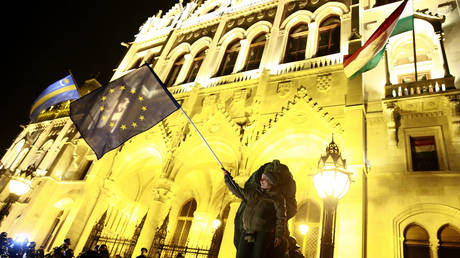
FILE PHOTO: A protester waves a EU flag outside the parliament building in Budapest, December 16, 2014
Brussels, we got a problem! 30 years after collapse of communism, Eastern Europe is losing its faith in Liberal Democracy

Who would have thought that the daughter of a locksmith, a Communist, would become mayor,” she said in her first speech following the vote.

Having acknowledged a number of issues to deal with in the city, especially during the Covid-19 pandemic, the new mayor highlighted a housing policy, pledging to put a stop to profit-driven construction in Ganz.

The Communists have also already formed a coalition with the Greens and the Social Democratic Party (SPÖ), and another precedent in European city governance was made – two women serving as mayor and deputy. Green leader Judith Schwentner was chosen as Graz’s vice mayor, with the new governing coalition saying they would support not only social, but also environmental changes, aiming to improve living standards especially for low-income groups. Providing a bicycle for every child in the city from the municipality is in their program.

However, not everyone in the local government is happy with the new Communist rule. A member of the right-wing Freedom Party of Austria (FPÖ), Alexis Pascuttini, described the choice as “unpleasant,” having accused the Graz Communists of empty catchphrases in their program and refusing to participate in what he described as “left-wing nonsense.” Kahr herself has been exposed to strong pressure to justify her party, being repeatedly asked about her position on “the crimes of communist parties around the world since 1917,” according to Austrian media.

If you like this story, share it with a friend!

find more fun & mates at SoShow now !

Greece will soon prohibit unvaccinated residents from entering a litany of public spaces, the country’s prime minister has announced, claiming its current Covid outbreak is largely fueled by those who haven’t received the jab.

Starting next week, the unvaccinated will be barred from entry to restaurants, cafes, theaters, bars, gyms and museums, among other indoor public places, PM Kyriakos Mitsotakis said on Thursday, noting that a negative Covid-19 test will no longer be accepted as an alternative to proof of vaccination.

“This is indeed a pandemic of the unvaccinated,” he said as he announced the move in a televised address, adding “Greece is mourning unnecessary losses because it simply does not have the vaccination rates of other European countries.”

The new rules are set to take effect on Monday, and will require Greeks to present vaccine certificates to businesses and other indoor establishments to be allowed inside. Those attending religious services mark a rare exception, however, as they will only be asked to present a negative test in order to enter a church or other place of worship.

Read more

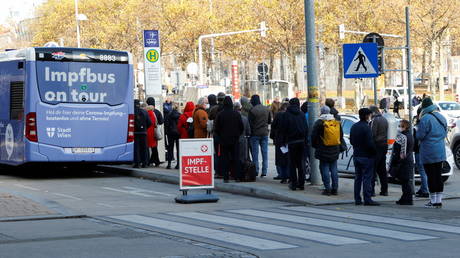
People wait in front of a vaccination after Austria's government has imposed a lockdown on people who are not fully vaccinated, in Vienna, Austria, November 18, 2021. © Reuters /Leonhard Foeger
Austria may lock down the vaccinated too

In a bid to encourage booster vaccinations among the elderly – a population much more vulnerable to Covid-19 – citizens over the age of 60 will be made to renew their certificate after a period of seven months.

While officials had hoped to hit a full vaccination figure of 70% for Greece’s population of 11 million by autumn, the number currently stands at about 62%, according to Reuters. As its weekly case counts continue to soar to record highs, the country reported 7,317 new Covid-19 infections and 63 deaths on Thursday, bringing the totals to more than 860,000 cases and some 17,000 fatalities since the pandemic kicked off in late 2019.

The new restrictions in Greece mirror similar policies implemented elsewhere in Europe, with Austria, Germany, Italy, France, the Czech Republic and Slovakia each imposing limits on public life for the unvaccinated. Though the Austrian government recently imposed a full lockdown for millions of residents who have not received the shot, some officials in that country are pushing for even harsher policies, including a national stay-at-home order on the jabbed and non-jabbed alike.

Think your friends would be interested? Share this story!

find more fun & mates at SoShow now !

EXPERT PERSPECTIVE — On 16 June, US President Joe Biden and Russian President Vladimir Putin met for just under four hours in Geneva. This was Mr. Biden’s first meeting with Mr. Putin during his presidency and Biden is the fifth US President with whom Putin has held a summit.

Expectations for the summit were characterized as low by both sides in advance and assessed a bit more positively after the conclusion of the meeting. The meeting presented an opportunity for both leaders to present grievances and warnings to the other (and show toughness to their domestic constituencies).  Other than presenting the opportunity to blow off steam, the results of the meeting appear modest:  the agreement to return ambassadors to their posts, to resume bilateral arms control discussions, to conduct discussions on “strategic stability” and to hold unspecified consultations on cyber. In typical fashion, Mr. Putin rejected all of Mr. Biden’s assertions about Russian actions and made counter accusations referencing hostile US actions.

Of the deliverables from the summit, cyber will no doubt turn out to be the most problematic area for follow up. Mr. Biden apparently delivered to Mr. Putin a list of 16 US critical infrastructure sectors that should be considered “off limits” for cyberattacks, e.g., “red lines” not to be crossed without the risk of significant retaliation. For his part, Mr. Putin asserted that it is Russia that is the victim of cyberattacks originating from the territory of the US and it’s NATO partners and also is the victim of  attempts to interfere with Russian elections.  The challenge in cyber discussions going forward will center around three areas:  differing interpretations of the relevance of deterrence theory in today’s cyber environment, attribution, and control.

Mr. Biden’s firm comments to Mr. Putin on recent cyberattacks against the US such as the ransomware attack on Colonial Pipelines (Mr. Biden is said to have asked Mr. Putin how he would react if Russia’s pipelines were hit?) and his provision of a list of “off limits” US infrastructure entities suggests a deep belief in this administration that Russia can be deterred from engaging in future conduct of cyber operations against US targets or “sanctioning” attacks originating from the territory of the Russian Federation by criminal groups.

Unfortunately, it is highly likely that either Mr. Putin nor those who control the levers of Russian cyber operations agree that deterrence theory applies.  Deterrence only works when both sides know the other is capable of – and willing to – cause significant harm to the other.

The Russian side likely believes (and may have amply demonstrated) that the US is disproportionately vulnerable to cyber risk at every level of its economic, societal, and political infrastructure whereas Russia is not.  There is a reason the use of cyber tools has become a central feature of Russian strategic doctrine. They work and seem a legitimate tool that falls short of conventional war. Hybrid warfare using cyber tools, the Russian side would argue, is no different than the economic warfare Russia is experiencing from sanctions imposed by the US its allies.

For full access to the article, sign up to become a Cipher Brief member for just $10/mo.


“The Cipher Brief has become the most popular outlet for former intelligence officers; no media outlet is even a close second to The Cipher Brief in terms of the number of articles published by formers.” – Sept. 2018, Studies in Intelligence, Vol. 62 No.

Access all of The Cipher Brief’s national-security focused expert insight by becoming a  Cipher Brief Level I Member .  


The post After Geneva: US – Russia Strategy Moving Forward appeared first on The Cipher Brief.
find more fun & mates at SoShow now !

The planned introduction of chemical castration for serial rapists in Pakistan has been dropped due to objections from experts in Islamic law, who said such punishment would be counter to Sharia.

The controversial clause in a bill amending criminal law in Pakistan was dropped before the National Assembly voted on it on Wednesday, a parliament official said on Friday. If it were passed, it would have been unconstitutional, Parliamentary Secretary for Law and Justice Maleeka Bokhari explained. The basic law of the country requires all its laws to be in line with the Sharia and the Koran.

Bokhari said the decision to drop the clause was taken due to objections from the Council of Islamic Ideology, a constitutional body that advises the government of Pakistan on the intricacies of Islamic law.

Read more

© publicdomainpictures.net
Outrage as teen’s rapist spared jail time

The bill amends Pakistan’s Penal Code and Criminal Procedure Code to streamline investigations and prosecutions of sexual crimes as part of wider anti-rape reform. Some conservative lawmakers vocally argued against the castration clause as the piece of legislation was moving towards approval. Senator Mushtaq Ahmed from the Islamist Jamaat-i-Islami party argued that rapists should be hanged publicly, while castration was never mentioned in Sharia.

A separate bill also approved by the parliament on Wednesday introduces a system of special regional investigators for rape allegations to be appointed by the prime minister, as well as new protections for victims, and punishments for officials who fail to investigate their complaints properly. Among other things, it makes evidence that a victim is “generally of immoral character” inadmissible in court.

The reform is necessary because currently deterrence of sexual crimes in Pakistan is undermined by “poor investigation, archaic procedures and rules of evidence and delay in the trial,” the bill said.

If you like this story, share it with a friend!

find more fun & mates at SoShow now !

As the U.S. works toward getting more 11,000 Americans, diplomats and Afghan allies out of the country, what kind of Taliban should the U.S. expect to deal with in Afghanistan?  So far, there have been assurances from the Taliban that a new regime may not be as brutal as regimes past, but few who have worked with the Taliban believe the assurances.  How might the regime work with, or shelter groups like al-Qaeda, which is the reason why the U.S. entered into Afghanistan after 9/11.  And how might a massive-scale exodus of Afghans impact neighboring countries?

The Cipher Brief sat down with the former National Intelligence Manager for Iran at ODNI, Norman T. Roule to get his expert-level perspective.

Norman T. Roule, Former National Intelligence Manager for Iran, ODNI

Cipher Brief Expert Norm Roule served for 34-years in the Central Intelligence Agency, managing numerous programs relating to Iran and the Middle East. He served as the National Intelligence Manager for Iran (NIM-I) at the Office of the Director of National Intelligence from November 2008 until September 2017.  As NIM-I, he was the principal Intelligence Community (IC) official responsible for overseeing all aspects of national intelligence policy and activities related to Iran, to include IC engagement on Iran issues with senior policy makers in the National Security Council and the Department of State.

The Cipher Brief: How would you characterize the international community’s response to the Taliban victory in Afghanistan?

Roule:  Historians of the future will likely describe the response to the Taliban victory as a strange mix of apathy and confusion.

In terms of apathy, there is extraordinary irony in the fact that after spending so much blood and treasure to defeat Da’esh efforts to establish an extremist Islamic Republic in Syria and impose its oppression over Iraqis and Syrians, the international community failed to prevent the creation of an Islamic Republic in Afghanistan. Many of the arguments behind our involvement in Syria – from a refugee crisis to the need to deny international Islamic militants a home to birth new terror groups – apply to Afghanistan. Whether or not one supported this decision, it is hard to avoid thinking that this episode will embolden militants worldwide.

In terms of confusion, we seem to be unable to accept that no one can predict the course and pace of crowd dynamics that so quickly eroded Afghan resistance. We live in a world where people acknowledge their inability to predict who will win our presidential elections but insist the Intelligence Community can somehow predict the day events will occur in a denied environment. But such a worst-case possibility should have been part of the planning deck and resourced on the ground accordingly.

The Cipher Brief: How would you expect the international community to respond in the coming days?

Roule: Absent a Taliban attack, operations at the airport should proceed more smoothly as our response architecture grows. Beyond that, much depends on how the Taliban act in the coming weeks. The group is not a monolith. Their success was highly likely as much a surprise to them as anyone. As they define their path and choose their leaders, there will be internal debates, jockeying for power, and perhaps some violent infighting.

In terms of indicators of the regime’s direction, we may want to consider the following questions:

First and foremost, how will the Taliban respond to our ongoing evacuation? Thus far, they seem willing to let us leave untouched, probably believing that the sooner we get out, the easier it will be for them to take control. At the same time, international media coverage of the evacuation will impose a strategic embarrassment on Washington.

Second, to what extent have the Taliban changed? They certainly understand that diplomacy played a role in their victory. Some of their leaders have spent hundreds of hours with foreign diplomats and traveled to multiple foreign capitals. How will these leaders merge such experiences into governance with more insular colleagues? They are likely to talk initially about compromise regarding women’s rights and inclusion of opponents in the government, but this may well be another effort to buy time. The international community has few pressure points over the group. How this plays out will be a good indicator of how they plan to run the country.

Next, how will they handle the issue of al-Qaida and other terrorists? We cannot overlook the deep connections between the Taliban and al-Qaida. If they believe the international community will limit its response to demarches, press statements, and empty sanctions, many in the group will be inclined to allow al-Qaida to reorganize.

Last, I would look at the refugee issue. They are likely to welcome external aid and allow at least some humanitarian groups to remain in country. Doing so requires no political concessions, addresses a domestic headache, and provides an opportunity for corruption. Humanitarian groups also offer a lever the Taliban can use against the West, i.e., refrain from criticizing us, or we will block your humanitarian operations. The Houthis have done this with great effect in Yemen.


The Cipher Brief hosts private briefings with the world’s most experienced national and global security experts.  Become a member today.


The Cipher Brief: How do you think will China, Russia, and other adversaries will respond to the withdrawal? 

Roule: Chinese propagandists have aggressively exploited our evacuation from Afghanistan. Its media is already claiming that these events show Taiwan that “once war breaks out in the Straits, the island’s defense will collapse in hours, and the US military won’t come to respond.” China’s press has also reportedly announced that the U.S. will not stand by Hong Kong activists.

Beijing, Tehran, and their proxies will likely point to the withdrawal as evidence that the U.S. is a declining power, unwilling or incapable of defending its friends. It will be lost on no one that whereas the U.S. has abandoned Afghanistan, Russia, China, and Iran have not wavered in support of their – admittedly few and otherwise isolated – allies.

In a worse case, if our adversaries believe the withdrawal reflects a lack of national resolve, they may be tempted to test our will on other issues. In this case, a miscalculation could lead to a conventional war in another theater.

The Cipher Brief: What would you say to those who say that the withdrawal demonstrates that the U.S. will only focus on strategic interests?

Roule:  Certainly, this argument has an appeal. It is true that our strategic adversaries like nothing better than the U.S. expending resources and diplomatic energy in such areas as Afghanistan, in part because we are, in essence, protecting their interests for free. But it does beg two questions.

First, what will happen differently next year regarding China, Russia, efforts to combat climate change, and cyber actors, now that we are out of Afghanistan? Second, what exactly is a U.S. strategic interest that we would protect? Estonia? Bahrain? Taiwan?

This argument also glosses over how others respond to such a posture. If a country perceives itself outside the international community’s protection, it will likely accommodate an aggressor. Our next call for a coalition of the willing will likely meet with less enthusiasm.

U.S. influence depends on the respect shown to us in multiple arenas. The echoes of this localized respect become self-reinforcing. We should think about what happens to collective international security if these echoes are silenced.

Last, this argument inherently argues that values are strategic interests. Unless violence directly touches Americans, we will limit our response to diplomacy and public statements. Such protests are unlikely to stop those behind a future Srebrenica massacre or the Rwandan genocide. Indeed, one can make a case that such a response might even encourage such events.

The Cipher Brief: How can the U.S. now best demonstrate its national resolve?

Roule:  As the saying goes, the best way to demonstrate national resolve is to demonstrate national resolve. Fair or not, this episode will tar the Biden administration. It doesn’t help that some allies reportedly have complained that the U.S. did not sufficiently consult with them on its decision to withdraw. Public criticism of the withdrawal decision by some of our closest European partners is growing. Adversaries will now consider their action through the lens of Afghanistan, much as the post-Vietnam malaise encouraged Soviet aggression in the 1970s.

I am not saying that we can’t reverse this situation. The U.S. withdrawal from Lebanon in 1984 caused many to question U.S. resolve. Although it did signal an end to U.S. (and international) efforts to eradicate Hezbollah, Reagan’s actions in other arenas (to include Afghanistan) restored the image of U.S. national resolve. Difficult diplomacy and a demonstration of our willingness to use military power when needed lay ahead.


Go beyond the headlines with expert perspectives on today’s news with The Cipher Brief’s Daily Open-Source Podcast.  Listen here or wherever you listen to podcasts.


The Cipher Brief: What does the return of the Taliban mean for al-Qaeda?

Roule:  There is little reason to believe the Taliban-Al-Qaida relationship will not resume, although al-Qaeda is a fragmented and a pale version of its original stature. Nonetheless, it is easy to imagine the delight of its remaining leadership and cadres. Elements in Iran will likely seek to return to Afghanistan, perhaps assuring Iran that in exchange for tolerance of periodic transit of Iranian territory, the group will use its influence with the Taliban to protect Iran’s interests. We should watch for any signs of a return to Afghanistan by Zawahiri’s deputy, Sayf al-Adel, who is currently in Iran with other members of the group’s leadership council.

But al-Qaeda is not the only actor on this stage. Its leader Ayman al-Zawahiri has not appeared for months and has far less influence than Osama Bin Laden. Afghanistan also hosts al-Qaeda in the Indian Subcontinent (AQIS), ISIS, and other groups. The Taliban have emptied Afghanistan’s prisons which held deeply committed and dangerous militants who may gravitate to whatever new militant leadership might arise. But a lethal threat to Americans is sure to appear. The only questions are its size, goals, and reach.

The Cipher Brief: What does the U.S. withdrawal mean for China and Russia?

Roule: Both countries have sought to undercut U.S. influence in Afghanistan. They will each be delighted with the rhetorical violence of our internal debate over the withdrawal. But they also enjoyed the stability our engagement provided in a country so close to their borders.

Both countries have developed relations with the Taliban. I believe each hosted a Taliban delegation in recent weeks. It shouldn’t be lost on us that neither country felt compelled to withdraw its personnel from Kabul. That’s a pretty good sign of their confidence in the relationship.

Outside of Afghanistan, each will use the withdrawal to increase their influence with Central Asian actors – including Turkey. Coordination on terrorism and narcotics issues will come most easily. For example, Uzbekistan will worry that the Taliban will renew support of the violent Islamic Movement of Uzbekistan, which has long maintained a presence in Afghanistan.

China’s concerns will be threefold. Beijing will use economic and diplomatic inducements to ensure that the Taliban do not encourage unrest among China’s oppressed Uighur population, let alone support the East Turkistan Islamic Movement or other Chinese militants in Xinjiang province. Next, Beijing will want to explore the Belt and Road access Afghanistan offers. Last, China will likely test whether it can achieve a commercially viable deal to mine Lithium and other minerals. In that mine operations require many years to develop and a vast amount of capital to construct, such arrangements are likely to be few given Afghanistan’s unpredictable political and security environment.

As for Russia, the U.S. withdrawal offers a chance for greater influence in Central Asia. We should watch for signs of new Russian military bases in the region. Moscow’s concern that Afghanistan will once more become a sanctuary for anti-Russian terrorists will also drive its relationship with the Taliban.

The Cipher Brief: What about Iran and Pakistan?

Roule: Iran has long maintained a relationship with Taliban elements. Reportedly, this involved sanctuary and provision of some weaponry. Tehran’s goals were to hedge its bets in Afghanistan, influence the enemies of the U.S., and protect the Shi’a of Afghanistan.

On the last point, Iran may have much work to do. Taliban personnel reportedly tore down Shi’a posters as they entered Kabul. Tehran must now contend with the consequences of refugees and the rise of warlords on its border.

The current head of Iran’s Qods Force, Esmail Qaani, has considerable experience on Afghan issues, and I expect he will play a prominent role in Iran’s response. We should watch to see how the Qods Force deploys its seasoned Afghan Fatemiyoun proxies from Syria.

Pakistan’s long-time relationship with the Taliban will give it more influence over the group than other countries. But Islamabad also will be on the receiving end of a flood of refugees, renewed militant terrorism in its loosely-controlled border areas, and Western pressure for its support of the Taliban. Ties to the Taliban may also complicate Islamabad’s relationship with India and China.

The Cipher Brief: What does this mean for the U.S. intelligence community?

Roule: The counterterrorism cadre of the US intelligence community and its partners have achieved extraordinary successes in the last years. But their work is now more complicated but no less urgent. For example, our withdrawal has reduced collection streams and potential access when the Afghanistan-based terrorist threat has only begun to grow. This challenge arrives as we shift counterterrorism resources from al-Qaeda to domestic extremists, cyber threats, and China.

The Cipher Brief: Any final comments?

Roule: If I may, I would like to close with a couple of brief comments.

First, we need to do everything we can to support personnel on the ground in Afghanistan. They – and their support teams at home – are trying to restore order in the middle of a hurricane. We are watching heroism at its best.

Next, the narrative of Afghanistan is unsurprisingly partisan. But politics shouldn’t obscure the truth. For more than twenty years, thousands of American and coalition partners volunteered to risk their lives in Afghanistan. We didn’t come to colonize. We didn’t steal Afghan resources. The operational goals were to bring Bin Laden to justice, destroy al-Qaeda, and prevent Afghanistan from becoming a haven for the group in the future. We also worked to transform Afghan society. The need for this last effort wasn’t apparent at the outset of our invasion. But it was likely unavoidable if we hoped to satisfy our values and enable Afghan society to confront its militant population. This effort represents the best of our values, and we owe all who served in this arena our most profound respect. Afghans who have participated in their country’s efforts during the past two decades will endure tremendous suffering. But they remain Afghanistan’s best hope and they deserve our support. Last, we need to end the fiction that Afghans didn’t fight for their country. Tens of thousands of Afghans were killed and wounded in the fight against al-Qaeda. Many involved in this fight are reportedly being sought door-to-door by the Taliban. Discounting their efforts may serve a political narrative, but it does them a terrible injustice.

Read more expert-driven national security insights, perspective and analysis in The Cipher Brief


The post What Should the U.S. Expect from the ‘New’ Taliban Regime? appeared first on The Cipher Brief.
find more fun & mates at SoShow now !