A gunman injured two civilians, one of them fatally, and two police officers before being shot dead by security forces near Jerusalem’s Western Wall on Sunday morning, Israeli police said.

The civilian victims were taken to Shaare Zedek Medical Center. One, who was in his 30s, succumbed to his injuries at the hospital. The other, a 46-year-old, is said to have suffered moderate injuries. Two police officers were hurt by shrapnel.

In a video clip shared on social media and purportedly filmed at the scene, multiple gunshots could be heard amid agitated shouting. Security officers could then be seen standing around what appears to be a dead body. Witnesses speculated it was that of a “terrorist.”

The gunman, whose identity was not immediately disclosed, was killed during the incident. Police said he had used a homemade submachine gun.

DETAILS TO FOLLOW

find more fun & mates at SoShow now !

Extinction Rebellion has targeted Colombian diplomatic missions across several EU countries, including France and Italy, demanding that the nation address deforestation, coal mining, and indigenous peoples’ rights.

The hard-line climate activist group staged simultaneous protests outside several of Colombia’s diplomatic missions on Tuesday, calling on Bogota to protect biodiversity and stop deforestation. It also urged the country’s government to take action against the El Descanso open-pit coal mine, which is said to be threatening the Yukpa indigenous people.

The French branch of the activist group targeted the Colombian Embassy in Paris, vandalizing its entrance. Footage from the scene shows activists dousing the mission’s entrance in black paint, while plastering placards over its walls.

XR members then chanted slogans, lighting flares that emitted thick pink and black smoke. At least one activist was seen bathing in fake blood.

Another protest held outside Colombia’s consulate in Milan, Italy, saw that mission vandalized too. The building’s entrance was covered in fake blood, with a pile of a black substance, which looked like charcoal or coal, left by its doors.

Demonstrations also took place outside Colombia’s missions in Germany’s capital, Berlin, as well as in Madrid, Spain. Those protests appeared to be more civil, with activists rallying outside of the missions without vandalizing them.

Think your friends would be interested? Share this story!

find more fun & mates at SoShow now !

Scientists in Sweden claim that a single protein in the blood could predict the onset of Type 2 diabetes nearly 20 years in advance. The breakthrough potentially affects hundreds of millions of people worldwide.

Diabetes is the world’s ninth-leading cause of death, and affects nearly half a billion people worldwide, according to the World Health Organisation (WHO). The vast majority of diabetes patients suffer from Type 2 diabetes, a condition that can lead to blindness, kidney failure, heart attacks, strokes, and lower limb amputation. Cases of diabetes quadrupled worldwide between 1980 and 2014, with unhealthy diets and lack of exercise blamed for the rise.

Read more

© Getty Images / Peter Dazeley
NHS setting up fat camps for children

However, researchers at Lund University in Malmo, Sweden claim that elevated levels of a certain protein – follistatin – in the blood can predict the onset of Type 2 diabetes regardless of a person’s age, weight, diet or activity level. In a study published last week, the scientists wrote that high levels of follistatin can predict the condition up to 19 years before symptoms appear.

To discover the link between follistatin and diabetes, the researchers tracked 5,300 people from Sweden, Italy, and the UK for between four and 19 years. Follistatin helps break down body fat, while simultaneously leading to an increase in fat in the liver. This buildup can cause fatty liver disease and Type 2 diabetes.

“This study shows that follistatin has the potential to become an important biomarker to predict future Type 2 diabetes, and it also brings us one step closer to the understanding of the mechanisms behind the disease,” Dr. Yang De Marinis, associate professor at Lund University and lead author of the study, told a university newsletter. De Marinis added that the next step for her team would be to help develop an AI-based diagnostic tool that could analyze a patient’s blood sample and use their follistatin levels – and other biomarkers – to calculate their “risk score” for Type 2 diabetes.

As follistatin levels rise in response to food intake and activity levels, the same advice for prevention of diabetes still applies. “Balanced meals, eat[ing] healthy and regular exercise are important to decrease the risk of developing Type 2 diabetes,” De Marinis told StudyFinds.

Think your friends would be interested? Share this story!

find more fun & mates at SoShow now !

The Robert Koch Institute, Germany’s disease control agency, has warned that the country will face a “really terrible Christmas” unless steps are taken to mitigate a huge rise in Covid-19 cases.

Speaking on Thursday, the director of the Robert Koch Institute, Lothar Wieler, reiterated the case for new, strict countermeasures to prevent the spread of Covid-19.

Read more

(FILE PHOTO) © REUTERS/David W Cerny
Czechia rolls out new restrictions for unvaccinated

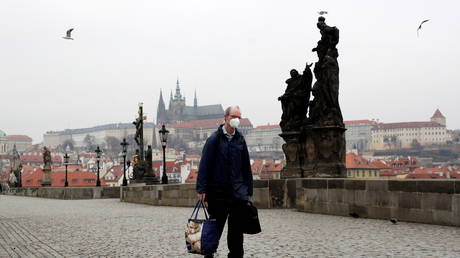
“We are currently heading toward a serious emergency,” Wieler stated, adding we are going to have a really terrible Christmas if we don’t take countermeasures now.” He added that hospitals were already struggling to find enough beds.

Wieler has called for a campaign for a further increase in vaccine uptake, from the current 67% to well over 75%.

The diseases institute director also believes bars, nightclubs, and other large-scale venues should be temporarily forced to close, and that other areas of public life should be off-limits to the unvaccinated.

His comments come as German leaders ponder new restrictions to replace the nationwide epidemic rules, which could include a lockdown of the unvaccinated, following measures already taken in neighboring Austria.

On Thursday, in an attempt to counter waning immunity levels, the country’s vaccine advisory board recommended that booster shots be made available to everyone aged 18 or above. 

If you like this story, share it with a friend!

find more fun & mates at SoShow now !

Mark Kelton, Former Deputy Director, CIA’s Counterintelligence, National Clandestine Service

Cipher Brief Expert Mark Kelton is a retired senior Central Intelligence Agency executive with 34 years of experience in intelligence operations. Before retiring, he served as CIA’s Deputy Director for Counterintelligence.  He is a partner at the FiveEyes Group and is Board Chair of Spookstock, a charity that benefits the CIA Memorial Foundation, the Special Operations Warrior Foundation and the Defense Intelligence Memorial Foundation.

EXPERT PERSPECTIVE — Winston Churchill’s 04 June 1940 speech in which he vowed that he and his countrymen would “fight on the beaches “and would “never surrender” in the face of a seemingly inevitable Nazi invasion is rightly renowned as perhaps history’s most famous address by a wartime leader.  Less well known, however, is the cautionary tone the new Prime Minister struck in that same appearance before the House of Commons, as he sought to temper the joy and relief engendered by the seemingly miraculous extraction of the British army from the beaches of Dunkirk.  “We must,” Churchill warned, “be very careful not to assign to this deliverance the attributes of a victory.”  “Wars” he admonished, “are not won by evacuations.”

Shortly before the 2011 Abbottabad operation that killed Osama bin Laden, I was asked by my HQ, my views on mounting an assault on the target we knew as Abbottabad Compound 1, (AC1) given that we were not sure it sheltered the terrorist leader.  After expressing my 95% confidence that the Al Qaeda (AQ) leader was in fact, there, I allegorically added that we must strike as ‘you cannot leave Hitler in his bunker and end the war’.  I was fortuitously, right in my assessment that the murderer of so many innocents was present within AC1.  Sadly, however, his death did not bring our war with radical Islamic terrorism to a conclusion.  As was the case after Dunkirk, our enemy was unwilling to quit the field or to limit his unbounded war aims.

Likewise, we should have no expectation that the withdrawal of our forces from the Afghan theater of combat signals an end to the conflict with terrorists who started that war by attacking us on September 11, 2001.  We cannot unilaterally declare an end to the War on Terror by leaving Afghanistan – however much we might wish to do so – for the very simple reason that our enemies do not share that desire.  As former Defense Secretary Leon E. Panetta put it, “I understand that we’re trying to get our troops out of there, but the bottom line is, we can leave a battlefield, but we can’t leave the war on terrorism, which still is a threat to our security.”

The Taliban parading of the American-made weapons and accoutrements of their defeated foes was, in a manner akin to that of ancient Rome, intended not only to celebrate victory.  It was also meant to humiliate the vanquished.   Such triumphal demonstrations – and what will be a galling celebration of the anniversary of 9/11 as their own holiday to follow – will evoke enthusiastic responses from Islamic extremists and will draw many new adherents to the cause that lies at the core of Taliban legitimacy and belief.

As was the case when we left Iraq and later had to go back into the region to crush the ISIS Caliphate that metastasized in the wake of our departure, there is every prospect that the Taliban’s success will breathe new life into Islamic extremist groups.  And there is no reason to believe that the “new” and now much more heavily armed Taliban – an organization that refused to break with AQ over the course of a brutal twenty-year battle, will be any less receptive to working with Islamic terror groups than were their pre-9/11 forebears.


The Cipher Brief hosts private briefings with the world’s most experienced national and global security experts.  Become a member today.


“We are going to have to maintain very, very intense  levels of indicators and warnings and observstion and ISR [Intelligence, Surveillance, Reconnaissance] over that entire region to monitor potential terrorist threats”, said Chairman of the Joint Chiefs, General Mark Milley in a recent interview, adding it will not be easy.

As CIA Director William Burns said during Senate testimony in April, “Our ability to keep (the) threat…in check in Afghanistan from either al Qaeda or ISIS…has benefited greatly from the presence of U.S. and coalition militaries on the ground and in the air fueled by intelligence provided by the CIA and our other intelligence partners.” With the withdrawal of the American military, Burns said, “the U.S. government’s ability to collect and act on threats will diminish.”

Much discussed ‘over the horizon’ intelligence collection against Afghan terror targets will not fill the void left by the loss of our ability to monitor and attack terrorist targets from in-country bases.  With Afghanistan bordered by countries unlikely to be willing to host a significant US presence, intelligence collection missions will now have to be launched from bases well beyond the horizon with all that implies for the quantity, quality and timeliness of intelligence collected.  Such operations will also be commensurately more expensive and difficult to mount.  Moreover, the intimate knowledge of our adversaries that we have painstakingly built over the course of nearly 20 years on the ground, began aging the moment we departed Afghanistan.  Absent an intelligence presence on the ground, our ability to collect on terrorist groups operating in and from that country will only degrade further as time goes on.

After acknowledging that we “could see a resurgence of terrorism out of the region in the coming 12-36 months”, Milley went on that we will, “as opportunities present themselves… have to continue to conduct strike operations if there’s a threat to the United States.”  However, as our pre-9/11 experience showed, such remote strikes can delay our terrorist enemies’ plans, but will not deter them from their intent to strike the US homeland.

As such, Secretary Panetta is undoubtedly correct in his conclusion that US involvement in Afghanistan is not over.  “We’re going to have to go back in to get ISIS,” Panetta said.  “We’re probably going to have to go back in when al-Qaeda resurrects itself, as they will, with this Taliban.”  And, as was the case with our operations to destroy ISIS’s so-called Caliphate after we precipitously left Iraq, there can be no doubt that should we have to go back into Afghanistan, our task will be greatly complicated by the manner in which we left that country, abandoning our allies and bases there.


Go beyond the headlines with expert perspectives on today’s news with The Cipher Brief’s Daily Open-Source Podcast.  Listen here or wherever you listen to podcasts.


The US withdrawal from Afghanistan will have profound geo-strategic implications for America’s position in the region and in the world.  Our Chinese, Russian and Iranian adversaries will seize the opportunity to fill the void left in the wake of our departure.

The Taliban has already indicated it will engage with China, which covets Afghanistan’s mineral wealth.  Entry into a transactional relationship with the cash-strapped Taliban regime and granting access to Afghan mineral resources – and possibly use of Bagram Air Base – in exchange for financial aid and Chinese support for the Taliban in international organizations would suit Beijing, which would evince no concerns about human rights and the like.

For their part, Central Asian countries will look away from Washington and ever more towards their old masters in Moscow and a rising China to ensure their security and economic well-being.   Islamabad, while publicly celebrating the victory of their Taliban proxies and its role in guiding it, must at the same time worry that the extremism embodied by the victors will gain renewed traction beyond its frontier provinces with all that implies for the security of the Pakistani state.

Caught by surprise by Washington’s decision to leave and the conduct of the withdrawal, even our closest and oldest allies are questioning US resolve.  They will surely think twice before acceding to any future US request to join in joint operations.  Our decision to quit Afghanistan, and its messy execution, will also evoke questions about the validity of American assurances to other nations under threat from aggressors.  It will not have been lost on them that the withdrawal of American air, intelligence, planning expertise and logistical support ensured the collapse of an Afghan Army that was dependent on the US.

Our adversaries, too, will see the chaotic nature of our departure as well as the abandonment of Americans, allied citizens and Afghans to uncertain fates as signs of weakness and enfeeblement.   This possibility is particularly dangerous in that they could seize this moment of US distraction to engage in opportunistic adventurism that could include movement by China against Taiwan; a Russian attempt to resolve its impasse with Ukraine forcibly; stepped-up Iranian prosecution of its proxy war with Israel; or a further ramping up by North Korea of its nuclear program.  Any such eventuality would force the US to respond vigorously or risk further erosion of its international credibility.

Finally, the costs involved in remotely monitoring and trying to deter threats emanating from a Taliban-controlled Afghanistan mean that we will be unable to shift intelligence and military resources away from the War on Terror to confront the threat posed by peer competitors to the degree we had hoped.

Aristotle is said to have pronounced, “You will never do anything in this world without courage. It is the greatest quality of the mind next to honor.”  Likewise, the courage shown by so many – and the heroic conduct of US military and CIA personnel in particular – in seeking to extract American citizens from Afghanistan and to honor our obligations to Afghans who worked and fought alongside us for so long, cannot obviate the dishonor attendant to having left so many behind.  Bloody Taliban outrages and reprisals against the latter are a certainty.

It will not be long before Kabul’s new rulers recognize that the Americans now under their control, are potentially useful pawns in trying to extract diplomatic, financial and other concessions in exchange for their freedom.  The effectiveness of our efforts hereafter to extract our own people and our Afghan allies from the clutches of the Taliban and how we respond to any attempts to use them as leverage against us, will determine the depth of the stain on our national honor already attendant to the disastrous end of our Afghan campaign.

In that same famous speech, Churchill solemnly told his countrymen that: ‘The Battle of France is over: The Battle of Britain is about to begin.”  He went on that “we would be well advised to gird our loins for the continued warfare to come.”

As we approach the 20th anniversary of 9/11, we should honor our sacred dead from that horrible day.  But we should likewise prepare ourselves for the battles with Al Qaeda and its murderous kindred of Cain that will surely come.

Recent polls would indicate that Americans support the decision to withdraw from Afghanistan, if not the way in which it was conducted.  One wonders how those polled would have responded if the question had been ‘Do you support a withdrawal from Afghanistan even if it markedly increases the chance of terror attacks and atrocities directed at your fellow citizens at home and abroad?’  I fear we will find out soon enough.

Read more expert-driven national security insights, perspective and analysis in The Cipher Brief

The post Wars are not Won by Evacuations appeared first on The Cipher Brief.

find more fun & mates at SoShow now !

French luxury giant Dior has taken down a controversial photograph that had been criticized in China for “smearing Asian women” by pandering to Western stereotypes while “distorting Chinese culture.”

The photo, which was part of the brand’s ‘Lady Dior’ exhibition in Shanghai, depicts an Asian model wearing a traditional dress and clutching a Dior handbag. It came under fire this week from Chinese media outlets for featuring “spooky eyes, [a] gloomy face and Qing Dynasty-styled nail armor.”

Read more

A screenshot from D&G's apology video © YouTube / Dolce & Gabbana
Dolce & Gabbana beg for forgiveness after ‘racist’ ad triggers backlash in China

Although Dior has not released a statement regarding the controversy, it confirmed to fashion trade publication Business of Fashion that the photo had been removed from the exhibition. The brand has also reportedly taken the photo off Chinese social media platform Weibo.

The image, which was shot by Chinese photographer Chen Man, had drawn both media ire and public outrage. However, there were apparently no calls for a boycott of the brand.

In an editorial on Monday titled “Is This the Asian Woman in Dior’s Eyes?”, the Beijing Daily paper had noted that the image makes Chinese consumers uncomfortable. The publication criticized Man for “playing up to the brands, or the aesthetic tastes of the Western world.”

For years, Asian women have always appeared with small eyes and freckles from the Western perspective, but the Chinese way to appreciate art and beauty can’t be distorted by that.

Warning that both the brand and the photographer had “gone too far,” the China Women’s News paper ran an editorial on Wednesday that claimed it “indicated their intention of uglifying Chinese women and distorting Chinese culture.”

Read more

RT
‘Deeply sorry’: Versace in hot water as China accuses fashion brand of questioning its sovereignty

“Again, from… Dior’s ghost-style picture, which makes the public feel uncomfortable, it’s easy to see some Western brands’ ‘pride and prejudice’ in their aesthetics and culture,” said the newspaper, which is run by the All-China Women’s Federation.

Meanwhile, the Global Times noted that the “lingering controversy could pose a delicate situation” for Dior and other global brands – for whom China’s “massive” luxury market was one of the biggest sources of revenue. The paper said that the Chinese public had become “increasingly sensitive” toward the depiction and treatment of Chinese people and culture by foreign companies.

While pointing out that Chinese social media users had demanded the company and photographer explain their intention, a number of media outlets also highlighted how some netizens had praised the photo as a departure from typical standards of beauty in the country, often characterized by “fair skin and large eyes.”

If you like this story, share it with a friend!

find more fun & mates at SoShow now !
A gunman injured two civilians, one of them fatally, and two police officers before being shot dead by security forces near Jerusalem’s Western Wall on Sunday morning, Israeli police said.

The civilian victims were taken to Shaare Zedek Medical Center. One, who was in his 30s, succumbed to his injuries at the hospital. The other, a 46-year-old, is said to have suffered moderate injuries. Two police officers were hurt by shrapnel.

In a video clip shared on social media and purportedly filmed at the scene, multiple gunshots could be heard amid agitated shouting. Security officers could then be seen standing around what appears to be a dead body. Witnesses speculated it was that of a “terrorist.”

The gunman, whose identity was not immediately disclosed, was killed during the incident. Police said he had used a homemade submachine gun.

DETAILS TO FOLLOW

find more fun & mates at SoShow now !

A stream literally flowing with booze emitting a strong beery odor has been discovered in one of the tropical islands of Hawaii. Its waters have been apparently contaminated with alcohol after a leak at a beverage warehouse.

A small river with a distinctive alcoholic smell was recently found on the island of Oahu, some 15 miles (24 kilometers) away from Honolulu, Hawaiian capital. Its waters have been flowing through the Waipio valley and even turned into a 100-foot (30 meters) waterfall on their way.  

Read more

Image from geosociety.org
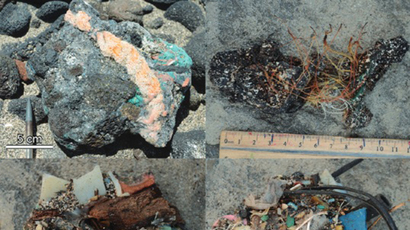
​‘Plastic stones’ found at remote Hawaii beach

The stream caught the attention of local environmental activists, who noticed the smell in the area.

The other day we came here you would think it was a beer pub that hadn’t opened its doors for three or four days,” activist Carroll Cox told local Hawaii News Now. She also contacted the Department of Health about the issue.

Local media took samples from the unusual stream and had them checked at a private laboratory. It tested positive for alcohol, containing 1.2% percent of the substance in its waters – nearly a quarter the content in regular beer and strong enough to cause a buzz.

Local health authorities got involved, and an investigation into the source of contamination was launched. It was learned that the stream was coming from a drain pipe that was traced back to a warehouse of Hawaii’s largest liquor distributor, Paradise Beverages. Its representatives told local media they were working with officials to eliminate a possible spill, with the booze river apparently closing its free drinks service.

Like this story? Share it with a friend!

find more fun & mates at SoShow now !

People are weird. They cook and eat the strangest things. This time it’s an octopus stuffed inside a turkey, sitting on top of crab legs, and (optionally) garnished with bacon strips. This monstrous culinary invention was inspired by H.P. Lovecraft’s Cthulhu mythos, and honestly… it looks like a crime against food.

Cthulhu turkey.

Cthulhu turkey.

Cthulhu turkey.

Cthulhu turkey.

Cthulhu turkey.

Cthulhu turkey.

Cthulhu turkey.

Cthulhu turkey.

Cthulhu turkey.

Cthulhu turkey.

Cthulhu turkey.

Cthulhu turkey.

Cthulhu turkey.

Cthulhu turkey.

Cthulhu turkey.

Cthulhu turkey.

Cthulhu turkey.

Cthulhu turkey.

Cthulhu turkey.

Cthulhu turkey.

Cthulhu turkey.

If this gallery wasn’t disgusting enough for you, you should also check out pre-cooked canned chicken that we’ve previously featured on this fun and useful site. We know you’ll love it!

The post Meet Cthulhu Turkey: It’s a Turkey Stuffed With Octopus That People Actually Make first appeared on .

find more fun & mates at SoShow now !
Mark Kelton, Former Deputy Director, CIA’s Counterintelligence, National Clandestine Service

Cipher Brief Expert Mark Kelton is a retired senior Central Intelligence Agency executive with 34 years of experience in intelligence operations. Before retiring, he served as CIA’s Deputy Director for Counterintelligence.  He is a partner at the FiveEyes Group and is Board Chair of Spookstock, a charity that benefits the CIA Memorial Foundation, the Special Operations Warrior Foundation and the Defense Intelligence Memorial Foundation.

EXPERT PERSPECTIVE — Winston Churchill’s 04 June 1940 speech in which he vowed that he and his countrymen would “fight on the beaches “and would “never surrender” in the face of a seemingly inevitable Nazi invasion is rightly renowned as perhaps history’s most famous address by a wartime leader.  Less well known, however, is the cautionary tone the new Prime Minister struck in that same appearance before the House of Commons, as he sought to temper the joy and relief engendered by the seemingly miraculous extraction of the British army from the beaches of Dunkirk.  “We must,” Churchill warned, “be very careful not to assign to this deliverance the attributes of a victory.”  “Wars” he admonished, “are not won by evacuations.”

Shortly before the 2011 Abbottabad operation that killed Osama bin Laden, I was asked by my HQ, my views on mounting an assault on the target we knew as Abbottabad Compound 1, (AC1) given that we were not sure it sheltered the terrorist leader.  After expressing my 95% confidence that the Al Qaeda (AQ) leader was in fact, there, I allegorically added that we must strike as ‘you cannot leave Hitler in his bunker and end the war’.  I was fortuitously, right in my assessment that the murderer of so many innocents was present within AC1.  Sadly, however, his death did not bring our war with radical Islamic terrorism to a conclusion.  As was the case after Dunkirk, our enemy was unwilling to quit the field or to limit his unbounded war aims.

Likewise, we should have no expectation that the withdrawal of our forces from the Afghan theater of combat signals an end to the conflict with terrorists who started that war by attacking us on September 11, 2001.  We cannot unilaterally declare an end to the War on Terror by leaving Afghanistan – however much we might wish to do so – for the very simple reason that our enemies do not share that desire.  As former Defense Secretary Leon E. Panetta put it, “I understand that we’re trying to get our troops out of there, but the bottom line is, we can leave a battlefield, but we can’t leave the war on terrorism, which still is a threat to our security.”

The Taliban parading of the American-made weapons and accoutrements of their defeated foes was, in a manner akin to that of ancient Rome, intended not only to celebrate victory.  It was also meant to humiliate the vanquished.   Such triumphal demonstrations – and what will be a galling celebration of the anniversary of 9/11 as their own holiday to follow – will evoke enthusiastic responses from Islamic extremists and will draw many new adherents to the cause that lies at the core of Taliban legitimacy and belief.

As was the case when we left Iraq and later had to go back into the region to crush the ISIS Caliphate that metastasized in the wake of our departure, there is every prospect that the Taliban’s success will breathe new life into Islamic extremist groups.  And there is no reason to believe that the “new” and now much more heavily armed Taliban – an organization that refused to break with AQ over the course of a brutal twenty-year battle, will be any less receptive to working with Islamic terror groups than were their pre-9/11 forebears.


The Cipher Brief hosts private briefings with the world’s most experienced national and global security experts.  Become a member today.


“We are going to have to maintain very, very intense  levels of indicators and warnings and observstion and ISR [Intelligence, Surveillance, Reconnaissance] over that entire region to monitor potential terrorist threats”, said Chairman of the Joint Chiefs, General Mark Milley in a recent interview, adding it will not be easy.

As CIA Director William Burns said during Senate testimony in April, “Our ability to keep (the) threat…in check in Afghanistan from either al Qaeda or ISIS…has benefited greatly from the presence of U.S. and coalition militaries on the ground and in the air fueled by intelligence provided by the CIA and our other intelligence partners.” With the withdrawal of the American military, Burns said, “the U.S. government’s ability to collect and act on threats will diminish.”

Much discussed ‘over the horizon’ intelligence collection against Afghan terror targets will not fill the void left by the loss of our ability to monitor and attack terrorist targets from in-country bases.  With Afghanistan bordered by countries unlikely to be willing to host a significant US presence, intelligence collection missions will now have to be launched from bases well beyond the horizon with all that implies for the quantity, quality and timeliness of intelligence collected.  Such operations will also be commensurately more expensive and difficult to mount.  Moreover, the intimate knowledge of our adversaries that we have painstakingly built over the course of nearly 20 years on the ground, began aging the moment we departed Afghanistan.  Absent an intelligence presence on the ground, our ability to collect on terrorist groups operating in and from that country will only degrade further as time goes on.

After acknowledging that we “could see a resurgence of terrorism out of the region in the coming 12-36 months”, Milley went on that we will, “as opportunities present themselves… have to continue to conduct strike operations if there’s a threat to the United States.”  However, as our pre-9/11 experience showed, such remote strikes can delay our terrorist enemies’ plans, but will not deter them from their intent to strike the US homeland.

As such, Secretary Panetta is undoubtedly correct in his conclusion that US involvement in Afghanistan is not over.  “We’re going to have to go back in to get ISIS,” Panetta said.  “We’re probably going to have to go back in when al-Qaeda resurrects itself, as they will, with this Taliban.”  And, as was the case with our operations to destroy ISIS’s so-called Caliphate after we precipitously left Iraq, there can be no doubt that should we have to go back into Afghanistan, our task will be greatly complicated by the manner in which we left that country, abandoning our allies and bases there.


Go beyond the headlines with expert perspectives on today’s news with The Cipher Brief’s Daily Open-Source Podcast.  Listen here or wherever you listen to podcasts.


The US withdrawal from Afghanistan will have profound geo-strategic implications for America’s position in the region and in the world.  Our Chinese, Russian and Iranian adversaries will seize the opportunity to fill the void left in the wake of our departure.

The Taliban has already indicated it will engage with China, which covets Afghanistan’s mineral wealth.  Entry into a transactional relationship with the cash-strapped Taliban regime and granting access to Afghan mineral resources – and possibly use of Bagram Air Base – in exchange for financial aid and Chinese support for the Taliban in international organizations would suit Beijing, which would evince no concerns about human rights and the like.

For their part, Central Asian countries will look away from Washington and ever more towards their old masters in Moscow and a rising China to ensure their security and economic well-being.   Islamabad, while publicly celebrating the victory of their Taliban proxies and its role in guiding it, must at the same time worry that the extremism embodied by the victors will gain renewed traction beyond its frontier provinces with all that implies for the security of the Pakistani state.

Caught by surprise by Washington’s decision to leave and the conduct of the withdrawal, even our closest and oldest allies are questioning US resolve.  They will surely think twice before acceding to any future US request to join in joint operations.  Our decision to quit Afghanistan, and its messy execution, will also evoke questions about the validity of American assurances to other nations under threat from aggressors.  It will not have been lost on them that the withdrawal of American air, intelligence, planning expertise and logistical support ensured the collapse of an Afghan Army that was dependent on the US.

Our adversaries, too, will see the chaotic nature of our departure as well as the abandonment of Americans, allied citizens and Afghans to uncertain fates as signs of weakness and enfeeblement.   This possibility is particularly dangerous in that they could seize this moment of US distraction to engage in opportunistic adventurism that could include movement by China against Taiwan; a Russian attempt to resolve its impasse with Ukraine forcibly; stepped-up Iranian prosecution of its proxy war with Israel; or a further ramping up by North Korea of its nuclear program.  Any such eventuality would force the US to respond vigorously or risk further erosion of its international credibility.

Finally, the costs involved in remotely monitoring and trying to deter threats emanating from a Taliban-controlled Afghanistan mean that we will be unable to shift intelligence and military resources away from the War on Terror to confront the threat posed by peer competitors to the degree we had hoped.

Aristotle is said to have pronounced, “You will never do anything in this world without courage. It is the greatest quality of the mind next to honor.”  Likewise, the courage shown by so many – and the heroic conduct of US military and CIA personnel in particular – in seeking to extract American citizens from Afghanistan and to honor our obligations to Afghans who worked and fought alongside us for so long, cannot obviate the dishonor attendant to having left so many behind.  Bloody Taliban outrages and reprisals against the latter are a certainty.

It will not be long before Kabul’s new rulers recognize that the Americans now under their control, are potentially useful pawns in trying to extract diplomatic, financial and other concessions in exchange for their freedom.  The effectiveness of our efforts hereafter to extract our own people and our Afghan allies from the clutches of the Taliban and how we respond to any attempts to use them as leverage against us, will determine the depth of the stain on our national honor already attendant to the disastrous end of our Afghan campaign.

In that same famous speech, Churchill solemnly told his countrymen that: ‘The Battle of France is over: The Battle of Britain is about to begin.”  He went on that “we would be well advised to gird our loins for the continued warfare to come.”

As we approach the 20th anniversary of 9/11, we should honor our sacred dead from that horrible day.  But we should likewise prepare ourselves for the battles with Al Qaeda and its murderous kindred of Cain that will surely come.

Recent polls would indicate that Americans support the decision to withdraw from Afghanistan, if not the way in which it was conducted.  One wonders how those polled would have responded if the question had been ‘Do you support a withdrawal from Afghanistan even if it markedly increases the chance of terror attacks and atrocities directed at your fellow citizens at home and abroad?’  I fear we will find out soon enough.

Read more expert-driven national security insights, perspective and analysis in The Cipher Brief

The post Wars are not Won by Evacuations appeared first on The Cipher Brief.

find more fun & mates at SoShow now !