EXPERT PERSPECTIVE — On 16 June, US President Joe Biden and Russian President Vladimir Putin met for just under four hours in Geneva. This was Mr. Biden’s first meeting with Mr. Putin during his presidency and Biden is the fifth US President with whom Putin has held a summit.

Expectations for the summit were characterized as low by both sides in advance and assessed a bit more positively after the conclusion of the meeting. The meeting presented an opportunity for both leaders to present grievances and warnings to the other (and show toughness to their domestic constituencies).  Other than presenting the opportunity to blow off steam, the results of the meeting appear modest:  the agreement to return ambassadors to their posts, to resume bilateral arms control discussions, to conduct discussions on “strategic stability” and to hold unspecified consultations on cyber. In typical fashion, Mr. Putin rejected all of Mr. Biden’s assertions about Russian actions and made counter accusations referencing hostile US actions.

Of the deliverables from the summit, cyber will no doubt turn out to be the most problematic area for follow up. Mr. Biden apparently delivered to Mr. Putin a list of 16 US critical infrastructure sectors that should be considered “off limits” for cyberattacks, e.g., “red lines” not to be crossed without the risk of significant retaliation. For his part, Mr. Putin asserted that it is Russia that is the victim of cyberattacks originating from the territory of the US and it’s NATO partners and also is the victim of  attempts to interfere with Russian elections.  The challenge in cyber discussions going forward will center around three areas:  differing interpretations of the relevance of deterrence theory in today’s cyber environment, attribution, and control.

Mr. Biden’s firm comments to Mr. Putin on recent cyberattacks against the US such as the ransomware attack on Colonial Pipelines (Mr. Biden is said to have asked Mr. Putin how he would react if Russia’s pipelines were hit?) and his provision of a list of “off limits” US infrastructure entities suggests a deep belief in this administration that Russia can be deterred from engaging in future conduct of cyber operations against US targets or “sanctioning” attacks originating from the territory of the Russian Federation by criminal groups.

Unfortunately, it is highly likely that either Mr. Putin nor those who control the levers of Russian cyber operations agree that deterrence theory applies.  Deterrence only works when both sides know the other is capable of – and willing to – cause significant harm to the other.

The Russian side likely believes (and may have amply demonstrated) that the US is disproportionately vulnerable to cyber risk at every level of its economic, societal, and political infrastructure whereas Russia is not.  There is a reason the use of cyber tools has become a central feature of Russian strategic doctrine. They work and seem a legitimate tool that falls short of conventional war. Hybrid warfare using cyber tools, the Russian side would argue, is no different than the economic warfare Russia is experiencing from sanctions imposed by the US its allies.

For full access to the article, sign up to become a Cipher Brief member for just $10/mo.


“The Cipher Brief has become the most popular outlet for former intelligence officers; no media outlet is even a close second to The Cipher Brief in terms of the number of articles published by formers.” – Sept. 2018, Studies in Intelligence, Vol. 62 No.

Access all of The Cipher Brief’s national-security focused expert insight by becoming a  Cipher Brief Level I Member .  


The post After Geneva: US – Russia Strategy Moving Forward appeared first on The Cipher Brief.

find more fun & mates at SoShow now !

AstraZeneca has announced that its preventative antibody cocktail offers 83% protection against symptomatic Covid-19 for at least six months, making it more effective than its own vaccine.

In a statement on Thursday, AstraZeneca cemented its lead in the race to develop and market a preventative Covid-19 drug, which is delivered as a shot in the arm. 

The drug, named AZD7442, reduces the risk of symptomatic Covid-19 by 83% over the course of six months, according to data from a trial in which participants were given one 300mg dose. There were no deaths or severe infections recorded within the trial group, it said. 

Read more

Paxlovid, a Pfizer's coronavirus disease (Covid-19) pill, is seen manufactured in Ascoli, Italy (FILE PHOTO) © Pfizer/Handout via REUTERS
Pfizer gets new $5.3bn boost over Covid

A separate trial showed the drug reduced the risk of severe Covid-19 or death by 88% when administered within three days of the onset of symptoms. 

“These new data add to the growing body of evidence supporting AZD7442’s potential … We are progressing regulatory filings around the world and look forward to providing an important new option against SARS-CoV-2 [Covid-19] as quickly as possible,” AstraZeneca Executive Vice President Mene Pangalos said in the statement. 

The Anglo-Swedish firm has agreed to supply the US government with 700,000 doses of AZD7442 if the Food and Drug Administration grants it emergency use, which AstraZeneca requested on October 5. The firm has similar agreements with other nations. 

The drug is created using a combination of two antibodies originating from immune B-cells donated by a recovering Covid-19 patient. 

The treatment could be used in people who are known not to respond well to vaccines, such as cancer patients. Around 2% of people are considered to be at risk of not creating enough antibodies following the administration of a Covid-19 vaccine. 

Based on the numbers, the drug appears to be more effective than the firm’s first-generation Covid-19 vaccine. Britain’s Zoe Covid study showed the effectiveness of the vaccine dropped to around 67% after four to five months. 

If you like this story, share it with a friend!

find more fun & mates at SoShow now !

A stream literally flowing with booze emitting a strong beery odor has been discovered in one of the tropical islands of Hawaii. Its waters have been apparently contaminated with alcohol after a leak at a beverage warehouse.

A small river with a distinctive alcoholic smell was recently found on the island of Oahu, some 15 miles (24 kilometers) away from Honolulu, Hawaiian capital. Its waters have been flowing through the Waipio valley and even turned into a 100-foot (30 meters) waterfall on their way.  

Read more

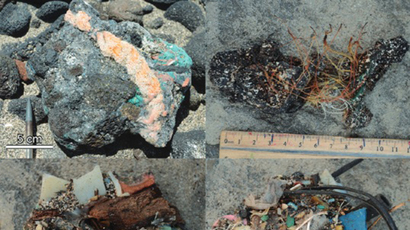
Image from geosociety.org
​‘Plastic stones’ found at remote Hawaii beach

The stream caught the attention of local environmental activists, who noticed the smell in the area.

The other day we came here you would think it was a beer pub that hadn’t opened its doors for three or four days,” activist Carroll Cox told local Hawaii News Now. She also contacted the Department of Health about the issue.

Local media took samples from the unusual stream and had them checked at a private laboratory. It tested positive for alcohol, containing 1.2% percent of the substance in its waters – nearly a quarter the content in regular beer and strong enough to cause a buzz.

Local health authorities got involved, and an investigation into the source of contamination was launched. It was learned that the stream was coming from a drain pipe that was traced back to a warehouse of Hawaii’s largest liquor distributor, Paradise Beverages. Its representatives told local media they were working with officials to eliminate a possible spill, with the booze river apparently closing its free drinks service.

Like this story? Share it with a friend!

find more fun & mates at SoShow now !

Hard-line cleric Ebrahim Raisi won Iran’s presidential election on Saturday in a move that is expected to bolster the conservative legacy of the country’s supreme leader, Ayatollah Ali Khamenei.

The decision is not expected to derail ongoing negotiations aimed at restoring the Joint Comprehensive Plan of Action (JCPOA) nuclear deal, even though Mr. Raisi himself is under US sanctions over accusations of human rights abuses.  Many voters stayed away from the polls as the outcome had been predicted for months with many progressive candidates barred from running.

The Islamic Republic has entered a post-revolutionary dynamic in which a fading revolutionary generation seeks to ensure that the rising political leadership sustains their revolutionary ideals,” says Norman T. Roule, former National Intelligence Manager for Iran at ODNI and Cipher Brief Expert. “The regime’s decision to bar so many candidates and the low turnout make this election a historic embarrassment for the regime and its supporters.”

The Cipher Brief talked with Roule about what the election means and what it doesn’t mean when it comes to relations with the west, the progressive movement within Iran and the election’s impact on the oil markets.


“The Cipher Brief has become the most popular outlet for former intelligence officers; no media outlet is even a close second to The Cipher Brief in terms of the number of articles published by formers.” – Sept. 2018, Studies in Intelligence, Vol. 62 No.

Access all of The Cipher Brief’s national-security focused expert insight by becoming a  Cipher Brief Level I Member .  


The post What Iran’s Election Tells Us About Where It’s Headed appeared first on The Cipher Brief.

find more fun & mates at SoShow now !

At least ten people have been killed and several wounded by security forces during mass demonstrations in Sudan against the recent military coup, a medics organization has said.

“The coup forces used live bullets heavily in different areas of the capital and there are tens of gunshot injuries, some of them in serious condition,” the Central Committee of Sudanese Doctors (CCSD) said in a statement.

The group of medics, which supports the protest movement, said several of the injured were in critical condition. It reported ten deaths across Bahri, Omdurman and the capital Khartoum.

According to AFP, citing witnesses, security forces also fired tear gas at protesters in the capital.

Although internet services have been disrupted and telephone lines cut since the military coup on October 25, thousands of people made it to the streets of major cities. 

The Sudanese Professionals Association, which also supports the demonstrators, said people were witnessing “excessive repression” and that there was a “deliberate interruption of voice and internet communications services.”

READ MORE: Protests in Sudan escalate amid reports of victims, videos claim to show military opening fire

Videos posted on social media show protesters wrapping up in national flags, chanting anti-military mottos and demanding the release of activists detained by the military since the takeover. Resistance committees across Sudan adopted the Liverpool Football Club’s chant ‘You Will Never Walk Alone’ as their slogan, which has already become a popular hashtag on Twitter.

On October 25, following a long period of tensions between Sudan’s military and civilian-led government, General Abdel Fattah al-Burhan announced the dissolution of both the Sovereign Council and the transitional government, declaring a state of emergency. The apparent military coup immediately prompted mass protests across the country.

Think your friends would be interested? Share this story!

find more fun & mates at SoShow now !

Hundreds of major websites returned ‘404: not found’ errors after an apparent problem with Google Cloud. Alphabet said the problem was “partially resolved” after about ten minutes, but it will take time for everything to update.

The site Downdetector began showing a spike in reports of outages starting at 12:40pm Eastern time on Tuesday, affecting Google, Facebook, Instagram, Snapchat, Discord, Spotify, and TikTok, as well as e-commerce sites Target, Etsy, Shopify, and Home Depot, among others.

Amazon, Amazon Web Services (AWS), and Cloudflare were also affected.

Google’s Status Dashboard reported an unspecified “issue” with the Cloud service starting at 10:10 Pacific, which was causing users to encounter errors when accessing websites. 

“We believe the issue with Cloud Networking is partially resolved,” the company said by 10:17 PST, but it added that “Customers will be unable to apply changes to their load balancers until the issue is fully resolved,” and they did not have an estimate as to when that might be.

Think your friends would be interested? Share this story!

find more fun & mates at SoShow now !

The children of families who were affected by the massive earthquake which devastated large parts of south-west Haiti in August this year are receiving free hot meals at school as part of an initiative by the UN’s World Food Programme (WFP) to support the recovery of the country’s most vulnerable communities.

Read the full story, “Hot meals helping Haiti’s children recover from the earthquake”, on globalissues.org

find more fun & mates at SoShow now !

Denmark’s air force showed off its brand-new electric-powered planes on Thursday, saying its test flights have so far proven that the cheaper-to-run, more eco-friendly technology has potential.

It had obtained the two Velis Electro jets from Slovenian manufacturer Pipistrel, becoming the first military in the world to operate this type of hardware.

“The aircraft are 100% emission-free, very quiet, and otherwise cheap to operate,” Lieutenant Colonel Casper Børge Nielsen of the Defense Ministry’s material and procurement agency said. Initial tests indicate “there may be perspectives in using electric aircraft when the technology becomes mature,” he added.

Denmark has leased the planes for two years, rather than buying it, to avoid the “risk of ending up with equipment that we can’t really use,” Børge Nielsen said. During the lease period, the Danish Air Force hopes to gain an insight into the benefits and disadvantages of the jets’ technology to decide how it can be applied in the future.

Read more

© CIAM / Facebook
Russia to debut world’s first electric plane at MAKS 2021 airshow

The pilots described flying the one-man light electric planes, which are powered by two lithium batteries, as “exciting,” saying they were “built well and fly well.” 

Last year, the United States military said it had been keeping an eye on the development of electric-powered planes, describing their ability to approach targets silently as “tremendous.” However, their battery capacity isn’t currently sufficient to meet the US Air Force’s needs.

Work on electric aircraft has been underway since the 1970s, but the battery issue has been a stumbling block in the way of wider adoption of the technology. Global military interest could change all that, stimulating research and investment.

The switch to electric power is likely to be a win-win across the board, as it will drastically reduce CO2 emissions and also make flying much cheaper for commercial carriers and their passengers.

Think your friends would be interested? Share this story!

find more fun & mates at SoShow now !

Behind the Headlines brings you expert perspectives on today’s headlines by telling you more than what happened, but also what it means.  You can also listen to The Cipher Brief’s Daily Open-Source Collection Podcast wherever you listen to podcasts.

Jack Devine, Former Acting Director, National Clandestine Service, CIA

Cipher Brief Expert Jack Devine, a 32-year CIA veteran. Devine served as both Acting Director and Associate Director of CIA’s operations from 1993-1995.  He is a founding partner and President of The Arkin Group, which specializes in international crisis management, strategic intelligence and investigative research. Devine is the author of Spymaster’s Prism: The Fight Against Russian Aggression.

Russia’s multi-pronged support of Myanmar is a microcosm of its strategy in Southeast Asia.

In the months since Myanmar’s February military coup, Russia and China have been the junta’s most powerful allies, but Russia has exploited regional instability to position itself as a third path between China and the West. While China was closer with the former Myanmar government than the military, it was also concerned about the government’s ties with the West and potential interference in its development efforts, particularly its Belt and Road Initiative. Russia, on the other hand, doesn’t depend on stability in Southeast Asia to the same degree as China and can instead take advantage of warring factions. Last month, on his first trip outside of the immediate region since February, Myanmar’s junta leader Min Aung Hlaing went to Moscow to meet with high-level Russian defense officials instead of heading to Beijing. Hlaing has reportedly visited Russia seven times within the past decade and previously stated that over 6,000 Myanmar officers have studied at Russian military academies. According to data from the Stockholm International Peace Research Institute (SIPRI), Russia was responsible for almost 40% of arms sales to Myanmar from 1999-2018, second only to China. SIPRI data further indicates that Russia has been Southeast Asia’s largest arms supplier over the past two decades, counting Vietnam and Laos as top customers. But Russia is offering the region more than arms and has promised Myanmar two million Covid-19 vaccines and assistance in the nation’s own vaccine production efforts. Russia has also been trying to expand free trade agreements between its Eurasian Economic Union (EAEU) and Southeast Asian countries, most recently getting Indonesia to sign on to the deal. Stepping even further into soft power efforts, last week Russia’s foreign minister met with his Bangladeshi counterpart and agreed to encourage Myanmar to engage in dialogue with Bangladesh on the Rohingya crisis.


Get your free daily Open-Source Collection report in The Cipher Brief newsletter or take it on the go as a podcast.  Listen here or wherever you listen to podcasts.


Leftist, former schoolteacher Pedro Castillo is declared President of a divided Peru, projected economic growth could play in his favor. 

Peru, like many of its neighbors, has been battling the triple and interwoven threat of Covid-19, social unrest, and severe economic downturn. But for the past several years Peru has also been challenged by sharp divisions between its executive and legislative powers. Last November, Peru’s unicameral legislature voted to impeach then-President Martín Vizcarra, citing mismanagement of the pandemic and corruption, in a move that outraged thousands. The June presidential elections were likewise fraught. Castillo’s right-wing rival Keiko Fujimori, who is also under investigation for corruption, alleged electoral fraud and the Peruvians initiated a six-week long investigation, eventually finding Castillo the rightful victor. The EU, U.S. and 14 electoral missions deemed the elections legitimate, and the U.S. called the election a “model of democracy” for the region. Castillo, who previously worked as an elementary school teacher and has never held public office, will be greeted by a political establishment that is almost entirely against him. Peruvian citizens are also deeply divided, and many urban elites reportedly moved their money overseas out of fear for Castillo’s economic policies. But Castillo’s Peru Libre party holds fewer than 40 of 130 seats in the legislature and Castillo has already recruited several moderate advisors. Further, he has backed away from talk of nationalizing Peru’s lucrative multinational mining, oil, gas, and hydrocarbon companies, instead pledging to raise taxes on mining firms. Prices of copper and gold, two of Peru’s most critical exports, remain high and Covid-related trade obstacles are expected to ease over the coming months. While it is uncertain how effective Castillo will be, or where he will ultimately fall on his policies, positive projections for Peru’s export-based economy will likely play in his favor.


The Cipher Brief hosts private briefings with the world’s most experienced national and global security experts.  Become a member today.


Enjin becomes first blockchain platform to gain acceptance into the United Nations Global Compact, signaling widespread range of corporate sustainability efforts.

On Tuesday, Enjin, an innovative blockchain technology company focused on non-fungible tokens (NFTs), became the first such company to join the United Nations Global Compact. Upon admission, Enjin stated that it hopes to use NFTs to promote sustainability and equality in line with the UN pact that encourages businesses and firms worldwide to adopt more environmentally friendly and socially responsible practices. NFTs have surged in popularity in the past two years, and during the first quarter of 2021 NFT sales reportedly exceeded US $2 billion. In essence, an NFT is a way to prove ownership of a unique virtual item. It’s a unit of data that’s stored on a blockchain, or digital ledger, that certifies exclusive ownership of digital files ranging from photos to sports trading cards. Enjin, which is headquartered in Singapore, has focused its NFT efforts on games and apps and is reportedly able to operate with a lower carbon footprint than Bitcoin due to a slimmed-down verification model that requires less energy. This week, the UN Global Compact not only included Enjin as a member, but gave the company its highest membership rank, sending a signal that it’s interested in promoting such an environmental effort by crypto and blockchain entrepreneurs. For its part, Enjin has stated that it wants to employ the technology in carbon capture companies, fighting climate change in the process. The Head of the UN AI and Robotics Center remarked that during the global struggle to recover from the pandemic we should take advantage of new technologies like AI and blockchain to better equip ourselves for the future.

Read more expert-driven national security insights, perspective and analysis in The Cipher Brief


The post Behind the Headlines: Russia in Myanmar, Peru’s New President and what Enjin means for the United Nations Global Compact appeared first on The Cipher Brief.

find more fun & mates at SoShow now !