Robert Dannenberg, Former Senior CIA Officer

Cipher Brief Expert Rob Dannenberg is a 24-year veteran of the CIA, where he served in several senior leadership positions, including chief of operations for the Counterterrorism Center, chief of the Central Eurasia Division and chief of the CIA’s Information Operations Center. Dannenberg is a member of the Board of Advisors to the Director of the National Counterterrorism Center and is a senior fellow at the GWU Center for Cyber and Homeland Security. He is now an independent consultant on geopolitical and security risk, after serving as the managing director and head of the Office of Global Security for Goldman Sachs, and director of International Security Affairs at BP.

EXPERT PERSPECTIVE — The images from Kabul are demoralizing and depressing—unless you are sitting in the Kremlin, where they are certainly being viewed in a quite different light. Probably something close to giddiness and glee.

From Russian President Vladimir Putin’s perspective, this likely reinforces his view that President Joe Biden and his national security team are weak and naïve.  ‘This is Obama’s third term’, Putin must be thinking. And of course, the images of US helicopters desperately trying to evacuate thousands from Kabul also resonate in Kiev, Tbilisi, and probably Tallinn, Riga, and Vilnius and beyond—think Taipei.  The appalling mismanagement of the withdrawal from Afghanistan will have consequences that will affect American credibility globally and linger well beyond the end of Biden’s presidency.

A first order consequence concerns Russia.

It is highly likely there was practical cooperation between the Kremlin and the Taliban in the preparation for the American withdrawal and this may have included direct support to Taliban forces. We don’t need to revisit the narrative of Russian bounties for dead American soldiers in Afghanistan, but the evidence of Russian energetic engagement with the Taliban in recent months is manifest and the fact the Russian embassy in Kabul is currently protected by Taliban fighters is significant.

For both Russia and the Taliban there was a clear shared strategic objective: Get the Americans and their allies out of Afghanistan and ideally in the most humiliating fashion possible.  The Russian-Taliban honeymoon may not last long, but for the moment it has served both sides well.

For over a decade and a half of his tenure as Russia’s president, Putin has been preaching the gospel that you can’t trust the Americans to back you in the long run or when the chips are down, but you can count on the Russia he leads (think the Russian intervention in Syria and support for Assad or their intervention—whether acknowledged or not—in Libya on the side of Khalifa Haftar among other examples). This messaging is important in current times and reinforces Putin’s narrative about the decline of the West and the waning relevance of western liberal systems of governance.

In recent years, Chinese President Xi Jinping has picked up the trumpet to echo this message that American power is in decline and that American security guarantees cannot be relied on in East Asia and beyond.

Putin has been Russia’s Czar for over two decades without meaningful interruption and is likely to remain so for the foreseeable future. He has seen US Presidents come and go and he has been quick to size them up and adjust his moves accordingly. He was genuinely scared of what George W. Bush might do in the immediate aftermath of 9/11 and the speed and efficacy of the US response made a deep impression on him.  He adjusted his approach to the US to one of partner and ally against Islamic extremism (Putin was also busy consolidating his control over the Russian Federation in the immediate post-Yeltsin period).

Putin also sized up then-President Barack Obama after Obama’s failure to act when Syrian President Bashar al-Assad blithely crossed the “no use of chemical weapons” red line.  That opened the door for the annexation of Crimea as well as the Russian military intervention in Syria (and later Libya). Joe Biden was Vice President at the time. Putin likely has a very good book on Joe Biden and was quite confident of what the end result for the US in Afghanistan would look like.  Putin may even have a better feel for Joe Biden than many realize, if any of the Hunter Biden material is true.  One leader’s assessment of another, matters in geopolitical relations. Putin has a high level of confidence in his ability to read his international opposition.

As recently as July 2021 President Biden said, “There’s going to be no circumstance where you see people being lifted off the roof of the US embassy in Afghanistan.”  He went on to add, “The likelihood there’s going to be the Taliban overrunning everything and owning the whole country is highly unlikely.”  President Biden made these statements knowing perfectly or should have known—from intelligence briefings and expert commentary—as well as historical precedent—that when the US announces a withdrawal of forces with a hard deadline, in this case 9/11, our adversaries use the time to prepare for their offensive military action. Our Afghan allies knew this as well and prepared accordingly.  Now the Taliban will celebrate the twentieth anniversary of the September 11 attacks in the US embassy in Kabul, probably with their ISIS and Al Qaeda friends as honored guests.  If you think the videos from Afghanistan have been troubling to this point, just wait for the anniversary celebrations.

Perhaps of more near term geopolitical significance, Putin will use the Taliban takeover of Afghanistan to support a narrative that Russia needs to defend its interests from the spread of Islamic extremism from Afghanistan by strengthening “security and counterterrorism” cooperation with Turkmenistan, Uzbekistan, Tajikistan, Kyrgyzstan. Does anyone want an excuse to get – and keep – those pesky Americans out of Central Asia and start rebuilding that corner of the Soviet Union?

Putin’s use of terrorism risk as justification for military action is well-rehearsed and goes back to the Moscow apartment bombings (which the FSB almost certainly organized) in September 1999, which Putin used both to consolidate political power and to justify the brutal military campaign in Chechnya. Putin is acutely aware of the risks of Islamic extremism spreading from Afghanistan to Central Asia, the Caucasus, and into the Russian Federation. In fact, Russian, Uzbek, and Tajik troops conducted exercises in July, which appear to have been designed to prepare to respond to cross border incursions from Afghanistan. This is only the first step in his plan for consolidation of Russian power and influence in Central Asia and the Caucasus.


The Cipher Brief hosts private briefings with the world’s most experienced national and global security experts.  Become a member today.


Some might ask – given the risk of the spread of Islamic extremism from Afghanistan to the Russian Federation – why would Putin would want to partner with the Taliban?  Those who ask this question are misunderstanding the depth of Putin’s enmity toward the United States and the West and everything for which we stand.  Putin views the world as a “zero sum” game.  What hurts the US must serve Russia’s interests. The debacle in Afghanistan clearly qualifies. A short-term deal with the Taliban is a risk with taking in Putin’s mind.  Putin plays on the superpower chessboard using the only tools he has at hand, military power, cyber and disinformation capability and US ineptitude and lack of strategic thought.  He has taken clever advantage of President Trump’s four years of thoughtless estrangement of US allies around the world.

Beyond the propaganda value and regional leverage our withdrawal has given adversaries like Russia and China, there is the impact of our withdrawal on the many nations among our allies who contributed to the Afghanistan mission. The images of Afghans clinging to a departing US Air Force C-17 and falling to their deaths will not fade easily. How easy will it be to assemble their support when we inevitably have to go in again to deal with a resurgent Al Qaeda, a globally ambitious Taliban, or an even more dangerous embedded ISIS in the hills of Afghanistan?

We should also consider the impact on Pakistan.  Pakistan has nurtured Islamic extremism in Afghanistan for decades.  While a part of the Pakistani security establishment partnered with the US effectively after 9/11, other parts simultaneously were nurturing relations with extremists including the Taliban. The “Great Game” is still being played in that part of the world, and neither the Pakistanis, nor the Indians or Chinese have forgotten it.

Pakistan also still certainly chafes from the US raid to kill bin Ladin in Abbottabad a little over ten years ago.  One wonders if the waning of US influence in Islamabad has opened the door for Islamic extremists to enter the security establishment there. Pakistan is a nuclear power and has in recent years, increased its development of tactical nuclear weapons. Does the Taliban now have a path to nuclear weapons?  This is an important question and it’s answer casts a shadow over our withdrawal from Afghanistan.

The Biden Administration, for all its vaunted claims of “return to competence” in Washington, has fallen flat in its first serious challenge. One could argue that Biden’s capitulation on Nord Stream 2 and Putin’s mocking rejection in Geneva of charges of US election interference and cyberattacks on the US, foretold the debacle in Afghanistan. The challenge for the US now will be to manage the airlift of those Afghans who were willing to partner with the US and carefully look for opportunities to rebuild the credibility of US security guarantees around the world.

Taiwan and South Korea would seem good places to start.

At the same time, we need to recognize that Afghanistan will once again become the training ground for those who hope to replicate 9/11 attacks on the US. A strong and robust intelligence capability will be essential in mitigating that risk.

Read more expert-driven national security insight, perspective and analysis in The Cipher Brief

The post Putin’s Calculated Afghanistan Play appeared first on The Cipher Brief.

find more fun & mates at SoShow now !

After vowing to retaliate against Lithuania’s move to allow Taiwan open a “representative office” in Vilnius, Beijing has announced it is downgrading diplomatic relations with the Baltic state.

In a statement on Sunday, the Chinese foreign ministry said that China’s diplomatic relations with Lithuania will be formally lowered to the level of charge d’affaires, while blasting Vilnius for setting a “bad international precedent” by giving the island the green light to open its mission in the Lithuanian capital.

The ministry went on to accuse Vilnius of undermining the One China principle and the principle of neutrality in bilateral relations, explaining its decision to demote relations by citing the need to “safeguard its sovereignty and the basic norms of international relations.”

Read more

The Lithuanian flag (FILE PHOTO) © REUTERS/Ints Kalnins
China reveals whether it’ll ‘punish’ Lithuania over Taiwan

“The Lithuanian government must bear all the consequences arising from this,” the ministry said, while calling on Vilnius to “correct its mistakes immediately.”

“No matter how the ‘Taiwan independence’ forces distort facts and reverse black and white, they cannot change the historical fact that the mainland and Taiwan belong to the same China,” the ministry asserted.

The move comes just two days after Beijing went on a verbal offensive against the Baltic country, warning that pushback for its cozying up to Taiwan would be imminent. “As to what necessary measures China will take, you may wait and see,” it said at the time.

Lithuania and China have been embroiled in a diplomatic row and have not maintained relations at ambassadorial level since September. After the Baltic state revealed that it would be opening a de facto Taiwanese embassy, China withdrew its ambassador from the country in August. Vilnius followed suit the following month.

Think your friends would be interested? Share this story!

find more fun & mates at SoShow now !

AstraZeneca has announced that its preventative antibody cocktail offers 83% protection against symptomatic Covid-19 for at least six months, making it more effective than its own vaccine.

In a statement on Thursday, AstraZeneca cemented its lead in the race to develop and market a preventative Covid-19 drug, which is delivered as a shot in the arm. 

The drug, named AZD7442, reduces the risk of symptomatic Covid-19 by 83% over the course of six months, according to data from a trial in which participants were given one 300mg dose. There were no deaths or severe infections recorded within the trial group, it said. 

Read more

Paxlovid, a Pfizer's coronavirus disease (Covid-19) pill, is seen manufactured in Ascoli, Italy (FILE PHOTO) © Pfizer/Handout via REUTERS
Pfizer gets new $5.3bn boost over Covid

A separate trial showed the drug reduced the risk of severe Covid-19 or death by 88% when administered within three days of the onset of symptoms. 

“These new data add to the growing body of evidence supporting AZD7442’s potential … We are progressing regulatory filings around the world and look forward to providing an important new option against SARS-CoV-2 [Covid-19] as quickly as possible,” AstraZeneca Executive Vice President Mene Pangalos said in the statement. 

The Anglo-Swedish firm has agreed to supply the US government with 700,000 doses of AZD7442 if the Food and Drug Administration grants it emergency use, which AstraZeneca requested on October 5. The firm has similar agreements with other nations. 

The drug is created using a combination of two antibodies originating from immune B-cells donated by a recovering Covid-19 patient. 

The treatment could be used in people who are known not to respond well to vaccines, such as cancer patients. Around 2% of people are considered to be at risk of not creating enough antibodies following the administration of a Covid-19 vaccine. 

Based on the numbers, the drug appears to be more effective than the firm’s first-generation Covid-19 vaccine. Britain’s Zoe Covid study showed the effectiveness of the vaccine dropped to around 67% after four to five months. 

If you like this story, share it with a friend!

find more fun & mates at SoShow now !

Covid-battered global supply chains are being threatened by organized criminals, including drug cartels and con artists posing as legit suppliers, a new study has found, warning that the situation is set to get worse.

The international supply chain woes amid the Covid-19 pandemic are highlighted in a new annual report, released this week by the British Standards Institution (BSI).

The document, titled the ‘Supply Chain Risk Insights Report’, highlights Covid’s impact on supply chains, with the experts also warning that organized crime has increasingly preyed on this crucial area during the pandemic. On multiple instances, criminals were posing as legitimate logistics providers, stealing goods during shipment.

“I’m seeing a significant number of false suppliers acting as genuine potential suppliers in supply chain logistics provision – warehousing distribution, distribution centres, transportation companies – and actually, they are criminal groups trying to infiltrate the logistics supply chain,” said David Fairnie, BSI’s principal consultant in supply chain security. He urged producers to “continuously monitor” the supply chain and to not immediately trust new logistics providers – especially those contacted only remotely.

So, arguably today more than ever, you do need to know your suppliers. So far in 2021, BSI has noted this issue of fake carriers in an increasing number of countries in both the Americas and Europe.

Criminals have apparently been trying to steal goods in various ways, with phony truck drivers loading up items and taking off with them, while conmen “posing as legitimate employees” have reportedly been observed lurking around delivery destinations to steal cargo.

Read more

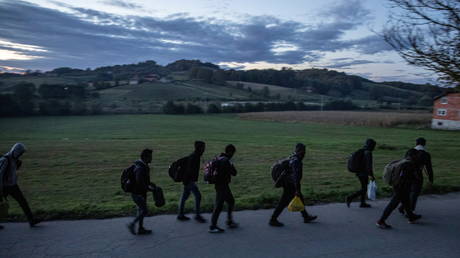
FILE PHOTO: Migrants walk towards the Bosnia-Croatia border in attempt to cross. © Reuters / Marko Djurica
Human trafficker explains migrant smuggling business

At the same time, the report found that trade in illicit goods has also been on the rise lately, with the illegal drug industry in particular appearing to flourish. While the supply chain for drug cartels, which require large amounts of assorted chemicals to produce narcotics, was disrupted due to the pandemic lockdowns and border closures impacted trafficking routes, organized crime quickly overcame these problems, the BSI noted.

“Drug cartels around the world did not miss a beat,” Chris Tomas, BSI lead intelligence analyst, said.

While many cartels shifted their production towards synthetic drugs, namely amphetamine, amid the pandemic, the apparent “lack of eradication of coca crops in Latin American countries” also remains an issue, the BSI said. The flow of cocaine has grown over the past year and is expected to increase even further, the organization warned.

“The numbers and quantities of cocaine seizures in Europe increased steadily in 2020 and 2021 and are expected to continue to rise in 2022,” the report reads.

Think your friends would be interested? Share this story!

find more fun & mates at SoShow now !

Germany has been plunged into a “nationwide state of emergency” because of its current high level of Covid infections, acting health minister Jens Spahn has said. He also refused to rule out further lockdowns.

Read more

FILE PHOTO © Reuters / Kai Pfaffenbach
Germany sets ‘grim’ Covid record & eyes new curbs

The situation is serious, the dynamic is unbroken,” Spahn told a press conference Friday.

The incidence has increased fivefold in four weeks. We see sadly high values in the death rate. We are in a national emergency.”

Spahn refused to rule out the possibility of another lockdown, saying that, in such a drastic health situation, “we can’t rule anything out.”

The head of the Robert Koch Institute (RKI), Lothar Wieler, added to the gloomy picture by saying that “all of Germany is one big outbreak,” with an estimated half a million active Covid cases in the country – and numbers rising. For the third day in a row, more than 50,000 cases have been registered in the country, while the death toll in Germany since the start of the pandemic is above 98,700, according to figures compiled by the RKI.

Wieler added that, with many hospitals already overwhelmed, more should be done to tackle the spread of the virus. Besides obvious measures such as vaccination and wearing masks, he also suggested closing poorly ventilated bars.

On Thursday, lawmakers in the Bundestag approved new measures in the fight against coronavirus, including requirements to prove vaccination status, a negative test, or proof of recovery from infection before employees can access communal workspaces or use public transport. The measures will have to be passed by the upper house before they can take effect.

Neighboring Austria announced on Friday that it would enter full lockdown as of Monday, November 22.

Think your friends would be interested? Share this story!

find more fun & mates at SoShow now !

Objects, including spacecraft, could pierce through the universe using several black holes as a ‘shortcut’, a new study suggests.

The new theory posited by French physicist Pascal Koiran marks a break from earlier research in the field of black hole studies. Previously, it was thought that a so-called ‘wormhole’ composed of two black holes would be prone to instantly collapse, thus making it impossible for an object to successfully travel all the way from one side and out the other. However, by employing different metrics, the French scientist’s new model has arrived at a very different conclusion: “We show that the particle reaches the wormhole throat for a finite value t′1 of the time marker t′.” In essence, that means an object, for instance, a spacecraft, could pass through this wormhole portal intact and reach some far-away region of the universe, taking far less time than would be needed if traveling conventionally.

Read more

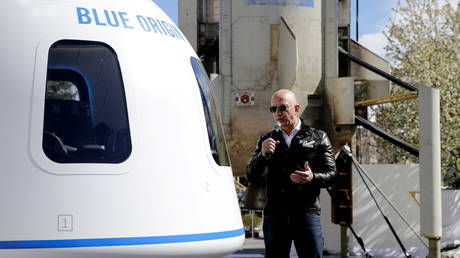
FILE PHOTO: Jeff Bezos addresses the media about the New Shepard. ©REUTERS / Isaiah J. Downing
Amazon’s Bezos predicts only limited number of people will get to remain on Earth

The study in its entirety will see the light of day in the upcoming issue of the Journal of Modern Physics D, though an abstract has been available since early October.

Yet, there are too many ifs as to whether this purely theoretical model has any bearing on the way the universe actually works. For starters, to create such a time-and-space tunnel you would need a regular black hole and a so-called white hole, which is essentially a black hole in reverse. While black holes never let anything out, their ‘twins’ never let anything in. So, according to Albert Einstein’s theory of general relativity and Nathan Rosen’s additions to it, if you were to connect the two, they would make up a bridge across time and space. However, if the laws postulated by another branch of physics, thermodynamics, are anything to go by, such a construct would be highly unstable. Perhaps more importantly, the very existence of white holes has yet to be proven beyond a reasonable doubt. At present, they remain a pure theorization, thus putting any talk of space-and-time portals on rather shaky ground.

If you like this story, share it with a friend!

find more fun & mates at SoShow now !

When The Washington Post reported this week that CIA Director William Burns slipped into Afghanistan on Monday to meet with Taliban leader Abdul Ghani Baradar, it was described as the highest-level face-to-face encounter between the Taliban and the Biden Administration.  WaPo cited anonymous sources for the information and the CIA offered no immediate comment on the reporting.  If the reporting is accurate, it doesn’t answer any immediate questions about why the President would dispatch the CIA director for such a meeting.

What we do know, is that the unexpected advances of the Taliban that have dominated the headlines over the past week and a half were initially blamed on an intelligence failure by many.  Early on, Cipher Brief Expert and former Acting Director of CIA John McLaughlin tweeted that “The ‘intelligence failure’ drumbeat is starting. People should be careful about the charge if they have not actually seen/read the intelligence…”

So, what intelligence did the US have that would have led to a different outcome in Kabul and throughout the country?

  • The New York Times reported last week that “classified assessments by American spy agencies over the summer painted an increasingly grim picture of the prospect of a Taliban takeover of Afghanistan and warned of the rapid collapse of the Afghan military, even as President Biden and his advisers said publicly that was unlikely to happen as quickly.” The paper cited current and former US government officials, saying, “By July, many intelligence reports grew pessimistic, questioning whether Afghan security forces would muster serious resistance and whether the government could hold on in Kabul, the capital.”
  • On August 15, The Wall Street Journal reported that administration officials said they knew that a “total capitulation of the Taliban was a possibility, and they planned their withdrawal efforts accordingly.” But they also cited an administration official, saying “it wasn’t so much a failure in intelligence in which the administration based its decision, but rather, a change in circumstances brought about by the swift U.S. withdrawal.”

But private sector analysts were watching as well. Here’s an inside look at what The Cipher Brief has been publishing since January with key outtakes from Cipher Brief Expert Tim Willasey-Wilsey:

Brief: January 25, 2021

“The Afghans themselves are also monitoring the Washington newsfeeds in forensic detail and will be encouraged by Sullivan’s statement. Recently, all too many conversations in Kabul have been about when to leave and which route to take. Some wealthier Afghans already have their money in Dubai and children in foreign universities. Some even have passports and property in the United States, UK or Germany. For those who are less fortunate, the discussions are about which route to take out. The Uzbekistan border is favoured because a visa costs just $30 and there is a variety of onward routes via Turkey or Russia to the West whereas the routes via Iran or Pakistan are more restrictive or liable to interference.”

Brief: March 11, 2021

“Saleh will advise Ghani not to take Taliban or Pakistani promises on trust. Instead, Ghani may decide to call Washington’s bluff. He may doubt that Washington is really willing to abandon Afghanistan on 1st May with the risk of a rapid Taliban victory jeopardising all the hard-won advances in areas such as women’s rights and counterterrorism over the past 20 years. The spectre of Al Qaida re-establishing camps in Afghanistan would surely be too much for Biden and Blinken.”

“Even if there were no helicopters from the US Embassy roof, the TV pictures of the Taliban entering Kabul, and of Afghan refugees fleeing their advance could evoke memories of Saigon in 1975. The reimposition of Taliban curbs on women would provoke international opprobrium. And subsequent reports of AQ training camps being re-established in Afghanistan would bring back recent and painful memories. After all the blood and treasure expended in Afghanistan that would be a disastrous outcome.”

Brief: April 19, 2021

“The Afghan government may be able to hold on to power for a few years as the Najibullah administration survived after the Soviet departure. However, there is a danger that there will be a sudden dam-burst in confidence with senior officials and politicians leaving en masse and hundreds of thousands of refugees fleeing westwards through Iran, Pakistan and the Central Asian Republics. As the Taliban re-enter Kabul, we could see disturbing scenes of retribution and, in time, the return of Al Qa’ida figures from their hiding-places in the tribal borderlands in Pakistan. Only then will people re-examine this decision and recognise that the Afghan deployments since 2014 have not been that onerous.”


The Cipher Brief hosts private briefings with the world’s most experienced national and global security experts.  Become a member today.


Brief: June 1, 2021

“According to my sources, the Taliban are convinced they can take Kabul “within days” of the NATO withdrawal and they believe the Afghan army is “in a shambles and demoralised”. Although the Taliban will not disrupt departing US troops (unless attacked) they are not willing to wait until September to continue their campaign against Kabul government forces.”

“But we should not take much comfort from the Najibullah example. The comparisons with today’s Afghanistan are misleading. Najibullah’s government was able to reach and supply all the major towns by military convoy. The Afghan army was deployed to protect towns and road communications. By contrast, in 2021, only the route between Kabul and Jalalabad is reasonably safe. Convoys cannot get through from Kabul to Kandahar, Kandahar to Herat, or Kabul to Mazar-e-Sharif. The Afghan army is spread across the country in piecemeal district centres (often surrounded by Taliban-controlled countryside) and have to be resupplied by air. This is not a sustainable model.”

“Furthermore, a number of today’s Afghan leaders, officials and military officers have received offers to relocate to the United States, Germany and elsewhere. As the security situation continues to deteriorate, the gradual trickle of departures is likely to gather pace. In such circumstances, the government could implode quite suddenly.”

“To some, this may evoke images of the 1975 fall of Saigon with the big losers being the Afghans who remain, particularly the women, who face a future of uncertainty and anxiety. There could also be a migration crisis reminiscent of Syria in the last decade.”

Brief: June 28, 2021

“One key indicator is that Afghan security forces have begun to surrender to the Taliban. The procedure is quick and simple. Tribal elders are used to deliver a stark message to Afghan troops often holding positions in district centres. The message is often; “The non-believers are leaving Afghanistan. They are defeated. Your leaders are corrupt. You can surrender now, and we will protect you; or you can fight, and we will kill you.” Recently, the Taliban appear to have honoured their promise not to punish Afghan soldiers who surrender. News of this new-found leniency is likely to encourage other units to follow suit and lay down their arms. In several provinces, including in the north, the Taliban are tightening their grip on those cities which are still held by the government. The Taliban will soon be in a position to cut off food supplies and demand their surrender, possibly offering a similarly lenient dispensation to the population. Now that the Taliban possesses captured armoured vehicles and artillery, their ability to exert pressure on the cities is enhanced. In Kabul, a sense of panic has begun to grip the capital. There are desperate attempts to sell family homes but there are no buyers even when houses are on the market at one tenth of their previous value. Some families have departed to Tajikistan, conscious that several of the land border crossing-points with the Central Asian Republics have been captured by Taliban forces in recent weeks.”

Read also Putin’s Calculated Afghanistan Play from Cipher Brief Expert Robert Dannenberg


The Cipher Brief hosts private briefings with the world’s most experienced national and global security experts.  Become a member today. 


Read more expert-driven national security insight, perspective and analysis in The Cipher Brief


The post What Intelligence was there on Afghanistan? appeared first on The Cipher Brief.

find more fun & mates at SoShow now !

The EU must quickly seal its external borders to stem the flow of migrants who are no longer welcome in the 27-member bloc, according to Slovenia’s interior minister, whose country currently holds the presidency of the EU Council.

Speaking at the ‘Sarajevo Migration Dialogue’ on Thursday, Interior Minister Ales Hojs said EU countries were preoccupied recently with the coronavirus pandemic, the fall of the government in Afghanistan, and now a migrant crisis on the Poland-Belarus border, which he said was a hybrid war waged by Minsk against the EU.

Read more

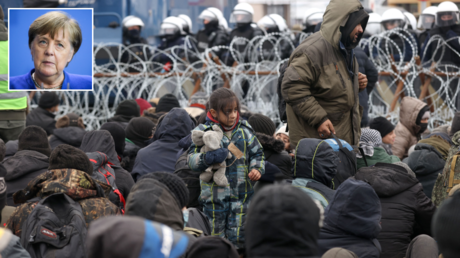
Migrants gather on the Belarusian-Polish border on November 15, 2021. © AFP / OKSANA MANCHUK; (inset) German Chancellor Angela Merkel. © AFP / MARKUS SCHREIBER
Germany agreed on plan to open humanitarian corridor for refugees on Poland-Belarus border – Minsk

“All three have additionally contributed to the increase in numbers of illegal migrants moving towards Europe and the Balkans, destabilizing the European Union,” Hojs told reporters.

The Slovenian minister said the current situation was similar to the 2015 influx of refugees and migrants from the Middle East and North Africa, when the EU admitted over one million people across its borders.

This time the situation is different, Hojs said, warning that “there is no more ‘refugees welcome.’”

“I believe that external borders must be secured, even with fences if necessary,” Hojs said, saying that he supported a plan for Brussels to finance the building of fences to reinforce the bloc’s borders.

He said it was important to strengthen cooperation and partnership across the EU in order to better manage migration and maintain security.

Thousands of migrants have been trying to cross the Belarus-Poland border in an attempt to reach the EU. They have been stranded at barbed-wire fencing with Polish border guards repelling their attempts to cross. Warsaw has accused Belarus of orchestrating the crisis to destabilize the EU and “weaponize” migration in an effort to have sanctions lifted.

A spokesperson for Belarusian leader Alexander Lukashenko claimed on Thursday that Germany agreed to open a humanitarian corridor for 2,000 refugees on the border.

If you like this story, share it with a friend!

find more fun & mates at SoShow now !