An Argentinian woman has become the second-ever HIV-infected person whose immune system helped defeat the virus without requiring additional medical treatment. She was first diagnosed with the AIDS-causing infection in 2013.
Scientists have dubbed the 30-year-old mother the “Esperanza patient,” after her hometown. The word ‘esperanza’ translates to ‘hope’ in English. Publishing their findings in the Annals of Internal Medicine journal on Monday, the researchers said the discovery boosts hope for a “sterilizing cure” for the estimated 38 million people with the life-long infection.
“I enjoy being healthy,” the Esperanza patient told NBC News over email. “I have a healthy family. I don’t have to medicate, and I live as though nothing has happened. This already is a privilege.”
The study found no intact remnants of the virus in the 1.5 billion blood and tissue cells the researchers analyzed – confirming the discovery first announced in March at an international meeting of HIV experts.
No additional information about the woman has been made public, but she was described at the time as “athletic and beautiful” and revealed to have an HIV-negative boyfriend and newborn baby.
Only one other person, identified in August 2020 as 67-year-old Loreen Willenberg from San Francisco, has been confirmed to have overcome the virus without medical intervention. The two women have been labeled ‘elite controllers’, referring to a rare subset of HIV patients who show no signs of the infection despite not undergoing antiretroviral treatments.
Typically, an HIV-infected person requires constant drug therapy to prevent the virus from attaching to their immune cells’ DNA and replicating. But, in the eight years since she was diagnosed, the Esperanza patient only received medication for six months during pregnancy to ensure her baby would be healthy.
In all, there have been four patients cured of HIV, two of whom – the ‘Berlin patient’ Timothy Ray Brown and the ‘London patient’ Adam Castillejo – were also cancer patients who received risky bone marrow transplants from donors with HIV-resistant genes. However, the success of their procedures is yet to be replicated.
“This is really the miracle of the human immune system that did it,” Dr. Xu Yu, an immunologist at the Ragon Institute in Boston, who co-authored the study, told NBC.
The EU must quickly seal its external borders to stem the flow of migrants who are no longer welcome in the 27-member bloc, according to Slovenia’s interior minister, whose country currently holds the presidency of the EU Council.
Speaking at the ‘Sarajevo Migration Dialogue’ on Thursday, Interior Minister Ales Hojs said EU countries were preoccupied recently with the coronavirus pandemic, the fall of the government in Afghanistan, and now a migrant crisis on the Poland-Belarus border, which he said was a hybrid war waged by Minsk against the EU.
“All three have additionally contributed to the increase in numbers of illegal migrants moving towards Europe and the Balkans, destabilizing the European Union,” Hojs told reporters.
The Slovenian minister said the current situation was similar to the 2015 influx of refugees and migrants from the Middle East and North Africa, when the EU admitted over one million people across its borders.
This time the situation is different, Hojs said, warning that “there is no more ‘refugees welcome.’”
“I believe that external borders must be secured, even with fences if necessary,” Hojs said, saying that he supported a plan for Brussels to finance the building of fences to reinforce the bloc’s borders.
He said it was important to strengthen cooperation and partnership across the EU in order to better manage migration and maintain security.
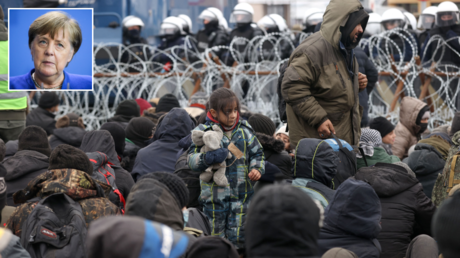
Thousands of migrants have been trying to cross the Belarus-Poland border in an attempt to reach the EU. They have been stranded at barbed-wire fencing with Polish border guards repelling their attempts to cross. Warsaw has accused Belarus of orchestrating the crisis to destabilize the EU and “weaponize” migration in an effort to have sanctions lifted.
A spokesperson for Belarusian leader Alexander Lukashenko claimed on Thursday that Germany agreed to open a humanitarian corridor for 2,000 refugees on the border.
Scientists have used an AI tool to identify which animals are most likely to contract and spread mutated versions of Covid-19. The model highlighted both pets and wild animals as likely reservoirs for the virus.
Using information about their habitats and various biological traits, researchers at the Cary Institute of Ecosystem Studies in New York developed the machine learning tool to figure out which animals had the particular ACE2 protein that the coronavirus was most likely to latch onto.
Out of 5,400 tested, the scientists narrowed it down to 540 mammalian species.
Some of its predictions have been previously documented as transmission risks, for instance, dogs, cats and bats, while farm animals like pigs and exotic zoo animals were surprise additions.
Other expected additions are minks, Sunda pangolins, and 35 species of bats – which are together ranked among the top 10% of animals most likely to spread the virus, in line with lab results.
The study, published in the Proceedings of the Royal Society journal, also ranked water buffalo, a number of primates, including gorillas and 76 rodent species as being more susceptible to infection.
The researchers taught the AI to identify patterns between rates of transmission and some 60 ecological and biological traits collected by earlier studies, including the overlap between the animal and human habitats as well as their respective lifespans, diets, and sizes.
Previously, the specific amino acid sequences had only been mapped out in around 300 species, including about 143 mammals — and figuring out which ones are more prone to infection is key to predicting the spread of the virus, researchers said.
Arinjay Banerjee at the University of Saskatchewan in Canada told the New Scientist that the results will help researchers “track viral infections and the possible emergence of animal-adapted coronavirus variants” around the world. Barbara Han, who led the study, said predictions needed to be followed up with systematic surveillance and lab studies.
Think your friends would be interested? Share this story!
The EU Commission has released draft legislation aimed at tackling the destruction of woodland by introducing import restrictions on products not certified as ‘deforestation-free’.
The draft proposal, which the commission hopes will become binding rules for all member states, seeks to limit the import of beef, cocoa, coffee, palm, soy, and wood if it is not proven “deforestation-free.”
Outlining the legislation, the EU commissioner for climate action policy, Virginijus Sinkevicius, called it a “ground-breaking” proposal that will help fight “illegal deforestation” and “deforestation driven by agricultural expansion.”
Our proposal to fight deforestation will help us protect 1/3 of 🌎 lands.
We don’t only target illegal deforestation but 𝙖𝙡𝙡 deforestation driven by agricultural expansion.
We start with 6 products that must be deforestation-free 👉🏼 beef, wood, palm oil, soya, coffee, cocoa. pic.twitter.com/Cs9POoydNX
The bill comes after nations at the COP26 summit agreed to work to end deforestation by 2030. It would impose two criteria on imports, requiring items to have been produced in accordance with the origin country’s laws, and not on land that has been deforested or degraded since the start of 2021.
It is not clear when the rules would come into effect; legislative proposals by the commission have to be debated and considered by both the EU Parliament and the Council of the EU before they are passed. The implementation of measures could potentially impact the EU’s trade relations with countries like Brazil, where clearing of the Amazon rainforest hit a new record in October.
During the recent COP26 climate summit, 110 world leaders – whose countries contain around 85% of the world’s woodland – committed to ending and reversing deforestation by 2030, pledging around £14 billion ($18.84 billion) of public and private funds towards the goal.
Slovakia has become the latest European country to implement lockdown restrictions on people who haven’t had the Covid vaccine, as it seeks to prevent a resurgence in infections and hospital admissions over the winter.
Slovakian Prime Minister Eduard Heger announced the new measures in a press conference on Thursday, declaring a “lockdown for the unvaccinated” after the country reported a record number of new cases.
The new restrictions in Slovakia, which come into effect on Monday, will require people to have been vaccinated or have recovered from Covid in the past six months to enter restaurants, non-essential shops, or public events.
In the past few days, the European nation has seen record numbers of new infections, including over 8,000 on Tuesday, with hospitals running out of space to treat Covid patients.
Slovakia has one of the lowest rates of vaccination in the European Union, with over 50% of individuals still not jabbed. The country of around 5.5 million has so far only inoculated 2.5 million people against the virus.
Earlier this week, Austria became the first nation to impose restrictions on unvaccinated individuals, as it sought to limit pressure on hospitals and emergency care units. The move came into effect at midnight on Monday for anyone aged 12 and older who has not received their Covid vaccine or recently recovered from the virus.
The German state of Bavaria and the Czech Republic followed Austria in restricting access for unvaccinated individuals. Only people who can show proof of vaccination or that they have recently recovered from Covid will be allowed to enter public spaces, such as restaurants and shops.
Marx, Lenin, and Ho Chi Minh – the revolutionaries’ namesakes – have gathered for a wedding in India’s state of Kerala. Friedrich Engels was the one walking down the aisle.
And this has nothing to do with time travel. In India’s southwestern state of Kerala parents have often named their children after prominent figures in the hammer and sickle movement. The local communist party has been at the helm there for much of the past 60 years, and is still quite popular with voters.
In the town of Athirappilly on Sunday the groom, Friedrich Engels, a namesake of the 19th century German philosopher who helped conceive Marxism, tied the knot with the bride, Bismitha. In attendance were also Engels’s brother Lenin, named after the man behind the 1917 Russian Revolution, as well as the groom’s friends, Marx and Ho Chi Minh, who bear the names of Marxism’s founding father and the Vietnamese revolutionary leader respectively.
All four men are members of India’s Communist Party. Incidentally, Marx is currently working and residing in ultra-capitalist Dubai, but flew back to see his friend exchange wedding vows with his betrothed, as reported by local media.
Another wedding ceremony that took place in June in the state of Tamil Nadu, saw Socialism getting married in front of his brothers, Communism and Leninism, as well as nephew, Marxism.
Think your friends would be interested? Share this story!
Scientists have used an AI tool to identify which animals are most likely to contract and spread mutated versions of Covid-19. The model highlighted both pets and wild animals as likely reservoirs for the virus.
Using information about their habitats and various biological traits, researchers at the Cary Institute of Ecosystem Studies in New York developed the machine learning tool to figure out which animals had the particular ACE2 protein that the coronavirus was most likely to latch onto.
Out of 5,400 tested, the scientists narrowed it down to 540 mammalian species.
Some of its predictions have been previously documented as transmission risks, for instance, dogs, cats and bats, while farm animals like pigs and exotic zoo animals were surprise additions.
Other expected additions are minks, Sunda pangolins, and 35 species of bats – which are together ranked among the top 10% of animals most likely to spread the virus, in line with lab results.
The study, published in the Proceedings of the Royal Society journal, also ranked water buffalo, a number of primates, including gorillas and 76 rodent species as being more susceptible to infection.
The researchers taught the AI to identify patterns between rates of transmission and some 60 ecological and biological traits collected by earlier studies, including the overlap between the animal and human habitats as well as their respective lifespans, diets, and sizes.
Previously, the specific amino acid sequences had only been mapped out in around 300 species, including about 143 mammals — and figuring out which ones are more prone to infection is key to predicting the spread of the virus, researchers said.
Arinjay Banerjee at the University of Saskatchewan in Canada told the New Scientist that the results will help researchers “track viral infections and the possible emergence of animal-adapted coronavirus variants” around the world. Barbara Han, who led the study, said predictions needed to be followed up with systematic surveillance and lab studies.
Think your friends would be interested? Share this story!
Scientists have used an AI tool to identify which animals are most likely to contract and spread mutated versions of Covid-19. The model highlighted both pets and wild animals as likely reservoirs for the virus.
Using information about their habitats and various biological traits, researchers at the Cary Institute of Ecosystem Studies in New York developed the machine learning tool to figure out which animals had the particular ACE2 protein that the coronavirus was most likely to latch onto.
Out of 5,400 tested, the scientists narrowed it down to 540 mammalian species.
Some of its predictions have been previously documented as transmission risks, for instance, dogs, cats and bats, while farm animals like pigs and exotic zoo animals were surprise additions.
Other expected additions are minks, Sunda pangolins, and 35 species of bats – which are together ranked among the top 10% of animals most likely to spread the virus, in line with lab results.
The study, published in the Proceedings of the Royal Society journal, also ranked water buffalo, a number of primates, including gorillas and 76 rodent species as being more susceptible to infection.
The researchers taught the AI to identify patterns between rates of transmission and some 60 ecological and biological traits collected by earlier studies, including the overlap between the animal and human habitats as well as their respective lifespans, diets, and sizes.
Previously, the specific amino acid sequences had only been mapped out in around 300 species, including about 143 mammals — and figuring out which ones are more prone to infection is key to predicting the spread of the virus, researchers said.
Arinjay Banerjee at the University of Saskatchewan in Canada told the New Scientist that the results will help researchers “track viral infections and the possible emergence of animal-adapted coronavirus variants” around the world. Barbara Han, who led the study, said predictions needed to be followed up with systematic surveillance and lab studies.
Think your friends would be interested? Share this story!
The European Union’s top court has ruled that Hungary’s 2018 law aimed at criminalizing aiding illegal immigrants who are claiming asylum violates the “rights safeguarded” by the bloc’s legislature.
The Hungarian legislation, passed in 2018, sought to punish anyone “facilitating illegal immigration” with a year in prison, under a bill dubbed the “Stop Soros” law. Hungary’s government justified it at the time by arguing that migrants illegally entering the country threatened its national security.
In the ruling, handed down on Tuesday, the European Court of Justice declared that “criminalizing such activities impinges on the exercise of the rights safeguarded by the EU legislature in respect of the assistance of applicants for international protection.”
The EU’s advocate general, Athanasios Rantos, had urged the court to make such a judgement back in February, claiming the introduction of the legislation meant that “Hungary has failed to fulfil its obligations under the [bloc’s] Procedures Directive.”
It became known as the Stop Soros law after billionaire philanthropist George Soros became a vocal opponent of the Hungarian government’s opposition to migration. The administration, in turn, accused Soros of orchestrating migration to Europe, with the Open Society Foundation, run by the philanthropist, closing its operation in the country in response.
Hungary, under the leadership of right-wing Prime Minister Viktor Orban, has repeatedly clashed with the EU in recent years over its strong stance on immigration and concerns from the bloc about threats to the rule of law in the country.
At the end of 2020, a dispute between Hungary and Poland and the EU risked derailing the bloc’s budget, as both member states were threatening to veto it over their view that the EU was attempting to interfere in their domestic affairs. Ultimately, the EU backed down, agreeing to a compromise with Budapest and Warsaw to ensure the budget secured the support of all 27 member states.
Despite acknowledging the EU court’s ruling, Hungary’s government defended its right to challenge any foreign-funded non-government organizations that are attempting to “promote migration.”
“Hungary’s position on migration remains unchanged: Help should be taken where the problem is, instead of bringing the problem here,” Hungarian government spokesperson Zoltan Kovacs said, adding that the country will challenge outside entities “seeking to gain political influence and interference.”
Think your friends would be interested? Share this story!
French President Emmanuel Macron has dismissed the possibility of locking down unvaccinated people in France, claiming the move would not be necessary because of the success of the Covid-19 ‘health pass’.
Speaking to La Voix du Nord newspaper in an interview published on Thursday, Macron said there was no need for France to follow Austria’s lead by locking down its unvaccinated citizens.
“Those countries locking down the non-vaccinated are those which have not put in place the [health] pass. Therefore, this step is not necessary in France,” Macron claimed.
The president’s health pass, which was the target of much criticism when it was introduced, requires people to provide proof of vaccination or a recent negative test before undertaking certain normal activities.
The ‘Pass Sanitaire’ is required if citizens wish to go to restaurants, cafes, cultural venues, or cinemas. It’s also required to take long-distance trains, among other activities.
Austria has led the way by starting a partial lockdown of the unvaccinated amid a surge in Covid-19 cases. The Czech Republic will follow suit next week, while Germany decided on Thursday to introduce similar measures in areas where Covid incident rates exceed the threshold.
Earlier in November, Macron made the continued use of the Covid health pass for over 65s dependent on getting a booster jab.
Some 20,366 new infections were registered in the last 24-hour recording period. Case numbers have risen steeply in recent weeks.